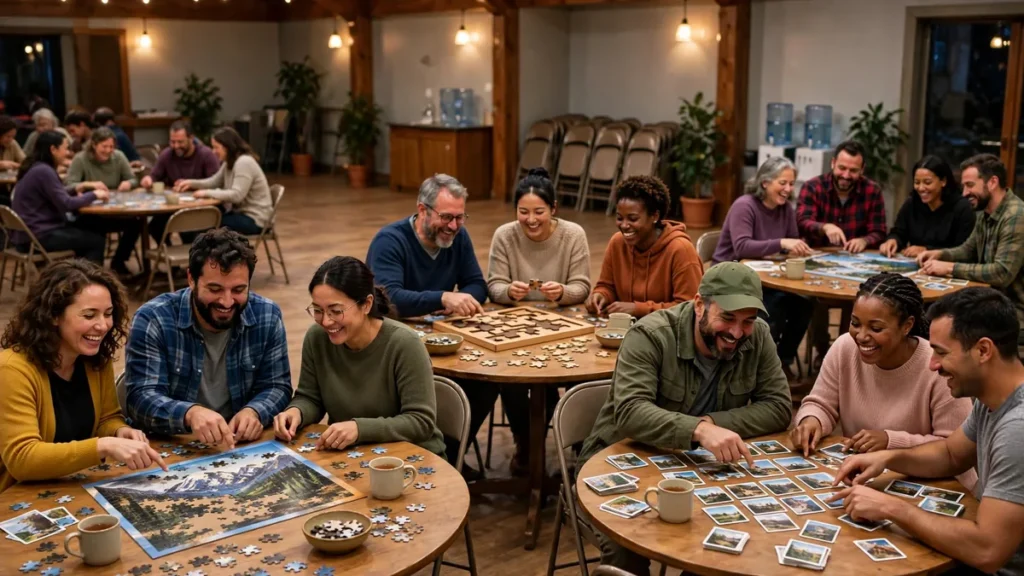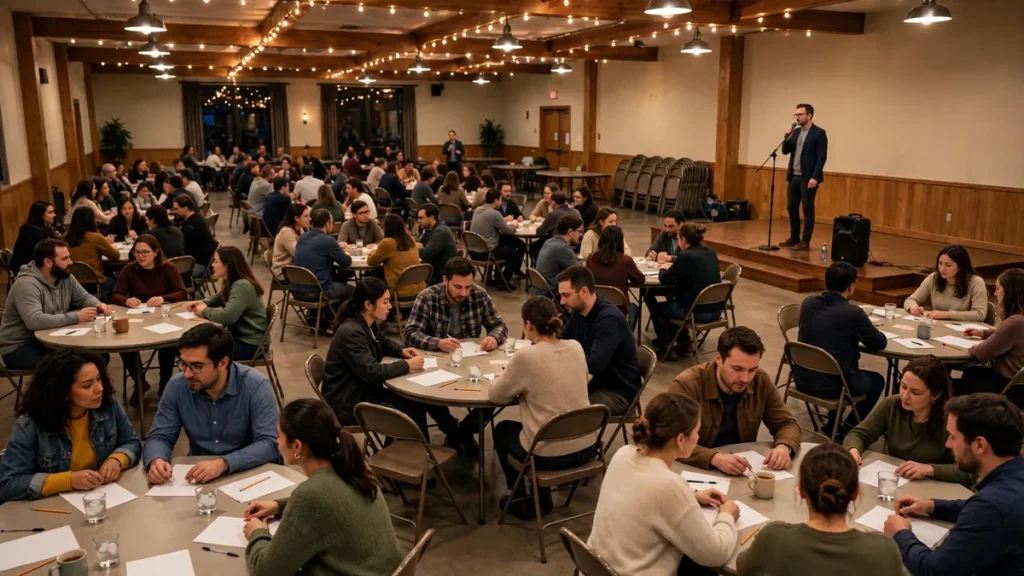
The best trivia games for 89 players are not the games you play at a kitchen table with six friends. They are team-based, multi-table, whole-room events where eighty-nine people answer the same questions at the same time, and the format matters far more than any single question on the sheet. No boxed trivia game seats eighty-nine players around one table, and any guide that pretends otherwise is selling you a fantasy. What works at this scale is a quiz built for teams, tables, and tournament brackets, and this guide shows you exactly how to run one.
When eighty-nine people walk into a room for trivia night, you are not hosting a game. You are hosting a small event. You need enough teams that nobody sits idle, enough rounds that the night has shape, and a scoring system that eighty-nine competitive people will trust. The best trivia games for 89 players solve those problems by splitting the crowd into teams of four to eight, running identical question sets at every table, and using one host, one microphone, and one clear set of rules for the whole room.
This guide covers the formats that genuinely work for eighty-nine players, compares them side by side, and walks through scoring, hosting, and the common mistakes that sink large trivia nights. If your headcount shifts by one, our guide to the best trivia games for 88 players covers nearly identical setups with the same team sizes and round structures. Everything here is built around one honest premise: the game must fit the room, not the other way around.
Key takeaways
- No single boxed game seats 89 players. The best trivia games for 89 players are team-based formats played across multiple tables at once.
- Split eighty-nine people into 12 to 18 teams of five to eight players for the best balance of energy, fairness, and scoring speed.
- Use identical question sets at every table, one host, and one microphone so every team faces exactly the same quiz.
- Mix question rounds with picture rounds, music rounds, and a wager round to keep a very large room engaged for two hours.
- Score with a simple spreadsheet or answer-sheet swap between tables, and announce the leaderboard after every round to keep the tension high.

Why 89 Players Changes the Game
A trivia night for ten people is a conversation. A trivia night for eighty-nine people is a production. The difference is not just the number of chairs. It is the sound in the room, the time it takes to collect eighty-nine answer sheets, the way a single unclear question can derail a dozen teams at once, and the fact that one host cannot make eye contact with everyone. Every decision you make has to scale, and the formats that work are the ones designed for scale from the start.
The first thing to accept is that eighty-nine is an awkward number for neat team maths, and that is fine. You do not need equal teams: twelve teams of seven plus one team of five gives you eighty-nine, and similar splits work just as well. Small differences in team size barely matter, because every team gets one answer sheet and one collective brain. What matters is that every team has between four and eight people, because below four a team feels thin and above eight people talk over each other instead of thinking.
The second thing to accept is that the room itself is part of the game. Eighty-nine players need roughly fifteen tables, which means a hall, a large restaurant back room, a school gym, or a community centre. You need a sound system that reaches the back table, a projector or large screen so picture rounds are visible from everywhere, and enough space between tables that teams cannot overhear each other.
The third thing is time. A round of ten questions takes about fifteen minutes for eighty-nine people once you include reading, thinking, collection, and marking, so six rounds take about ninety minutes plus breaks, a final round, and prize-giving. Plan for two to two and a half hours from the first question to the last cheer.
The Best Trivia Games for 89 Players
The games below are not competing products on a shelf. They are proven formats, each one suited to a different kind of crowd and a different kind of evening. Pick the one that matches your players, then steal the best ideas from the others.
Classic Pub Quiz
The classic pub quiz is the backbone of large-group trivia for a reason. One host reads ten questions per round, teams write answers on a sheet, sheets are swapped between tables for marking, and the leaderboard is updated after every round. It needs almost no equipment beyond a microphone, printed answer sheets, and questions prepared in advance. For eighty-nine players, run six rounds of ten questions: two general knowledge rounds, one picture round, one music round, one themed round, and one wager round to finish. It is the safest choice for a mixed crowd, because everyone understands the rules within thirty seconds.
Team Trivia Tournament
A team trivia tournament adds a bracket to the classic quiz. Teams play head-to-head in short heats, winners advance, and the night builds toward a grand final between the two best teams. Run three heats of fifteen minutes each, take the top two teams from each heat into a semi-final, and finish with a head-to-head final in front of the whole room. The format creates natural drama and gives weaker teams a reason to keep playing, because a single strong heat can carry them through.
Whole-Room Buzzer Quiz
In a whole-room buzzer quiz, every team answers the same question at the same time, and the fastest correct team scores. You can run this with hand-raising, coloured cards at each table, or a buzzer app on one phone per team. It is the loudest, most energetic format on this list, and it suits crowds that want a show rather than a quiet evening of writing. The risk is that confident teams dominate, so use it for one or two rounds only. A buzzer round in the middle of a classic quiz works like a shot of energy for a tiring room.
Relay Trivia
Relay trivia turns the quiz into a race. Each team sends one player at a time to a central station to answer a question, then tags the next player, so all six members of a team rotate through and nobody sits out for long. It uses movement to solve the problem of a large, static room, works best outdoors or in a big hall with a clear centre, and suits younger crowds, corporate away days, and school events. Keep the questions short with single-word answers, because a relay round moves fast.
Picture Round Challenge
A picture round is the great equaliser of large trivia nights. Teams identify famous faces, landmarks, flags, logos, or film stills from images shown on a screen, and the visual format gives every table the same information at the same moment. For eighty-nine players, picture rounds are essential, because they break up the listening and give the back tables something to look at. Prepare twenty images and show each for twenty seconds.
Music Round Showdown
A music round plays short clips of songs and asks teams to name the artist, the song, or the year. Ten clips of fifteen seconds each make a perfect round, and hearing a familiar song sweep across a room of eighty-nine people is one of the best moments a trivia night can produce. Music rounds need a decent speaker system and a playlist tested in advance, because a clip that is too quiet at the back table is a wasted question. Mix decades and genres so every age group has a fair shot.
Speed Trivia Sprint
Speed trivia is a timed race through as many short questions as possible in a fixed window. Give each team a sheet of fifty quick questions and ten minutes, and the team with the most correct answers wins the round. It needs no host patter and works brilliantly as an opening round while latecomers are still arriving. Hand out the sheets as people sit down and the game starts itself.
Trivia Bingo
Trivia bingo combines a quiz with a bingo card. Each team gets a card with answers printed on it, and the host reads questions whose answers appear somewhere on the cards. Teams mark the correct squares and shout when they complete a line. It is the most playful format on this list, it suits family crowds and charity nights, and it keeps eighty-nine people listening hard because any question could complete their card.
Comparing the Best Trivia Games for 89 Players
Every format above works, but they work for different reasons. Use the comparison below to match the format to your crowd and your room.
| Format | Best For | Equipment Needed | Energy Level | Setup Time |
|---|---|---|---|---|
| Classic Pub Quiz | Mixed crowds, first-time hosts | Microphone, answer sheets | Steady | Low |
| Team Trivia Tournament | Competitive groups | Microphone, bracket board | High | Medium |
| Whole-Room Buzzer Quiz | Energetic crowds | Buzzers or cards, sound system | Very high | Medium |
| Relay Trivia | Young or active groups | Open floor, question station | Very high | Medium |
| Picture Round Challenge | Visual learners, fundraisers | Projector or large screen | Medium | Medium |
| Music Round Showdown | All ages, social nights | Speakers, playlist | High | Medium |
| Speed Trivia Sprint | Openers, warm-ups | Printed question sheets | High | Low |
| Trivia Bingo | Families, charity nights | Printed bingo cards | Medium | Medium |
If you are hosting for the first time, start with the classic pub quiz and add one picture round and one music round. That combination covers every kind of player in the room without asking you to manage buzzers, brackets, or relay stations. If you want variety across the evening, pair the quiz with the best board games for 89 players as a side activity for the break, so early finishers and restless players have something to do while scores are tallied.
How to Structure the Night
A good trivia night for eighty-nine players has a shape the whole room can feel. Aim for six rounds plus a final, with a break in the middle and a clear finish. A structure that works in practice is a speed sprint opener, two general knowledge rounds, a picture round, a music round, a themed round, and a wager final. Announce the structure at the start so teams know what is coming, and announce the scores after every round so the leaderboard stays alive in the room.
Team size deserves a decision before the night, not during it. Cap teams at eight and set a minimum of four. If a group of twelve arrives together, split them into two teams of six and let them enjoy the rivalry. If a couple arrives alone, seat them with another small group rather than letting them play as a team of two against teams of eight.
The wager round is the secret weapon of large trivia nights. In the final round, each team wagers some of its points before hearing the questions, and the wager is won or lost on the answers. A team in last place can win the night with a bold wager, and a team in first place can lose it with a careless one. For eighty-nine players, the wager round is what keeps all fifteen tables listening to the very last question, because the leaderboard is never safe until the final score is read out.
Scoring That Keeps 89 People Honest
Scoring is where large trivia nights are won or lost, and the rule is simple: make it visible, make it fast, and make it impossible to argue with. Swap answer sheets between neighbouring tables for marking, read the answers aloud immediately after each round, and post the running totals where everyone can see them, whether that is a whiteboard, a projected spreadsheet, or a printed leaderboard pinned to the wall. When eighty-nine people can see the scores, they trust the scores.
Use a spreadsheet with one row per team and one column per round, and assign one person to scoring who is not also hosting. The host reads questions and entertains the room. The scorer collects sheets, enters totals, and updates the board. Splitting those jobs is the single most effective thing you can do for a night of this size.
Settle disputes with one rule, announced at the start: the host’s answer sheet is final, and spelling does not matter as long as the answer is clearly right. A team that argues after the ruling loses the room, and the host must move on. Eighty-nine people will respect a host who is fair and fast far more than one who lets every dispute eat five minutes.
Questions That Work for a Very Large Room
Writing questions for eighty-nine people is a different skill from writing questions for ten. Every question must have one clear answer, must be answerable in under a minute, and must be fair to the youngest and the oldest person in the room. Avoid questions that depend on a single generation’s memory, avoid questions with two defensible answers, and avoid trick questions, because a trick question that confuses fifteen tables at once will cost you ten minutes of explaining.
Aim for a spread of difficulty in every round: three easy questions that every team gets, four medium questions that separate the good teams from the average ones, and three hard questions that only the best teams answer. That balance keeps weak teams in the game and keeps strong teams honest. Test your questions on two or three people before the night. If all three get a question wrong, it is too hard. If all three get it instantly, it is too easy.
Mix the topics deliberately. A round of ten questions should touch at least five different subjects, so the film fan, the sports fan, the food lover, the history buff, and the music fan each have a moment to shine. A quiz that is all sport will lose half the room by round two. For a lighter evening, borrow energy from the best party games for 88 players and add a physical or silly round between the serious ones, because a room that laughs together stays in the game together.
Hosting Checklist for 89 Players
Run through this checklist before the doors open. Every item on it has saved a large trivia night from a preventable problem.
- Confirm the venue holds eighty-nine people seated at fifteen tables, with a sound system that reaches the back table and a screen visible from every seat.
- Prepare six rounds of ten questions plus a wager final, with one printed answer sheet per team per round and spare pens at every table.
- Assign a host and a separate scorer, and give the scorer a spreadsheet with one row per team and one column per round.
- Test the microphone, projector, and speakers at full volume before anyone arrives, and test the music round playlist at the volume the back table will hear.
- Decide team sizes in advance, cap teams at eight players, and seat small groups together at the door so nobody plays alone against teams of eight.
- Print the rules on every table, announce that the host’s answer sheet is final, and prepare prizes for first, second, and last place so every team has something to play for.
Frequently Asked Questions
Can one trivia game really work for 89 players?
Yes, if it is run as a team event rather than a single-table game. Split eighty-nine people into twelve to eighteen teams, give every team the same questions at the same time, and use one host with a microphone and a screen. Team formats scale to any number of players.
How many teams should 89 players form?
Twelve to eighteen teams is the sweet spot. Teams of five to eight players work best, because smaller teams feel thin and larger teams talk over each other. Uneven team sizes are fine, so do not worry if one team has five players and another has seven.
How long does a trivia night for 89 players take?
Plan for two to two and a half hours. Six rounds of ten questions take about ninety minutes including marking, plus time for a break, a wager final, and prize-giving.
What equipment do I need for 89 players?
A microphone and speaker system, a projector or large screen, printed answer sheets and pens, a scoring spreadsheet, and a projected leaderboard. A music round needs tested speakers, and a picture round needs a screen every table can see.
How do I stop teams from cheating?
Swap answer sheets between tables for marking, ban phones during rounds, space the tables so teams cannot overhear each other, and announce the rules before the first question.
What prizes work for a group this large?
Prize the top three teams and the last-place team, and add a small prize for the best team name. Gift cards, a trophy, or a donated prize from a local business all work well. The last-place prize keeps the bottom teams playing to the end.
The Bottom Line
The best trivia games for 89 players are team formats played across many tables in one room, led by one host with a microphone and a clear set of rules. Split the crowd into teams of five to eight, mix classic rounds with picture and music rounds, finish with a wager, and score visibly after every round. Do that, and eighty-nine players stop being a logistical problem and start being the reason the night is unforgettable.