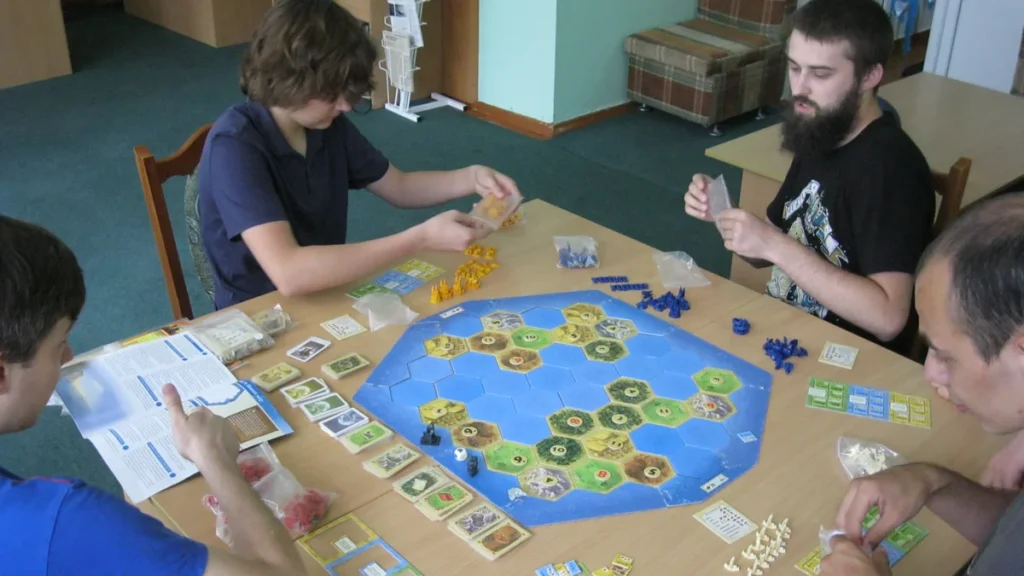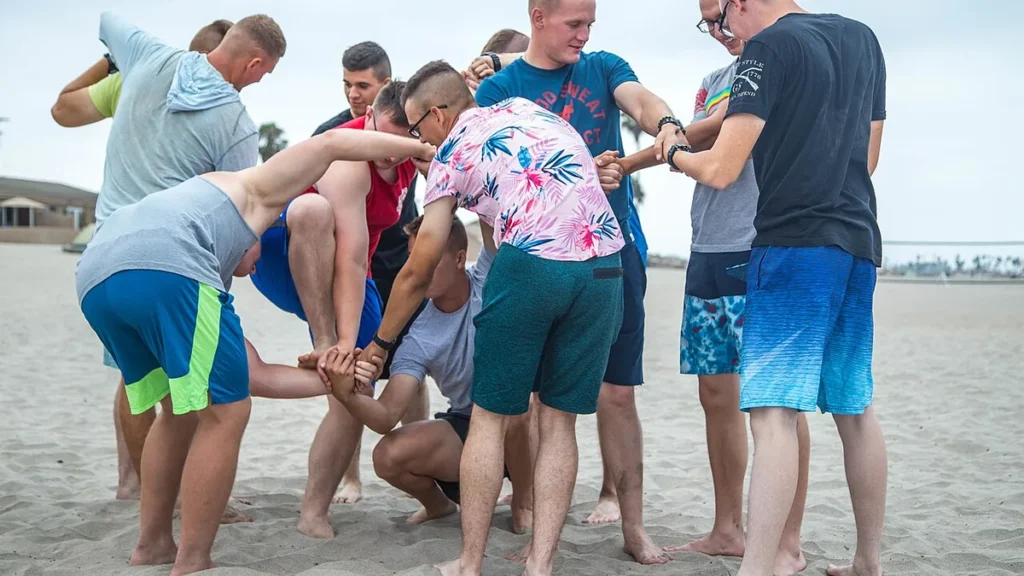
Four hundred and seventy players in one hall sounds impossible until you stop picturing one giant game and start picturing forty-seven small ones running at the same time. Nobody waits for a turn, nobody watches from the side, and nobody needs to be a puzzle expert to join in. Every team of ten works on the same nine games, just in a different order, so the whole day feels like a festival rather than a queue.
The trick is stations. Each game gets its own table, its own set of printed sheets or pieces, and its own judge with a stopwatch. Teams rotate from station to station, score points at each one, and the best totals go through to the finals. A team that is slow at one puzzle can still catch up at the next, which keeps every group in the hunt until the last round.
This guide gives you nine puzzle games that scale cleanly to 470 players, a team plan that uses every seat in the hall, and a tournament shape that finishes on time. All nine games use printed sheets, cards, or simple pieces, so you can run the whole day without screens, apps, or special equipment.
Key takeaways
- Split 470 players into 47 teams of ten, with five teams sharing each station.
- Nine stations, one game each, with fifteen-minute rounds and a five-minute move.
- Every game works on paper, so no team is slowed down by a dead battery or a bad connection.
- Teams score points at every station, and the top eight teams reach the finals.
- Print spare sheets and keep a practice puzzle on every table before the round starts.

How 470 players fit into teams and stations
Forty-seven teams of ten is the simplest split, and it works because ten is small enough for everyone to have a job and large enough to cover a hard puzzle from several angles. Give each team a colour and a number, and hand the captain a scorecard at check-in. The captain keeps the card, collects the stamps at each station, and brings it to the scoring desk at the end of the day.
Nine stations hold about five teams each, which means fifty players per station and a busy but workable table. Put the quiet paper puzzles at one end of the hall and the lively drawing game at the other, so the teams solving grids are not distracted by the teams cheering over Pictionary guesses. The format builds on the 469-player puzzle games, which used the same team-of-ten shape and the same station rotation, and it held up well at that size.
Each round lasts fifteen minutes, with five minutes to move, reset the table, and read the next puzzle. Nine rounds take three hours, including a short break after round five. Judges stay at their stations all day, which means they get faster at explaining the rules, and teams get a fresh judge and a fresh puzzle every time they move.
The 9 puzzle games at a glance
The nine games below were chosen because they are easy to explain in two minutes, hard to finish in fifteen, and fair for mixed teams. Four of them are number and reasoning grids, three use word cards, one is a letter hunt, and one gets the whole team drawing, so the day never feels like the same puzzle nine times. Every game also has a clear finish line, which makes scoring simple for the judges.
| Game | Team split | Minutes | What you need |
|---|---|---|---|
| Futoshiki Inequality Race | Pairs on rows | 15 | Printed grids, pencils |
| Hidato Number Path Race | Pairs on paths | 15 | Printed grids, pencils |
| Pictionary Clue Race | One drawer, rest guessing | 15 | Whiteboards, markers, clue cards |
| Codenames Clue Link Race | One clue-giver, rest guessing | 15 | Printed word cards, answer sheets |
| Boggle Letter Hunt | Pairs on letter grids | 15 | Printed letter grids, timers |
| Lights Out Toggle Race | Pairs on panels | 15 | Printed toggle grids, pens |
| Taboo Word Race | One describer, rest guessing | 12 | Printed word cards, timers |
| Twenty Questions Deduction Race | Whole team questioning | 15 | Printed answer cards, score sheets |
| Shakashaka Triangle Race | Pairs on corners | 15 | Printed grids, pencils |
1. Futoshiki Inequality Race
Futoshiki is a number grid with a twist: the squares hold the numbers one to five, and inequality signs between the squares tell the team which number must be bigger. No number may repeat in any row or column, so every sign narrows the choices until only one number fits. Pairs take two rows each and fill in the numbers they can prove, while the rest of the team checks the rows and columns for repeats.
Score one point for every correct cell and five bonus points for a finished grid. Print the grids with large inequality signs, because a small sign is easy to misread and one flipped sign ruins the whole puzzle. Pencils are essential, since a wrong number usually needs rubbing out and rethinking.
2. Hidato Number Path Race
Hidato gives the team a grid with a few numbers already filled in, and one job: place the missing numbers in order so they form a single winding path, with each number touching the next one sideways or diagonally. The given numbers act as signposts, and the empty squares between them leave only a few possible routes. Pairs take one stretch of the path each and work towards each other, calling out the squares they are sure about.
Score one point for every correct number and five bonus points for a complete path. Print the grids large with bold given numbers, because the path is hard to follow when the clues blur together. A pencil beats a pen here, since a wrong turn usually needs a quick correction before the path can continue.
3. Pictionary Clue Race
Pictionary is the loudest station in the hall, and that is exactly why it belongs here. One player draws a word on a whiteboard while the rest of the team shouts guesses, and the drawer changes every word so everyone gets a turn with the marker. No letters, no numbers, and no pointing at objects in the room: the picture has to do the work. The sixty-second limit per word keeps the round moving and stops one hard word from eating the whole round.
Score one point for every word guessed inside the minute, with a bonus point for a run of three correct guesses in a row. Use a fresh clue card for each word and keep the words at a similar difficulty, so no team is beaten by a single impossible draw. A big whiteboard and thick markers matter more than anything else, because a small board cannot be read from the back of the table.
4. Codenames Clue Link Race
Codenames gives the team a grid of twenty-five word cards and one clue-giver, who must link several of the team’s words with a single word and a number. The team discusses the clue, picks the cards it thinks match, and stops before it touches a trap card that ends the round early. One clue-giver talks while the rest of the team argues the case for each word, which makes it the best talking game in the set.
Score five points for every correct word and five bonus points for finding all of the team’s words without touching a trap. Print the words on separate cards rather than on a sheet, because teams need to cover the found words as they go. Use fresh word sets for each round, and keep the links fair: a link that only one player could ever see will frustrate the other nine.
5. Boggle Letter Hunt
Boggle gives each pair a printed four-by-four letter grid and three minutes to find as many real words as they can, with each word built from letters that touch each other sideways, diagonally, or up and down. Longer words are worth more, so teams hunt for the big ones first and mop up the short ones with the time that is left. Pairs take one grid each and write down every word they spot, while a second pair checks the list against the dictionary rules.
Score one point for every three-letter word, two for four letters, and three for five or more, with five bonus points for the longest word on the grid. Print the letter grids large with clear letters, because small print slows the hunt to a crawl. Use a fresh grid for each round and a visible timer, so every pair starts and stops together.
6. Lights Out Toggle Race
Lights Out is played on a small grid of printed light panels, and the rule is simple to learn but tricky to apply: pressing one panel flips it and the panels beside it, from lit to dark or dark to lit. The team must switch every panel off, and every press changes four or five panels at once, so the team has to think several moves ahead. Pairs take opposite corners and work towards the middle, calling out the presses they are sure about so the two halves join cleanly.
Score one point for every panel switched off correctly and ten bonus points for a fully dark grid. Use printed grids with large squares, because small grids lead to muddled marks and disputed presses. A fine pen works best, and the judge should check the grid by counting the lit panels rather than by eye alone.
7. Taboo Word Race
Taboo is the liveliest word game in the hall after Pictionary, and that is exactly why it belongs here. One player describes a word on a card while the rest of the team shouts guesses, and the describer may not use any of the forbidden words printed under it. The one-minute limit per card keeps the round moving and stops one hard word from eating the whole round, and the describer changes every card so everyone gets a turn.
Score one point for every word guessed before the timer ends, and five bonus points for a clean round with no banned words spoken. Print the forbidden words in bold under each target word, because a missed ban is the main cause of disputes. Keep the words at a similar difficulty, so no team is beaten by a single impossible card.
8. Twenty Questions Deduction Race
Twenty Questions gives the team a secret answer on a sealed card, a person, a place, or a thing, and twenty yes-or-no questions to work out what it is. The team must agree on each question before it is asked, because a wasted question cannot be taken back, and the best teams start broad and narrow down fast. One questioner speaks to the judge while the rest of the team argues the case for each question, which keeps all ten players in the discussion.
Score five points for every correct answer, with five bonus points for guessing in ten questions or fewer. Print the secret answers on sealed cards, because a leaked answer ruins the round for everyone. Choose answers everyone in the hall could reasonably know, so the round is won by good questions rather than lucky knowledge.
9. Shakashaka Triangle Race
Shakashaka asks teams to place black triangles into a grid so the white spaces left behind form perfect rectangles and squares. The clue numbers tell the team how many triangles must touch each numbered square, and every white area must end up a proper rectangle. Pairs take opposite sides of the grid and draw towards each other, checking that the white shapes still form rectangles as they go.
Score one point for every correctly placed triangle and ten bonus points for a grid of perfect rectangles. Print the grids large with bold clue numbers, and remind teams that a triangle may never leave a white shape with a missing corner. A steady hand matters more than speed, so the judge should reward a tidy grid over a rushed one.
How the tournament runs
The day runs in two parts: nine station rounds in the morning, then finals in the afternoon. Every team plays all nine games, and the scorecard collects the points from each station. The top eight teams go through to the finals, which use three fresh puzzles: a Futoshiki Inequality Race, a Codenames Clue Link Race, and a Shakashaka Triangle Race. The finals follow the same knockout shape as the 468-player tournament format, with the top two teams meeting in the last round.

Scoring stays simple on purpose. Each station is worth the same maximum, so a team cannot win the day by dominating one game and ignoring the rest. Judges record the score on the team card and on a master sheet, and the scoring desk posts the top twenty teams after round six so everyone knows where they stand. Ties are broken by the fastest finish in the finals puzzles, which the judges time with a stopwatch.
Keep the finals short and public. Put the two finalist teams on a stage or in the middle of the hall, project the puzzle on a screen if you can, and let the crowd watch. A final that takes twenty minutes and ends with a clear winner sends everyone home happy, while a long final with a confused finish spoils an otherwise good day.
Setup checklist
Work through this list the day before the event, not on the morning itself.
- Print nine station sets plus spares, and pack them in labelled boxes per station.
- Set out forty-seven team tables with ten chairs each, and mark the station order clearly.
- Brief every judge on the rules, the scoring, and the tie-break before the doors open.
- Put a practice puzzle and a worked example on every table for teams to try while they wait.
- Test the timer, the microphone, and the scoreboard, and keep spare pens and pencils at each station.
- Prepare the finals puzzles in sealed envelopes, and keep the answers with the head judge only.
Frequently asked questions
Do players need to know these puzzles before the day?
No. Every station starts with a two-minute explanation and a worked example, and the practice puzzle on the table lets teams try before the clock starts. Most players have met at least one grid puzzle before, and the other games use rules that fit on a single card. A team of ten almost always includes someone who picks each game up quickly.
How do 470 players fit into teams?
Players are split into 47 teams of ten, and each team gets a colour, a number, and a captain. Five teams share each station, so about fifty players work in one area at a time. Teams stay together all day and rotate through the nine stations in a fixed order, which keeps the hall moving smoothly.
How long does the whole day take?
The nine rounds take three hours, with fifteen minutes of play and five minutes to move at each station, plus a short break after round five. The finals add about an hour, including the knockout rounds and the prize giving. Plan for a five-hour day from doors open to the last team leaving.
Do we need one big hall, or can we split across rooms?
One big hall works best, because teams can see the scoreboard and hear the announcements. If you must split across rooms, keep the quiet paper puzzles together in one room and the noisy building games in another, and put a runner in charge of moving scorecards between rooms. Announce the rotation over a speaker so no team misses its move.
What if a team has never played one of the nine formats?
That is normal, and the scoring is designed for it. A team that scores badly at one station can recover at the next, since every station is worth the same maximum. Judges are allowed to answer rule questions during the round, and the worked example on the table shows the first few moves of each puzzle.
Can we reuse puzzles from other events?
Yes, as long as the puzzles are fresh for your players. Check what your teams have already seen, and swap in new grids where the old ones are familiar. The 463-player set is a good place to look for fresh formats that work at the same scale, and its station plan matches this one closely enough to borrow ideas from directly.
The bottom line
Four hundred and seventy players is a big number, but it is really forty-seven small teams playing nine fair games in turn. Split the players into teams of ten, give each game its own station and judge, and let the points decide the finalists. Do that, and the day runs itself.