The best board games for 121 players are not played the way most people imagine a board game night. No single board game seats 121 people around one table, and no honest guide should pretend otherwise. Board games are designed for small groups, usually two to six players, so a gathering of 121 needs a plan that spreads the fun across many tables, teams, and rounds instead of squeezing everyone into one impossible game.
The good news is that 121 players is a wonderful size for a board game event. With twenty tables of six players, every person is rolling dice and making decisions within minutes of sitting down, and a host with a microphone and a simple scoring system can keep the whole room playing together.
This guide covers the board games that work best at that scale, the three formats that make 121 players possible, and the exact setup you need for a school hall, a company party, a family reunion, or a community fundraiser. Every game below is easy to learn, takes under an hour per round, and works without betting, screens, or complicated equipment.
Key takeaways
- No board game seats 121 players at one table, so split the group into tables of five to seven and run the same game everywhere at once.
- Team play, multiple tables, and tournament rounds are the three formats that make a 121-player board game night work.
- Codenames, Ticket to Ride, Catan, Azul, Telestrations, Dixit, and Pandemic are the strongest picks for very large groups.
- Buy several copies of each game, print a simple score sheet for every table, and appoint one table captain per table.
- Keep rounds short, rotate players between tables, and finish with one whole-room final that everyone can watch.

How 121 Players Can Actually Play Board Games Together
A 121-player board game night works when the organiser stops thinking about one giant game and starts thinking about one shared event. The room plays together, but the games happen at separate tables. Everyone follows the same schedule, plays the same games in the same order, and competes for the same overall prize, which keeps the event feeling unified even though nobody shares a single board.
The maths is simple and reassuring. Twenty tables of six players gives you 120 seats, plus one host makes 121, and either layout fits comfortably in a school hall or community centre, with one copy of the game, one score sheet, and one captain per table.
Multiple Tables Playing the Same Game
The simplest format is also the most reliable. Every table plays the same game at the same time, for the same length of time, and the winners from each table advance to a final round. This works beautifully with Ticket to Ride, Catan, and Azul, because each table is a complete, self-contained game and the results are easy to compare. The host calls out the start and end of each round over a microphone, and table captains record the scores.
This format also solves the teaching problem. Instead of explaining the rules to 121 people at once, the host teaches them once from the front of the room while each table captain demonstrates with the pieces in front of them. A short practice round of ten minutes lets everyone ask questions before the scored rounds begin. The same idea works for a slightly smaller crowd, and our guide to board games for 119 players uses the same multi-table approach for a hall of that size.
Team Play Across the Whole Room
Team play turns the whole room into two or more giant teams, which is ideal for word and guessing games such as Codenames and Dixit. In Codenames, for example, the room splits into a red team and a blue team, and each team gathers around several tables that all share the same clue. One spymaster per team gives clues from the front of the room, and every table discusses the clue together before voting on an answer.
Team play has a special advantage for shy players. Nobody is put on the spot alone, because every decision is made as a group, and a wrong guess is shared by the whole team rather than blamed on one person. For a group of 121, split into four teams of about thirty players each, with each team spread across four or five tables.
Tournament and Relay Rounds
A tournament format adds excitement by letting players move between tables after every round. Winners move up to a higher table, other players stay or move down, and everyone meets new opponents in each round. This is sometimes called a Swiss-style tournament, and it works well because nobody is eliminated early and sent to sit on the sidelines. Every player keeps playing until the final round.
Relay rounds suit faster games such as Azul and Telestrations. In a relay, each table plays a short round, records its scores, and then passes its game to the next table while the players rotate. The host keeps a leaderboard on a whiteboard or a projected screen, and three rounds of forty minutes, with ten-minute breaks between them, fill an evening of about two and a half hours.
The Best Board Games for 121 Players
The games below were chosen for four reasons: they are quick to teach, they play in under an hour, they work fairly when run on many tables at once, and they stay fun for both experienced players and complete beginners. You will need several copies of each game, so borrow from friends, ask players to bring their own copies, or buy a few extra sets and treat them as part of the event budget.
Codenames
Codenames is the single best board game for a group of 121 players, because it was designed for teams and scales gracefully to a whole room. Two teams compete to find their secret words on a grid of twenty-five word cards, guided by one-word clues from their spymaster. The rules take five minutes to explain, a full game takes about fifteen minutes, and nobody needs to have played before to contribute a good guess.
For 121 players, run Codenames as a room-wide team game. Show the same word grid on a large screen at the front of the room, let each team discuss every clue at its tables, and use several copies of the game so each team can track its guesses. A room full of people arguing happily over whether a clue points to “ocean” or “pirate” is exactly the atmosphere you want.
Ticket to Ride
Ticket to Ride is a gentle strategy game in which players collect coloured train cards and claim railway routes across a map. It plays in thirty to forty-five minutes, the rules fit on a single page, and the decisions are interesting without ever feeling stressful. That combination makes it perfect for a multi-table tournament, because new players can learn it in one practice round and experienced players still find it rewarding.
For a 121-player event, place one copy of Ticket to Ride on each of twenty tables and run three rounds. The winner of each table earns points toward the overall leaderboard, and the top scorers meet in a final game at a central table while the rest of the room watches. The colourful map and chunky trains also photograph beautifully, which is a bonus if you share pictures of the night afterwards.
Catan
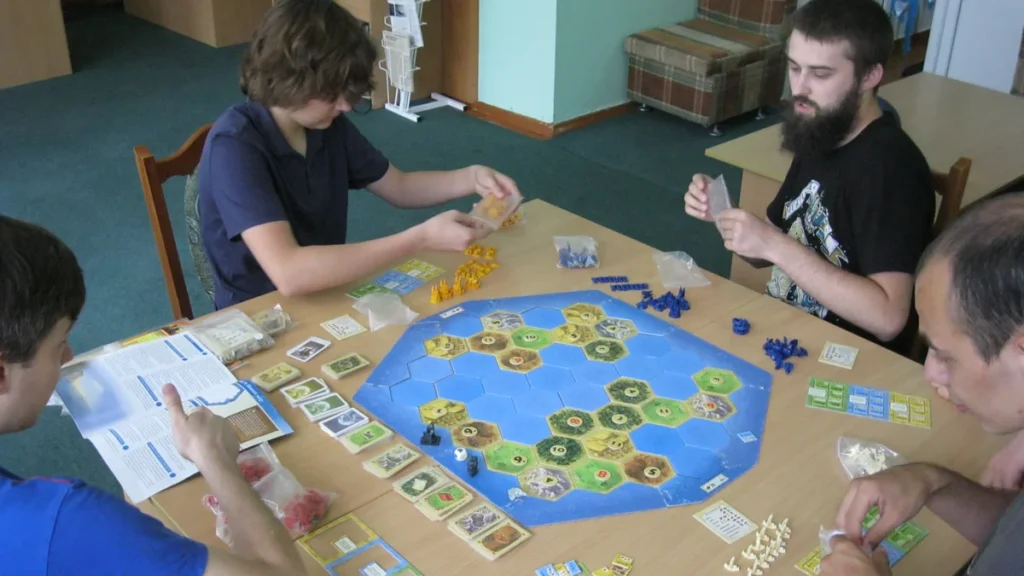
Catan is a classic trading and building game in which players collect wood, brick, wheat, sheep, and ore, then spend those resources to build settlements, cities, and roads. It takes about an hour per game, supports three or four players per table, and creates the kind of lively negotiation that fills a hall with laughter. Trading is the heart of Catan, and a room full of tables all haggling at once is a wonderful sound.
Because Catan plays best with three or four players, it suits a tournament format with smaller tables. Set up thirty tables of four players, run two rounds, and let the highest scorers advance to the final. Appoint a table captain who knows the rules well, keep a printed rules summary at every table, and remind players that trading is encouraged but never forced.
Azul
Azul is a beautiful tile-drafting game in which players take coloured tiles from shared factory displays and place them into patterns on their own boards. It plays in thirty to forty minutes, the rules take about five minutes to learn, and the tiles themselves are so pleasing to handle that even players who lose will enjoy the game. Azul is also quiet, which makes it a good choice when the hall is already noisy from other tables.
For 121 players, Azul works best as a relay or tournament game. Each table plays a complete game, records the scores, and then the players rotate to new tables for the next round. Because every game is short, you can fit three rounds into a single evening and still leave time for a final.
Telestrations
Telestrations is a drawing and guessing game that combines a sketch pad with a game of telephone. Each player draws a word, passes the pad on, and the next player guesses what the drawing shows. The results are almost always funny, and the game needs no artistic skill at all, which makes it welcoming for players of every age and confidence level. A full game takes about thirty minutes.
Telestrations is unusual because it can genuinely involve a very large number of players at once. With several copies of the game, each table of eight runs its own chain of drawings and guesses, and the best chains are read out at the end of the night for the whole room to enjoy. If your group enjoys that kind of whole-room silliness, our guide to party games for 120 players has more games in the same spirit.
Dixit
Dixit is a storytelling game built around a deck of large, dreamlike illustrated cards. One player gives a clue about a card, everyone else chooses a card from their hand that matches the clue, and the group votes on which card was the storyteller’s. It takes about thirty minutes, supports up to six players per table, and rewards imagination rather than speed or knowledge, which makes it a kind choice for mixed-age groups.
For a 121-player event, Dixit works well in the team format. Each team agrees on its clue together, then votes on the cards, and the storyteller rotates between tables so that everyone gets a turn. The artwork is a conversation starter in itself, and players who have never played a board game before often find Dixit the easiest game of the night to love.
Pandemic
Pandemic is a cooperative board game in which all the players work together to stop four diseases from spreading across the world. Nobody competes against anyone else at the table, and the game is won or lost as a team, which makes it a lovely change of pace in a tournament evening. A game takes about forty-five minutes, and the shared decisions create real teamwork.
For 121 players, run Pandemic as a cooperative challenge between tables. Each table plays the same scenario, and the tables compare how quickly they cured the diseases. The table that wins in the fewest turns takes the prize, and every table that beats the diseases counts as a winner, which suits school groups, work teams, and family gatherings.
Board Games for 121 Players at a Glance
Use this table to pick the right mix for your evening. A good programme pairs one team game, one tournament game, and one cooperative game, so that every kind of player finds something they enjoy.
| Game | Players per table | Time per round | Best format | Why it works for 121 players |
|---|---|---|---|---|
| Codenames | Whole room in teams | 15 minutes | Team play | One clue entertains the entire hall at once. |
| Ticket to Ride | 2 to 5 | 30 to 45 minutes | Tournament | Easy to learn and simple to score across tables. |
| Catan | 3 to 4 | 60 minutes | Tournament | Trading fills the hall with lively conversation. |
| Azul | 2 to 4 | 30 to 40 minutes | Relay | Short, quiet, and needs very little table space. |
| Telestrations | 4 to 8 | 30 minutes | Multiple tables | Every table produces a funny story to share. |
| Dixit | 3 to 6 | 30 minutes | Team play | Rewards imagination and welcomes all ages. |
| Pandemic | 2 to 4 | 45 minutes | Cooperative challenge | Tables compete together instead of against each other. |
Setting Up a 121-Player Board Game Night
Good organisation matters more than the choice of games. A hall of 121 players needs clear signs, a loud host, and a schedule that everyone can follow. Arrive at least an hour early, set up the tables in rows with wide aisles, and place one game, one score sheet, and one pen on every table before the first guest arrives.
The Room and the Tables
Choose a venue with room for twenty tables plus space for a host table, a refreshments table, and a leaderboard. A school hall, a church hall, or a community centre usually works well. Arrange the tables so that every player can see the host and the leaderboard, and leave enough space between tables for the host to walk around and answer questions.
The Schedule
A simple schedule keeps the evening moving. Allow thirty minutes for arrival and a welcome game of Codenames, then run three rounds of forty-five minutes with ten-minute breaks between them. Finish with a fifteen-minute final and a prize ceremony, and print the schedule on every table.
Scoring and Prizes
Keep scoring simple enough for a table captain to manage without a calculator. Award three points for a table win, two for second place, and one for taking part, then add the points across the three rounds. Offer small prizes for the overall winner, the best team, and the funniest Telestrations chain. Players who have enjoyed an evening of card games for 120 players will recognise the same approach: many small tables, one shared leaderboard, and prizes that celebrate taking part as well as winning.
Checklist for a 121-Player Board Game Night
Work through this checklist in the week before your event, and tick each item off as you complete it.
- Book a hall with space for twenty tables, a host table, and a refreshments area.
- Borrow or buy enough copies of each game so that every table can play at once.
- Recruit one table captain per table and send them the rules in advance.
- Print a score sheet, a schedule, and a rules summary for every table.
- Test the microphone, the projector, and the leaderboard before guests arrive.
- Prepare small prizes for the overall winner, the best team, and the funniest moment.
Frequently Asked Questions
Can 121 people really play one board game together?
Not around a single table, and no honest guide should claim otherwise. A group of 121 players enjoys board games by splitting into tables of five to seven, playing the same game at the same time, and sharing one schedule, one leaderboard, and one final. The event is shared, even though the boards are separate.
Which board game is best for 121 players?
Codenames is the best single choice, because it is a team game that scales to a whole room, takes fifteen minutes to play, and needs only five minutes to teach. Pair it with Ticket to Ride for a tournament round and Pandemic for a cooperative round, and you have a programme that suits every kind of player.
How many copies of each game do I need?
Plan for one copy per table. With twenty tables of six players, that means twenty copies of the main game, although in practice you can run different games on different tables and rotate them. Borrowing copies from players is the easiest way to reach that number, and many board game shops will lend sets for a community event if you ask in advance.
How long does a 121-player board game night last?
About two and a half to three hours is ideal. Allow thirty minutes for arrival and a warm-up game, three rounds of forty-five minutes with short breaks, and fifteen minutes for a final and prizes. Shorter evenings feel rushed, and longer evenings tire out younger players.
Are these games suitable for children?
Most of them are, with a little care. Codenames, Ticket to Ride, Azul, Telestrations, and Dixit all work well for children aged eight and over, especially when they play on a team with an adult. Catan and Pandemic suit older children and teenagers better, because the rules and the strategy are a little more involved.
What if some players have never played a board game before?
That is normal at a gathering of 121 people, and the format handles it well. Table captains teach the rules at each table, the first round is a practice round, and team games such as Codenames and Dixit let new players contribute without needing to know any strategy. Seat beginners with friendly, experienced players, and keep the first game of the night the simplest one you have.
The Bottom Line
The best board games for 121 players are the ones that turn a very large crowd into many small, happy tables sharing one evening. Codenames brings the whole room together, Ticket to Ride and Catan give the night its competitive spine, Azul and Telestrations keep the rounds fast and funny, and Dixit and Pandemic make sure every kind of player has a game to love. Book the hall, gather the copies, recruit your table captains, and let 121 players discover that the best board game night is not one giant game, but twenty small ones played together.