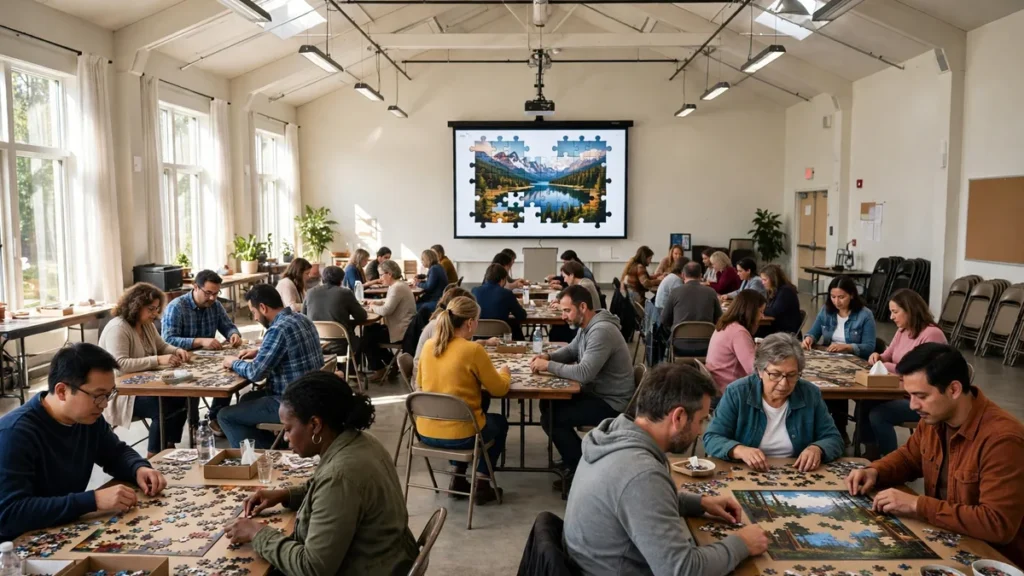
Planning party games for 136 players sounds impossible at first. Most party games are built for six, ten, or twenty people around a table, and a crowd of 136 feels like a different kind of event altogether. Yet large groups gather for parties all the time: school celebrations, company gatherings, community festivals, wedding receptions, and family reunions can easily reach triple figures, and those guests still deserve games that make them laugh, compete, and meet each other.
The secret is structure, not one magical game that seats everyone at once, because no such game exists. Split a huge crowd into teams, run several games at the same time, and bring everyone together for whole-room rounds, and 136 players stop being a problem and start being an advantage: louder cheers, bigger teams, and a party atmosphere a small gathering can never match.
This guide shows you exactly how to do it: the formats that genuinely work at this scale, a step-by-step plan for teams and stations, a comparison table to help you choose, and a checklist that keeps the evening on track. Every idea here scales honestly to 136 players without leaving anyone standing around bored.
Key takeaways
- No single party game seats 136 players at once, so plan team play, multiple tables, and whole-room rounds instead of searching for one giant game.
- Split the crowd into teams of 8 to 12 players, which gives you 12 to 17 teams and keeps every team small enough for everyone to take part.
- Run games in stations or rotations so that several teams play at the same time and nobody waits long for a turn.
- Mix whole-room games, table games, and relay races so that quiet guests, loud guests, thinkers, and movers all get a game they enjoy.
- Keep rounds short, score simply, and announce a running leaderboard so that all 136 players stay involved from the first game to the last.

The Honest Truth About Party Games for 136 Players
Let us start with the fact that matters most. No single party game seats 136 players. A card game needs a table, a board game needs a board, and even the liveliest guessing game falls apart when 136 people try to shout answers at the same time. Any list that pretends otherwise is selling a fantasy, and a host who believes it will end up with a confused crowd and a flat party.
That does not mean a 136-player party cannot have brilliant games. It means the games must be designed around the size of the group. The formats that work are team play, where a crowd is divided into squads; multiple tables, where the same game runs at many tables at once; tournament formats, where teams rotate through rounds and the winners meet in a final; relay formats, where players take turns so a whole team contributes; and whole-room games, where everyone answers, votes, or performs at the same time.
Think of it the way a sports day works. Nobody expects 136 people to play one game of football against each other. Instead, there are teams, heats, and a scoreboard, and the crowd enjoys both playing and watching. Your party works the same way. The best board games for 136 players follow this same logic, running the same game at many tables and combining the scores.
The other honest truth is that 136 players need more planning than 16 players, but not more money or stress: a clear team list, a simple schedule, enough space for teams to spread out, and one confident host. You do not need expensive equipment. Most of the games in this guide use paper, pens, a speaker, and everyday household items, which keeps the budget low and the preparation simple.
How to Organise 136 Players Without Chaos
Organisation is the difference between a legendary party and a noisy mess. With 136 guests, you cannot simply announce a game and hope everyone understands the rules. You need a plan every guest can follow in the first minute, written down before the party starts.
Split Into Teams of 8 to 12 Players
Teams of 8 to 12 players are the sweet spot for a crowd of this size. With 136 guests, teams of 8 give you 17 teams, teams of 10 give you 13 teams with six players left over, and teams of 12 give you 11 teams with four left over. Choose the size that fits your tables and games, then balance the leftovers across the teams rather than creating one tiny team.
Give every team a name, a colour, and a table or home base. Colour-coded wristbands, badges, or table flags cost very little and solve the biggest problem of a large party: guests not knowing where they belong. Mix the teams deliberately rather than letting friendship groups stay together, because mixed teams help guests meet new people and keep the competition fair.
Appoint a team captain for each team. The captain collects the answer sheets, keeps the team on schedule, and reports the score, leaving the host free to run the games instead of chasing paperwork.
Run Stations, Not One Big Game
Stations are the engine of a 136-player party. Set up six to eight stations around the room or garden, each with a different short game, and rotate the teams through them. While one team plays a guessing game at station one, another is doing a relay at station two and a third is solving puzzles at station three. Nobody waits long, and the party feels busy and alive.
Keep each station game short, around eight to ten minutes, with two minutes to rotate. A full rotation through six stations takes about an hour. Station hosts can be volunteers or friends of the host, and each one only needs to learn a single game.
Make sure the stations suit the space: quiet table games in a calm corner, relays and physical games in open floor or garden space, and clear walkways between stations so that 136 people can move safely.
Build a Simple Schedule
Write the schedule on a large board or a printed sheet at every table. A good schedule starts with a whole-room icebreaker, moves into two or three station rotations, brings everyone back together for a whole-room quiz or performance round, and finishes with a final relay and the prize ceremony. Guests who can see the plan relax, because they know what happens next.
Allow generous time between sections. Moving 136 people takes longer than moving 16, so build in ten minutes of slack for every hour of games, and use music during the gaps so the energy never drops while people move.
Whole-Room Games That Work at 136 Players
Whole-room games are the moments when all 136 players play together, and they are the most memorable part of the evening. They need a confident host with a microphone and a speaker, and they work best when the answers are simple and the rounds are fast.
Team trivia is the classic whole-room game for a large crowd. The host reads a question, every team writes down an answer, and the captains hold up their answer cards at the same time. Ten questions take about fifteen minutes, and the format works for general knowledge, music rounds, picture rounds, and questions about the guest of honour. Because every team answers every question, all 136 players are involved in every round.
Bingo works beautifully at this scale too. Print a card for every guest, call the numbers or clues over the speaker, and let the whole room play at once. Picture bingo, music bingo, and themed cards keep the game fresh, and the first guest to complete a line wins a small prize. Bingo also suits mixed ages, because children, parents, and grandparents can all play together without disadvantage.
Other whole-room games that scale well include a singalong quiz, where teams guess the song from a short clip, and a vote-and-reveal game, where teams vote on funny questions and the host reveals the most popular answer. If your crowd is smaller on the night than expected, these same formats still work, and our guide to party games for 98 players shows how the same whole-room ideas adapt to a slightly smaller group.
Table and Station Games for 136 Players
Table and station games are where the real variety lives. Because the same game runs at many tables at once, you can offer games that would never work for 136 people in a single group, and every guest gets far more turns than they would in one giant game.
Card games are a natural choice for stations. A simple card game that takes five minutes to learn can run at twelve tables at the same time, with each table playing its own mini tournament and earning points for the team. Our list of card games for 136 players explains which card games suit this format best: choose games with short rounds and simple scoring so no table falls behind the rotation.
Word games make excellent stations too. A word scramble, a categories game, or a quick guessing game can be played with paper and pens at every table, and the answers are easy to score. Word games also suit guests who prefer thinking to running, which matters when your crowd includes a wide range of ages and energy levels.
Other strong station games include building challenges, memory games, drawing games, and dice games. The common thread is that every station game should be explainable in under a minute, playable in under ten minutes, and scoreable with a single number.
Tournament and Relay Formats
Tournaments and relays turn a party into a proper competition, and competition is what keeps 136 players engaged for hours. A good tournament format gives every team a path to the final, even if they lose an early round.
A simple tournament works like this. Teams play short head-to-head matches at the stations, and each win earns points rather than eliminating the loser. After the rotations, the four teams with the most points meet in a semi-final, and the two winners play a grand final in front of the whole room. Because points accumulate across the evening, a team that starts slowly can still climb the leaderboard.
Relay races are the most exciting format for a large party. Each team lines up, and players take turns running, carrying, stacking, or solving one small task before tagging the next player. A spoon race, a balloon relay, or a dress-up relay all work, and the whole room can watch the final relay together. Every player takes a turn, the crowd cheers for their own team, and the finish is always dramatic.
For a gentler version of the same idea, run a relay of brain games instead of physical ones: one player solves a riddle, the next unscrambles a word, the next names a capital city, and so on down the line. This suits indoor parties, older guests, and venues with limited space.
Party Games for 136 Players Compared
Choosing the right mix matters more than choosing the single best game: a party that is all quizzes will bore the movers, and a party that is all relays will exhaust the thinkers. Use this table to build a balanced programme with at least one game from each row.
| Format | Best For | Players at Once | Time per Round | Space Needed |
|---|---|---|---|---|
| Team trivia | Whole-room fun, all ages | All 136 players | 15 minutes | One large room |
| Bingo | Mixed ages, relaxed play | All 136 players | 20 minutes | One large room |
| Station card games | Quick competitive rounds | 8 to 12 per table | 10 minutes | Several tables |
| Word game stations | Thinkers and quiet guests | 8 to 12 per table | 10 minutes | Several tables |
| Relay races | Energy and team spirit | One player per team at a time | 10 minutes | Open floor or garden |
| Tournament finals | A dramatic finish | Top four teams | 15 minutes | One stage or open floor |
Timing and Scoring That Keeps Everyone Involved
Timing is the quiet skill behind every successful large party. Rounds that are too long lose the room, and rounds that are too short feel rushed. For 136 players, aim for rounds of eight to fifteen minutes, with a clear signal for the start and end of each round: a whistle, a bell, or a short burst of music works better than shouting.
Scoring should be simple enough for a team captain to manage without a calculator: ten points for a station win, five for second place, and two for taking part, or one point per correct answer for quizzes. Post the running scores on a large board where everyone can see them, and update it after every rotation. A visible leaderboard creates friendly rivalry and gives teams a reason to care about the next round.
Prizes do not need to be expensive, but they should be ready before the party starts: small prizes for each station winner, a fun prize for the overall winning team, and a light-hearted prize for the best team name or team spirit. Avoid a single huge prize that makes the rest of the evening feel pointless for teams that fall behind early.
Common Mistakes to Avoid
The most common mistake is choosing games that only work for small groups and hoping they will stretch. A game that needs every player to speak in turn will take hours with 136 people, and a game that needs a single board will leave 130 people watching. Test every game against a simple question: can all 136 players take part within ten minutes, either at the same time or through teams and rotations?
The second mistake is skipping the sound system. A host without a microphone cannot be heard by 136 guests in a large hall, and rules explained to the front row will never reach the back. Hire or borrow a microphone and a speaker, test them before the guests arrive, and keep spare batteries nearby.
The third mistake is forgetting the quiet guests. In a crowd of 136, the loudest guests will always find a way to play, but shy guests, older guests, and children need games that let them contribute without performing in front of everyone. Table games, written quizzes, and team roles like scorekeeper give every guest a way in.
The final mistake is running out of time for the games themselves. Food, speeches, photographs, and dancing all compete for the same evening, and games are usually the first thing to be squeezed. Protect at least ninety minutes for games, and start on time even if a few guests are still arriving.
Your 136-Player Party Checklist
Use this checklist in the week before the party, and tick each item off as it is done.
- Split the guest list into teams of 8 to 12 players, name every team, and assign a colour and a captain to each one.
- Choose six to eight station games, prepare the materials for every station, and brief a volunteer host for each station.
- Book a microphone, a speaker, and a large scoreboard, and test the sound system in the actual venue before the guests arrive.
- Print answer sheets, bingo cards, scorecards, and the schedule, with enough copies for all 136 players plus spares.
- Plan the room layout with clear stations, walkways, a quiet corner for table games, and open space for relays.
- Buy small prizes for station winners, the overall winning team, and the best team spirit, and keep the prize ceremony in the schedule.
Frequently Asked Questions
Can one party game really seat 136 players?
No, and any claim that it can should be treated with suspicion. No single table game, card game, or board game seats 136 players at once. The games that work at this scale use teams, multiple tables, rotations, and whole-room rounds, so all 136 players take part through structure rather than through one giant game.
How many teams should 136 players be split into?
Teams of 8 to 12 players work best, which gives you between 11 and 17 teams. Teams of 10 are a good default, with the six remaining players distributed across the teams so no team is much larger than the rest.
How long should the games section last?
Allow at least ninety minutes for games, and two hours if the party is built around them: a fifteen-minute whole-room opener, an hour of station rotations, and a fifteen-minute final.
What if the venue is too small for relays?
Drop the physical relays and replace them with seated relay rounds, where players take turns answering, drawing, or solving puzzles at their tables. You keep the excitement of taking turns and the team spirit of a relay without needing open floor space.
How do you keep score fairly with 136 players?
Use one simple scoring system across every game, such as ten points for a win, five for second place, and two for taking part. Let team captains record their own scores, and display a running leaderboard where everyone can see it.
What games suit a mixed-age crowd of 136?
Team trivia, bingo, word games, and memory games suit the widest range of ages, because they reward knowledge and teamwork rather than speed or strength. Mix these with one or two active games for the guests who want to move.
The Bottom Line
Party games for 136 players work when you stop looking for one giant game and start building a proper structure. Split the crowd into teams of 8 to 12, run short games at several stations, bring everyone together for whole-room rounds, and finish with a tournament or relay the whole room can watch. Keep the rounds short, the scoring simple, and the leaderboard visible, and all 136 players will stay involved from the first question to the final prize.