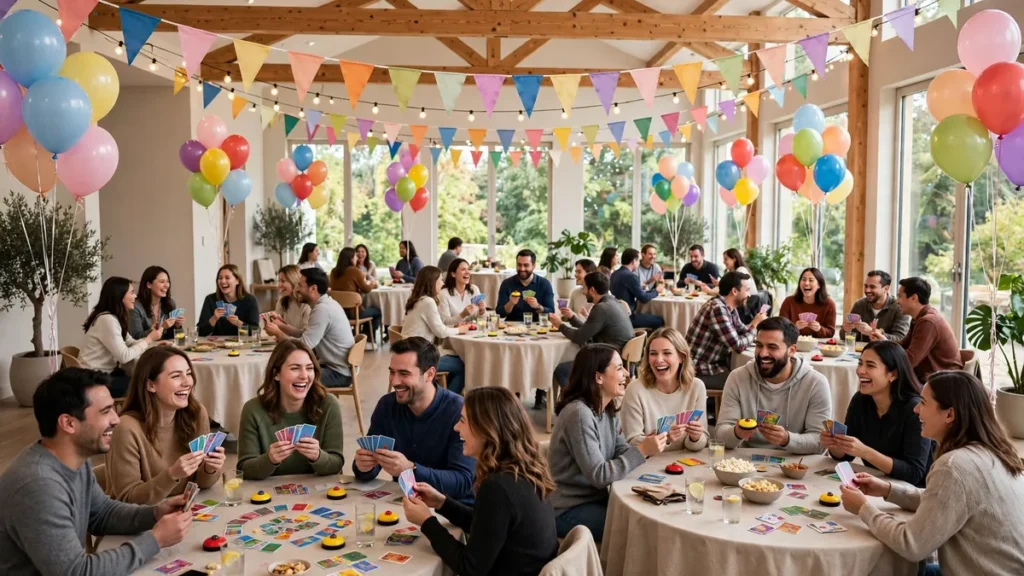
The best party games for 98 players are not the games you would choose for a quiet evening with six friends around one table. No single party game seats 98 players at once, and no single table, board, or buzzer set can hold a crowd that large. The best party games for 98 players work because they turn a crowd into teams, split the room into tables or stations, and give every person something to do within the first few minutes. When that structure is in place, 98 players stop being a problem and start being the point: more teams, more energy, and a louder finish.
Planning for 98 players means planning for 14 teams of seven, or seven teams of 14, rather than planning for one giant game. Each team needs its own table, its own scorecard, and its own way to answer, while the host needs a visible scoreboard, a clear rotation plan, and rounds short enough that no team waits long. Supplies matter more than at a small party: 98 answer sheets, 98 pens, and enough buzzers or cards for every table, counted out before anyone arrives.
This guide covers the 10 best party games for 98 players, how to set each one up for a crowd this size, what supplies you need, and how to run the whole event without confusion. Every game here has been chosen because it scales cleanly to 14 teams, needs only basic supplies, and keeps all 98 players involved from the first round to the final score. If you have run a slightly smaller crowd before, the lessons from the best party games for 97 players carry over almost exactly, with one extra player to place on a team.
Key takeaways
- No single party game seats 98 players, so every game on this list runs as team play, multiple tables, a tournament, or a whole-room format.
- Fourteen teams of seven is the simplest structure for 98 players, giving every team its own table, scorecard, and captain.
- Short rounds of five to ten minutes keep all 98 players involved and stop any team from waiting too long between turns.
- One visible scoreboard, one clear host, and pre-counted supplies are what separate a smooth 98-player party from a chaotic one.
- Mix quiet table games with loud whole-room games so the energy rises and falls instead of burning out in the first hour.

Why 98 Players Changes Everything
A party game built for eight people assumes everyone can hear the host, see the board, and take a turn within a minute or two. With 98 players, none of those assumptions hold. A single question read aloud to 98 people means most of them are listening, not playing, and a single board in the middle of the room is invisible to everyone past the third row. The games that work at this size are the ones that give every team its own copy of the action.
Team play is the first fix. Split 98 players into 14 teams of seven and each team becomes a small party of its own, with its own discussion, answers, and score. Multiple tables are the second fix: instead of one game in front of 98 watchers, 14 games happen at once. Tournament and relay formats are the third fix, letting teams rotate between stations so nobody plays the same game twice in a row.
Whole-room games are the fourth fix, and they matter because they are the only format where all 98 players genuinely play at the same moment. A music round, a picture round, or a vote-based game can involve the entire room at once, and those shared moments are what guests remember. The best 98-player parties alternate between table games and whole-room games so the room never stays in one mode for too long.
How to Set Up a 98-Player Party
Start with the room. Fourteen round tables of seven seat 98 players comfortably, with space between tables for the host and any runners to move. If round tables are not available, long tables split into groups of seven work just as well, as long as each group can talk without shouting over its neighbours. Put a numbered sign on every table so teams can find their home base quickly and runners know where to deliver supplies.
Next, choose a team structure and stick to it all evening. Fourteen teams of seven is the cleanest split, but seven teams of 14 also works if you prefer fewer, larger teams and a simpler scoreboard. Either way, give every team a captain, a name, and a colour. Captains collect answer sheets, call out answers, and keep their team on schedule, which takes an enormous load off the host.
Supplies should be counted and bagged per table before the party starts. Each table needs answer sheets, pens, a scorecard, and whatever the current game requires, whether that is cards, buzzers, or picture sheets. A simple kit per table, prepared in advance, is far faster than handing out supplies one item at a time while 98 people wait.
Finally, plan the timing. Rounds of five to ten minutes work best, with a short break between games for scoring and rotation. Three hours gives you room for six or seven games, a whole-room finale, and time for food and conversation. Announce the schedule at the start and keep a visible timer so every table finishes together.
Best Party Games for 98 Players Compared
| Game | Format | Players per team | Round length | Supplies needed |
|---|---|---|---|---|
| Team Trivia Showdown | Multiple tables | 7 | 10 minutes | Question sheets, pens |
| Picture Round Relay | Multiple tables | 7 | 8 minutes | Picture sheets, pens |
| Music Bingo Bonanza | Whole room | 7 | 10 minutes | Bingo cards, markers |
| Charades Tournament | Tournament | 7 | 8 minutes | Prompt cards, timer |
| Card Game Circuit | Stations | 7 | 10 minutes | Card decks per table |
| Word Chain Challenge | Multiple tables | 7 | 6 minutes | Answer sheets, pens |
| Scavenger Hunt Sprint | Relay | 7 | 10 minutes | Clue lists, small items |
| Balloon Pop Quiz | Whole room | 7 | 8 minutes | Balloons, question cards |
| Team Pictionary Race | Tournament | 7 | 8 minutes | Whiteboards, markers |
| Grand Finale Vote-Off | Whole room | 7 | 10 minutes | Voting cards, scoreboard |
The 10 Best Party Games for 98 Players
1. Team Trivia Showdown
Team trivia is the most reliable large-group party game ever made, and it is the natural opener for 98 players. Every table gets the same set of questions, every team writes down its answers, and the host reads the answers aloud at the end of each round. Nobody waits for a turn, nobody is put on the spot alone, and the whole room plays at the same time. Five rounds of ten questions, with a different category each round, fill a full hour without ever feeling repetitive.
For 98 players, use 14 teams of seven and keep the questions fair across ages and interests. Mix general knowledge, music, food, sport, and picture questions so every team has a round where it shines. Give one point per correct answer and a bonus point for a perfect round, and post running totals on a visible scoreboard after every round.
Preparation is simple. Print one question sheet and one answer sheet per team, plus a spare set for the host. Number the questions clearly and read them twice, slowly, so teams at the back of the room hear them properly. A microphone is essential at this size, and a short practice round at the start helps every team learn the rhythm before the points count. The best trivia games for 90 players use the same team structure, so any format that worked for 90 will work for 98 with one extra player per team.
2. Picture Round Relay
A picture round works beautifully for 98 players because it is silent, visual, and fair to teams with different strengths. Each table receives the same sheet of 20 pictures: famous faces, landmarks, logos, animals, or movie scenes. Teams have eight minutes to identify as many as they can, writing answers on their sheet.
The relay element comes from the scoring. After each round, tables swap answer sheets with the table next to them for marking, which keeps scoring honest and gives teams a reason to talk to their neighbours. Themed rounds, such as food, travel, or music, let you match the pictures to the occasion.
3. Music Bingo Bonanza
Music bingo is a whole-room game, which makes it one of the few formats where all 98 players genuinely play at the same moment. Every player gets a bingo card printed with song titles instead of numbers. The host plays short song clips, players mark off any title they hear, and the first team with three bingos wins the round.
For a crowd of 98, print several different card layouts so no two tables share the same card, and play clips of 15 to 20 seconds so everyone has time to recognise the song. Choose songs the whole room knows, from different decades, so every age group has its moment.
4. Charades Tournament
Charades scales to 98 players only as a tournament. Each team sends one player at a time to act out a prompt while their own team guesses, earning points for every correct guess within 60 seconds. With 14 teams playing at their own tables at the same time, the room fills with laughter, wild gestures, and frantic shouting.
Run it in heats. Every team plays three one-minute rounds, then the top four teams advance to a semi-final in front of the whole room, and the top two meet in a grand final. The audience rounds are the highlight: 98 people watching two teams act out the hardest prompts. Keep prompts fair and fun, with movies, songs, everyday objects, and famous people.
5. Card Game Circuit
A card game circuit turns 98 players into 14 simultaneous card tables, each playing a short, simple card game. Teams rotate to a new table every ten minutes, so by the end of the circuit every team has played four or five different games. The format works because the games are short and the rules are simple.
Choose games that take five minutes to learn and ten minutes to play: matching games, speed games, bluffing games, and simple trick-taking games. Put a printed rules card on every table so teams can start without waiting for the host to explain. Each table has a station captain who keeps score, and teams carry their points with them as they rotate, so the competition follows them around the room.
6. Word Chain Challenge
The word chain challenge is a quiet, clever table game that works perfectly for 98 players because it needs nothing more than paper and pens. The host gives every team a starting word, and each team builds a chain where every word starts with the last letter of the previous word. Teams have six minutes to build the longest valid chain they can.
Run three chains per game with different starting letters and rules. One round might ban proper nouns, another might require every word to be about food, and a third might allow only words of five letters or more. Scoring is simple: one point per valid word, with a bonus for the longest chain overall.
7. Scavenger Hunt Sprint
A scavenger hunt for 98 players is a relay, not a free-for-all. Each team receives a list of 20 items to find or photograph within the party space: something red, something round, a photo of the whole team jumping, and a photo with the host. Teams send runners out in pairs while the rest of the team plans the next find, and the first team to complete the list wins.
The relay structure is what makes it safe and fair for a crowd this size. Only two runners per team are moving at any time, so the room never becomes a stampede, and the list is designed so that most items can be found without leaving the party area. Set a strict ten-minute limit and a clear boundary, and make sure every item on the list is actually findable, with nothing that requires leaving the building or disturbing other guests.
8. Balloon Pop Quiz
Balloon pop quiz combines the excitement of popping balloons with the satisfaction of answering questions, and it is a natural whole-room game for 98 players. Before the party, the host writes questions on slips of paper and seals one slip inside each balloon. Teams take turns choosing a balloon, popping it, and answering the question inside. A correct answer earns a point, and a wrong answer passes the question to the next team.
For 98 players, prepare at least 60 balloons with questions of mixed difficulty, hung in clusters around the room. Easy questions earn one point, medium questions earn two, and hard questions earn three, so teams choose their own risk level. A team that is behind can gamble on a hard balloon, while a team in the lead can play it safe.
9. Team Pictionary Race
Team Pictionary is a classic party game, and the race format makes it work for 98 players. Each team has a small whiteboard and a marker, and one player draws while their team guesses. All 14 teams draw the same word at the same time, and the first team to guess correctly earns three points, the second earns two, and the third earns one.
Run it in heats of eight words, with a new drawer each round so everyone gets a turn. Words should be drawable in under 30 seconds: animals, objects, actions, and simple phrases, rather than abstract ideas. A visible timer and a strict no-letters rule keep the game fair.
10. Grand Finale Vote-Off
Every 98-player party needs a finale that involves the whole room, and the grand finale vote-off is the perfect ending. The host presents a series of fun questions, such as best team name, funniest moment of the night, or best dressed team, and every player votes with a coloured card. Teams earn points for every vote they receive, and the team with the most votes across all categories wins the finale.
The vote-off works because it rewards the whole evening, not just one game. Teams that played well, helped others, and kept the energy high tend to win votes, which makes the finale feel fair even to teams that did not top the scoreboard. Run five or six categories, keep the voting quick, and announce results one category at a time so tension builds to the final announcement.
End the vote-off with the overall winner announcement, a prize for the winning team, and a round of applause for every team. The finale takes ten minutes, needs only voting cards and a scoreboard, and leaves the room on a high note. If you are planning a slightly smaller crowd next time, the best party games for 96 players use the same finale format, so the structure transfers directly.
Your 98-Player Party Checklist
- Split 98 players into 14 teams of seven, give every team a name, a colour, and a captain before the first game starts.
- Count and bag supplies per table in advance, with one kit per table and spare pens and sheets in a central box.
- Set up one visible scoreboard and one microphone, and test both before any guests arrive.
- Plan rounds of five to ten minutes, with a short break between games for scoring, rotation, and a drink.
- Mix quiet table games with loud whole-room games so the energy rises and falls across the evening.
- Keep a visible timer running, announce the schedule at the start, and end with a whole-room finale that involves everyone.
Frequently Asked Questions
Can one party game really seat 98 players?
No single party game seats 98 players at one table. The games on this list work because they use team play, multiple tables, tournament heats, relay formats, or whole-room play, so all 98 players are involved even though no single table holds them all.
How many teams should 98 players form?
Fourteen teams of seven is the simplest split, because every team fits around one table and the scoreboard stays easy to read. Seven teams of 14 also works if you prefer fewer, larger teams, but tables of seven are easier to manage, easier to hear, and easier to keep involved.
How long does a 98-player party take?
Three hours is a comfortable length for six or seven games, a whole-room finale, and time for food and conversation. Rounds of five to ten minutes keep the pace brisk, and a short break between games gives teams time to score, rotate, and recharge.
What supplies do I need for 98 players?
Count everything per table: 14 sets of answer sheets, pens, scorecards, and whatever each game requires, plus spares. A kit per table, prepared before the party, is far faster than handing out supplies during the event.
Do I need a microphone for 98 players?
Yes, a microphone is essential. Without one, only the tables nearest the host can hear the questions, the rules, and the scores. Test the microphone and the scoreboard before guests arrive, and keep a spare battery or a backup speaker within reach.
What is the best game to start with?
Team trivia is the best opener, because every team plays at the same time, nobody is put on the spot alone, and the first round teaches every team how the evening works. Start with an easy practice round, then let the points count from the second round onwards.
The Bottom Line
The best party games for 98 players are the ones that respect the size of the crowd instead of fighting it. Split the room into 14 teams of seven, run short rounds, keep one visible scoreboard, and mix quiet table games with loud whole-room moments. Do that, and 98 players will not feel like a crowd to manage. They will feel like the reason the party works.