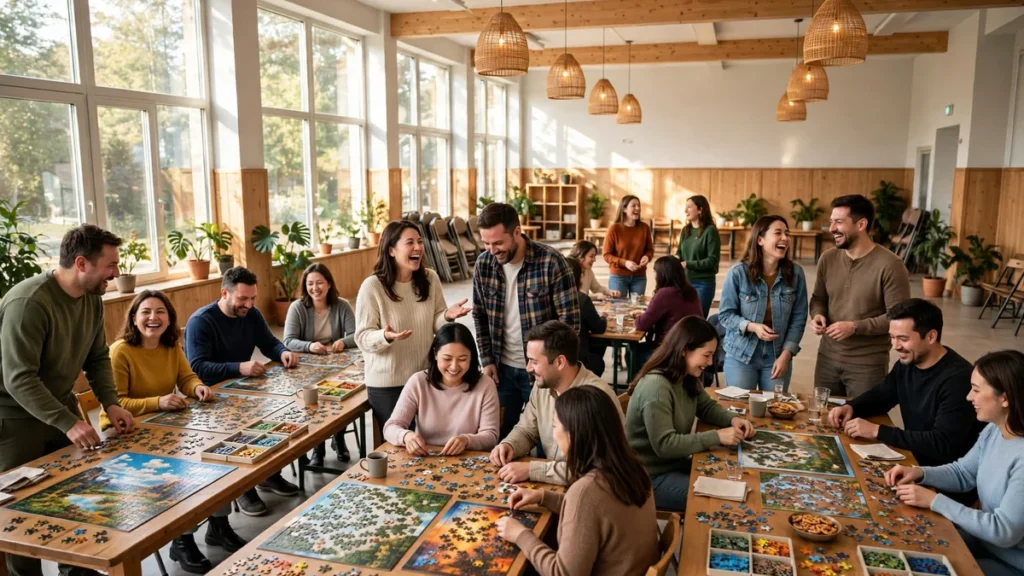
Finding the best trivia games for 107 players starts with an honest fact: no single trivia game is built to seat 107 people around one table. A standard trivia box serves four to eight players, and even the biggest party editions top out long before triple digits. That does not mean a 107-player trivia night is impossible. It means the game has to change shape, from one board and one buzzer into teams, tables, heats, and a whole room playing together.
The best trivia games for 107 players are therefore the ones that scale. They work when 107 people are split into teams of five to eight, when questions are shown on a big screen or read aloud by a host, and when scoring is simple enough that nobody waits twenty minutes for their turn. The games below were chosen for exactly that reason. Each one keeps every player involved, keeps rounds moving, and keeps the energy of a full hall instead of letting it dissolve into a long queue.
This guide covers ten formats that genuinely work at this size, from a classic pub quiz run across eighteen team tables to app-based quizzes where all 107 players answer on their phones at once. You will also find a comparison table, a setup checklist, and answers to the most common questions about running trivia for a crowd this large. Pick one main format, add one whole-room round for variety, and your 107-player night will feel like a party, not a lecture.
Key takeaways
- No single trivia game seats 107 players, so every format here uses teams, multiple tables, heats, or whole-room play.
- Teams of five to eight work best, giving 107 players about fourteen to twenty teams and a lively competition.
- Big-screen or app-based scoring keeps a large game moving and stops long waits between turns.
- Mix question types, with general knowledge, music, pictures, and themed rounds, so every team has a strength.
- One confident host, clear answer sheets, and a simple scoring system matter more than an expensive game set.

Why 107 Players Changes Trivia Completely
A trivia game for six friends is a conversation. A trivia game for 107 players is an event, and it needs event thinking. The moment the group passes about twenty people, the usual rules stop working. Players at the far end cannot hear the question, cannot see the board, and cannot reach the buzzer. Teams that wait too long between turns lose interest, and a single slow scorer can stall the whole evening. Planning for 107 players means planning for sound, sightlines, and speed before anything else.
The maths of the room shapes every choice that follows. With teams of six, 107 players become eighteen teams, with one team of five. With teams of eight, they become fourteen teams, with one team of three that deserves a friendly extra member or a handicap point. Either way, you need enough tables, enough answer sheets, and enough pens for every team, plus a host who can project to the back of the hall. A microphone is not optional at this size, and a screen or printed question sheets for each table make a real difference.
How to Run Trivia for 107 Players
There are four proven ways to organise 107 players, and the best trivia games for 107 players all fit into one of them. The team-table format is the simplest: every team sits together, answers the same questions, and hands in one sheet per round. The tournament format splits the room into heats, with winning teams advancing to a final. The relay format rotates teams through stations, so a picture round, a music round, and a general knowledge round all run at once. The whole-room format has every player answering at the same time, usually on a phone or a card, with no waiting at all.
Most successful large nights combine two of these. A team-table quiz for the first hour, followed by a whole-room music round and a buzzer final between the top four teams, gives everyone plenty of play and builds to a finish the whole hall can watch. If you are comparing large-group formats, the ideas in our guide to party games for 80 players show how similar numbers are handled when the whole room plays together.
The Best Trivia Games for 107 Players
The ten games below are ranked by how well they scale, how much fun they create in a full hall, and how easy they are to run without specialist equipment. Every one of them has been adapted here for 107 players, with team sizes, round lengths, and hosting notes included. A near-identical setup for a slightly smaller crowd is covered in our guide to trivia games for 105 players. Use the comparison table after this section to pick the format that fits your venue, your budget, and your crowd.
1. Classic Pub Quiz, Team-Table Format
The classic pub quiz is the most reliable of all the best trivia games for 107 players, because it was designed for teams from the start. Split the room into teams of five to eight, give each team an answer sheet and a pen, and read ten questions per round from the front. Teams discuss quietly, write one answer per question, and hand the sheet in when the round ends. Five rounds of general knowledge, geography, sport, food, and entertainment give every team a chance to shine.
What makes this format work at 107 players is its simplicity. Nobody needs a phone, an app, or a buzzer, and nobody is left out because they do not know the technology. The host controls the pace, the questions are the same for everyone, and scoring is a single point per answer. Add a picture round, where each table receives a printed sheet of ten images, and a music round played over the speakers, and the evening gains variety without gaining complexity.
2. Jeopardy-Style Buzzer Tournament
A Jeopardy-style game brings drama to a large room, but it cannot put 107 players on buzzers at once. The answer is a tournament. Run heats of four teams, with each heat playing a short board of fifteen to twenty clues, and let the winning team from each heat advance. With eighteen teams, five heats produce five finalists, and a short final between those teams decides the champion while the rest of the room watches, cheers, and plays along on paper.
This format works because the final is theatre. The audience knows the teams, has followed their progress, and cares about the result. The host needs a visible board, whether a projected slide deck or a simple grid on a screen, and a clear rule for who answers first when two teams buzz together. Keep clue values simple, such as 100, 200, and 300 points, and include one double-points clue per heat so a trailing team can still catch up.
3. App-Based Live Quiz
An app-based live quiz is the easiest way to let all 107 players answer at the same time. Each player joins with a phone, the questions appear on a big screen, and everyone answers within a time limit, usually twenty to thirty seconds per question. Scores update instantly, the leaderboard is visible to the whole hall, and there is no paper to collect, no handwriting to decipher, and no waiting for the host to add up scores.
The strength of this format is speed and scale. A round of ten questions takes about ten minutes, including the leaderboard breaks, and the whole game can run for an hour without losing momentum. It also suits mixed crowds, because players answer individually even when they sit in teams, and the team score can simply be the average or the total of its members.
4. Trivial Pursuit Team Edition
Trivial Pursuit is a household name, and its team edition adapts well to a large hall. Instead of one board for 107 players, which would be unworkable, set up one board per table and run the same categories at the same time. Each team plays its own game, answering questions from the six classic categories, and the first team at each table to complete a set, or the team with the most correct answers after a fixed time, wins its table. Table winners then face each other in a short final.
5. Kahoot-Style Big-Screen Quiz
A Kahoot-style big-screen quiz turns the whole hall into one game show. Questions and four coloured answer buttons appear on the main screen, players tap their answer on their phones, and points are awarded for correct answers and speed.
The format is at its best with younger crowds and mixed groups, because the interface is simple and the pace is fast. A full game of twenty questions takes about fifteen minutes, so you can run three or four games in an hour with different themes, such as general knowledge, music, films, and a custom round about the company, school, or birthday person the night is celebrating. Custom rounds are the secret weapon here, because questions about the guests themselves always get the biggest reaction.
6. Wits and Wagers Team Play
Wits and Wagers is a clever fit for 107 players because it rewards good guessing as much as good knowledge. Each question asks for a number, such as the year a film was released or the height of a famous building, and every team writes down its best guess. The guesses are then laid out in order, teams bet on the answer they think is closest, and the nearest guess wins. Even a team that knows nothing can win a round by judging the numbers well.
7. Music Trivia and Name That Tune
Music trivia works brilliantly for 107 players because the whole hall hears the same clip at the same time. Play a five-second clip, give teams thirty seconds to write down the song title and the artist, and award a point for each correct part. Twenty clips make a full round, and you can theme the rounds by decade, by genre, or by film soundtracks, so every generation in the room gets its moment.
The whole-room format is the key here. There are no heats, no waiting, and no equipment beyond a good speaker system, which matters when the room holds more than a hundred people. Test the sound from the back of the hall before the night begins, because a clip that is clear at the front and muffled at the back will frustrate half the room. A short sound check with a volunteer at the furthest table takes two minutes and saves the round.
8. Picture Round and Mystery Box Relay
A picture round suits 107 players because every table receives the same printed sheet and works through it at its own pace. Ten images, perhaps famous landmarks, close-ups of everyday objects, or baby photos of celebrities, give teams something to debate together. The mystery box relay adds movement: teams send one member at a time to a central table, open a box, identify the object inside, and run back to tag the next player. The fastest team with the most correct identifications wins.
Running the two together gives the night a change of pace. The picture round is calm and thoughtful, while the relay is noisy and physical, and the contrast keeps energy high. For the relay, set up four identical stations so four teams compete at once, and run heats until every team has had a turn. Each heat takes about five minutes, so plan the schedule carefully and keep the queue moving with a clear order of teams.
9. Trivia Bingo for a Full Hall
Trivia bingo is the simplest whole-room game for 107 players, and it needs almost no equipment. Each player receives a bingo card printed with answers instead of numbers, such as capital cities, film titles, or animal names. The host reads out questions, and players mark the square that holds the correct answer. The first player to complete a row, a column, or a full house calls out and wins the round.
10. Custom Themed Quiz Bowl
A custom themed quiz bowl is the most personal of the best trivia games for 107 players, because every question is written for the people in the room. For a company event, the rounds can cover the company history, the industry, and funny facts about the team. For a birthday or a reunion, they can cover the guest of honour, the year everyone met, and shared memories. That personal touch turns a generic quiz into an evening people talk about afterwards.
Run it as a team-table quiz with five rounds of ten questions, just like the classic pub quiz, but write the questions yourself or with a small planning group. Good themed questions are specific and fair, with one clear answer and no trick wording. If you need a bank of well-tested questions to adapt, our collection of 100 best trivia questions and answers is a useful starting point for general knowledge rounds alongside your custom ones.
Comparison Table: The Best Trivia Games for 107 Players
| Game | Format | Best for | Equipment needed | Time |
|---|---|---|---|---|
| Classic pub quiz | Team tables | Any crowd, first choice | Answer sheets, pens, microphone | 60 minutes |
| Jeopardy-style tournament | Heats and final | Drama and a big finish | Screen, buzzers, scoreboard | 60 minutes |
| App-based live quiz | Whole room on phones | Speed and instant scoring | Phones, Wi-Fi, big screen | 45 minutes |
| Trivial Pursuit team edition | One board per table | Familiar classic play | One set per table | 60 minutes |
| Kahoot-style big-screen quiz | Whole room on phones | Younger and mixed crowds | Phones, Wi-Fi, big screen | 45 minutes |
| Wits and Wagers | Team tables with betting | Mixed knowledge levels | Betting sheets, pens | 40 minutes |
| Music trivia | Whole room listening | Energy and variety | Speakers, playlist | 30 minutes |
| Picture round and relay | Tables plus heats | Movement and fun | Printed sheets, mystery boxes | 45 minutes |
| Trivia bingo | Whole room, individual | Warm-up or closing round | Printed bingo cards, pens | 20 minutes |
| Custom themed quiz bowl | Team tables | Personal celebrations | Answer sheets, custom questions | 60 minutes |
Checklist: Setting Up Trivia for 107 Players
- Confirm the venue holds 107 players seated in teams of five to eight, with clear sightlines to the host and the screen.
- Book a microphone, speakers, and a projector or large screen, and test them from the back of the hall before guests arrive.
- Print one answer sheet per team per round, plus spare pens, and number every team so scoring stays organised.
- Prepare six rounds of questions in advance, mixing general knowledge, music, pictures, and a themed round.
- Appoint a host and at least two scorers, so one person presents while the others collect sheets and update the leaderboard.
- Buy small prizes for the winning team, the best team name, and the last-placed team, and plan a short awards moment to close the night.
Frequently Asked Questions
Can one trivia game really seat 107 players?
No single boxed game seats 107 players at one table. The honest solution is to split the group into teams of five to eight and play the same game across many tables, or to use a whole-room format where everyone answers at once on a phone or a card. Every format in this guide is built around one of those two approaches.
How many teams should 107 players form?
Teams of six give eighteen teams, with one team of five, which is a good balance of discussion and competition. Teams of eight give fourteen teams, which is easier to manage but gives each player less say.
How long should a trivia night for 107 players last?
Plan for ninety minutes to two hours of play, including breaks and scoring. Five or six rounds of ten questions, with short leaderboard updates between rounds, fill that time well. Longer nights tire the room, while shorter ones feel rushed when eighteen teams are handing in sheets.
Do we need Wi-Fi for a large trivia game?
Only if you choose an app-based or big-screen format. Paper-based games, such as the classic pub quiz, picture rounds, and trivia bingo, need no technology at all beyond a microphone and speakers. If you do use phones, test the venue Wi-Fi in advance and keep a paper backup ready.
What prizes work best for 107 players?
Small shared prizes work best, such as a box of chocolates, a fun trophy, or a voucher the winning team can share. Add a prize for the best team name and a light-hearted prize for the last-placed team, so more than one team leaves with something and the whole room stays in good humour.
How do we keep 107 players engaged between rounds?
Announce the leaderboard after every round, read out the funniest wrong answers, and keep breaks to five minutes. Short rounds, visible scores, and a host who talks to the room rather than reading in a monotone will hold attention far better than any single game choice.
The Bottom Line
The best trivia games for 107 players are the ones that respect the size of the room instead of pretending it is a small gathering. Split into teams, keep the scoring simple, mix your rounds, and let a confident host carry the evening. A classic pub quiz across eighteen tables will never let you down, an app-based quiz will give you the fastest night, and a music round or a themed final will give the evening its most memorable moments. Prepare your sheets and your sound system in advance, and 107 players will feel like one room playing together.