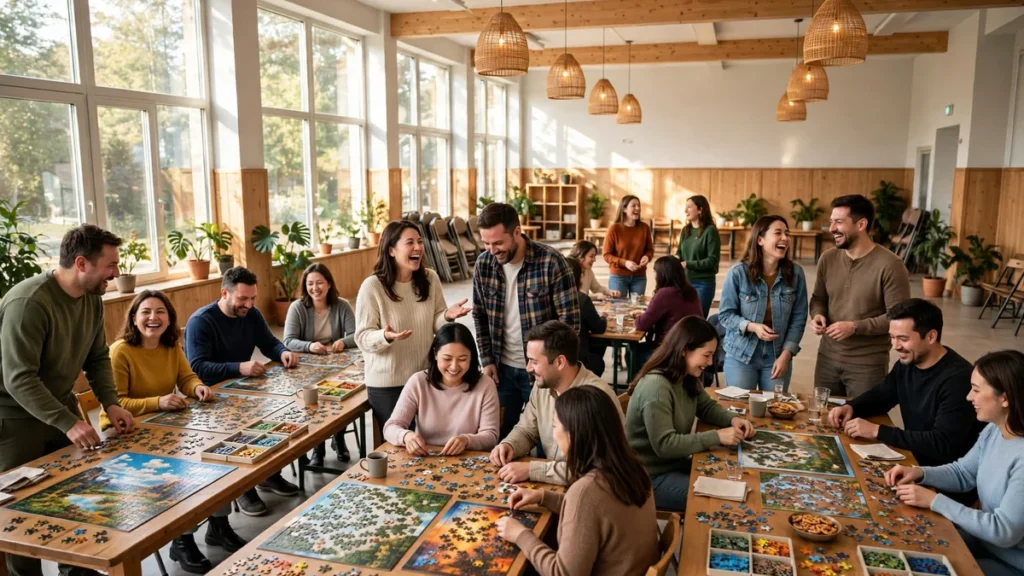
Finding the best party games for 106 players starts with an honest fact: no single party game seats 106 people at once. Every classic party game was designed for a living room, not a hall full of more than a hundred guests, A group of 106 can still have a brilliant game night, but only when the games are rebuilt around teams, multiple tables, tournament brackets, and whole-room formats that let everyone play at the same time.
The good news is that 106 is a wonderful number for a party. It is large enough for ten or twelve teams and a proper tournament, yet small enough for one host with a microphone to run. The games in this guide were chosen because they scale, and each one keeps waiting time short so nobody spends the evening watching other people have fun.
This guide covers the formats that make a 106-player party work, the ten best games for a crowd this size, a comparison table to help you choose, and a practical checklist for the night itself. Every game here includes all 106 players, stays fun for an hour, needs simple equipment, and runs without professional help.
Key takeaways
- No single party game seats 106 players, so the best party games for 106 players use teams, multiple tables, tournaments, or whole-room play.
- Split 106 guests into ten or twelve teams of nine to eleven players to keep every game fast, fair, and easy to score.
- Trivia, charades relays, scavenger hunts, bingo, and minute-to-win-it challenges scale best because they run in parallel across the room.
- One host with a microphone, a visible scoreboard, and a clear rotation plan matters more than any single game you choose.
- Plan ninety minutes of games, rotate teams between stations, and finish with one whole-room finale that brings all 106 players together.

Why 106 Players Changes Everything
A party of twelve and a party of 106 are different events, not bigger versions of the same event. With twelve people, one game and one table is enough. With 106 people, that same game leaves ninety-four guests standing around with nothing to do, The first decision is therefore how the crowd will be organised so everyone plays at the same time.
Space is the second change. A hundred and six players need room to move, sit, stand, and cheer without crowding each other. A hall with ten round tables of ten or eleven seats works far better than rows of chairs facing a stage, Leave clear walkways between tables and one open central area for relays and finals.
Time behaves differently at this scale too. Everything takes longer with 106 players: explaining rules, handing out answer sheets, collecting scores, and settling disputes. A ten-minute game for eight players can take thirty with a hundred, so choose games explainable in under two minutes. The best large-group games are the ones guests understand the moment they hear them.
Scoring also needs a rethink. With ten or twelve teams, a visible scoreboard becomes essential, whether it is a whiteboard, a projected slide, or a large sheet of paper on the wall. Update it after every round so teams can see where they stand, Keep scoring simple: one point per correct answer or completed challenge, plus a small bonus for the fastest team.
How to Run Party Games for 106 Players
The format matters more than the game. The same trivia round can be a triumph or a disaster depending on how the room is organised, so choose one of the four formats below before you choose your games. Most successful parties mix team play, stations, a tournament bracket, and one whole-room finale.
Split Into Teams
Teams are the foundation of every large party. Divide 106 guests into ten teams of ten or eleven, or twelve teams of eight or nine, and give each team a name, a table, and a captain. Captains collect answer sheets and settle small questions so the host does not have to. Mix ages, friendships, and confidence levels so no team dominates. The same instincts behind classic party games for adults still apply here, only the teams are bigger and the room is louder.
Run Multiple Tables
Multiple tables let many games happen at once. Set up four or five game stations around the room, each running a short game that takes ten to fifteen minutes, and rotate teams through them on a fixed schedule. Teams collect points at every station, and the rotation keeps the evening moving so no group waits long. This format works especially well when guests have different tastes, because everyone finds at least one station they love.
Use Tournament Brackets
Tournaments add drama to a big party. In a knockout bracket for fast games such as charades or quizzes, winners advance and the whole room gathers for the semi-finals and final. Keep early rounds short so losing teams are not sidelined for long, and give eliminated teams a side game or a consolation challenge so they stay involved. A tournament final in front of all 106 players is one of the most memorable moments a party can produce.
Play Whole-Room Games
Whole-room games are the only format where all 106 players genuinely play at the same moment. Bingo, trivia with individual answer sheets, human bingo, and music rounds all work this way, with one host leading from the front and every guest answering, guessing, or moving at the same time. They work as openers that settle a crowd and as finales that reunite teams. Keep whole-room rounds short and punchy, with a new question or task every minute.
The Best Party Games for 106 Players
The ten games below are ranked by how well they scale, how much fun they create, and how easy they are to run. Each one works for 106 players in at least one of the four formats above, and most work in two or three. The comparison table gives a quick overview, and the sections that follow explain how to run each game.
| Game | Best Format | Players at Once | Time Needed | Equipment |
|---|---|---|---|---|
| Team Trivia Tournament | Teams / whole room | All 106 | 45 minutes | Questions, answer sheets, pens |
| Charades Relay | Tournament | All 106 | 30 minutes | Prompt cards, timer |
| Giant Scavenger Hunt | Teams / stations | All 106 | 40 minutes | Clue lists, small props |
| Whole-Room Bingo | Whole room | All 106 | 25 minutes | Bingo cards, caller, prizes |
| Pictionary Relay | Tournament | All 106 | 30 minutes | Whiteboards, markers, prompts |
| Human Bingo Mixer | Whole room | All 106 | 20 minutes | Printed grids, pens |
| Word Chain Challenge | Teams / stations | All 106 | 25 minutes | Answer sheets, timer |
| Minute-to-Win-It Relay | Stations | All 106 | 35 minutes | Cups, balls, spoons, timers |
| Two Truths Tournament | Teams / whole room | All 106 | 25 minutes | Slips of paper, pens |
| Music Quiz Showdown | Whole room | All 106 | 30 minutes | Speaker, playlist, buzzers |
Team Trivia Tournament
Trivia is the most reliable large-group party game ever invented, and it is the natural centrepiece of a 106-player evening. Split the room into teams, hand each team one answer sheet per round, and read the questions aloud so everyone hears them at the same time. Five rounds of eight questions work well: general knowledge, music, food and drink, sport, and a final round about the guests of honour or the occasion itself. Test questions beforehand and aim for teams to answer roughly two thirds correctly.
Charades Relay
Charades becomes a spectator sport when 106 people are watching. Run it as a relay tournament: two teams face each other, one player acts out a prompt while their team guesses, and the fastest correct guess wins the point before the next player steps up. Prompts should be big and physical, such as films and animals, because subtle prompts die in a large room. Keep each turn to sixty seconds and let the audience cheer without shouting out answers. The final between the last two teams, played in the open centre of the room, is usually the loudest moment of the night.
Giant Scavenger Hunt
A scavenger hunt turns the whole venue into a game board. Give each team the same list of thirty items or tasks to find, photograph, or perform within the venue, and set a forty-minute limit. Items can be simple: something red, a team photo, or a paper aeroplane that flies five metres. Teams race together, which builds teamwork fast, and the photos make great prize-ceremony material. Set clear boundaries, and award bonus points for creativity rather than speed alone.
Whole-Room Bingo
Bingo is the simplest way to get all 106 players doing the same thing at the same time. Print a different card for every guest, call the numbers over the microphone, and let the room fill with the familiar rhythm of checking, groaning, and cheering. Themed bingo works better: picture bingo, music bingo with song clips instead of numbers, or custom bingo tied to the occasion. Offer small prizes for a line, a bigger prize for a full house, and keep the pace brisk, with a new call every fifteen seconds. Bingo is also the perfect filler game, ready whenever there is a gap in the schedule.
Pictionary Relay
Pictionary scales beautifully when it becomes a relay. Each team lines up beside a whiteboard or a large pad, the first player draws a prompt while their team guesses, and as soon as the answer is correct the marker passes to the next player. The team that completes the most prompts in ten minutes wins the round. Choose prompts that are easy to draw, such as a cat or a bicycle, and keep rounds short so reluctant artists are only in the spotlight for a minute. The drawings themselves become part of the entertainment, and photographing the best ones gives the party a ready-made set of funny memories.
Human Bingo Mixer
Human bingo is the best icebreaker for a crowd where many guests do not know each other. Each guest receives a grid of squares, and each square describes a person to find, such as someone who has travelled to three countries, someone who plays a musical instrument, or someone who has met a celebrity. Guests walk around, introduce themselves, and collect signatures, with prizes for the first row and a full house. It works best in the first twenty minutes, while energy is high.
Word Chain Challenge
Word games are made for teams, because a group of ten can always find an answer that one person would miss. In the word chain challenge, each team receives a starting word and must build the longest possible chain in five minutes, with each new word beginning with the last letter of the previous word. A second round asks teams to list as many words as they can in one category within three minutes. Rotate categories so different strengths shine. Fans of language games will find plenty more to enjoy in dedicated word games for adults, which offer the same team-friendly spirit in a smaller setting.
Minute-to-Win-It Relay
Minute-to-win-it games are sixty-second physical challenges using ordinary household objects, and they are perfect for stations at a 106-player party. Classic challenges include stacking cups, moving a biscuit from forehead to mouth without hands, and bouncing balls into cups. Set up five stations, give each team one minute per station, and award a point for every completed challenge. Test every challenge yourself first: one that looks easy can be impossible.
Two Truths Tournament
Two truths and a lie is a small game with a big heart, and it adapts well to a large crowd when it becomes a team tournament. Each team writes three statements about one of its members, two true and one false, and the opposing team must guess the lie. Teams take turns presenting, and the room votes on the answers before the truth is revealed. The statements work because they are personal: hidden talents and strange holidays always surprise the room. Collect statements in advance so the host can pick the funniest for the main stage. Keep presentations short, one minute per team.
Music Quiz Showdown
A music quiz is the loudest and most joyful finale a large party can have. Play short clips of well-known songs and ask teams to name the song, the artist, or the year it was released, with bonus points for singing the next line. Mix decades and genres so every generation has a moment to shine. If you want a broader view of how tabletop play handles the same scaling challenge, see our guide to board games for 106 players. End with a full-room singalong round, with points for enthusiasm as well as accuracy.
What You Need Before Game Night
A great 106-player party is built in the week before the event, not on the night itself. The checklist below covers the essentials: work through it in order, and tick each item off only when it is genuinely ready, not merely planned. Most large-party problems, from missing pens to a speaker that is too quiet, are easy to prevent and miserable to fix in front of a hundred guests.
- Venue and layout: confirm ten or twelve round tables, clear walkways, one open central area, and enough chairs for all 106 guests plus the host and helpers.
- Sound system: test a microphone and speakers loud enough for the whole room, with a spare microphone and fresh batteries on standby.
- Scoreboard: prepare a large visible scoreboard, team name cards, and a simple scoring sheet that helpers can update after every round.
- Game supplies: print answer sheets, bingo cards, human bingo grids, and prompt cards in advance, with at least ten percent spares of everything.
- Helpers: recruit four or five helpers, brief them on the schedule, and give each one a clear job, such as scoring, timekeeping, or running a station.
- Prizes: buy small prizes for round winners and one standout prize for the overall champions, plus a few fun prizes for the best team name and the best effort.
Frequently Asked Questions
Can one party game really seat 106 players?
No, and any guide that claims otherwise is misleading you. No single party game is designed for 106 people at one table, because the format simply does not exist. The honest answer is that 106 players enjoy party games through teams, multiple tables, tournaments, and whole-room formats.
How many teams should 106 players form?
Ten teams of ten or eleven players, or twelve teams of eight or nine, work best for most parties. Teams of ten are large enough to feel like a real crowd and small enough that every member can contribute. Teams much larger than twelve tend to leave quieter guests out of the conversation, while teams smaller than six create too many tables to manage. Give each team a captain, a name, and a home table.
How long should games run at a 106-player party?
Ninety minutes of structured games is the sweet spot for most parties, usually split into three thirty-minute blocks with short breaks between them. Shorter than an hour feels rushed and leaves guests wanting more, while longer than two hours causes energy to fade, especially late in the evening. Start with a whole-room icebreaker, move into team games and stations, and finish with a tournament final or music quiz.
What equipment do I need for 106 players?
Less than you might expect. The essentials are a microphone and speakers, printed answer sheets and game cards, pens, a visible scoreboard, a timer, and the small props for your chosen games, such as cups, balls, whiteboards, and prompt cards. Print at least ten percent more of everything than you need, because sheets get lost, pens run out, and cards get damaged. Test the sound system in the actual venue before guests arrive.
How do I keep all 106 players involved?
Rotate formats, keep rounds short, and never let one team wait more than a few minutes without something to do. Mix whole-room games, where everyone plays at once, with station games, where teams move and compete in parallel, and give eliminated tournament teams a side challenge so they stay in the action. A visible scoreboard helps too, because teams that can see the race stay invested even when they are not winning.
What prizes work best for a large party?
Small, fun prizes beat expensive ones. Gift cards, bottles, boxes of chocolates, and silly trophies all work well, and the best prize of all is often a simple champions trophy that the winning team can photograph and remember. Offer prizes for round winners as well as overall champions, and add a few light-hearted awards, such as best team name, best celebration, and best effort, so more teams go home with something.
The Bottom Line
The best party games for 106 players are not the games with the biggest boxes or the loudest advertising, but the games that respect the size of the crowd and turn it into an advantage. Split the room into teams, run games in parallel, and finish with one whole-room moment. They will feel like the best party you have ever hosted.