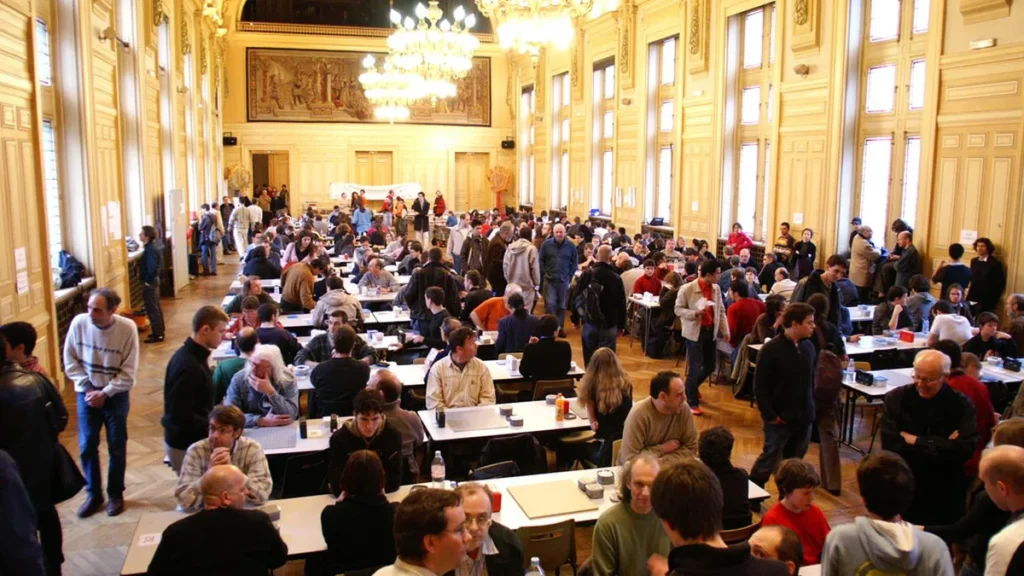
Dice games for 400 players sound impossible until you change the shape of the game. No single table holds 400 people, and no single roll can include everyone at once, so the trick is to stop thinking of one giant game and start thinking of one event built from many small games running at the same time. Dice games for 400 players work when tables, teams, and a shared clock carry the size, while the dice themselves stay simple, fast, and fair for every person in the room.
The games in this guide were chosen for three reasons. Each one uses ordinary six-sided dice or a small set of specialty dice, each round lasts only a few minutes, and each result is easy to record on a single score sheet. That combination matters at scale, because a game that needs ten minutes of explanation or a complicated score pad will stall when dozens of tables are waiting for the next round to start.
You do not need 400 dice sets or a stadium to make this work. A school hall, a community centre, a large office floor, or a park pavilion with enough tables will do, and most of the games below run well with one dice set shared by each table of five players. Read the scaling plan first, pick three or four games from the table, and build the evening around those choices.
Key takeaways
- 400 players means 80 tables of five, not one giant table.
- Short rounds and simple scoring keep dozens of tables moving together.
- Farkle, Pig, and Zombie Dice are the fastest games for huge groups.
- One shared score sheet per table prevents most disputes before they start.
- A short practice round before scoring begins is worth more than a long rule speech.

How Dice Games Scale to 400 Players
The number 400 is a range, not a table size. The games below work for groups of three players at a kitchen table and for 400 players in a hall, because the same rules run at every table and the event adds the structure around them. Split the crowd into 80 tables of five, add a handful of hosts who float between zones, and you have 400 people playing the same game at the same time without anyone waiting for a turn that never comes.
Stations turn that split into a schedule. Set up eight zones with about ten tables in each zone, give every zone a captain with a whistle and a timer, and run the same game at every table for a fixed round length. When the whistle sounds, teams record their scores, and the next game begins. Nobody needs to move tables between rounds, which saves the ten minutes of shuffling that ruins most large game nights. For a closer look at how the same format plays with a slightly smaller crowd, see these dice games for 397 players and how they handle fast opening rounds.
Tournaments add the finish. After three scored rounds, the top two teams from each zone move to a final round at eight tables, and the winners of those tables meet for one last game on a stage or a central table where everyone can watch. The other teams keep playing a friendly round at their own tables, so nobody sits out the ending. That structure gives 400 people a shared result and a clear winner while keeping every table busy from start to finish.
Keep the scoring honest and simple. One score sheet per table, one pen, and one rule card are enough. The zone captain collects the sheets at the end of each round and posts the running totals on a board where everyone can see them.
Dice Games for 400 Players at a Glance
Use this table to pick your games before the night begins. Fast games open the evening, longer games fill the middle, and a short game closes the night while the finals are set up.
| Game | Players per table | Round length | Best for |
|---|---|---|---|
| Farkle | 2 to 6 | 20 minutes | Risk and reward scoring |
| Pig | 2 to 6 | 10 minutes | Fast push-your-luck rounds |
| Zombie Dice | 2 to 8 | 15 minutes | Themed fun and quick turns |
| Cee-lo | 2 to 6 | 10 minutes | Quick betting-style showdowns |
| Balut | 2 to 5 | 20 minutes | Classic scoring and strategy |
| Chicago | 2 to 6 | 15 minutes | Simple rules for all ages |
| Beetle | 2 to 6 | 15 minutes | Drawing, luck, and laughs |
| Drop Dead | 2 to 6 | 10 minutes | Fast eliminations and tension |
| Going to Boston | 2 to 6 | 15 minutes | Counting, luck, and kids |
The Best Dice Games for Huge Groups
Each game below is described the way a zone captain would explain it: what you roll, how you score, and what changes when 80 tables are playing at once. Pick three or four and let the rest wait for the next event.
Farkle
Farkle is the best-known push-your-luck dice game, and it earns its place as the anchor of this list. Each player rolls six dice and scores for ones, fives, and runs of three or more of a kind. The player can bank the points or roll the remaining dice again for more, but if a roll scores nothing, the whole turn is lost. A full game to 10,000 points takes about twenty minutes, so it suits the middle of the evening when the room has settled and players want a game with real decisions.
At scale, Farkle works because every table plays the same scoring card. Give each table a printed scoring card, because the combinations are the one thing players forget under pressure. The scoring card also stops arguments: if it is not on the card, it does not count. Run Farkle as a team event: each table of five shares one score sheet, and players take turns rolling for the team.
Pig
Pig is the simplest push-your-luck game ever printed, and that simplicity makes it perfect for a huge crowd. A player rolls one die again and again, adding each result to a running total, and may stop at any time to bank the points. Roll a one, though, and the whole turn is lost. The first player to reach 100 points wins the table, and a round takes about ten minutes.
For 400 players, Pig is the ideal opener after the practice round. It needs only one die per table, it can be taught in thirty seconds, and every roll is a small drama that the whole table watches. Our guide to dice games for 396 players uses a similar fast opener to warm up a crowd of almost the same size, and the same trick works here.
Zombie Dice
Zombie Dice is the quickest themed game in this guide, and it is the best choice when the crowd includes children or players who want a story without complex rules. Players roll thirteen dice showing brains, shotguns, and footprints, then set aside one kind of die after each roll. Brains are points, shotguns are danger, and three shotguns end the turn with nothing banked. The first player to reach thirteen brains wins.
At a table of five or six, Zombie Dice works as a fast round between longer games, and it needs only one set of thirteen dice per table, which makes it easy to supply for 80 tables. Use it as the second game of the night, when teams are still learning the whistle and the score sheet, and the silly theme will loosen up the quietest tables in the room.
Cee-lo
Cee-lo is a fast showdown game that feels like a tiny casino without any money changing hands. Each player rolls three dice, and the best roll wins the round: a 4-5-6 is the top roll, triples beat pairs, and a pair with a higher single die beats a lower one. A round takes only a few minutes, and the whole game is over in about ten.
For a crowd of 400, Cee-lo works best as a short party round rather than a full game, and it fits the station schedule because every table finishes at nearly the same time. Play it with points instead of stakes, give each table three dice and a simple ranking card, and let the table winner collect a point for the team total.
Balut
Balut is the classic scoring game on this list, and it gives a large event a result that feels earned. Each player rolls five dice up to three times per turn, trying to fill boxes on a score sheet with straights, full houses, and five of a kind, with bonus points for a Balut, which is five of a kind in one category. A full game takes about twenty minutes, so it works best once the room has warmed up.
For 400 players, run Balut as a team event rather than a solo contest. Each team of five plays one shared score sheet, and players take turns rolling for the team, discussing each choice out loud. That shared sheet turns a quiet solo game into a team discussion, and it means one score sheet per table instead of five.

Chicago
Chicago is the simplest scoring game in this guide, and simple is a strength when 400 people need to learn the rules at once. Each player rolls two dice, and over eleven rounds the target total moves from two up to twelve. A player scores points only when the roll matches the target for that round, and the highest total after eleven rounds wins the table. There is no bidding, no bluffing, and no scoring card to memorise.
The game also makes a fair tiebreaker. When two teams finish a tournament round level on points, a single round of Chicago at the central table settles it in front of the whole room. A full game takes about fifteen minutes, which makes Chicago a calm middle round between louder games.
Beetle
Beetle is the drawing game on this list, and it is the one that makes tables laugh the loudest. Each player rolls one die and draws part of a beetle according to the number rolled: a six for the body, a five for the head, and the other numbers for legs, antennae, eyes, and a tail. A player must roll the body before drawing the head, and the first player to finish a whole beetle wins the table. A round takes about fifteen minutes.
At scale, Beetle works because it needs almost no equipment: one die, one pencil, and one sheet of paper per player. Give each table a printed beetle key so nobody has to remember which number draws which part. Beetle is the best game for tables with children, because the drawing keeps younger players busy even when the dice are unkind.
Drop Dead
Drop Dead is a fast elimination game where every roll can end a turn in a single moment. Each player rolls five dice and sets aside every five and two, which are dead, then rolls the rest again. The player keeps rolling until all five dice are dead, and the player with the fewest rolls wins the table. The game takes about ten minutes, needs no score sheet, and works for two to six players at a table.
For a crowd of 400, Drop Dead fits any spare table or quiet corner. Give each table a cup for the dice, because five dice rolling off a table is the one thing that slows this game down. Run it as a filler round while the finals are set up, and the short, tense turns will keep the room buzzing instead of drifting.
Going to Boston
Going to Boston is a counting game that children learn in minutes and adults enjoy far longer than they expect. Each player rolls three dice and keeps the highest die, then rolls the other two and keeps the highest of those, then rolls the last die alone. The three kept dice are added together, and the highest total after a set number of rounds wins the table. A full game takes about fifteen minutes.
The game works for a huge group because the turn structure is identical every time, so a zone captain can teach it to a whole zone in one short announcement. It needs only three dice per table, and the simple adding makes it a gentle choice for mixed-age tables.
Setting Up 400 Players Without Chaos
Setup decides whether the night feels smooth or crowded, and most of the work happens before anyone arrives. Lay out eight zones with about ten tables each, label every table with a number and a zone letter, and place one dice set, one score sheet, one pen, and one rule card on each table before the doors open. Zone captains should walk their zone before the first whistle, checking that every table is ready.
Dice sets are the main supply question. Farkle needs six dice per player, while Pig needs only one die per table, so the total depends on which games you choose. A practical kit for this guide is eighty sets of six dice for Farkle, eighty cups of five dice for the other games, and eighty sets of thirteen dice for Zombie Dice, plus spare dice at each zone captain station. Buy dice in bulk packs of matching colours per table, so a stray die can be returned to the right table at a glance. The same timed-round system works for a slightly smaller crowd, as shown in our guide to dice games for 395 players, where the whistle keeps dozens of tables in step.
Start with a practice round. Before any points are scored, run one short round of Pig at every table so players learn the rhythm of rolling, scoring, and shouting for the zone captain. A five-minute practice round is worth more than a twenty-minute speech, and it lets the captains spot the tables that need help before the real games begin. Keep every table on the same clock, with the zone captain blowing a whistle to start each round and again to end it, and record the scores in the two minutes between rounds.
Your 400-Player Dice Night Checklist
Run through this list the day before the event, and most problems will never reach the night itself.
- Count the tables, chairs, dice sets, score sheets, pens, and rule cards, and pack spares of each.
- Label every table with a number and a zone letter, and brief the eight zone captains on the whistle signals.
- Print one scoring card or beetle key per table for every game you plan to play.
- Run a five-minute practice round of Pig before any points are scored.
- Post the running totals on a board where every player can see them after each round.
- Keep the final round on a central table so the whole room can watch the finish.
Frequently Asked Questions
Can 400 people really play dice games at the same time?
Yes, when the crowd is split into 80 tables of five and every table plays the same game on the same clock. The games stay small, and the event structure carries the size. Nobody plays against all 400 people at once, and nobody waits for a turn that never comes.
Which game should open the night?
Pig is the best opener, because it can be taught in thirty seconds and needs only one die per table. A fast, simple first game teaches the room the whistle, the score sheet, and the rhythm of the night before any complicated scoring begins.
How many dice do we need for 400 players?
It depends on the games you choose. Pig needs one die per table, while Farkle needs six dice per player. A practical kit is eighty sets of six dice, eighty cups of five dice, and eighty sets of thirteen Zombie Dice, plus spare dice at every zone captain station.
What if some players have never played a dice game before?
Start with Pig, Chicago, or Going to Boston, which have almost no rules to learn. Keep a printed rule card on every table, run a practice round before scoring, and let the zone captains help the tables that need it. Simple games first is the whole secret.
How do you pick a winner from 400 players?
After three scored rounds, the top two teams from each zone move to a final round at eight tables, and the winners of those tables meet for one last game on a central table. The other teams keep playing a friendly round at their own tables, so nobody sits out the ending.
What is the best game for mixed-age tables?
Beetle and Going to Boston are the best choices for mixed-age tables. Beetle keeps children busy with drawing, and Going to Boston needs only simple adding. Both games are easy to teach, quick to play, and fun for adults as well as children.
The Bottom Line
Dice games for 400 players work when the games stay small and the event does the heavy lifting. Split the room into 80 tables of five, run short rounds on a shared clock, and pick three or four games from this guide that fit your crowd. Start with Pig, build the middle of the night around Farkle and Balut, and close with a final that everyone can watch. The dice will do the rest.