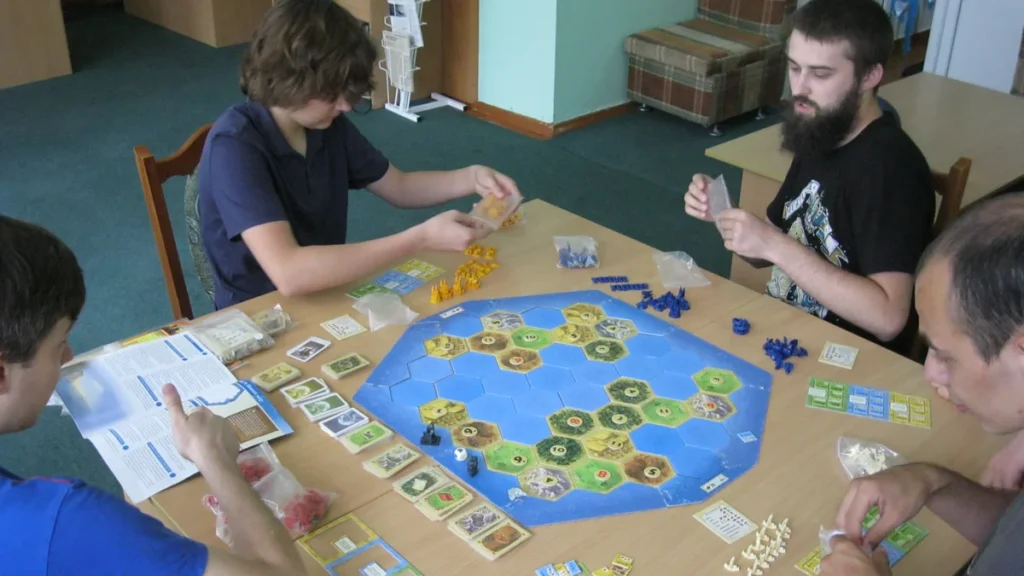
Four hundred and sixty players in one room sounds impossible until you see it done well. The secret is that nobody expects 460 people to sit around a single table. Instead, the night is split into tables of four to six, every table plays the same kind of game at the same time, and the whole hall shares one clock, one scoring sheet, and one finish line.
The games on this list were picked because they work in that festival format. Each one teaches in under ten minutes, plays in about an hour, and stays interesting when twenty or thirty copies are running side by side.
This guide walks through the whole plan: how to lay out the hall, how many copies and helpers you need, the nine games themselves with setup notes for each, a short checklist for the night, and answers to the questions every organiser asks first.
Key takeaways
- Split 460 players into tables of four to six, with every table playing at the same time on one shared clock.
- Pick games that teach in under ten minutes and finish in about an hour, so no table is left waiting.
- Plan on 92 tables, around 30 copies of each featured game, and one helper for every six to eight tables.
- Run the night in rounds, with a short break between rounds for scoring, snacks, and table changes.
- Keep score simple: points per table, added up per team, with one clear winner announced at the end.

How 460 Players Actually Play at Once
The first thing to accept is that 460 players never play one game together. They play many copies of a few good games together, and the shared experience comes from the schedule, the scoring, and the room itself.
The team format is the simplest. Divide the crowd into teams of four to six, give every team a table, and let each table play its own copy of the chosen game. Teams earn points from their table result, and the team with the most points across the night wins.
The station format suits a hall with distinct zones. Set up six to nine stations, one game per station, and rotate teams through them on a timer. Every team tries every game, and the variety keeps energy high. Our guide to board games for 458 players uses the same station idea for a crowd only two players smaller, and the table counts there transfer almost exactly.
The tournament format is for the final hour. Take the top scorers from the earlier rounds, seat them at feature tables in the middle of the hall, and let everyone else watch, cheer, and play relaxed games at the side tables.
The Numbers: Tables, Copies, and Helpers
Before you buy or borrow a single box, work out the numbers. The table below assumes tables of five, which is the sweet spot for most of the games on this list: small enough that everyone stays involved, large enough that the hall does not need a hundred tables.
| What you need | How many | Notes |
|---|---|---|
| Players | 460 | Split into teams of four to six |
| Tables (five per table) | 92 | Allow a spare table or two for late arrivals |
| Copies of each featured game | 25 to 30 | Enough for one per table in a single-game round |
| Helpers and rules teachers | 12 to 15 | About one helper for every six to eight tables |
| Rounds in the evening | 3 | About an hour per round, with breaks between |
| Minutes to teach each game | Under 10 | Teach once per table, then let play begin |
Copies are the biggest cost, so borrow aggressively. Ask local game shops, clubs, libraries, and regular players to lend boxes for the night, and label every box with its owner and table number. Give every helper a printed one-page rules summary and a coloured lanyard so players can spot them across a crowded hall.
The 9 Best Board Games for 460 Players
Every game below was chosen to be fresh for this series and to fit the festival format: quick to teach, fun at four to six players, and strong enough to carry a whole round on its own. Each entry explains how the game works for a huge group, how to set it up across many tables, and why it scales when so many copies run at once.
1. Barenpark
Barenpark is a tile-laying game about building the best bear park, and it is one of the friendliest heavy-feeling games you can put in front of a new player. Each player has their own park board and fills it with enclosures, paths, and animal houses, covering squares to unlock bigger tiles. The rules take about five minutes to explain, the pieces are chunky and satisfying to handle, and every turn is a small puzzle with a visible result.
For a huge group, Barenpark shines because every table runs the same quiet race at the same time. Set up one copy per table with the tile supply sorted into trays before the doors open, and put a printed scoring example at each table so players can add up their own parks without calling a helper. It scales cleanly: thirty tables of Barenpark feel exactly like one table, just louder and happier.
2. Isle of Cats
Isle of Cats is a polyomino puzzle in which players rescue cats and fit them into the rooms of a ship, drafting square tiles and placing them to fill gaps, group cat families, and complete room goals. The theme does the teaching for you: everyone understands at once that cats need to fit on the boat.
At scale, the drafting is the trick to manage. Each table drafts from its own deck, so there is no cross-table delay, and the simultaneous tile placement means nobody sits idle watching someone else think. Set up the cat tiles in colour-sorted piles and hand each table a small bag for the drafted tiles, which keeps the pieces from wandering between tables.
3. My City
My City is a competitive legacy-style game in which every player builds their own city, tile by tile, across a campaign of short chapters in sealed envelopes. Each chapter adds one small rule and one new scoring twist, so the game grows with the group instead of asking everyone to learn everything at once.
For 460 players, My City works best as a league rather than a one-night event. Run chapter one on the first night, hand each player a personal envelope with their city board, and bring the same group back for the next chapter. If you only have one night, play a single chapter as a standalone game and treat it as a taster. Setup is simple because every player has identical pieces, so helpers can lay out ninety identical sets in minutes.
4. Obsession
Obsession is a worker-placement game set in a Victorian manor, where players improve their estate, host guests, and build the reputation of their family. It is the heaviest game on this list, and it belongs at the tables where experienced players gather. The theme is strong, the choices are tight, and the game rewards planning two turns ahead. New players can still enjoy it, but give it to the tables that ask for something deeper.
Running Obsession at scale means protecting its pace. Seat it at no more than a third of your tables, staff those tables with your most confident helpers, and print the guest and improvement cards in a large-type reference sheet for each table. The game takes a little longer than the others on this list, so schedule it in the first round, when the room is freshest and nobody minds a slower start.

5. Architects of the West Kingdom
Architects of the West Kingdom is a fast worker-placement game about hiring apprentices, gathering resources, and building landmarks, with a capture mechanic that lets players arrest each other’s workers and send them to jail. The rules are simple, the turns are quick, and the jail gives every table something to laugh about. A full game takes under an hour at five players, and the board state is easy to read from across the table, which matters when helpers are scanning a hall of ninety tables.
For a huge group, Architects is one of the safest picks on this list. It teaches in five minutes, it never stalls, and the player interaction keeps tables lively without ever turning mean. Set up one copy per table with the workers sorted by colour in small cups, and remind helpers that the jail is the rule new players forget most. If you need one game you can trust at thirty tables at once, this is it.
6. Lost Ruins of Arnak
Lost Ruins of Arnak mixes deck-building with worker placement on an expedition theme: players send archaeologists to dig sites, gather artefacts, and climb the research track while a guardian watches the ruins. It looks heavier than it plays, because every card and site does exactly what it says, and the two currencies are easy to track. The sense of discovery carries the game, and the research track gives every player a visible goal from the first turn.
Across a hall of 460, Arnak works because it is a game of personal puzzles played side by side. Each table runs its own island, so there is no waiting for other tables, and the quiet concentration suits the middle round, when the room needs a calmer hour. Setup takes a little longer than the lighter games here, so bag each table’s site tiles and starting cards in advance and let helpers lay out the boards before players sit down.
7. Dune: Imperium
Dune: Imperium blends deck-building and worker placement on a desert planet, where players send agents to factions, gather spice, and fight for control of key spaces. It is the most dramatic game on this list, and it earns its place as a finale game: the conflict track, the shifting alliances, and the race for ten points keep every table tense until the last card. The theme helps teaching enormously, because even players who have never read the books understand spice, sand, and survival.
Save Dune: Imperium for the last round or the feature tables. It plays best with experienced players, so seed those tables with your strongest gamers and let the rest of the hall play lighter games alongside. One copy per feature table is enough, and a helper who knows the game should stay nearby for the first few turns. The lessons from board games for 456 players apply here too: the heaviest game belongs in the last round, when the room is warmed up.
8. Clank!
Clank! is a deck-building dungeon crawl in which players sneak into a dragon’s lair, grab treasure, and try to escape before the dragon wakes. Every noisy action adds cubes to the dragon bag, and when the dragon attacks, the cubes decide who gets hurt. The push-your-luck heart of the game is instantly clear: go deeper for better treasure, or run now and live.
For a huge group, Clank! is the energy game. Put it on the tables nearest the entrance, where new arrivals can hear the laughter, and let the dragon attacks become a shared joke across the room. Setup is quick because each table needs only one board, one deck, and a bag of cubes, and the game teaches in about five minutes. Run it in the middle round, when the room needs a lift.
9. Sagrada
Sagrada is a dice-drafting game in which players build a stained-glass window, placing coloured dice into a grid under placement rules about colour and number. The game is beautiful on the table, silent enough to concentrate on, and simple enough to teach in three minutes. Every round, players draft dice from a shared pool, so the whole table makes the same kind of decision at the same time, and the window each player builds is a small work of art by the end.
At scale, Sagrada is the quiet star of the night. It needs almost no table talk, so it works in the noisiest hall, and its short turns mean ninety tables can stay in step without a clock. Sort the dice by colour before the night and give each table a dice tray, because loose dice are the one thing that slows this game down. For a crowd that includes players of every age and experience, it is the most welcoming game here.
Your Setup Checklist for the Night
A big night is won in the week before it, not on the day. Work through this checklist in order, and check each item off as you finish it.
- Book a hall that fits 92 tables with walking space, and confirm the power, lighting, and toilet access in advance.
- Borrow or buy 25 to 30 copies of each featured game, label every box, and sort the pieces into trays before the doors open.
- Recruit 12 to 15 helpers, give each one a game to master, and print a one-page rules summary for every table.
- Print score sheets, team lists, and table numbers, and put a clock or timer where the whole room can see it.
- Plan three one-hour rounds with short breaks, plus snacks and water that players can reach without leaving the hall.
- Set up a visible final table and a simple prize for the winning team, then announce the winner before anyone packs up.
If you are short on helpers, borrow a format idea from the party games for 458 players guide, which shows how to run large-group stations with fewer staff by letting confident players teach their own tables.
Frequently Asked Questions
Can one board game really seat 460 players?
No single copy can, and that is the point. One game seats four to six players, so 460 players need about ninety copies running at once, all on the same schedule.
How many tables do 460 players need?
At five players per table, you need 92 tables, plus one or two spares for late arrivals and helpers. If your tables seat six, the count drops to about 77, and if they seat four, it rises to 115. Measure your hall first, then pick the table size that fits.
How many helpers do we really need?
Plan on 12 to 15 helpers, which is about one for every six to eight tables. Each helper should master one game and carry its one-page rules summary. A few extra helpers at the door and the score table make the start and the finish much smoother.
Which game should we start with?
Start with the easiest game on the list, such as Sagrada or Barenpark. An easy first round gets everyone playing fast, builds confidence, and gives helpers time to sort out seating problems before the heavier games appear. Save the dramatic games for the last round.
What if some tables finish much faster than others?
Keep a few quick filler games on a side table, and let early finishers play them while they wait. Short games such as Sagrada work well here.
How long does a night for 460 players take?
Plan on about four hours: three one-hour rounds, two short breaks, and time at the start for seating and teaching. Doors open half an hour before the first round, and the final and prize giving take about twenty minutes at the end.
The Bottom Line
Running board games for 460 players is a logistics job with a playful heart. Get the tables, the copies, and the helpers right, pick games that teach fast and play in an hour, and the crowd takes care of the rest. By the end of the night, 460 strangers will have shared ninety tables, nine games, and one story worth telling.