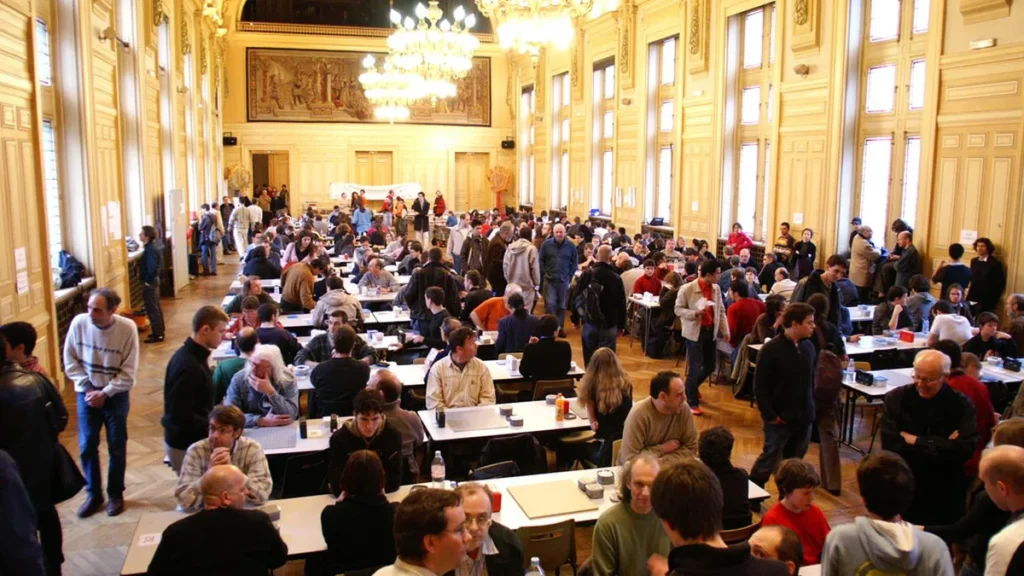
Best board games for 109 players is a search that sounds impossible at first, and for good reason: no single board game on the shelf seats 109 people around one table. The best board games for 109 players are therefore not one box but a plan — the right mix of team games, duplicate tables, tournament rounds, and whole-room formats that lets every single person play at the same time, instead of leaving most of the group watching.
That distinction matters more than any single game recommendation. A gathering of 109 people is a small conference, a whole school year group, or a very large family reunion. It needs a structure that scales, clear roles for everyone, and games that stay fun when the room is loud, the tables are full, and the clock is ticking. Pick the wrong format and half the room checks out within twenty minutes.
This guide solves the problem honestly. It explains the four formats that genuinely work for 109 players, compares the strongest games for each format, and gives you a practical running order for the night. Every game here was chosen because it scales through teams, copies, or whole-room play — not because its box claims a player count it cannot deliver.
Key takeaways
- No single board game seats 109 players, so plan for teams, multiple tables, or a whole-room format from the start.
- Split 109 players into teams of 5 to 10 and run the same game at every table for the fairest, simplest event.
- Whole-room games such as Codenames, Wavelength, and Two Rooms and a Boom keep everyone involved without buying dozens of copies.
- Run short rounds of 20 to 30 minutes, rotate tables between rounds, and keep score on one visible leaderboard.
- Test the sound, the scoring, and the team sizes with a small group before the big night.

Why 109 Players Changes Everything
Most board games are designed for two to six players. That range is no accident: it fits one table, one board, and one conversation. Once the group grows past ten, the basic maths of board gaming breaks down. Turns take too long, pieces run out, and quiet players disappear from the game entirely. At 109 players, those problems do not just grow — they change the kind of event you are running.
A group of this size needs movement, noise, and clear structure. People should be able to talk, laugh, and compete without waiting ten minutes for their turn. The games that work best are the ones with short turns, simultaneous play, or team-based decisions. If everyone acts at once, or if a team decides together, nobody is left sitting idle while the game happens somewhere else.
Space matters just as much as the game itself. You need enough tables for the format you choose, room to walk between them, and a central point where scores and announcements can be seen and heard. Decide the room layout before you decide the final game list, because the layout limits what is possible.
The Honest Truth About Board Games for 109 Players
Any article that promises a single game for 109 players is misleading you. The largest party games on the market top out at around twenty players, and even those need a confident host and a very patient group. Beyond that point, the only honest answer is to split the group, run the game in parallel, or switch to a format built for crowds.
That is not bad news. Splitting 109 players into teams is often more fun than squeezing them around one board would ever be. Teams create instant rivalries, give shy players a small group to talk to, and let the whole room share one leaderboard.
The other honest point is about copies. If you want every table playing the same game at the same time, you need one copy per table. Fifteen tables means fifteen copies of the same game, or a mix of games that share the same round length and scoring system. Borrowing from friends, hiring from a local games cafe, or choosing a game with a print-and-play version can all keep the cost down.
Four Formats That Actually Work for 109 Players
Every successful large-group game night uses one of four formats, and most use a mix of two or more across the evening. Choose the format first, then pick games that fit it. Choosing games first and hoping the format sorts itself out is how large events fall apart.
Multiple Tables, Same Game
This is the simplest format and the best starting point. Divide 109 players into teams of five to eight, seat one team per table, and give every table the same game. Everyone plays the same rounds at the same time, scores are collected after each round, and a central leaderboard shows which table is winning. With teams of six, you need about eighteen tables; with teams of eight, about fourteen.
The strength of this format is fairness. Every team faces the same questions, the same board, and the same time limit, so the final scores mean something. It also makes hosting easy: one set of rules, one timer, and one scoring sheet repeated across the room. Games with short rounds and simple scoring, such as Codenames, Wits and Wagers, and Telestrations, suit this format perfectly.
Team Tournament With Rotation
In a tournament format, teams rotate between different games at different tables. Each table hosts a different game, teams play for twenty to thirty minutes, and then a bell signals everyone to move to the next table. After four or five rotations, every team has played every game, and the total score decides the winner.
Rotation keeps the evening fresh and solves the copy problem, because each game only needs one or two copies. It also lets you include games that would not work for the whole room at once, such as a strategy game for six players or a word game that suits a small table. The trade-off is organisation: you need a clear rotation chart, a host who keeps time strictly, and helpers at each table to explain the rules quickly.
Whole-Room Games
Whole-room games put all 109 players into a single shared game, usually with two large teams or with everyone playing individually against the room. The host runs the game from the front, questions or prompts appear on a screen, and teams answer together. There is no need for dozens of copies, and the shared experience creates a real sense of occasion.
Games that suit this format include large-scale versions of Codenames and Wavelength, quiz-style games with team answer sheets, and social deduction games such as Two Rooms and a Boom, which is designed for very large groups. The key is a game where a team can discuss an answer together and submit one decision, so 109 voices become fourteen team answers instead of 109 separate shouts.
Relay and Festival Style
A relay or festival format turns the event into a series of short stations. Each station hosts a quick game or challenge that takes five to ten minutes: a word puzzle, a dexterity challenge, a memory game, or a fast card round. Teams move around the stations, collect points at each one, and the team with the most points at the end wins.
Festival style needs the most preparation, because each station needs its own materials, instructions, and scorer. Keep each station simple, use the same scoring scale everywhere, and give teams a scorecard to carry around. For word-based stations, the best word games for adults offer plenty of quick challenges that fit a five-minute station without needing a full board.
Best Board Games for 109 Players Compared
The table below compares the strongest choices for a 109-player event. The player count shown is the practical size per table or per team, not a claim that one copy seats 109 people. Use the format column to match each game to the structure you have chosen.
| Game | Per Table | Best Format | Round Length | Why It Scales |
|---|---|---|---|---|
| Codenames | 4 to 8 | Multiple tables | 15 to 20 minutes | Team wordplay, one-word clues, easy scoring |
| Wavelength | 2 to 12 | Whole room | 20 to 30 minutes | Teams debate one shared target together |
| Telestrations | 4 to 8 | Multiple tables | 20 minutes | Simultaneous drawing, no waiting for turns |
| Two Rooms and a Boom | 6 to 30 | Whole room | 15 to 20 minutes | Designed for very large groups |
| Wits and Wagers | 3 to 7 | Multiple tables | 20 to 25 minutes | Everyone answers every question at once |
The Best Picks in Detail
The games below are the strongest choices for a 109-player night, grouped by what they do best. Each one earns its place because it handles teams well, teaches quickly, and stays fun when the room is full and the energy is high.
Codenames
Codenames is the single best starting point for a 109-player event. Two teams compete to find their secret words on a grid, guided by one-word clues from their spymaster. At each table, a team of four to eight plays a complete game in fifteen to twenty minutes, and the rules take about two minutes to explain.
For a large event, run Codenames at every table at once. Give each table the same word grid or a different grid with the same difficulty, set a timer, and collect the scores after each round. Teams that finish early can play a second round while slower tables catch up. The game rewards clever thinking and teamwork rather than speed, so mixed-age and mixed-ability teams all have a fair chance.
Wavelength
Wavelength asks teams to place a hidden target on a scale between two opposites, such as hot and cold, or quiet and loud. One player gives a clue, the team debates, and the group agrees on a position. It is a conversation game, and conversation is exactly what a large group needs.
With 109 players, Wavelength works best as a whole-room game. Project the scale, let each team discuss the clue for one minute, and collect team answers on cards or a shared form. The debate is the entertainment: teams argue, laugh, and change their minds, and the reveal always produces a reaction.
Telestrations
Telestrations mixes drawing and guessing in a chain: each player draws a word, passes the book, and the next player guesses what the drawing shows. Everyone draws at the same time, so there is no waiting, and the results are almost always funny. That combination makes it ideal for a multi-table event.
At each table, four to eight players complete a full chain in about twenty minutes. The game needs no reading skill beyond the word cards, so it suits mixed groups and families with older children. Scoring is simple: points for correct guesses at the end of each chain, or no scoring at all if the group prefers to play for laughs.
Two Rooms and a Boom
Two Rooms and a Boom is the rare game designed for very large groups, with rules that support six to thirty players in a single game. Players are split between two rooms, each with a secret role, and they must find their teammates and complete their mission before time runs out. It is fast, loud, and full of bluffing.
For 109 players, run several parallel games of Two Rooms and a Boom in separate spaces, or run it as a headline whole-room event with teams of fifteen to twenty. Either way, it delivers something most board games cannot: a genuine large-group social deduction game where everyone has a role and a reason to talk to strangers.
Wits and Wagers
Wits and Wagers turns trivia into a betting game. Every team writes down an answer to a numerical question, then bets on which answer is closest to the truth. Everyone answers every question, so nobody sits out, and the betting adds a layer of strategy that pure trivia lacks.
The game suits the multiple-table format perfectly. Each table plays the same set of questions, bets with chips, and records its score after each round. Seven questions make a satisfying game in about twenty-five minutes, and you can prepare your own question set if you want the content to match the group.
Escape Room Energy Without the Small Room
Many large groups want the tension and teamwork of an escape room but cannot fit 109 people into a puzzle room. Board games can deliver the same feeling at scale: a shared goal, a ticking clock, and a puzzle that only teamwork can solve. The trick is to choose games where the whole team works on one problem at the same time.
If the group enjoys that style, the best escape room board games are a natural next step for smaller follow-up nights, when the same group meets in teams of four to six and can play the full escape-room style games properly. For the 109-player night itself, keep the escape-room flavour in short, timed rounds rather than a single long puzzle.
How to Run a 109-Player Game Night
A good plan matters more than a good game list. The running order below has been shaped for a group of 109 players across two and a half hours, and it balances energy, variety, and practical hosting.
Start with arrival and team formation. Give every player a coloured wristband or name sticker showing their team as they arrive, and seat teams together. This takes ten minutes and saves twenty minutes of confusion later. Put the team list and the table plan on a board near the door so nobody has to ask where to sit.
Open with a whole-room game such as Wavelength. One game, one host, and ten rounds will warm the room up, teach everyone how team answers work, and give the host a chance to test the microphone and the screen. Follow it with two rounds of a multi-table game such as Codenames, with a short break between rounds for scores and refreshments.
Keep the scoring visible throughout. A simple leaderboard on a whiteboard or a projected sheet, updated after each round, turns a series of games into a real competition. Teams that can see the scores try harder, and the final round matters more when the top three teams are close.
Checklist for Your 109-Player Game Night
- Confirm the venue holds at least fourteen tables with space to walk between them, plus a central area for announcements.
- Divide 109 players into teams of five to eight in advance and print the team lists and table plan.
- Count the copies: one per table for multi-table games, plus two spares for damaged or missing pieces.
- Test the microphone, projector, timer, and leaderboard in the actual room before the event starts.
- Prepare printed rules summaries, score sheets, and answer cards for every table.
- Plan the running order with breaks, and appoint one host and at least three helpers for scoring and rotation.
Frequently Asked Questions
Can one board game really seat 109 players?
No. No published board game seats 109 players around a single table, and any claim that one does should be treated with suspicion. The honest solution is to split 109 players into teams, run the same game at multiple tables, or use a whole-room format where teams answer together. Every recommendation in this guide follows that approach.
How many tables do I need for 109 players?
It depends on team size. Teams of six need about eighteen tables, teams of eight need about fourteen, and teams of ten need about eleven. Smaller teams are friendlier and give everyone more to do, but they need more tables and more copies of the game. Teams of six to eight are the best balance for most events.
What is the best game to start with?
Codenames is the safest opener because the rules take two minutes to teach, every team plays at once, and the game rewards teamwork rather than specialist knowledge. Wavelength is the best whole-room opener if you want one shared game to warm the room up before splitting into tables.
How long should a 109-player game night last?
Two to three hours works well, including arrival, introductions, breaks, and a final round. Four to six short games fit comfortably in that time. Longer events risk tired players and empty tables, so it is better to finish with energy high and the room wanting more than to drag on until people leave early.
Do I need to buy a copy of the game for every table?
For a multiple-table format, yes, one copy per table is needed. For a rotation format, you need one copy of each game, because teams move between tables. For a whole-room format, one copy is enough. Borrowing from friends, hiring from a games cafe, or choosing print-and-play games can keep the cost manageable.
What should I do after the big night?
Keep the teams together for a smaller follow-up night. The same group will enjoy the games that need a smaller table, and the rivalries from the big night will carry over. For a quieter wind-down evening, the best puzzle apps for adults give the group something to play at home between meetups, and they are an easy way to keep the habit going.
The Bottom Line
The best board games for 109 players are the ones that respect the size of the group instead of pretending it does not matter. Split the room into teams, choose games with short turns and simple rules, keep the scores visible, and let the format do the heavy work. Codenames at every table, Wavelength for the whole room, and a rotation of fast team games will give 109 players a night where everyone plays, everyone competes, and nobody is left watching from the side.