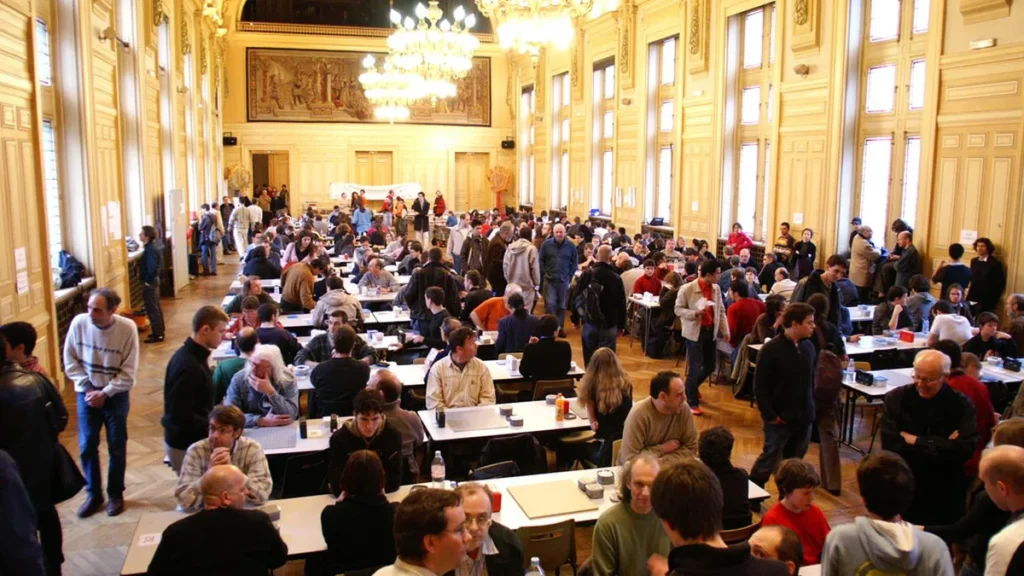
The best board games for 362 players are not games that seat three hundred and sixty-two people around a single table. No board is that big, and no single game can keep that many people involved at once. Instead, the best board games for 362 players are formats that split a huge crowd into small teams, run the same game at dozens of tables at the same time, and bring everyone back together on one shared scoreboard. When the format is planned well, a group of 362 feels like a festival rather than a queue.
A gathering of this size is usually a school games day, a company social, a community festival, a wedding weekend, or a large club meet-up. The challenge is not finding a fun game. The challenge is scale. A game that works beautifully for six people can fall apart for sixty, let alone three hundred and sixty-two. Pieces go missing, turns take too long, and the loudest table finishes while the others are still on round one. The answer is to choose games that split cleanly into teams of five or six, teach in under five minutes, and finish in a fixed time so every table starts and ends together.
This guide covers the 3-to-362 player range, ranks ten board game formats that work for 362 players, and explains how to set up the tables, teams, and scoring for an event of about two hours. Every pick below can be played in parallel across many tables, uses simple rules that new players can learn on the spot, and keeps the energy high from the first round to the final.
Key takeaways
- No single board game seats 362 people; the winning format is many small tables playing at the same time, linked by teams and one shared scoreboard.
- Teams of five or six work best, giving 362 players about sixty tables that all start and finish each round together.
- Pick games that teach in under five minutes and finish in thirty to forty-five minutes, so no table is left waiting.
- Run the event as stations or a tournament, with teams rotating between games and points carrying forward to a final.
- One host per zone, a visible scoreboard, and a fixed schedule matter more than any single game.

How Board Games Work for 362 Players
Think of 362 players as sixty small game nights happening in the same room. Each table seats five or six players, which is the sweet spot for most modern board games. Sixty tables of six gives you 360 players, with two extra players joining as floaters, scorekeepers, or substitutes. Nobody sits so far from the board that they cannot see the pieces.
The second idea is a shared clock. Every table plays the same round at the same time, for the same length of time. A host calls the start, a timer runs on a screen everyone can see, and a host calls the end. Tables that run long are stopped fairly, with points counted as they stand. This single rule is what turns sixty separate games into one event.
The third idea is a shared scoreboard. Each table reports one result per round: the winning team, the top score, or the points each team earned. Those results feed a leaderboard everyone can follow. The final round brings the top teams together for a showdown the whole room can watch.
The Three Scaling Methods
Teams are the simplest method. Split 362 players into teams of five or six, give each team a table, and let the team decide its moves together. Team play suits word, guessing, and strategy games, because discussion is part of the fun.
Stations are the most flexible method. Set up zones for different games, and let teams rotate from station to station every thirty minutes. A team might play Codenames at one station, Azul at the next, and Telestrations at the third. Stations keep the event moving and mean you need fewer copies of each game.
Tournaments are the most competitive method. Every table plays the same game in round one, the winners advance, and the field narrows until a final table decides the champion. Tournaments suit games with clear winners, such as Ticket to Ride, Catan, and Monopoly, and they give the event a final the whole room gathers to watch. The best board games for 360 players use the same three methods, and the lessons from those events apply directly here.
The 10 Best Board Games for 362 Players
The ten games below were chosen for three reasons: they teach in minutes, they play well in teams, and they finish on a fixed clock. Each one works at a single table of five or six, and each one scales to sixty tables without losing what makes it fun.
1. Codenames
Codenames is the best team board game for a crowd of this size, and it is the first game to plan around. Two teams sit at a table, each with a spymaster who gives one-word clues that link several words on a five-by-five grid. Teammates discuss each clue together, so all five or six players at the table are involved in every guess. A round takes about fifteen minutes, which means a station can run two full rounds in a half-hour slot. The words change every game, and winning teams can advance to face new opponents. Run it first, because it gets strangers talking within minutes.
2. Ticket to Ride
Ticket to Ride is a calm, friendly route-building game that suits a tournament format. Each player collects coloured train cards and claims routes between cities on a map, aiming to complete destination tickets for bonus points. A table of four or five finishes in about forty-five minutes, and the rules take less than five minutes to explain. For 362 players, run it as a bracket tournament: every table plays one game, the top two players from each table advance, and the field narrows through semi-finals to a final table.
3. Catan
Catan is the classic trading and building game, and it thrives in a team format. Players collect wood, brick, sheep, wheat, and ore, trade with each other, and build settlements, cities, and roads to reach ten victory points. At a team table the trading becomes loud, funny, and memorable. Plan team play with pairs sharing each seat to fit five or six people per table. Run it as a station with a fixed forty-five-minute clock, awarding points for settlements and cities built when the timer ends.
4. Scrabble
Scrabble is the most familiar board game on this list, which is exactly why it works for a mixed crowd. Almost everyone has played it, the rules need no explanation, and a team table can include a strong speller, a careful planner, and a beginner without anyone feeling left out. In team Scrabble, each side discusses its word together, so the game becomes a group puzzle. For 362 players, run it as a team competition: sixty tables each host a head-to-head match between two teams of three, with a fixed forty-minute clock, and the higher score wins. If your crowd enjoys word play, the best card games for 360 players make a useful companion event on the same day.
5. Monopoly
Monopoly is famous for long games, but with a fixed clock and a tournament format it becomes one of the most exciting games for a big event. Cap every game at sixty minutes and score by cash plus property value when the timer ends, rather than playing until one player owns everything. Run it as a knockout tournament: the richest player at each table advances, and the winners meet again in later rounds until a champion is crowned.
6. Azul
Azul is a quiet, beautiful tile-drafting game that balances a loud event perfectly. Players take coloured tiles from shared factory displays and place them in patterns on their own boards, scoring for complete rows and columns. It seats two to four players, takes about thirty to forty-five minutes, and the rules can be taught in three minutes, which makes it one of the easiest games on this list to run at scale. For 362 players, Azul is best as a station in a rotation.
7. Telestrations
Telestrations is the drawing game that turns a big room into a laughing crowd. Each player draws a word, passes the sketchbook on, and the next player guesses what the drawing shows, with the results getting funnier with every pass. A table of six to eight finishes a round in about twenty minutes, and the game needs no drawing skill, which is precisely why everyone enjoys it. Telestrations scales to 362 players with almost no effort. The reveal at the end of each round is a shared moment the whole table enjoys together. It is the best choice on this list when your crowd includes children, grandparents, and people who have never played a board game before.
8. Wavelength
Wavelength is a team guessing game built around a single dial. One player gives a clue that places a hidden target somewhere on a scale between two opposites, such as hot and cold, and the team debates where the target sits before locking in an answer. The discussion is the game. For a 362-player event, Wavelength is an ideal team game because it seats up to twelve players per copy, more than any other game on this list, If your group likes guessing and debate, the best party games for 360 players offer more games in the same spirit for a second day of play.
9. Chess
Chess is the oldest game on this list, and team chess is one of the best formats for a huge event. In team chess, each side of five or six players discusses every move together before playing it, which turns a quiet two-player game into a lively group challenge. Beginners contribute ideas, experienced players explain their thinking, and nobody has to face a stronger opponent alone. For 362 players, run chess as a team league: sixty tables each host one team match with a fixed thirty-minute clock, and points go to the winning team, with draws splitting the points. You need only one chess set per table, the cheapest setup on this list.
10. Dixit
Dixit is a storytelling and picture-guessing game that works wonderfully for a mixed crowd. Each player holds a hand of illustrated cards, and on their turn they describe one card with a word, a phrase, or a sound. The other players choose the card from their own hands that best matches the clue, and everyone guesses which card was the original. A table of three to six finishes in about thirty minutes. Dixit is gentle, creative, and easy to learn, and it works well as a closing station when the energy of the day is winding down.
Best Board Games for 362 Players at a Glance
| Game | Players per table | Teach time | Round length | Best format |
|---|---|---|---|---|
| Codenames | 4 to 8 | 3 minutes | 15 minutes | Teams |
| Ticket to Ride | 2 to 5 | 5 minutes | 45 minutes | Tournament |
| Catan | 3 to 4 | 5 minutes | 45 minutes | Teams |
| Scrabble | 2 to 4 | 1 minute | 40 minutes | Teams |
| Monopoly | 2 to 6 | 5 minutes | 60 minutes | Tournament |
| Azul | 2 to 4 | 3 minutes | 30 to 45 minutes | Stations |
| Telestrations | 4 to 8 | 2 minutes | 20 minutes | Stations |
| Wavelength | 2 to 12 | 3 minutes | 20 to 30 minutes | Teams |
| Chess | 2, or teams of 6 | 1 minute | 30 minutes | Team league |
| Dixit | 3 to 6 | 3 minutes | 30 minutes | Stations |
How to Set Up the Room for 362 Players
Start with the tables. Sixty tables of six players cover 360 people, with two players acting as floaters who fill empty seats, keep score, or step in when someone needs a break. Round or rectangular tables both work if the board sits in the middle. Leave about a metre of space between tables so hosts can walk the room, hand out score sheets, and answer questions without squeezing past chairs.
Next, count your copies. A station rotation needs far fewer copies than a single-game tournament, because only some tables play each title at once. If ten tables play Codenames in a given slot, you need ten copies of Codenames, not sixty. Borrow copies from a games cafe, a school library, or a local board game club, and label every box with its station number so nothing wanders off.
Divide the room into zones of ten to twelve tables, and put one host in charge of each zone. The zone host starts the clock, collects the score sheets, and settles rules questions for their tables. A central host runs the whole event from a stage or a raised table, calls the rounds over a speaker, and updates the scoreboard. Put the scoreboard where everyone can see it, and update it after every round.
Scoring and Tournament Format That Keeps Everyone Playing
The scoring system should reward playing well without punishing teams that lose early. The simplest system gives every table result a fixed set of points: three points for a table win, one point for a draw, and zero for a loss. Teams carry their points forward through the day, so a team that loses its first game can still climb the leaderboard with strong later rounds.
For tournament games such as Ticket to Ride and Monopoly, use a points-per-place system instead. The winner of a table takes five points, second place takes three, third takes two, and everyone else takes one point for finishing. The top scorers advance to the next round, while the other players move to a consolation station where they keep playing for fun and for smaller prizes. Nobody sits out after one loss: this is a social day first and a competition second.
Checklist: Running Your 362-Player Board Game Event
- Split 362 players into teams of five or six, and prepare a printed team list with table numbers before anyone arrives.
- Choose games that teach in under five minutes and finish in thirty to forty-five minutes.
- Set up sixty tables in zones of ten to twelve, with one host per zone and a central host running the clock.
- Label every game box with its station number, keep spare copies at the host desk, and count the pieces before and after the event.
- Use one shared scoreboard that everyone can see, and update it after every round so teams can follow the contest.
- Plan a visible final round on a central stage, with small prizes for the winners and the funniest team.
Frequently Asked Questions
Can one board game really work for 362 players?
Yes, but not at a single table. The format is sixty small tables playing at the same time, linked by teams, a shared clock, and one scoreboard. The event format is what scales it to 362 players.
How many tables do you need for 362 players?
Sixty tables of six players cover 360 people, with two extra players acting as floaters or scorekeepers. If your tables seat five, you will need seventy-three tables, so six-player tables are the more practical choice for a group this size.
How long does a 362-player board game event take?
About two hours fits four thirty-minute rounds with short breaks, or three forty-five-minute rounds with a longer break. Add thirty minutes for seating and rules, and fifteen for the final and prizes, for about two hours and forty-five minutes in total.
What if some players have never played a board game before?
Choose games that teach in under five minutes, seat beginners with experienced players in teams, and start with the simplest games on this list, such as Telestrations, Wavelength, and Scrabble. Team play means nobody has to learn alone.
How many copies of each game do you need?
It depends on the format. A station rotation needs one copy per table playing that game in a given slot, usually ten to twelve copies per title. A single-game tournament needs one copy per table in round one, which is sixty copies.
What is the best game to start a 362-player event with?
Codenames is the best opener, because it takes three minutes to teach, gets strangers talking within minutes, and finishes in fifteen minutes. A fast, funny first round sets the tone for the whole event.
Bottom Line
The best board games for 362 players are the ones that work brilliantly at a table of six and scale cleanly to sixty tables. Codenames opens the day, Ticket to Ride and Monopoly give the event its tournament drama, Catan and Scrabble reward steady teamwork, and Telestrations, Wavelength, and Dixit keep the room laughing. With teams of five or six, a shared clock, and a host in every zone, 362 players stop being a crowd and start being a festival. Pick your games, print your team list, set your timer, and let the tables do the rest.