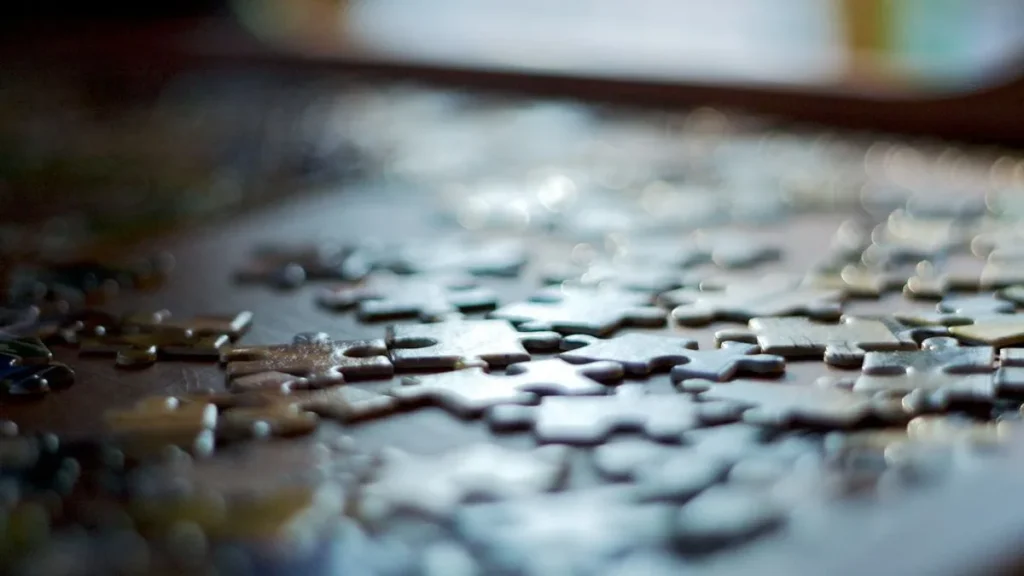
Our dining table has spent the last three weeks wearing a half-finished jigsaw. It is a thousand pieces of a harbour at dusk, all boats and lamplight, and it has taken over the middle of the table the way a guest takes over the middle of a sofa: completely, and without apology. We eat around it now, plates balanced on the corners. Nobody planned this. Nobody announced a new hobby. It just happened, the way small shared habits happen, and it has quietly become the best part of our evenings.
So when someone asks me whether jigsaw puzzles are good for couples, I do not reach for brain-training claims or the copy on the box. I think of that table, and of the two of us standing on opposite sides of it, not talking much, not needing to, and I say yes. A quiet yes, with conditions, because a jigsaw is not a cure for anything and it will not rescue a relationship that is already running on empty. But for two people who already like each other and want an evening that belongs to both of them, a jigsaw is one of the most generous things you can put between you.

The verdict, before the reasoning
Here it is, up front: jigsaw puzzles suit most couples well, provided both people actually want to be there and the puzzle fits the pair rather than one of them. A five-hundred-piece picture with clear regions is a fine first try. A thousand-piece wash of identical sky, bought to impress nobody, is a fast route to a sulk. The difference between a lovely evening and a silent standoff is almost never the puzzle itself. It is the size, the picture, and whether either of you secretly thinks the other one is doing it wrong.
That last part matters more than the brochures admit. A jigsaw is a shared project with no scoreboard and no winner, which sounds gentle until you discover that your partner sorts by colour and you sort by shape, or that they guard the border like a border guard while you happily start in the middle. A jigsaw hands a couple a small, low-stakes problem to solve together, and the way you solve it tells you things about each other that a decade of dinner conversation never quite surfaces.
A third thing in the room
The first thing a jigsaw does for a couple is give the evening a centre. Without it, our post-dinner hours used to dissolve into parallel scrolling: two people on the same sofa, in the same room, living in two different feeds. A puzzle on the table pulls the room back together. It is a third thing in the room, something neither of you owns and both of you are building, and it gives your hands somewhere to go that is not a phone.
Talking sideways
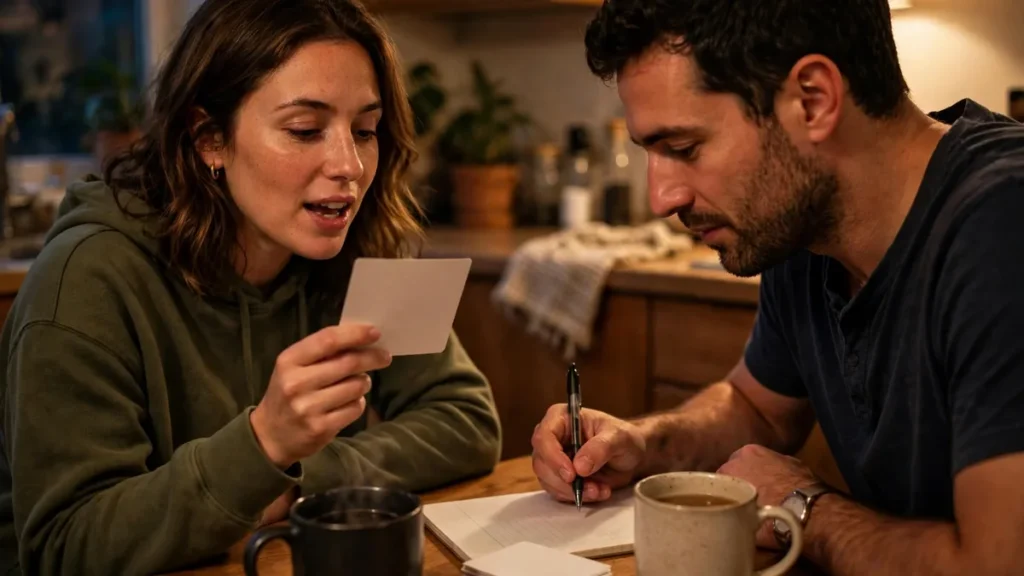
Here is the part I did not expect, and the part I would now defend most fiercely: a jigsaw makes conversation easier, not harder. Couples are often told to talk more, face to face, properly, as if a relationship were a meeting with an agenda. But sitting across a table staring at each other while you hunt for the right words is, for most of us, a terrible way to talk. A puzzle solves that problem by giving your hands something to do and your eyes somewhere to rest.
Some of the best conversations my partner and I have had in months happened while we were both looking down at pieces instead of at each other. None of it was planned. It just surfaced, the way things surface when the pressure is off and there is no silence to fill, because the puzzle is already filling it. You can go quiet for a stretch without it meaning anything. You can say something real while hunting for a piece of blue sky, and somehow the real stuff comes out easier when you are not performing it.
Plenty of couple activities demand attention in a way that blocks talking: a film wants your eyes, a game with turns wants your concentration at exactly the wrong moment, a walk demands you keep pace and keep up. A jigsaw asks for just enough attention to keep your hands busy and not so much that your mind cannot wander.
The table that stays out
A jigsaw has one practical quality that no other couples pastime can match: it stays. A board game gets packed away. A film ends. A walk finishes at the front door. A puzzle, once started, lives on the table for days, and that changes the texture of a home. It becomes a standing invitation. You pass it on the way to the kettle and fit a piece.
I will admit the other side of this, because honesty is the price of a verdict: a puzzle that stays out also stays in the way. We have eaten dinner with plates perched on the corners of a harbour scene, and I have bumped the table and watched a whole afternoon of careful work scatter. If your home has one small table and no spare surface, a jigsaw is a bigger commitment than it looks. A puzzle mat or a spare board helps, and so does choosing a puzzle that fits the table you actually own.
When sorting styles clash
Now the honest friction, because a verdict that skips it is just advertising. Every couple that puzzles together will, sooner or later, discover that they do not puzzle the same way, and the discovery usually arrives with a small flare of irritation that feels absurd even as it happens.
One of you builds the border first and treats it as law. The other dives straight into the middle and starts on the boat. One of you sorts pieces into neat colour piles on trays. The other tips the whole box out and hunts through the heap like a magpie. One of you works slowly and steadily, placing three pieces an hour. The other has a burst of twenty pieces and then wanders off to make tea, leaving you holding the hard middle alone. None of these are wrong. All of them feel wrong to the person watching.
We had our version of this in week one. I sort by colour, in rows, with the box lid propped up like a reference map. My partner sorts by shape, in a single swirling pile, and picks pieces up by feel. I found their pile chaotic. They found my rows joyless. We said so, and then we divided the picture. They took the boats and the water. I took the rooftops and the sky. We swapped zones whenever one of us got stuck, and the argument dissolved, because the puzzle had given us a way to work side by side without working on top of each other.
That is the real lesson, and it is not about puzzles. A jigsaw lets a couple practise the exact skill that long relationships run on: doing something together without insisting on doing it the same way. There is no score, so nobody can win the argument by winning the game. There is no timer, so nobody can lose by being slow. The only question is whether you can share a table without policing the other person, and a jigsaw asks that question gently, night after night.
Finishing together
And then there is the finish, which is the part nobody warns you about because it sounds sentimental and turns out to be true. Most of a couple’s life is unfinished business: the decorating that never gets done, the holiday that keeps sliding, the conversations that trail off, the plans that stay plans. A jigsaw comes to an end. The final piece slots home, the picture is whole, and for a minute the two of you just stand there looking at something you built together, out of nothing, with your own hands.
Ours took nineteen evenings, on and off, and the last piece was a tiny corner of lamplight that my partner had been carrying around in their pocket for two days, convinced it belonged somewhere it did not. When it finally went in, we did not cheer. We just looked at each other and laughed, because it was so small and so satisfying, and because we had both forgotten how good it feels to complete something together. We left it up for a week, then broke it apart and started again.
Keep it up for a while if you like. Frame it if you love it. Or break it up and begin again, because the pleasure was never really the picture. It was the evenings.
When a jigsaw is the wrong call
A fair verdict has to name the limits, and this one has several. First, a jigsaw is only good for a couple when both people want to be at the table. If one of you loves puzzles and the other is only there out of duty, the table becomes a stage for resentment, and every slow evening will feel like a chore the reluctant partner is enduring. Enthusiasm cannot be negotiated. Either you both choose it, or it is not the right evening.
Second, the size has to be honest. A box one of you could clear alone in one sitting turns flimsy with two pairs of hands on it. A puzzle that would challenge a group of six will drag on until the thread of it is lost, and the table will start to feel like a debt. For most pairs starting out, around five hundred pieces makes a relaxed evening; a thousand pieces is a project for a pair that already puzzles often, not a first date with a box.
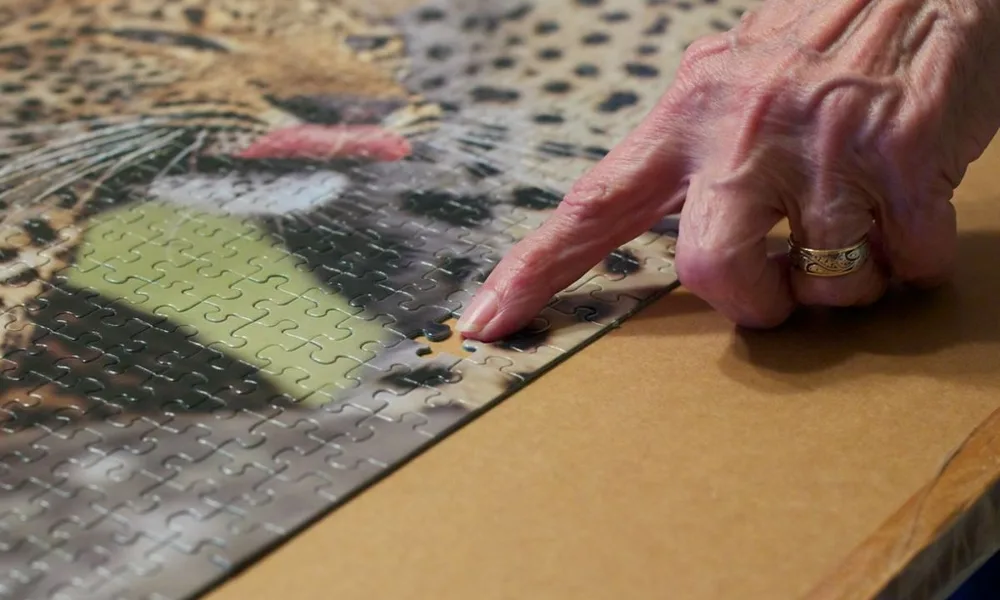
Third, the picture matters more than people admit. A puzzle with one huge stretch of identical sky or sea forces both of you to dig through the same heap for matching pieces, which is a recipe for elbows and sighs. Pick a picture with clear regions, so each of you has a patch of the picture to own. Our roundup of the best jigsaw puzzles made for couples is a useful place to start if you want picks chosen with a pair in mind.
How to start, if you are starting
If the verdict has persuaded you, keep the beginning small. Pick one evening and write it down, the way you would a dinner reservation, because an evening that stays a vague someday never arrives. Our guide to planning a puzzle night for couples handles the practical side, from choosing the evening to setting up the table, if you want the details sorted before you begin.
Choose the puzzle together, and let both of you veto. Then agree on one rule before you start: nobody moves a piece the other person has placed, and nobody reorganises the other person’s piles without asking. It sounds fussy. It will save you an argument by the third evening.
One more thing worth saying plainly: a jigsaw is not a board game, and it is worth knowing which one your evening actually wants. A board game gives you turns, rules, and a winner, and for some couples that spark is exactly right. Our verdict on whether board games are good for couples weighs that side fairly, including the moments when competition curdles into scorekeeping. A jigsaw gives you the opposite shape: no turns, no winner, no score, just a shared table and a picture that grows slowly while you talk. Some evenings want the contest. Some evenings want the quiet.
The quiet yes
So, are jigsaw puzzles good for couples? Yes, quietly and without fuss, in the way that most good things in a long relationship actually work. Because they give two people a table, a shared problem, and an unhurried hour in which to be together without a screen between them, talking sideways about the things that matter while their hands are busy with something small and finishable.
The conditions are simple enough to hold in one hand. Both of you have to want it. The puzzle has to fit the pair, not just one of you. The picture needs room for two. And nobody gets to police how the other person sorts. Get those right and a jigsaw becomes one of the most companionable pastimes a couple can share: slow, low-stakes, and honest. Get them wrong and the box turns into a nightly irritation, and a table you cannot eat at, which is a useful reminder that the puzzle was never the point. The point was always the two people at the table, and whether they can share something small without making it a contest. A jigsaw just gives them a gentle way to find out.