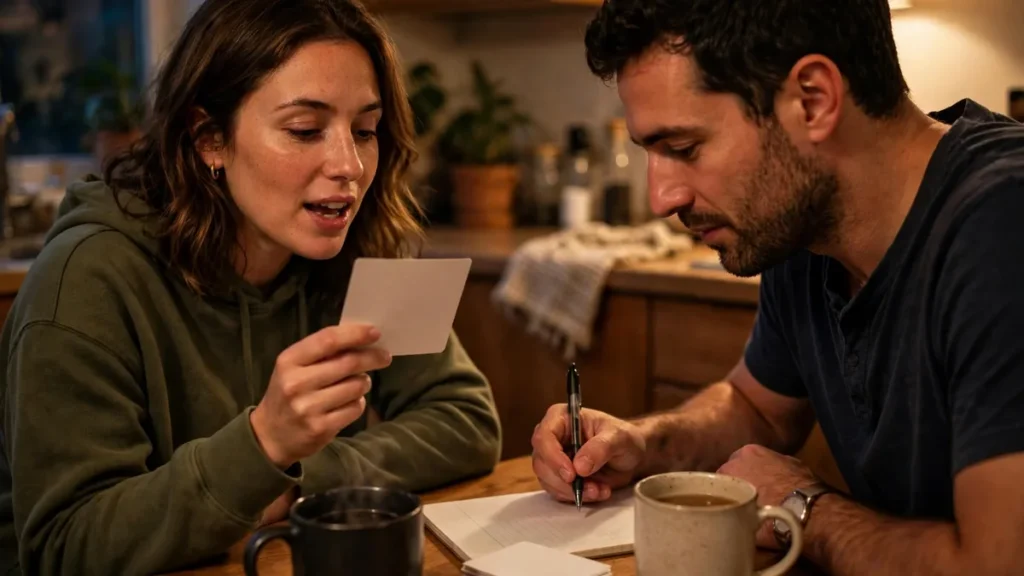
A trivia night built for a crowd has a host who stands apart from the game. A trivia night built for two people does not. When the whole evening is just you and your partner, somebody still has to read the questions, keep the score, and decide what counts as a right answer, and that somebody is also trying to win. That is what makes hosting for a couple different from hosting a party. Done well, the night feels like a game you built together rather than a quiz one of you inflicted on the other.
The trick is to stop copying the pub-quiz shape and build the evening around two people instead. No teams, no audience, no microphone. Just a table, a set of questions, and a host who hands the job over halfway through. This guide covers the setups that suit a pair, the room, a running order for the night, fair scoring when one of you knows more, and what to do when the evening you planned turns into an evening for two.
Pick a hosting setup that fits two people
Start by choosing who hosts, because everything else follows from that choice. There are three setups that work for a pair, and each one suits a different kind of couple. If another couple joins you, host as a pair against your guests instead: one of you reads while the other keeps score, then swap halfway through.
One hosts, one plays, then swap next time. One of you writes the questions, reads them out, marks the answers, and keeps the score, while the other one simply plays. The host gives up the chance to win that night, so agree the swap before you start: tonight you host, next time I host. This setup suits couples where one person genuinely enjoys putting a quiz together, and it produces the smoothest evening.
Take turns hosting a round each. Split the night into short rounds and pass the hosting job back and forth. Each host writes their own round in advance and keeps the answers sealed until their turn comes. Nobody sees the other person’s questions early, and nobody sits out the whole night. This is the setup most couples enjoy most.
Run it head to head from a shared bank. Build one shared pile of question cards together, shuffle them, and take turns drawing and reading. The reader asks, the other answers, then you swap. Nobody wrote the questions alone, so nobody has seen them all. This is the loosest setup and the easiest to start. For invitations, guest numbers, and choosing a date, see our planning a trivia night for couples guide.
Set the room for two
A room arranged for a crowd will fight you all evening. Pull the furniture in close instead. A kitchen table with two chairs opposite each other works better than a sofa, because you both need a firm surface to write on and a clear view of the cards. Sit across from each other for a contest, or side by side for a shared evening. Either way, keep the table small enough that you can hear each other without raising your voices.
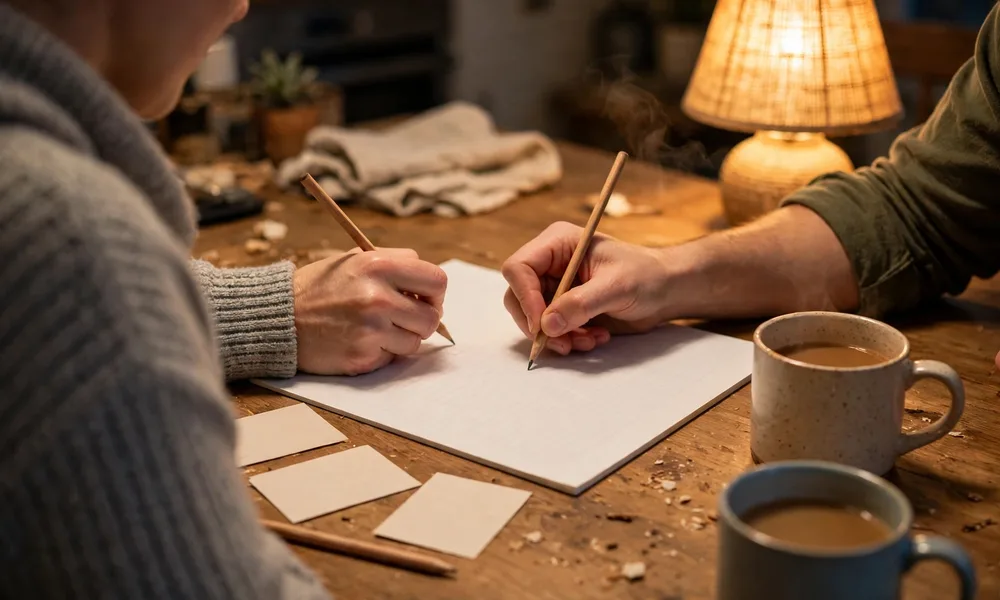
Put only what the game needs on the table: the question cards, two pens that work, a score pad, and your drinks. Phones go in another room or face down in a basket by the door, because a two-person quiz has no crowd to hide a quick search in. Agree that rule out loud before the first question. A lamp with warm light beats a bright overhead light, and snacks belong within reach rather than in the kitchen, so nobody has to leave the table mid-round.
A running order that works on the night
A two-person night needs a shape, but a loose one. Aim for about an hour and a half from the first question to the winner being named, with a short break in the middle. Longer than that and the evening starts to drag.
Open with a warm-up: five easy questions, asked quickly, with no score kept. The warm-up exists to shake off the day and get you both talking, so keep the questions gentle. Nobody should feel behind after five minutes. Then play the main part of the night: four rounds of five questions each, with the hosting job swapping between rounds. Each host reads their own round, marks it straight away, and updates the score pad where both of you can see it.
Take a proper break after the second round. Stand up, stretch, refill the drinks, and talk about something other than the quiz for ten minutes. Then play the last two rounds, and finish with a quick-fire closer: five short questions, asked one after another, with only a few seconds to answer each. The closer gives a trailing player one last chance to catch up. Announce the winner, hand over the prize, and stop. A good host knows when the night has peaked.
Writing questions when the host is also playing
The hardest part of hosting for two is writing questions you will not answer yourself. If you write every question, you already know every answer, and the night becomes a test your partner cannot win. The fix is to split the writing: each of you writes two rounds of five questions and keeps them hidden until your turn to host arrives. Write the answer on the back of each card and check every answer before the night begins.
Keep each question short enough to say aloud in one breath, with a single clear answer. Avoid questions where two different answers could both be defended, because a two-person game has no neutral judge. If a question turns out to be unclear, the host should throw it out and move on; one dropped question costs nothing, while a five-minute dispute costs the evening. Keep five spare questions in a sealed envelope for exactly that moment.
If you would rather not write questions at all, use a ready-made set instead. Our list of the best trivia questions for couples gives you fifty questions across eight rounds, and you can deal them out between you so each host takes half. Below are a few samples in the style that works best for a pair: short, plain, and answerable without specialist knowledge.
| Question | Answer |
|---|---|
| Which island is the largest in the world? | Greenland |
| What is the largest land animal? | The African elephant |
| In which year was the first Harry Potter book published? | 1997 |
| What is the capital city of Japan? | Tokyo |
| Which ocean is the smallest? | The Arctic Ocean |
| Who wrote Romeo and Juliet? | William Shakespeare |
| What is the square root of 144? | 12 |
| Which bird cannot fly but is a strong swimmer? | The penguin |
Scoring that suits a pair
With only two players, the score is always visible, and that changes how it feels. A big lead early on can end the night before the second half begins, so build the scoring to keep both of you in it until the closer. Keep it simple: a point each time you answer right, written on the pad where both of you can see it, with the running total announced at the break and before the final round.
Give the trailing player a way back. The cleanest method is a steal: if one player misses a question, the other gets one guess at it for a point. Steals keep both of you listening even when it is not your turn. Another method that works well for two is a head start for the weaker player, agreed before the first question. Three points on the board before you begin sounds like a lot, and it is meant to: it keeps the early rounds tense instead of letting one player pull away while the other is still warming up.
Settle ties with a single closest-guess question written in advance, such as how many beans are in the jar on the shelf. The player whose guess lands nearest takes the night. Write the tie-breaker down before you start, so nobody can claim it was invented to favour the host. And agree one small rule before the first question: a half-right answer is a wrong answer. A clear rule made in advance ends that argument before it starts.
Keeping it fair when one partner knows more
Most couples have a knowledge gap, and a two-person quiz shows it up fast. One of you will know more history, the other more music, and if the questions lean one way the night turns into a one-person show. The best time to stop that happening is before the night begins, when you choose the topics.
Draft the topics together. Each of you picks two round themes, and each of you gets one veto to strike a theme that plays too strongly to the other person’s strengths. If your partner knows every film ever made, veto the film round and keep the rounds you both stand a chance in. Mix the skills as well as the subjects: a round of picture questions, a round of numbers, and a round of quick guesses reward different kinds of thinking.
Let the weaker player host first. Hosting first means asking questions you wrote yourself, which is a gentle way to start, and it means the stronger player has to answer before they have found their rhythm. Swap the pen as well as the hosting job, so the person writing the answers changes every round. If one player still pulls far ahead, the host can offer a catch-up question anyone could answer, worth a point to whoever answers first. Used once, it keeps the night alive.
When only two people show up
Sometimes the pair night is not the plan at all. You invited friends, two of them cancelled, and now it is just the two of you and a quiz written for a room. Do not cancel the night. A quiz written for a crowd shrinks down to a pair more easily than most hosts expect.
Cut the question set in half and drop the team rounds entirely. Play head to head instead, taking turns to read and answer, and shorten the night to an hour. Keep the food you already bought, because a spread laid out for guests who never arrived is a shame to waste. Tell the friends who cancelled that you played anyway; it takes the pressure off the next invitation. Some of the best pair nights start exactly this way, as a party that fell through and turned into something quieter and better.
Handling the awkward bits on the night
Every host meets the same awkward moments, and with only two people there is nobody else to laugh them off. Decide your rulings in advance and the moments pass quickly. If an answer is disputed, the host checks the answer sheet and gives the point if the answer is plainly right, even if the spelling is off or a word is missing. If the sheet itself is wrong, the host owns the mistake, drops the question, and pulls a spare from the envelope.
If one player keeps answering before the question is finished, the host should ask for the answer to be written down first and read aloud only when both pens are down. That one habit fixes most interruptions without a lecture. If one player is clearly upset at losing, call the break early and change the subject for ten minutes. And if you catch your partner checking a phone, do not make a scene. Take the point for that round, put the phones further away, and carry on. The host’s real job is protecting the evening, not protecting the score.
Ending the night well
Finish with something small that two people can share: the loser cooks breakfast, the winner picks the next film, or a small treat is waiting on the table for whoever takes the night. A shared prize suits a pair far better than a trophy, because the evening was something you did together even while you were competing. Write the final score on the pad and keep it, then agree who hosts next time before you clear the table. A pair quiz works best as a habit, not a one-off. If you are still deciding whether a quiz night suits the two of you at all, read our honest verdict on trivia nights for couples before you host your first one.
Frequently asked questions
How many questions do we need for two people? Twenty-five is plenty: five for the warm-up and twenty across four main rounds, plus five spares in a sealed envelope.
What if my partner knows far more than I do? Draft the topics together, give each of you a veto, add a head start for the weaker player, and use the steal rule so a missed question is never wasted.