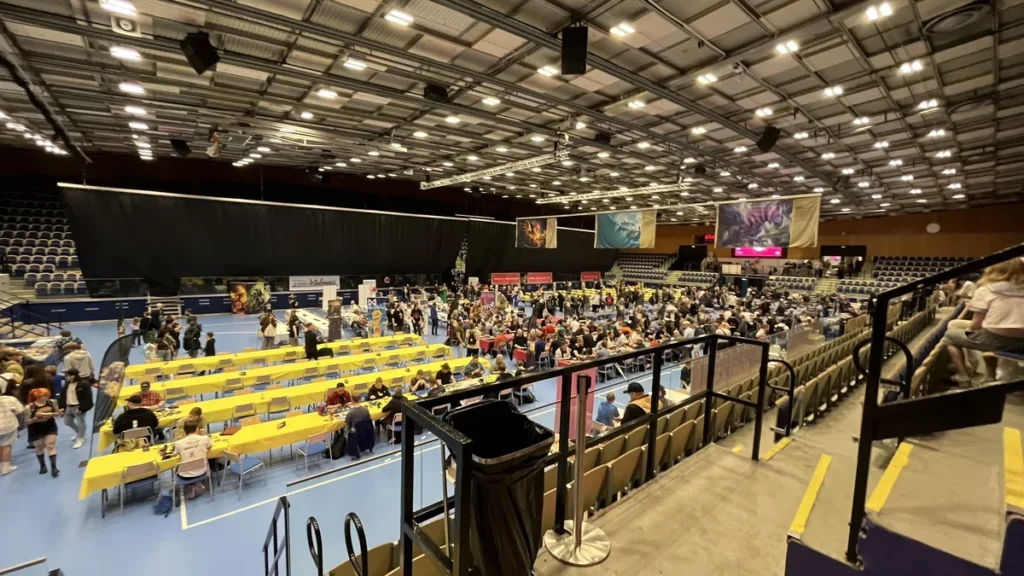
Dice games for 375 players sound impossible at first, until the group stops trying to play one game at one table. A crowd of 375 people can play dice games well when the event is built as a set of teams, a set of stations, and a clear tournament bracket. The dice stay the same, the rules stay simple, and the scale comes from organisation, not from a bigger table or louder shouting.
The trick is to treat 375 as the top of a range, not as a single fixed headcount. The same plan works for 30 players, 120 players, or the full 375, because every game below runs in small groups of five to eight people. When more players arrive, the organiser adds more tables and more dice sets, while the games and the scoring stay unchanged.
This guide covers ten dice games that scale cleanly, a comparison table to help choose between them, a practical plan for teams, stations, and tournaments, and a checklist that keeps a huge game day moving on time. The focus is on games that need little equipment, short explanations, and fast turns, so no group waits long between rolls. For a smaller version of the same idea, the guide to dice games for 373 players uses the same team and station structure with a slightly smaller crowd.
Key Takeaways
- Frame 375 as a range from 3 to 375 players, and scale with teams of five to eight, stations, and tournaments.
- Pick games with turns under one minute, simple scoring, and rules that can be explained in under two minutes.
- Use 50 teams of seven plus 25 hosts and scorekeepers for a full 375 player event, or 75 teams of five for faster rounds.
- Run short rounds of 12 to 15 minutes, rotate teams between stations, and keep one central scoreboard visible to everyone.
- Bring at least one dice set per table, printed score sheets, spare pens, and a loud timer that every table can hear.

How 375 Players Actually Works
A single dice game cannot hold 375 players at once, and it does not need to. The event works when 375 players are split into small playing groups that all play the same game at the same time, then compare scores. Each table becomes a small game of its own, and the tournament layer turns those small games into one big event with a winner.
Team size matters more than any other choice. Teams of five to eight keep every player rolling often and keep scoring simple. For 375 players, 50 teams of seven plus 25 hosts and scorekeepers is a clean split, and 75 teams of five works well when the organiser wants faster rounds.
The Team Model
In the team model, each team plays as one unit and shares one score sheet. Players take turns rolling for the team, and the team total decides the result. This model suits Farkle, Ten Thousand, and Bunco, where a run of good rolls can lift a whole team and a run of bad rolls becomes a shared joke rather than a personal failure. Team play also helps quiet players, because they roll as part of a group and other team members can help with scoring.
The Station Model
In the station model, the room is split into stations, and each station runs a different dice game. Teams spend 12 to 15 minutes at a station, then move to the next one when the timer sounds. Ten stations of about 37 or 38 players each can hold the full crowd, with each station split into five or six tables. This model suits a school fair, a company day, or a community festival, because players sample many games instead of playing one game for hours.
Stations need a host who knows the rules cold and can start a new group in under a minute. A printed rules card on every table helps, because players who arrive late can read the card and join without a fresh explanation.
The Tournament Model
In the tournament model, teams play short head to head rounds, winners move up, and the rest move into a friendly consolation bracket so nobody sits out early. A tournament suits Yahtzee, dice poker, and Left Center Right, where a clear winner emerges from each table. The bracket can be simple, with four rounds of 15 minutes each, a semifinal, and a final played on a central table where the crowd can watch.
A tournament needs a visible bracket and a firm schedule. Post the bracket on a wall or a large screen and update it after every round. Players accept losing a round when they can see the bracket and know what happens next.
Dice Games for 375 Players at a Glance
| Game | Players per table | Round length | Dice needed | Best format | Skill level |
|---|---|---|---|---|---|
| Farkle Relay | 5 to 8 | 15 minutes | 6 dice | Teams | Easy |
| Yahtzee Tournament | 4 to 6 | 20 minutes | 5 dice | Tournament | Easy |
| Bunco Marathon | 4 per table | 15 minutes | 3 dice | Stations | Easy |
| Ten Thousand Race | 5 to 8 | 15 minutes | 6 dice | Teams | Easy |
| Dice Bingo | 8 to 12 | 12 minutes | 2 dice | Stations | Very easy |
| Left Center Right | 6 to 10 | 12 minutes | 3 dice | Tournament | Very easy |
| Roll and Write Rally | 6 to 10 | 15 minutes | 2 dice | Stations | Easy |
| Dice Poker Showdown | 5 to 7 | 20 minutes | 5 dice | Tournament | Medium |
| Zombie Dice Horde | 5 to 8 | 12 minutes | 13 dice | Stations | Easy |
| Sevens Station Challenge | 6 to 10 | 12 minutes | 2 dice | Stations | Very easy |
The 10 Dice Games That Scale Best
Each game below works at a single table, and each one scales by adding tables. The notes cover the core rules and the scaling tip that matters most when the crowd grows past 100 players.
1. Farkle Relay
Farkle is a push your luck game with six dice. Players roll, set aside scoring dice, and choose whether to roll again for more points or bank the points they have. A roll with no scoring dice is a Farkle, and the turn scores zero.
For a large group, run Farkle as a relay. Each team member takes one turn in order, and the team total is the sum of all turns in the round. Use one scorekeeper per table and a target of 5,000 points so rounds end on time.
2. Yahtzee Tournament
Yahtzee uses five dice and a score sheet with thirteen categories, from ones through sixes to three of a kind, a full house, straights, and Yahtzee. Players roll up to three times per turn and choose the best category for the result.
For a large group, run Yahtzee as a tournament with printed score sheets and a fixed time limit of 20 minutes per round. Tables of four to six players finish a full sheet in that time when the host keeps the pace brisk. The earlier guide to dice games for 372 players uses the same timed round.
3. Bunco Marathon
Bunco is a fast social game for tables of four, played with three dice. Each round targets one number, starting with ones and moving up to sixes. Players score one point for each die that shows the target number, and five points for three of a kind in the target number.
Bunco is the best game in this list for mixing a large crowd, because the table rotation is built into the rules. Keep rounds to 15 minutes, use a bell to signal rotation, and give each table a small sign that shows the target number.
4. Ten Thousand Race
Ten Thousand is a close cousin of Farkle with a target of 10,000 points. Players roll six dice, score ones, fives, three of a kind, and straights, and choose whether to keep rolling for more points.
Scale Ten Thousand by running it as a race between tables. Start all tables together, announce the leading score every five minutes, and stop the round when the first table reaches the target or when the timer ends.
5. Dice Bingo
Dice Bingo replaces the numbered balls of bingo with two dice. Each player has a bingo card with numbers from 2 to 12, and the caller rolls two dice and calls the total. The first player to complete a row, a column, or a full card wins.
For 375 players, Dice Bingo works best as a whole room game with one caller and a large display of the called numbers. Tables of eight to twelve players share cards and help each other mark numbers, which keeps the pace fast.
6. Left Center Right
Left Center Right, often shortened to LCR, is a fast elimination game with three special dice and a pile of chips. Each die shows left, center, right, or a dot. Players pass chips in the direction shown, and the last player with chips wins the table.
LCR scales well because it needs almost no scoring. For a large group, run it as a tournament where table winners move to a winners table and other players join a fresh game. Give each player three chips at the start.
7. Roll and Write Rally
Roll and write games give every player the same dice result and a personal sheet to fill in. The host rolls two dice, calls the result, and every player writes it into a grid, a track, or a set of boxes.
For 375 players, the rally format is ideal. One host rolls at the front, a large screen shows the result, and every table plays at the same pace. A 15 minute round with about 20 rolls gives every player a full sheet.
8. Dice Poker Showdown
Dice poker uses five dice to make poker hands, from a pair up to five of a kind. Players roll, hold the dice they like, and reroll the rest up to two times. The best hand at the table wins the round.
For a large group, keep dice poker simple. Use a printed hand ranking card on every table, limit each round to 20 minutes, and play five rounds per match. Score by hand strength alone, so the game stays friendly and fast.
9. Zombie Dice Horde
Zombie Dice is a push your luck game where players roll dice that show brains, shotguns, and footsteps. Brains score points, shotguns end the turn when three appear, and footsteps allow a reroll. The rules take about one minute to explain.
For a large group, run Zombie Dice as a horde station with several copies of the game running at once. Tables of five to eight players finish a round in about 12 minutes. Keep spare sets ready, because dice go missing fast in a busy hall.
10. Sevens Station Challenge
Sevens is a simple two dice game where players predict, chase, or avoid the number seven. In the station version, each player rolls two dice, scores points for totals other than seven, and loses the turn when seven appears.
For 375 players, Sevens works as a high speed station that clears a queue fast. Tables of six to ten players can finish a round in 12 minutes, and the station host can start a new group with almost no delay.
How to Run the Day Without Chaos
A large dice day fails on logistics more often than on games. The games are simple, so the plan should be simple too. A clear schedule, a clear rotation, and a clear scoring system will carry the day, even when the crowd is larger than expected.
Schedule and Rotation
Build the schedule around 15 minute rounds with five minute breaks for movement, scoring, and water. Six rounds fit into two hours with a short welcome and a short final. Post the schedule on every table and use a loud timer that every table can hear.
Rotation should be simple. Teams move one station forward each round, in the same direction, every time. Number the stations clearly and keep the walkways clear of bags and chairs.
Scoring and Scorekeeping
Use one score sheet per table per round, with the team name, the table number, the game name, and the final score in large boxes. Scorekeepers should be players who enjoy numbers, or volunteers who are not playing in that round. A scorekeeper who also plays will fall behind, and the scores will be late.
Collect score sheets at the end of every round, not at the end of the day. A volunteer with a tray can collect sheets while teams move to the next station. Announce the top five teams after round three so the middle of the day has a moment of excitement.
Supplies and Staffing
Supplies are easy to underestimate. For 375 players, plan for at least 60 dice sets, 400 printed score sheets, 200 pencils, 60 printed rules cards, and 20 spare dice sets. Dice sets should be counted at the start and at the end, because small dice disappear into pockets, bags, and floor gaps. A simple count at the door saves a long search later. For a wider mix of activities beyond dice, the guide to party games for 372 players covers team games that fit the same station rotation.
Staffing needs about one host per station, plus two people at the scoreboard, two people at the welcome desk, and two floaters who solve problems. Hosts should arrive an hour early, play one practice round together, and agree on the rules for ties and late arrivals.
Checklist for a 375 Player Dice Day
- Confirm the player count, the team size, and the number of tables, and print a team list with names, colours, and table numbers.
- Choose six to ten games from the table above, and match each game to a station with the right dice, cards, and score sheets.
- Print score sheets, rules cards, rotation cards, and a large schedule, and pack spare pens, pencils, and dice sets.
- Set up tables in clear rows with numbered stations, wide walkways, a visible scoreboard, and a loud timer.
- Brief every host on the rules, the rotation, the scoring, and the plan for ties, late arrivals, and lost dice.
- Run a five minute welcome, start round one on time, collect scores after every round, and announce the winners before players leave.
Frequently Asked Questions
Can 375 players really play dice games at the same time?
Yes, when the crowd is split into small tables that all play at once. With 50 teams of seven or 75 teams of five, every player rolls often, every table finishes on time, and the central scoreboard turns many small games into one big event.
How many dice sets do I need for 375 players?
Plan for at least one dice set per table, plus 20 spare sets. For 60 tables, that means 60 sets in play and 20 spares, or about 80 sets in total. Count the dice at the start and at the end, and keep spares at the welcome desk.
What is the best team size for a huge dice event?
Teams of five to eight work best. Teams of five give every player many turns and keep rounds fast, while teams of seven or eight give more table talk and a stronger team feeling. For a first event, teams of six are a safe middle choice.
How long should a 375 player dice event last?
Two to three hours works well for most groups. Six rounds of 15 minutes, with five minute breaks and a short welcome and final, fit into about two hours. A three hour event can add a tournament semifinal and final and a break for food.
What if some players have never played dice games before?
Choose very easy games for the first two rounds, such as Dice Bingo, Left Center Right, and Sevens. Put a printed rules card on every table, and ask the host to play one open practice round before scoring starts. The team format also helps, because experienced players can guide new players.
How do I pick a winner fairly across so many tables?
Use the same scoring system at every table, collect score sheets after every round, and compare totals on a central board. For games with different scoring scales, convert each table result to ranking points, such as ten points for first place at a table and eight for second.
Bottom Line
Dice games for 375 players work when the plan is built for small tables and a shared scoreboard. Split the crowd into teams of five to eight, run short rounds at clear stations, keep the rules simple, and collect scores after every round. Pick six to ten games from the list above, bring enough dice and printed sheets, and start on time.