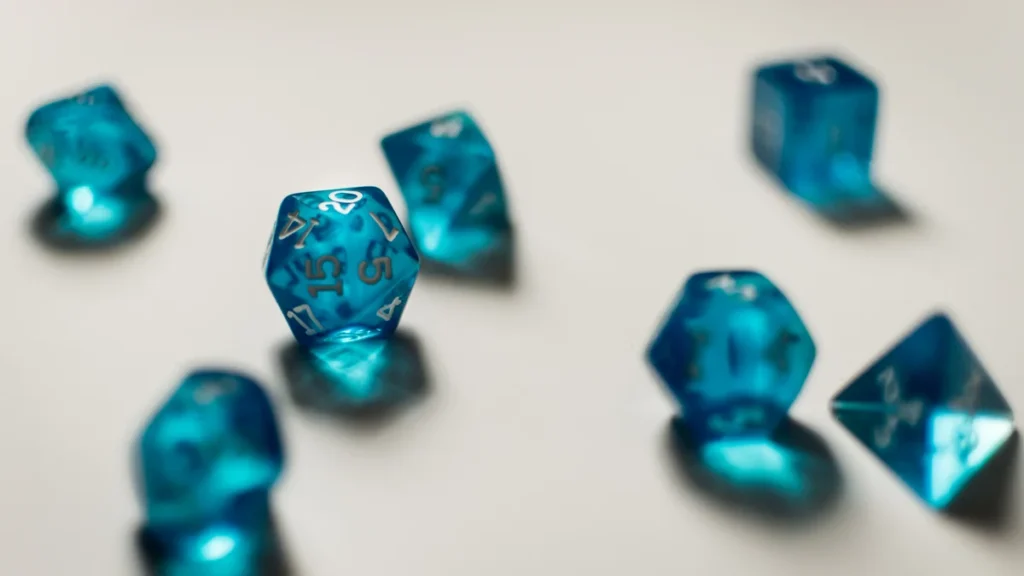
Four hundred and twenty-two players, one room, and a bucket of dice sounds like chaos, and on the first night it usually is. Someone rolls before the whistle, three tables argue about the same rule, and the scoreboard looks like it was filled in during an earthquake.
This guide gives you nine dice games that scale cleanly to 422 players: Dice Hockey, Dice Cricket, Dice Football, Dice Volleyball, Dice Rugby, Dice Solitaire, Dice Memory, Dice Dominoes, and Dice Chess. Each one works at a table of six, runs in short rounds, and produces a score a captain can report in one sentence.
The trick is to stop thinking of 422 players as one enormous game and start thinking of it as seventy small games played in parallel, with one shared clock and one shared scoreboard. The nine games below are ordered so you can open with something fast and loud, settle into the longer strategy games in the middle, and finish with a head-to-head finale that the whole room can watch.
Key takeaways
- Split 422 players into tables of six, with two spare seats at a few tables for late arrivals and uneven numbers.
- Run every table on the same clock, with rounds of ten to fifteen minutes and a clear sound for start, warning, and stop.
- Give every table the same dice, the same score sheet, and the same one-page rules so no table invents its own version.
- Use captains to report scores, because seventy captains reporting is fast and four hundred players shouting is not.
- Start fast with Dice Hockey, build through the strategy games, and finish with a Dice Chess finale the whole room can follow.

The 9 Games at a Glance
Before the first roll, it helps to see all nine games side by side. The table below shows how many dice each game needs, how long a round takes, and what kind of player it suits best, so you can plan the order of the night and the equipment for every table. Every game in this guide was chosen because it works with six players, fits inside a twenty-minute round, and produces a single score a captain can report without a calculator.
| Game | Dice needed | Round length | Best for |
|---|---|---|---|
| Dice Hockey | 3 per player | 8 minutes a period | Fast, loud openers |
| Dice Cricket | 2 per player | 15 minutes an innings | Calm, easy to learn |
| Dice Football | 2 per player | 20 minutes a match | Storytelling, team play |
| Dice Volleyball | 1 per player | 15 minutes for three sets | Quick filler between games |
| Dice Rugby | 2 per player | 20 minutes a match | Patient, tactical players |
| Dice Solitaire | 5 per player | 10 minutes a round | Quiet, focused players |
| Dice Memory | 12 per table | 10 minutes a round | All ages, all abilities |
| Dice Dominoes | 2 per player | 15 minutes a round | Sociable, chatty tables |
| Dice Chess | 2 per player | 20 minutes a game | Strategic finale |
If you are planning a series of big dice nights, the closest comparison is our guide to dice games for 421 players, which uses the same station model with a different set of nine games. Reading the two guides together shows how the same room setup can carry a completely different evening, and it is the fastest way to plan your second night once the first one works.
How a 422-Player Dice Night Actually Works
Split the Room Into Stations
The station model is the whole secret. Instead of one game for 422 people, you run seventy games for six people, and you treat each table as a station that plays the same game at the same time as every other station. The host announces the game, the captains read the one-page rules, the timer starts, and seventy tables roll together.
Run Every Table on One Clock
A shared clock is what turns seventy separate games into one event. Every round lasts ten to fifteen minutes, the host gives a two-minute warning, and a single sound ends the round for the whole room. Tables that finish early wait for the clock, and tables that run late stop when the sound comes, which keeps the night moving and stops the fast tables from drifting three games ahead of the slow ones.
Keep One Scoreboard for the Whole Room
Seventy tables produce seventy scores a round, and the scoreboard is where those scores become a competition. Captains report three things only: the table number, the winning player or team, and the score. The host writes the top ten totals where everyone can see them, and reads out the leaders between rounds. That public scoreboard is the engine of the night, because a table in fortieth place can see exactly what it needs to climb into the top ten, and a table at the top can feel the whole room chasing it. The fullest version of this setup, with the same clock and scoreboard ideas, is also covered in our complete guide to dice games for 420 players, which is worth a look if you are still deciding how many tables your room can hold.
The 9 Dice Games for 422 Players
1. Dice Hockey
Dice Hockey turns a table into a rink. Each player controls a line of three skaters, and every roll moves the puck, shoots, or saves, depending on the number that comes up. A roll of one or two passes the puck sideways, three or four carries it forward, five takes a shot on goal, and six forces a save or a rebound.
The game works for huge groups because it is loud in the right way. Players call out their rolls, the table groans or cheers together, and the score changes fast enough that nobody drifts away from the game.
2. Dice Cricket
Dice Cricket is the gentlest way to open a big dice night, because almost everyone already understands the shape of it: one side bats, one side bowls, and runs come from the dice. The batting player rolls two dice and adds them for runs, but a roll of seven means the batsman is out, and a double means a boundary worth double the total. Each batsman faces six rolls, an over, and then the next player takes the bat.
For 422 players, Dice Cricket shines as a calm anchor between louder games. Tables can play a full innings in about fifteen minutes, the scores are easy to compare across the room, and players who have never held a die before can learn the game in one over.
3. Dice Football
Dice Football plays like a match report written one roll at a time. Each table is a pitch, each player manages a team, and the dice decide passes, tackles, and shots. Roll a one or two and the ball moves up the wing, three or four works it through the middle, five is a shot, and six is a tackle that wins the ball back.
The reason Dice Football belongs in a 422-player night is that it gives every table a story to tell at the break. Someone always scores a late equaliser, someone always loses a two-goal lead, and those stories travel between tables faster than any announcement.
4. Dice Volleyball
Dice Volleyball is the fastest game in this set, and it is the best cure for a room that is starting to sag. Rallies are short, points come quickly, and the whole table is involved in every serve. The serving player rolls one die: one to three means the serve lands and the rally continues, four or five means the other side must roll to return it, and six is an ace that scores outright.
Because the game is so quick, Dice Volleyball is the ideal filler between longer games. A table that finishes Dice Cricket early can play a set of volleyball while waiting for the clock, and a table that is running behind can skip a set without falling out of step with the room.
5. Dice Rugby
Dice Rugby is the toughest game in the set, and that is why players remember it. It is a game of territory: each roll moves the ball down the pitch, and the other side rolls to tackle. A roll of one or two gains five metres, three or four gains ten, five breaks the line for twenty, and six is a turnover that hands the ball to the other side.
For a crowd of 422, Dice Rugby works best in the middle of the evening, once every table knows the rhythm of rolling together and the captains have found their voices. It rewards patience, because a team that keeps the ball for five rolls in a row can march the whole length of the pitch, and it punishes greed, because a player who always rolls for the big break will turn the ball over twice as often.
6. Dice Solitaire
Dice Solitaire sounds like a contradiction at a party for 422 people, and that is exactly why it works. It is the quiet game, the one that lets a loud room breathe. Each player has their own grid, rolls five dice, and places the numbers into rows and columns, trying to build runs and sets before the dice run out.
The quiet matters. After three loud team games, some players need ten minutes where the only sound is dice on felt, and Dice Solitaire gives them that without taking them out of the night.
7. Dice Memory
Dice Memory is the game that surprises hosts the most, because it looks gentle and plays ruthless. Twelve dice are laid face down in a grid, and players take turns turning over two at a time, looking for matching numbers. A match scores a point and earns another turn, a miss ends the turn, and the player with the most pairs at the end wins.
For 422 players, Dice Memory is the great equaliser. It needs no sporting knowledge, no maths beyond counting to twelve, and no luck beyond a steady memory.
8. Dice Dominoes
Dice Dominoes turns two ordinary dice into a whole set of dominoes, and it is the most sociable game in this guide. Each player rolls two dice and adds them, then places that total on the shared chain, matching the number at either end. A roll that matches neither end means the player passes, and the first player to place all of their totals wins the round.
The game scales beautifully because the table shares one chain, so all six players are watching the same thing at the same time. It also teaches the room to wait, because a player who rolls too early can place the wrong total and break the chain, and the table will notice.
9. Dice Chess
Dice Chess is the finale, and it earns that place. Each piece moves the way it does in chess, but the piece you may move is decided by the dice: roll a one and move a pawn, two a knight, three a bishop, four a rook, five a queen, and six lets you choose any piece. The board is small, eight by eight, the games are short, and a checkmate can come from a roll nobody expected, which is what makes the whole room lean in.
For the final round of a 422-player night, Dice Chess does something no other game in this set can do: it gives the room a single game to watch. Run the last round as a knockout, with each table sending its winner to a final table, and play the final on a large board at the front of the room while the other players watch and call out the rolls.
Setting Up the Room for 422 Players
Start with the room, because the room decides everything else. Seventy tables of six, with two spare tables for uneven numbers and late arrivals, fits 422 players with room to spare. Leave a clear lane down the middle of the room for the host and the captains, put the scoreboard where every table can see it, and place the dice station near the door so latecomers collect their set on the way in.
Count the dice before anyone arrives. Each table needs at least twelve standard six-sided dice, plus two spares, which comes to just under a thousand dice for the whole room. Buy them in bulk, in one colour per table, so a stray die can be returned to the right place without a debate.
If you want to see how a slightly smaller crowd is handled, our guide to dice games for 419 players uses the same seventy-table layout with three fewer players, and its setup notes cover the spare-table plan in more detail. The lesson is the same in both guides: the room setup is a job you do once, before anyone arrives, and the games are the reward you collect all night.
Your 422-Player Checklist
Run through this list the day before the night, and again an hour before the doors open. Every item on it is small on its own, and every one of them has ruined a big night when it was skipped.
- Count every table set before the doors open, twelve dice plus two spares per table, and keep a reserve bag of fifty dice at the host table.
- Put a captain at every table, give each captain a score sheet and a pen, and collect a practice score before the first real round.
- Test the timer sound from the back of the room, and agree the three signals: start, two-minute warning, and stop.
- Post the rules for the first game on the scoreboard and on every table, one page, large print, no small text.
- Run a five-minute practice round of Dice Hockey so every table has rolled together once before the scores count.
- Collect the scores after every round, update the scoreboard before the next round starts, and read out the top five tables.
Frequently Asked Questions
Can 422 players really play dice games at the same time?
Yes, and the trick is that they do not play one game of 422 people. They play seventy games of six people at the same time, on the same clock, with the same rules.
How many dice do we need for 422 players?
Plan on twelve dice per table plus two spares, which is fourteen per table across seventy tables, or just under a thousand dice in total. Buy them in bulk and in one colour per table so lost dice find their way home.
What if some players have never played a dice game?
Start with Dice Cricket or Dice Memory, because both can be learned in a single round and neither punishes a beginner. Seat new players with a captain who has played before, and give every table a one-page rules card in large print.
How long should a dice night for 422 players last?
Plan for about two and a half hours of play, plus thirty minutes for arrival and the captains briefing. That gives you nine rounds of ten to fifteen minutes, with short breaks between them for scores and the scoreboard.
Do we need a referee at every table?
No, and trying to find seventy referees would be harder than running the night. Each table captain handles the small disputes, and the only rule a captain needs is that a disputed roll is re-rolled once, in full view of the table, and the second result stands.
Which game should we start with?
Start with Dice Hockey, because it is fast, loud, and impossible to play quietly, which wakes the whole room up at once. Follow it with Dice Cricket while the energy is high, then move into the strategy games, Dice Rugby and Dice Chess, once the tables know the rhythm.
Bottom Line
A dice night for 422 players works when the structure does the heavy lifting and the games do the entertaining. Split the room into tables of six, run every table on one clock, give the captains clear jobs, and let these nine games carry the evening from the first roll of Dice Hockey to the final move of Dice Chess. The dice will do the rest: they will produce the late equaliser, the unlikely champion, and the story every table takes home. Set the tables, start the clock, and roll.