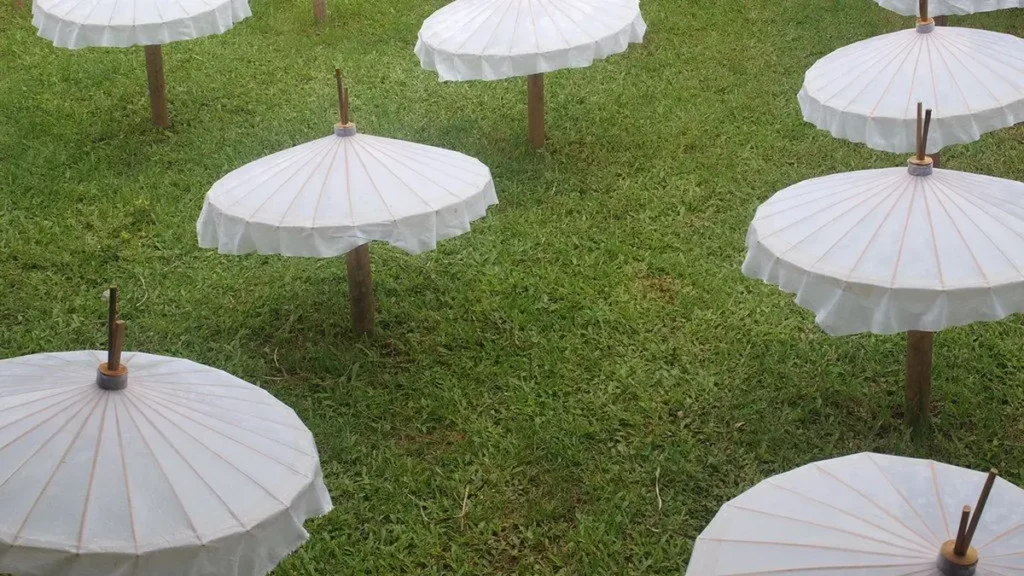
Five hundred and fifty-three players, one old village parasol-maker’s workshop, and nine races that turn canopies, fabric, and pale wood ribs into a full day of play. That is the whole plan in one line, and it works because every race uses the same simple shape: a worktop, a tray of workshop materials, a plain job to do, and a host who watches the minutes rather than the crowd. Nobody needs to know how a parasol is made before they arrive, and nobody needs to bring anything except a willingness to work with canopies with care.
The workshop gives the day its order. Each race takes its name from one small part of a parasol-maker’s working day: counting canopy panels, counting ribs, matching hues, measuring rib lengths, sorting fabric, checking the catch, ordering panels, counting snag-free openings, and weighing fabric. Teams move from one worktop to the next in turn, so the room never feels crowded, and every team meets every race before the closing call.
This plan runs through the whole day from the first welcome to the closing tally. It shows how to group five hundred and fifty-three players into teams, how long each race runs, and what the host watches at each worktop. Follow it in order, keep the rotation even, and the day runs itself.
Key takeaways
- Five hundred and fifty-three players split into sixty-one teams of nine, with one team of seventeen, so every race has nine players at its worktop.
- Nine races run in rotation around the parasol-maker’s workshop, each lasting twelve minutes with three minutes to move between worktops.
- Every race uses real workshop materials: canopies, fabric lengths, pale wood ribs, and finished parasols.
- One host per worktop watches, times, and tallies, while a lead host calls the rotation and keeps all sixty-one teams moving together.
- The team with the highest combined tally across all nine races takes the day, not the fastest team at any one worktop.

The 9 Races at a Glance
The nine races below are the whole day. Each one asks teams to do one parasol-maker’s job well under time pressure, and each one is tallied out of ten. Read the roster once, then run the races in the order shown,
| Race | What teams do | What the host watches |
|---|---|---|
| Canopy Panel Count Race | Count the panels on finished canopies | Exact counts, neat record, no missed panels |
| Parasol Rib Count Race | Count the ribs on open parasols | Exact counts, gentle handling, no bent ribs |
| Canopy Hue Match Race | Match fabric hues to hue samples | Correct hues, keen eyes, no swapped pieces |
| Parasol Rib Length Measure Race | Measure ribs and order them by length | Exact lengths, correct order, neat record |
| Canopy Fabric Sort Race | Sort fabric lengths into hue groups | Neat groups, correct hues, neat tray |
| Parasol Catch Check Race | Open parasols and check the catch holds | Firm catches, careful hands, honest count |
| Canopy Panel Order Race | Order canopies by their panel count | Correct order, exact counts, neat row |
| Parasol Open Count Race | Open a batch and count snag-free openings | Snag-free openings, no snags, exact count |
| Canopy Fabric Weigh Race | Weigh fabric lengths and order them | Exact weights, correct order, careful reading |
How 553 Players Fit Into One Day
Sixty-one teams of nine players fill the workshop floor, and one team of seventeen brings the count to five hundred and fifty-three. The team of seventeen splits into two halves at each worktop, with nine players working and eight watching and calling out what they see, then the halves change over halfway through the twelve minutes. That way every player handles the materials in every race, and no team waits idle while others work.
Nine worktops sit around the room, one for each race, and teams move one worktop along when the lead host calls the rotation. Twelve minutes of racing and three minutes of moving make fifteen minutes per turn, and nine turns of the rotation make two hours and fifteen minutes of racing in all. Add a welcome, a midday pause, and a closing tally, and the day fits inside four hours.
The 9 Races
Each race below runs the same way: the host shows the job once, the team works for twelve minutes, and the host tallies the result out of ten. Read each race through before the day begins, and keep one host at each worktop from the first race to the last.
1. Canopy Panel Count Race
The worktop holds nine finished canopies, each one made of panels fastened to pale wood ribs, and the team must count the panels on every canopy and write the counts on the tally sheet. One player lifts each canopy into the daylight, one player counts the panels aloud from the centre outward, and the rest of the team watches the count and calls out if a panel is missed or counted twice. The panels all look alike at first glance, so the team that counts slowly, one panel at a time, beats the team that relies on its eyes alone.
The host checks the written counts against the exact panel counts and tallies the team on how many canopies carry the correct figure. A team that counts all nine canopies right earns a full tally, while a team that misses one panel on one canopy earns nearly as much, because the host rewards careful counting over lucky guessing.
2. Parasol Rib Count Race
The worktop holds nine open parasols, each one showing its pale wood ribs beneath the canopy, and the team must count the ribs on every parasol. One player turns each parasol slowly in the daylight, one player counts the ribs aloud, and one player writes each count on the tally sheet, while the rest of the team watches the ribs pass and calls out if the count slips. Ribs are thin and close together, so the team works with a slow turn and an even voice, and no parasol is closed until the host has checked the count.
The host counts one parasol in full and checks the other eight against the written figures, then tallies the team on exact counts and even care. A team with nine correct counts earns a full tally, and the host rewards a team that counts twice over a team that writes the first figure and moves on. The old-globe workshop day in our puzzle games for 551 players runs its nine races the same way, with one host at each worktop and a written record that the host checks at the end of every race.
3. Canopy Hue Match Race
The tray holds fabric lengths in white, cream, rust, green, navy, brown, grey, and black, beside a row of hue samples that the host has put out in daylight. The team must match each fabric length to its sample, laying the length flat beside the sample it matches best. One player lifts each length into the daylight, one player reads the samples aloud, and the rest of the team agrees the match before the length is put beside its sample.
The host checks every match against the samples and tallies the team on correct hues and keen eyes, with a small loss for any length that sits beside the wrong sample. A team that holds each length up to the daylight before deciding earns more than a team that matches by memory, because fabric hues shift in dim daylight and only a direct look shows the exact hue.
4. Parasol Rib Length Measure Race
The worktop holds nine loose ribs of pale wood, each one a different length, and the team must measure every rib and put them in order from shortest to longest. One player measures with a tape, one player writes each length on the tally sheet, and the rest of the team checks the tape and reads the lengths aloud so no figure is missed.
The host checks the written order against the exact lengths and tallies the team on how many ribs sit in the right order. A team that puts all nine in the right order earns a full tally, and a team that swaps two ribs that sit side by side earns nearly as much, because the host knows how easy it is to misread a tape by a finger width. Ribs are thin and easy to muddle, so the best teams put each measured rib in a row as they measure, and the row itself shows any mistake before the twelve minutes run out.
5. Canopy Fabric Sort Race
The tray holds a jumble of fabric lengths in mixed hues, and the team must sort them into neat groups by hue. One player lifts each length gently, one player puts it in its group, and the rest of the team watches the groups grow and calls out any length that lands in the wrong group. Fabric creases if it is handled roughly, so the team works with flat hands and a slow pace.
The host checks each group for hue, and tallies the team on how many lengths sit in their correct group. A length in the wrong hue group costs the team, because hue is the whole job here and the host expects teams to get it right. The sailmaker’s loft day in our puzzle games for 550 players keeps the same nine-race shape, with teams moving from one worktop to the next and a host at each worktop who keeps the tally for the teams in front of them.

6. Parasol Catch Check Race
The worktop holds nine finished parasols, and the team must open each one, check that the catch holds it open, and close it again without forcing the ribs. One player opens each parasol with a slow lift, one player tests the catch, and one player writes the result on the tally sheet, while the rest of the team watches the ribs and calls out if a rib bends or the catch slips. A catch that holds firm earns the team its tally, while a catch that slips costs the team.
The host checks two parasols again at random and tallies the team on how many of the nine results match the host’s own check. A team whose nine results all match the host’s earns a full tally, and the host rewards a team that tests slowly over a team that rushes.
7. Canopy Panel Order Race
The worktop holds nine canopies with different panel counts, and the team must order them from fewest panels to most panels. One player counts the panels on each canopy, one player writes the counts on the tally sheet, and the rest of the team puts the canopies out in a row so the order can be seen at a glance. The row must run straight from one end to the other, with no canopy doubled over and no count wrong.
The host moves along the row from one end to the other, counting panels as they pass, and tallies the team on how many canopies sit in the right order. A team that puts the row out early and then checks it twice earns more than a team that counts every canopy before putting any one down, because the row itself shows mistakes that a written figure alone can miss.
8. Parasol Open Count Race
The worktop holds a batch of closed parasols, and the team must open each one and count how many open cleanly, with no snag and no bent rib. One player opens each parasol with a slow lift, one player watches the ribs as the canopy opens, and one player writes the count on the tally sheet, while the rest of the team watches for snags and calls out if a rib catches. A parasol that opens snag-free earns the team its tally, while a parasol that snags is put aside for the host.
The host opens the put-aside parasols one by one and tallies the team on how many of the batch opened snag-free. A team that opens every parasol in the batch snag-free earns a full tally, and the host rewards a team that opens slowly over a team that rushes and bends a rib. The violin-maker’s workshop day in our puzzle games for 549 players keeps the same nine-race shape, with a written record at each worktop and a host who checks the record before the team moves on.
9. Canopy Fabric Weigh Race
The worktop holds nine lengths of canopy fabric, each one a different weight, and the team must weigh each length and put them in order from lightest to heaviest. One player hangs each length on the weighing hook, one player reads the weight aloud, and one player writes it on the tally sheet, while the rest of the team watches the hook and calls out the reading before it is written down.
The host checks the written order against the exact weights and tallies the team on how many lengths sit in the right order. A team that puts all nine in the right order earns a full tally, and the host rewards a team that reads the hook twice. This is the last race of the day for most teams, so the host keeps the pace calm.
The Host’s Checklist
Run through this roster before the first team arrives, and again at the midday pause.
- Count the teams. Sixty-one teams of nine and one team of seventeen, with every player named on the roster and every team given a disc in its own hue.
- Fill every tray. Each worktop holds a full tray of canopies, fabric lengths, ribs, and finished parasols, with an extra tray waiting behind the host.
- Check the weighing hook. Hang a known weight on the hook at the ninth worktop and read it twice, so the last race of the day starts exact.
- Brief every host. Each host knows the job at their worktop, the tally out of ten, and the call that moves teams along.
- Run the rotation. Lead host checks the nine worktops in order, checking that the path between them is open and the daylight reaches every tray.
- Prepare the tally sheets. One sheet per team per race, with the team hue written above each tally, so no tally is ever missed or mixed.
Frequently Asked Questions
How long does the whole day take?
Nine turns of twelve minutes of racing and three minutes of moving make two hours and fifteen minutes. Add a welcome of twenty minutes, a midday pause of thirty minutes, and a closing tally of twenty minutes, and the day runs to about three hours and twenty-five minutes from the first welcome to the closing call.
What if a team has fewer than nine players on the day?
Let the team race with the players it has, and let the host ease the job a little, for example by counting ribs on fewer parasols. The tally stays out of ten either way, so a smaller team is never punished for an absent player, and the count stays honest across all sixty-one teams.
Do players need any parasol-maker’s skill before they arrive?
No. Every race is shown once by the host before the twelve minutes begin, and the jobs are simple ones: counting, measuring, matching, sorting, checking, ordering, and weighing. Players who have never held a canopy before do as well as anyone else by the third race, because the jobs reward care and talk, not prior skill.
What happens if a rib bends during a race?
The host hands the team a fresh rib at once and the twelve minutes keep running, because bent ribs are part of working with real materials. The team loses the minutes it spent on the bent rib, which is why the best teams open parasols slowly.
How do you keep sixty-one teams moving together?
One lead host calls the rotation, and every worktop host repeats the call at once, so all sixty-one teams hear it and move at the same moment. The path between worktops runs one way around the room, so no team meets another coming the other way, and three minutes of moving time is generous enough for the slowest team.
Can the day run with fewer than nine worktops?
Yes, if two races use one worktop in turn, but the day grows longer because teams wait for a free worktop. Nine worktops is the plan because it lets all sixty-one teams race at once, and the day stays inside four hours. With fewer worktops, add thirty minutes for each worktop you remove.
The Bottom Line
Five hundred and fifty-three players, nine races, one old village parasol-maker’s workshop, and a day that runs on canopies, fabric, and pale wood ribs. Keep the rotation even, keep one host at each worktop, and keep the tally honest, and the day takes care of itself. The team with the highest tally across all nine races takes the day, and every team leaves having handled real workshop materials.


