A trivia night is an evening built around quiz questions, played in small teams, with a host reading the questions out loud and a score kept as the night goes on. That is the whole idea in one sentence. Everything else — the venue, the rounds, the prizes, the snacks — is decoration around that core.
This guide explains what a trivia night actually is, how a typical one unfolds from the first question to the final scores, what the common formats and round types look like, how teams and scoring work, and what to expect if you have never been to one. It is written for the curious newcomer, not the organiser, so the focus stays on the experience of taking part.
The short answer: a social quiz, played together
At its simplest, a trivia night is a group quiz. A host, sometimes called a quizmaster, asks a series of questions. Players work in teams to agree on answers, write them down, and hand them in for marking. Points are added up, the totals are announced, and a winning team is declared. There is usually a small prize — a round of drinks, a voucher, a trophy that gets passed around, or simply the right to boast until next week.
The questions cover general knowledge. A single evening might touch on geography, history, music, films, food, sport, science, books, and current affairs. Some nights stick to one theme, such as a single decade, a television show, or a city. Most mix the topics up so that every team has a round where it shines and a round where it flounders.
What separates a trivia night from a quiz you take alone on your phone is the social side. The answers are discussed, not typed in silence. Someone at the table remembers half a fact, someone else remembers the other half, and together they land on the answer. The conversation between questions is as much a part of the night as the questions themselves. Many regulars will tell you they come for the company and stay for the competition, in that order.
How a typical trivia night runs
Most trivia nights follow a rhythm that becomes familiar after a single visit. People arrive and form teams, usually of four to six players. Some venues cap team size to keep things fair; a table of ten would have an obvious advantage over a table of three. If you arrive on your own, do not worry. Hosts and regulars are used to it, and solo players are often folded into a team that is short a member.
Next, the host explains the rules. This takes a couple of minutes: how many rounds there will be, how answers are submitted, whether phones are allowed, and what the prizes are. The phone rule matters. Most nights ban searching for answers, and many ask players to keep their phones face down or in a pocket. The point is to test what the team knows, not what it can look up in five seconds.
Then the rounds begin. A round is a block of questions, usually ten, all on one topic or in one style. The host reads each question aloud, often twice, and teams write their answers on a sheet or a card. There is a short pause after each question so teams can discuss it, and a longer pause at the end of the round so they can check their answers and hand the sheet in.
Marking usually happens between rounds. Sometimes teams swap sheets and mark each other’s answers, which keeps the host free to set up the next round. Sometimes the host collects the sheets and marks them. Either way, the scores are announced before the next round starts, so teams know where they stand. That running total is part of the drama. A team that trails by two points after three rounds still has everything to play for.
The rounds you will meet most often
General knowledge rounds are the backbone of most nights. Ten questions, ten different topics, no warning about what is coming. One question might ask for the longest river in South America, the next for the name of a novel’s author, the next for the year a famous bridge opened. The variety is the point: nobody knows everything, but everybody knows something.
Picture rounds work differently. Teams are handed a sheet of images — faces, places, flags, album covers, or close-ups of everyday objects — and have to identify them. These rounds reward a different kind of memory, and they give the table something to pass around and pore over together. A picture round can also level the field, since a team that struggles with dates might be excellent at recognising faces.
Music rounds are a crowd favourite. The host plays a few seconds of a song, and teams have to name the artist, the title, or both. Sometimes the round is built around a theme, such as songs from a particular year or film soundtracks. Humming along is allowed. Singing along is tolerated, at least for the first few bars.
Themed rounds narrow the focus to one subject for ten questions. A decade, a sport, a city, a cuisine, a television series — anything with enough facts behind it can become a round. Themed rounds are popular at special events, where the whole night might be built around one topic that the audience cares about.
Teams and scoring, in plain terms
Teams are the heart of a trivia night. The standard format is collaborative: everyone at the table discusses the question, and the team agrees on one answer. That means a team benefits from different kinds of knowledge. One person might know sport, another might know music, a third might remember geography from school. A good team is not a group of people who know the same things; it is a group whose knowledge overlaps as little as possible.
Scoring is usually simple. One point per correct answer is the most common system. Some rounds award two points for a harder question, or half points for an answer that is nearly right — a surname without a first name, for example. The host decides the rules at the start, and the same rules apply to every team.
Ties are common, and hosts plan for them. A tie-breaker is often a question with a numerical answer, such as guessing the length of a river or the year a building was completed. The team whose guess is closest wins. It is a neat way to settle a dead heat without another full round.

Pub, home, and online: three versions of the same night
The classic trivia night happens in a pub. Teams sit at tables, order food and drinks, and the host works the room with a microphone. Pub nights are often weekly, and the best ones build a loyal following. The atmosphere is part of the draw: the buzz of the room, the groan when a hard question lands, the cheer when an underdog team takes the lead.
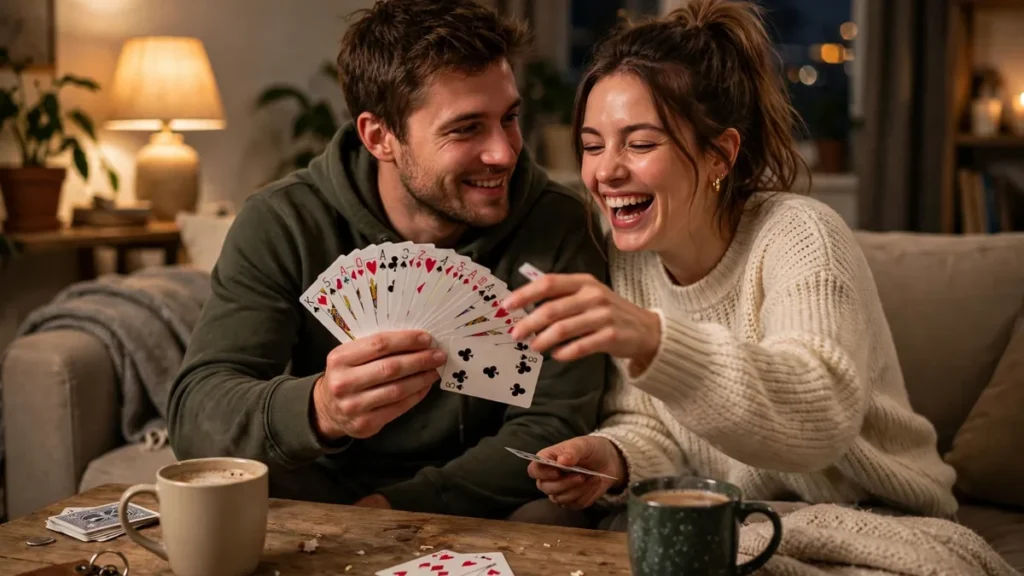
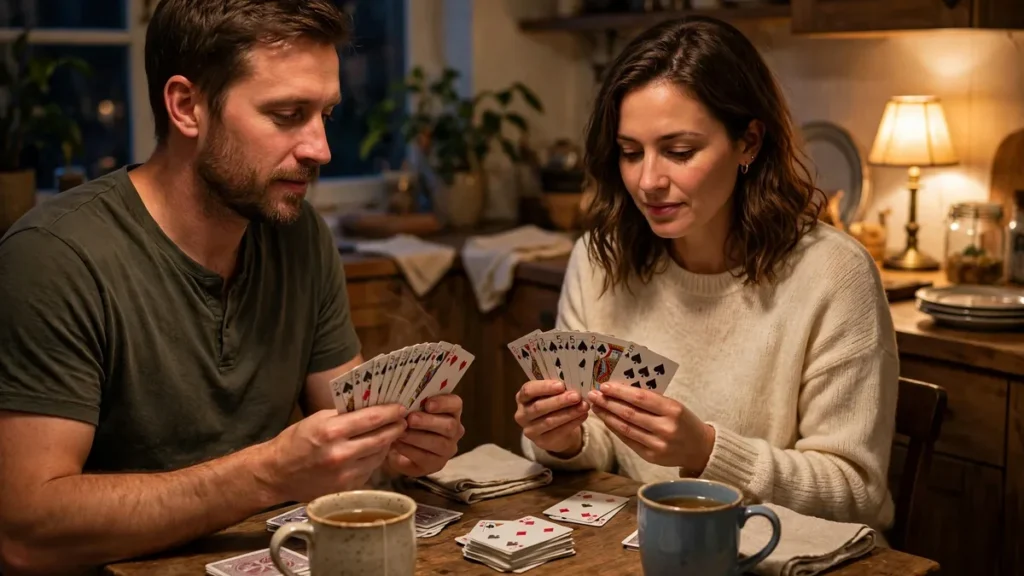
Home trivia nights are smaller and looser. A group of friends gathers in a living room, someone takes charge of the questions, and the rounds are played around a table with snacks and drinks. The format is the same — questions, teams, scores — but the scale is gentler, and the host is usually a friend rather than a professional. Home nights are a good place to start if the idea of a crowded pub feels too much for a first time.
Online trivia nights grew quickly when people started socialising over video calls, and they have stayed popular since. Teams join a call, the host shares questions on screen, and answers are sent through a form or a chat message. Some online nights are played by people in different cities or even different countries, which would be impossible in a pub. The core experience survives: a question, a discussion, and a score.
What to expect as a first-timer
If you have never been to a trivia night, the first visit is easier than it looks. You do not need to be a walking encyclopedia. You do not need to have a team ready. You do not even need to know the rules in advance, because the host will explain them. Here is what the evening will actually feel like.
Expect to feel out of your depth for the first round. Everyone does. The questions will cover topics you know nothing about, and a team at the next table will answer something instantly that leaves you blank. That is normal, and it passes quickly. By the second round, you will have contributed an answer — a song you recognised, a place you once visited, a fact you picked up years ago and never thought you would use. Most first-timers are surprised by how much they actually know once the questions start coming.
Expect to lose, or at least not to win. First-time teams rarely take the top prize, because the regulars have been building their knowledge together for weeks. That does not matter. The fun is in the rounds where your team does well, the answers you get right against the odds, and the running joke that starts at your table and carries through the night. Many regulars started with a last-place finish and came back because they enjoyed the evening anyway.
A few practical points help. Arrive a little early, so you can settle in before the first round. Bring a pen, though the host usually has spares. Put your phone away once the questions start, and enjoy the fact that nobody expects you to know everything. If you are joining a team of strangers, introduce yourself and mention a topic or two you are good at.
What a trivia night is not
A trivia night is not an exam. There is no pass mark, no certificate, and no consequence for a wrong answer beyond a lost point. The questions are meant to be fun, and the host wants the room to enjoy itself. A night where everyone scores badly is a badly run night, not a clever one.
A trivia night is not only for people who are good at quizzes. The team format exists precisely so that different strengths count. A person who knows nothing about history might be the one who recognises every song in the music round, or remembers the name of every football ground. The best teams are mixed, and hosts design their rounds with that in mind.
A trivia night is not quite the same as a game night, though the two overlap. A game night is built around board games or card games, where the players compete against each other or work together through a game with its own rules. A trivia night is built around questions, and the contest is between teams rather than within a game. The mood is similar — friends, snacks, friendly rivalry — but the activity at the centre is different, and the skills it rewards are different too. If you are weighing the two, our look at how a trivia night stacks up against a regular game night lays out the differences in detail.
Why people keep coming back
Trivia nights have been around for decades, and their appeal has proved durable. Part of it is the pleasure of remembering things — the small rush when a half-forgotten fact surfaces at just the right moment. Part of it is the social side: a regular evening with the same people, in the same place, with a shared activity to talk about afterwards.
There is also something satisfying about a format that rewards the odd corners of what you know. The facts that win trivia nights are rarely the ones you learned on purpose. They are the ones you picked up from a documentary, a song lyric, a holiday, a hobby, or a conversation years ago. A trivia night is one of the few places where that scattered knowledge is useful. That is why these evenings pull people together in a way that few other social formats manage.
Thinking of running one yourself?
Playing in a trivia night and organising one are two different jobs. If your first visit leaves you tempted to run a night of your own — for friends, a fundraiser, or a work event — the planning side is a bigger task than it looks, from choosing a theme to writing fair questions to keeping the scoring straight. Our guide to building a night from scratch walks through that process step by step, so you can start with the playing experience described here and move on to the organising side when you are ready.