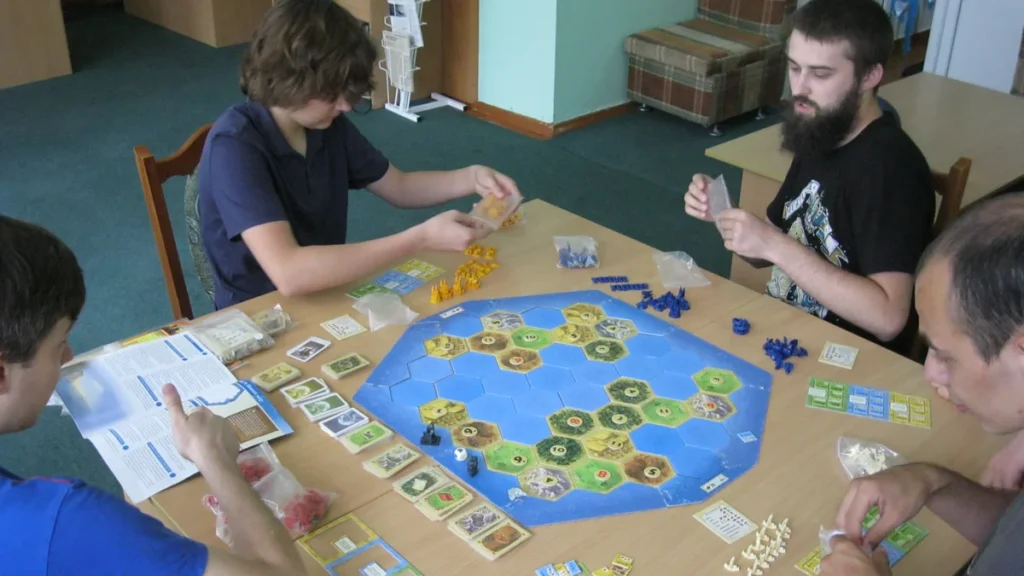
Four hundred and seventy-three players is a crowd, not a classroom. You cannot hand that many people one puzzle and expect a fair contest, so this plan splits the group into teams, runs nine different puzzle stations at the same time, and finishes with a short tournament that decides the winner. Every team visits every station, and nobody waits around with nothing to do.
The format works because it is built for scale. Teams of ten rotate through the stations in fixed time slots, so forty-eight teams can move through nine stations in a single day without a queue forming at any table. Each station tests a different kind of thinking, from untangling wire puzzles to estimating quantities, so a team that is weak at board strategy can still win points at the marble run or the estimation table.
This guide gives you the full plan: the nine games, the team sizes, the timing for each round, the equipment each station needs, and the scoring system that turns nine small results into one clear winner. Follow it as written and the day runs itself.
- Split 473 players into 47 teams of ten, with one team of thirteen, so every station has the same team size to plan around.
- Run nine stations at once and rotate teams every twenty minutes, which finishes the circuit in three hours.
- Give every game a different skill, from wire puzzles to dartboard maths, so no single strength decides the day.
- Score each station out of ten and add the nine scores together, then take the top eight teams into a short knockout tournament.
- Print spare puzzle sets, appoint one judge per station, and keep a visible scoreboard so every team knows where it stands.
How the day works
The day has three parts: the team circuit, a short break, and the final tournament. In the circuit, all forty-eight teams play at the same time, one team per station, with the rest waiting at tables with practice puzzles. Every twenty minutes a bell sounds and every team moves one station forward, so after nine rounds each team has played all nine games. The break gives the judges time to check the scores, and the tournament gives the top eight teams a head-to-head finish the whole hall can watch.
Team size matters more than anything else in a group this large. Ten players per team is the sweet spot: big enough that every team has a mix of skills, small enough that everyone at the table gets a turn. With 473 players you get forty-seven teams of ten and one team of thirteen, so the larger team splits into two groups for the hands-on games and plays together for the quiet thinking games. Every station is scored out of ten whatever the team size, so the bigger team gets no advantage from its extra hands.
The hall needs nine station tables, a rest area with practice puzzles, a scoreboard everyone can see, and a separate space for the final tournament. Put the noisy stations, the marble run and the human knot, at one end of the hall, and the quiet stations, the wire puzzles and the estimation table, at the other end, so concentration is not broken by cheering. One judge per station keeps the rules honest, and one floating organiser with a whistle keeps the rotations on time. If you want to see how the same station format works with a slightly smaller crowd, the 470-player puzzle plan runs the same nine-station circuit with forty-seven teams and is a useful check on timings and table layouts.
Timing is simple and strict. Twenty minutes per station, five minutes to move and reset, gives a round of twenty-five minutes and a full circuit of three hours and forty-five minutes including the opening briefing. Add a thirty-minute lunch break after round five and an hour for the final tournament. The whole day fits into five and a half hours, which leaves time for the prize-giving without rushing the last games.
The nine games at a glance
| Game | Players per team | What teams do | Round time |
|---|---|---|---|
| Wire Puzzle Challenge | 10 | Untangle metal wire puzzles against the clock | 20 minutes |
| Backgammon Puzzle Race | 10 | Choose the best move on printed backgammon boards | 20 minutes |
| Connect Four Puzzle Race | 10 | Build four in a row while blocking the other side | 20 minutes |
| Marble Run Challenge | 10 | Build a track that carries a marble from top to bottom | 20 minutes |
| Estimation Challenge | 10 | Guess quantities in jars and on the table | 20 minutes |
| Tic-Tac-Toe Puzzle Race | 10 | Solve noughts and crosses boards in the fewest moves | 20 minutes |
| Hex Connection Race | 10 | Connect opposite sides of a hexagonal board | 20 minutes |
| Human Knot Challenge | 10 | Untangle a circle of joined hands without letting go | 20 minutes |
| Dartboard Maths Race | 10 | Hit exact scores using mental arithmetic and darts | 20 minutes |
The nine games in detail
1. Wire Puzzle Challenge
Each team gets a set of six metal wire puzzles, the kind where two shaped pieces lock together and only one exact twist frees them. The team has twenty minutes to separate as many as possible, and every solved puzzle earns points, with a bonus for the team that frees all six first. The judge watches for the one rule that matters: no forcing, because a bent wire is a broken puzzle and a broken puzzle costs the team the points for that piece.
Wire puzzles suit a big group because they are silent, cheap, and easy to reset. Buy six different designs per station so teams cannot copy the solution from the team before them, and keep a spare set under the table for the moment a wire bends.
2. Backgammon Puzzle Race
Backgammon is a race game played with dice and fifteen checkers, and in this station the team solves printed positions instead of playing a full match. The judge gives the team ten boards, each one mid-game with a dice roll shown, and the team must choose the best move: which checkers to shift, which blot to hit, and when to start bearing off. Each correct move earns one point, and the team that solves the most boards in twenty minutes wins the station.
The boards get harder as the stack goes on, starting with an obvious move that bears a checker off and ending with positions where the right play is to leave a blot exposed as a trap. Teams do best when they count the pips before moving, because backgammon punishes a move that looks safe but leaves the back checkers stranded.
3. Connect Four Puzzle Race
Connect Four is a race to place four discs in a row on a standing grid, and in this version the team plays as a single side against a clock rather than against another team. The judge sets up a half-finished board with a winning move hidden in it, and the team must find the winning drop, working through a stack of ten printed positions in twenty minutes. Each solved board earns one point, and the team that solves the most boards wins the station.
The printed positions get harder as the stack goes on, starting with an obvious three in a row and ending with boards where the winning move is a diagonal hidden behind a trap. Teams do best when they talk through the board out loud, because the later boards punish a rushed first move.
4. Marble Run Challenge
The marble run station gives each team a box of tracks, tubes, funnels, and supports, and one marble. The task is to build a run that carries the marble from the top of the table to a cup on the floor without the marble stopping or falling off, and the team has twenty minutes to design, build, test, and rebuild. Points come from the height of the start, the turns the marble survives, and a clean finish in the cup.
This is the loudest station in the hall, so it should sit at the far end away from the quiet tables. Teams usually fail their first build in five minutes, which is the point: the station rewards teams that test early and fix the weak joint instead of starting again.
5. Estimation Challenge
Estimation is the simplest station to run and one of the hardest to win. The table holds ten sealed jars and boxes filled with everyday objects: dried beans, paper clips, buttons, marbles, and coins. The team has twenty minutes to estimate how many items are in each container, writing one number per container, and the team scores a point for every estimate that lands within ten percent of the true count.
The skill here is reasoning, not guessing. Count one small corner of a jar, multiply by the number of corners, and check the answer against the weight of the jar in your hand. Teams that guess wildly score two or three points; teams that measure and multiply score seven or eight.
6. Tic-Tac-Toe Puzzle Race
Tic-tac-toe looks too simple for a tournament until you play it as a puzzle race. The judge gives the team a set of ten printed boards, each one mid-game with a single move that guarantees a win or blocks a loss, and the team must circle the correct square on every board before time runs out. The early boards are obvious, but the later ones hide the winning move in a fork, where one move creates two threats and the opponent can only block one.
Each correct board earns one point, and the team that finishes all ten first earns a bonus point, so the maximum is ten. The station needs nothing beyond printed sheets and pencils, so it can run anywhere, even at the rest tables.
7. Hex Connection Race
Hex is played on a rhombus board of hexagonal cells, and the aim is to connect your two opposite sides with an unbroken chain of your own stones. In this station two players from the team share one side, placing stones in turn while the rest of the team watches the board and advises, and the team scores for the shortest chain it can build before time runs out. A completed connection earns ten points, and a chain that falls one stone short earns eight.
The game rewards blocking as much as building, because every stone your team places can also cut off the other side, and a single gap in the chain is enough to lose the game. Teams that plan three moves ahead win this station; teams that place the first stone they see lose it. The board is small and the stones are simple, so the station is quiet and easy to reset between teams.
8. Human Knot Challenge
The human knot is the most physical game on the circuit and the one teams remember longest. Ten players stand in a circle, reach across, and take the hands of two different people, forming a tangled knot of arms. The team must untangle itself into a single circle without letting go of any hand, talking and stepping over and under arms until the knot opens. The judge times the team, and the score depends on the time: under five minutes earns ten points, and every extra minute costs one point.
The station needs a clear floor space and a judge who watches for the one rule: no letting go, even for a moment, because a released hand breaks the knot and the team must start again. The best teams appoint one caller outside the circle to direct the moves, while everyone else follows instructions. For a full walk-through of how to run the whole day, the step-by-step plan for running puzzle games for 471 players covers the same rotation, briefing, and judging routines in the order you will need them.
9. Dartboard Maths Race
The dartboard maths race turns arithmetic into a team sport. The judge calls out a target number, and the team must reach exactly that number with three darts, which means choosing the right combination of singles, doubles, and trebles before anyone throws. A target of fifty-one can be treble seventeen and forty can be double twenty, but the team has to work out the combination first and then throw it. Each exact finish earns points, and the team that finishes the most targets in twenty minutes wins the station.
Safety comes first: the board hangs on a wall with a clear throwing line two metres back, and nobody crosses the line while darts are in the air. The maths is the real game, because teams that break a number into three dart scores in their heads finish twice as many targets as teams that throw first and add up later.
Setting up the stations
Good setup is what turns nine good games into a day that actually works. Most of the work happens the day before, and the checklist below covers it in order, from the hall layout to the spare equipment that saves you when something breaks.
- Book a hall with nine station tables, a rest area, and a clear floor space for the human knot, and mark each station with a large numbered sign.
- Print the score sheets, rotation cards, and answer sheets for the estimation and tic-tac-toe stations, with one spare set per station.
- Pack a spare wire puzzle set, spare marbles, spare darts, and spare printed boards, because the station that breaks is always the one with no spares.
- Brief one judge per station the night before, give each judge the scoring rules on a single card, and agree on the bell signal for rotations.
- Set the scoreboard where every team can see it, and appoint one scorer who updates it after every round so the leaderboard stays honest.
- Test the marble run, the dartboard, and the human knot floor space on the morning of the event, before the first team arrives.
Scoring and the final tournament
Every station is scored out of ten, so every team finishes the circuit with a total out of ninety. The nine station scores are added together, and the eight highest totals go through to the final tournament, with ties broken by the fastest total circuit time. The scoreboard shows the running totals after every round, which gives teams at the bottom something to chase.
The final tournament is a simple knockout. The top eight teams are paired first against eighth, second against seventh, and so on, and each pair plays a single head-to-head game chosen by the organiser, such as a wire puzzle sprint or a marble run build-off. The four winners go to the semi-finals, the two winners of those meet in the final, and the knockout takes about an hour. The same knockout structure appears in the running plan for 463 players, where the top eight teams play off in the same way after the circuit ends.
Prizes should reward more than the winner. Give a prize to the winning team, a prize to the best single station score, and a prize to the team that improved the most between the first and last rounds, which you can read straight off the scoreboard. Three prizes give every team a reason to keep playing hard even after the top eight is out of reach.
Frequently asked questions
How do 473 players fit into teams?
Split the group into forty-seven teams of ten and one team of thirteen. The thirteen-player team splits into two smaller groups for the hands-on stations and plays together for the quiet games, and every station is scored out of ten whatever the team size.
How long does the whole day take?
The circuit takes three hours and forty-five minutes with twenty-minute stations and five-minute changeovers, plus a thirty-minute lunch break and an hour for the final tournament. The full day fits into five and a half hours.
Do we need a big hall?
You need nine station tables, a rest area, and a clear floor for the human knot, which fits in a large school hall or community centre. If the hall is small, put the noisy stations in one room and the quiet stations in another.
What if a team has never played one of the formats?
Every station starts with a two-minute explanation from the judge, and the first round is always the slowest while teams learn the rules. Print the rules for each game on a card at the station.
Can younger or older players take part?
Yes, because every station can be adjusted without changing the rules. Younger players get the finish chart at the dartboard and simpler wire puzzles, older players get the harder tic-tac-toe boards, and the human knot works at any age because it rewards talking more than strength.
What should we do if a puzzle set breaks during a round?
Stop the clock for that station, hand the team the spare set from under the table, and add the lost minutes to the end of their round. If the spare set is also broken, move the team to the rest tables with a practice puzzle and score them on that instead.
The bottom line
Nine stations, forty-eight teams, one clear winner. Split the group, rotate every twenty minutes, score every station out of ten, and let the top eight fight it out in the knockout. Do that, and 473 players get a full day of puzzles with no queues, no confusion, and no team left standing around.