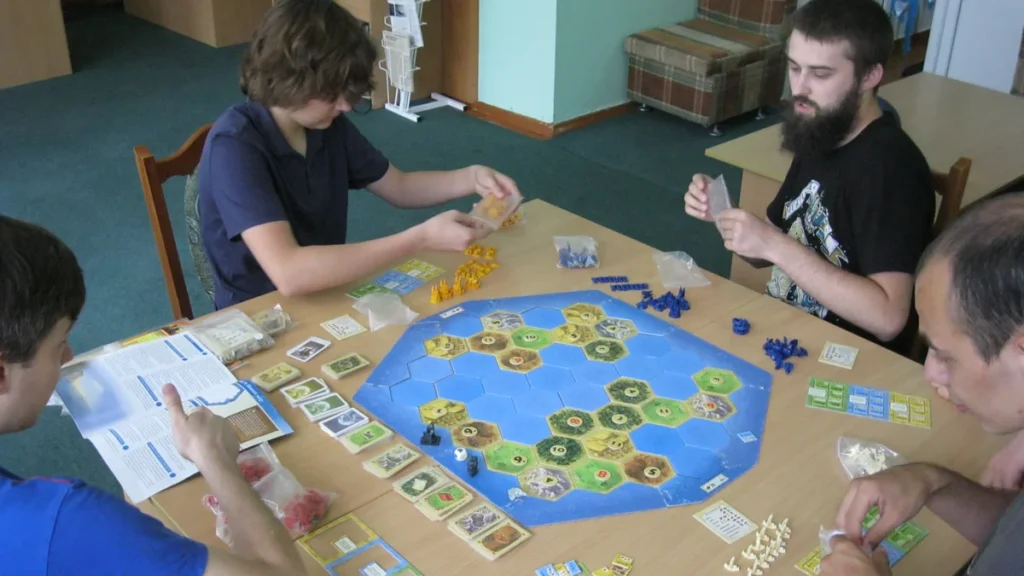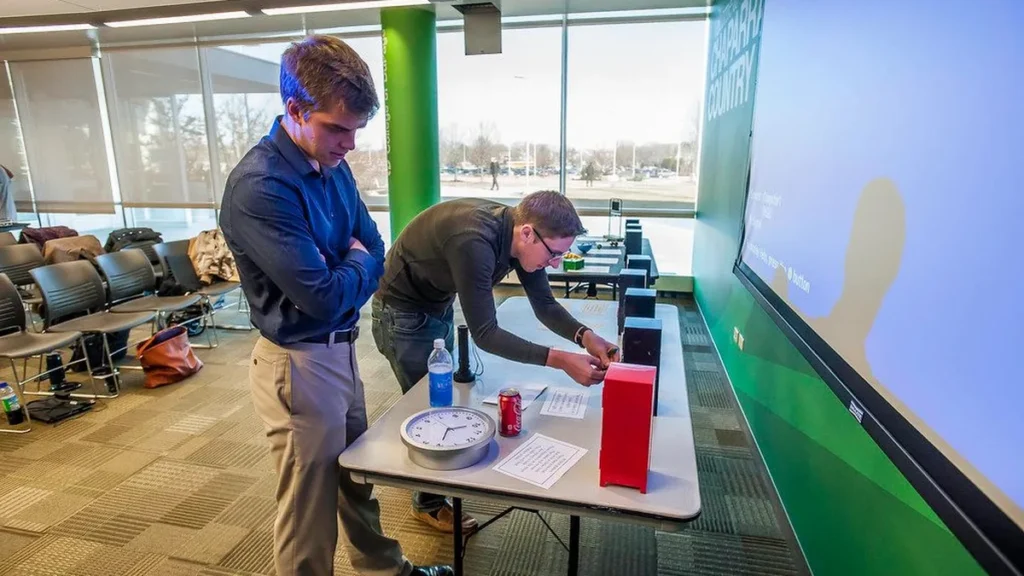
Four hundred and sixty-nine players sounds like too many people for a puzzle day, until you picture it as thirty-one small teams instead of one huge crowd. Each team has fifteen or sixteen players, its own table, and its own route through nine puzzle stations. The size of the group stops being a problem the moment the day is built around teams and stations rather than one big room doing one thing at once.
This plan runs on a simple rhythm. Teams rotate through nine stations, spending twenty minutes at each one, and every station holds a different kind of puzzle. Three or four teams share a station in each round, working at separate tables with separate puzzle packs, so a station never feels crowded even when the hall is full. A bell marks the end of each round, teams move on, and the scoreboard is updated while they walk.
What makes the plan work for 469 players is that nothing depends on one host talking to the whole hall. Each station has a printed instruction sheet, a worked example, and a team captain who reads the rules aloud. The games below were chosen because they scale: they use cheap printed materials, they work with fifteen people at a table, and they can be scored quickly by a volunteer with an answer sheet.
Key takeaways
- Split 469 players into 31 teams of 15 or 16, so every player has a table and a role.
- Run nine stations at twenty minutes each, with three or four teams sharing a station per round.
- Pick puzzles that use printed sheets and simple props, so every station can be reset in two minutes.
- Score each station out of ten points, and update a visible scoreboard between rounds.
- Brief team captains, not the whole hall, and let the printed sheets do the explaining.

How the day works
The day is built around thirty-one teams and nine stations. Twenty-seven teams have fifteen players and four teams have sixteen, which absorbs all 469 players without leaving anyone as a spare. Each station is run by one volunteer who hands out the puzzle pack, starts the timer, and collects the answer sheet at the end of the round.
Rounds last twenty minutes, with five minutes between rounds for moving, scoring, and resetting the station. Three rounds run back to back, then a fifteen-minute break, then three more rounds, then lunch, then the final three rounds. The 467-player plan uses the same station rotation with a different set of nine games, and it works on the same timetable.
| Time | What happens |
|---|---|
| 9:00 | Doors open, teams check in, captains collect route cards and answer sheets |
| 9:30 | Captain briefing and a five-minute practice round at the first station |
| 10:00 | Rounds one to three, twenty minutes each with five-minute changeovers |
| 11:15 | Fifteen-minute break and scoreboard update |
| 11:30 | Rounds four to six, twenty minutes each with five-minute changeovers |
| 12:45 | Lunch break, forty-five minutes, stations reset for the afternoon |
| 13:30 | Rounds seven to nine, twenty minutes each with five-minute changeovers |
| 15:00 | Final scoring, tie-break round if needed, and the prize ceremony |
The nine games
Each game below fills one station, and each one was picked because it works with a big team at a table and can be scored in under a minute. That mix keeps energy up across nine rounds and gives every kind of player a station where they shine. If your group prefers grid puzzles, the 465-player plan is built entirely around them instead, but the nine games here need no grid knowledge at all.
1. Coin Target Challenge
Each team receives a tray of mixed coins and a set of ten target amounts, and must make each amount exactly using the coins in the tray. Teams score one point per correct amount, with a bonus for any amount made with the fewest coins possible. A second set of target cards is used in later rounds, so no team can memorise the answers from an earlier round.
Setup is one tray of coins and one set of target cards per team, plus a spare tray at the station for any coins that roll off the table. Use real coins in mixed values, and print the target amounts on cards large enough to read from across a table. This game scales because fifteen players can work on different targets at the same time, and the only equipment is a tray of coins. It is quick to score, fast to reset, and suits players who like working with their hands.
2. Timeline Order Challenge
Each team gets a set of twenty event cards, from the invention of the printing press to the first Moon landing, and must arrange them in the correct order on the table. The cards show the event and a short clue, but no dates, so teams have to reason about what came before what. Points are awarded for each card in its correct position, with a bonus for a fully correct timeline.
Setup is a shuffled pack of twenty cards per team and a long table where the line can be laid out. Print the cards on thick paper so they survive nine rounds of handling, and number the backs in the correct order so the volunteer can score the line in seconds. This game scales because it turns a history question into a team discussion, and fifteen people can argue about the order of twenty cards without anyone being left out.
3. Atlas Outline Challenge
Each team receives a blank outline map of a continent and a set of twenty place labels, and must pin each label in the right place. The labels name cities, rivers, and mountain ranges, and the map shows coastlines and borders but no names. Teams score one point per correctly placed label, with a bonus if every label is right.
Setup is one large printed outline map per team, twenty small labels with sticky backs, and a reference map kept by the volunteer for scoring. Print the map at least A3 size so fifteen people can gather around it,. This game scales because it is visual and hands-on, and a team can split the work by region: some players place the northern cities while others work on the south.
4. Sound Clue Challenge
Each team listens to ten short sound clips played on a speaker, from a kettle boiling to a train leaving a station, and must write down what each sound is. The clips last five seconds each and play twice, and teams score one point per correct answer. A bonus point goes to any team that also names the odd sound out, a clip that does not belong with the rest.
Setup is a phone or small speaker, a playlist of ten clips, and an answer sheet per team. Keep the volume low enough that the sound stays at one station, and choose everyday sounds rather than obscure ones so the game is fair. This game scales because listening has nothing to do with reading speed or puzzle experience, so it gives quieter players a real chance to lead.
5. Dice Pattern Puzzle
Each team receives a tray of twelve dice and a target pattern card showing a three-by-four grid of faces, and must arrange the dice so the top faces match the card exactly. Dice may be rolled and turned, but not stacked, and the team scores points for each row that matches, with full points for a perfect grid. Three pattern cards of rising difficulty are used across the day.
Setup is one tray of dice and one pattern card per team, plus a spare set of dice at the station for any that roll off the table. Use standard six-sided dice with clear pips, and print the pattern cards large enough to read from across a table. This game scales because twelve dice and fifteen players means everyone has something to roll, turn, or check, and the team has to agree on a plan instead of one person doing all the work.
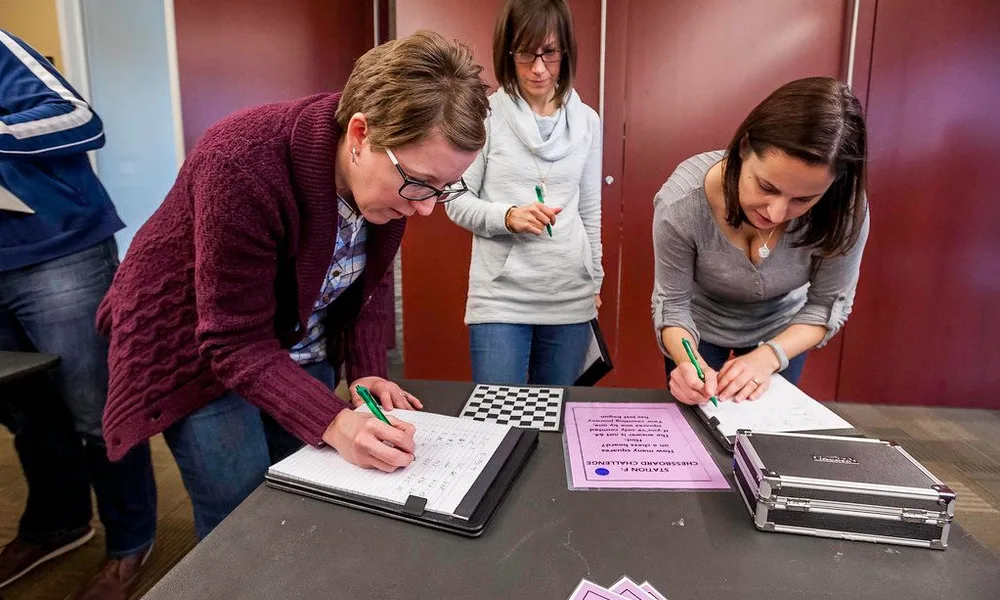
6. Playing Card Sequence
Each team receives a shuffled pack of playing cards and a clue sheet describing a target sequence, such as all the red cards in ascending order followed by all the black cards in descending order. The team must arrange the full pack into the target order, using the clues to work out the exact sequence. Points are awarded for each correctly placed run of five cards, with full points for a perfect pack.
Setup is one pack of cards and one clue sheet per team, and a reference sequence kept by the volunteer. Use large-print cards if you can, so the whole team can read them from around the table, and use a different target sequence each round. This game scales because a full pack of fifty-two cards gives a team of fifteen plenty to sort, check, and rearrange at the same time.
7. Mirror Drawing Challenge
Each team must copy a simple line drawing, such as a star or a house, while looking only at its reflection in a mirror. The paper sits behind a small screen so the player cannot see it directly, and the team takes turns, with each player drawing one line before passing the pen on. The team scores points for accuracy, judged against the original by the station volunteer.
Setup is one mirror, one screen, one drawing to copy, and a stack of paper and pens per team. Use bold, simple shapes with five or six lines, and keep a fresh copy of the original at the station for scoring. This game scales because it is funny to watch and impossible to rush: every player has to take a turn, and the whole team gathers around to coach the person holding the pen.
8. Flag Fragment Puzzle
Each team receives twenty cropped fragments of national flags, showing just a corner, a stripe, or a symbol, and must name the country each fragment comes from. Teams score one point per correct country, with a bonus for naming all twenty. The fragments are printed on cards, and teams may ask the volunteer for one hint per round, at the cost of one point.
Setup is a set of twenty fragment cards per team and an answer key kept by the volunteer. Choose a mix of famous flags and less familiar ones, and crop each flag tightly enough that the answer is a puzzle rather than a giveaway. This game scales because it is a quick, visual quiz that a whole team can play at once, with different players recognising different flags.
9. Hidden Object Hunt
Each team receives one large, busy printed scene, such as a market square or a workshop, and a list of twenty small objects hidden inside it. The team must find every object and circle it on the sheet, scoring one point per object found, with a bonus for a complete list. The scene is the same for every team at the station, but the object list changes each round.
Setup is one printed scene per team, one object list per round, and a set of pens for circling. Print the scene at least A3 size so fifteen people can search it together, and choose a scene with plenty of detail: shelves, crowds, tools, and signs all make good hiding places. This game scales because a single big picture gives fifteen pairs of eyes something to do at the same time, and the team naturally splits the search by area.
Setting up for 469 players
Good setup is what turns a clever plan into a smooth day. Most of the work happens the day before: printing the packs, labelling the stations, and briefing the volunteers. On the morning itself, the organiser should be free to walk the hall and fix problems, not stuck at a station.
Count the materials carefully before the day, because 469 players use a lot of paper. Each station needs enough packs for thirty-one teams across the day, plus spares, and each team needs a fresh answer sheet at every station. The 464-player tournament format shows another way to rank a large field when you want a single champion at the end.
Setup checklist
- Print thirty-five packs per station, four more than the thirty-one teams, so damaged sheets never stop a round.
- Label every station with a large number and a one-line description of the game, visible from across the hall.
- Give each team captain a route card, a pen, and a folder for the nine answer sheets.
- Place a visible clock or timer at every station, and agree on one sound for the end of each round.
- Keep spare pens, paper, dice, and cards in a box at the scoring table for quick replacements.
- Set out water and a first-aid kit at the scoring table, and mark the nearest toilets on the route card.
Scoring that stays fair
Every station is scored out of ten points, so the maximum score for the day is ninety. The volunteer marks the answer sheet as soon as a team hands it in, writes the score on the sheet and on the team folder, and sends the sheet to the scoring table. Two scorers add the numbers to the scoreboard during the changeover, so the hall always knows where every team stands. If two teams finish level at the end of the day, the tie is broken by the fastest total time across the nine stations, which the volunteers record at each round.
Fairness also depends on keeping the stations separate. Teams at the same station work at different tables with different puzzle packs, and the volunteer watches for copying between tables. Answer sheets are collected before teams move on, so no team can carry an answer to the next round.
Frequently asked questions
Do players need to know these puzzles before the day?
No. Every station has a printed instruction sheet and a worked example, and the team captain reads the rules aloud before the timer starts. The games were chosen so that a complete beginner can start playing within two minutes, and the practice round at 9:30 gives every team a chance to ask questions before the scoring begins.
What happens if a team has fewer than fifteen players?
The plan still works. A team of twelve or thirteen players can play every station, because none of the games needs a full fifteen to function. The team simply has fewer hands to split the work, so the captain should give each player a clear role.
How do you stop teams from copying each other?
Three or four teams share a station, but each team works at its own table with its own puzzle pack, and the packs are different in each round. Volunteers watch the tables, answer sheets are collected before teams move on, and the sound and card games use different clips and sequences for each team. The scoreboard also rewards speed, so a team that waits to copy will run out of time.
What if a puzzle sheet has a printing mistake?
Each station keeps four spare packs, so a faulty sheet can be swapped in seconds. If the mistake is found after a round has started, the volunteer tells every team at that station, and the scorers adjust the round so that all teams are marked on the same basis. The instruction sheets are checked the day before, and the volunteer reads the worked example aloud to catch errors early.
Can this plan work in a smaller hall?
Yes, with two changes. First, run the nine stations in two waves instead of one, so only half the teams are playing at any time and the rest wait in a second room. Second, shorten the rounds to fifteen minutes and use the waiting time for the scoreboard and the prize ceremony. The games themselves need no more than a table each, so the plan fits any hall that can hold sixteen tables.
What should the winning team receive?
Keep the prize simple and shared, so the whole team can enjoy it. A trophy or a medal for each player works well, and a small puzzle book or a box of games for the team table is a prize that gets used rather than put in a drawer.
Bottom line
Running puzzle games for 469 players is a logistics job with a puzzle theme, and the logistics are simple: thirty-one teams, nine stations, twenty minutes a round, and a scoreboard everyone can see. The nine games in this plan need nothing more than printed sheets, dice, cards, and a speaker, yet they give every player a different skill to use and every team a fair chance to win. Print the packs, brief the captains, and let the rotation do the work.