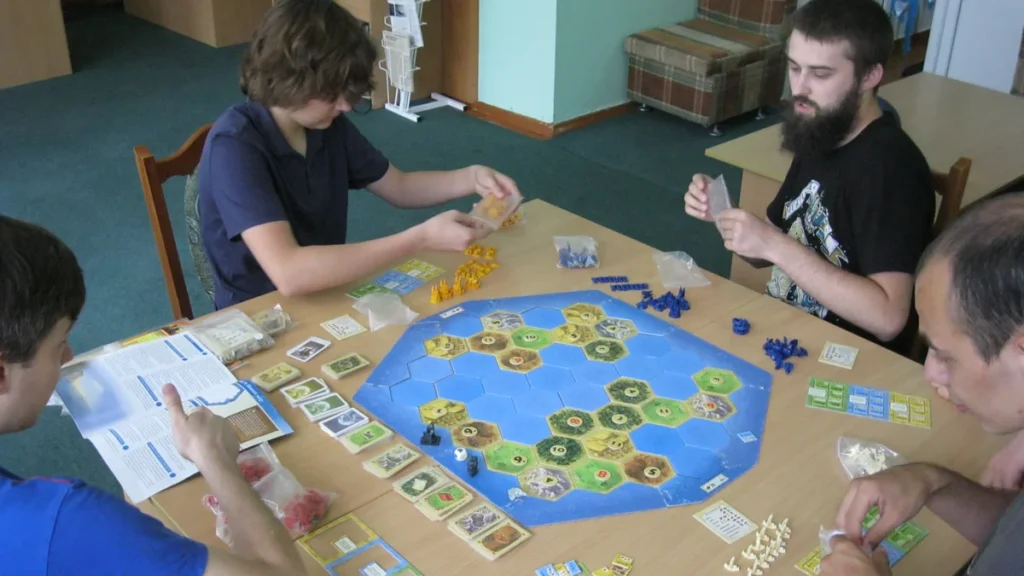
Four hundred and sixty-six players, one evening, and a hall full of board games sounds impossible until you stop picturing a single giant table. Nobody seats 466 people around one board. A night this size works like a festival: many small tables, all playing at the same time, under one simple plan.
The trick is to treat the evening as ninety-three tables of five players rather than one crowd of 466. Five is the sweet spot: everyone gets a turn quickly, and a table can finish a game in under an hour. The nine games in this guide were picked because they survive that multiplication without losing what makes them fun.
Each game below explains how it works when dozens of tables play it at once, what you need to set it up, and why it scales. You will also find the numbers for the night, a short checklist, and answers to the questions every organiser asks first. For the same idea one step down in size, the board games we chose for 464 players show the format in action with a slightly smaller hall.
Key takeaways
- 466 players means 93 tables of five, plus a few spare tables for late arrivals and broken pieces.
- Pick games that teach in five minutes, play in under an hour, and work with five players at a table.
- Run the night in rounds with a clear start and finish, so every table moves together.
- Give each table a printed rules card and one named helper for every ten tables.
- End with a short final round for table winners, so the evening builds to one shared moment.

How 466 players actually play together
A crowd of 466 does not play one game. It plays the same game ninety-three times, or it plays nine different games across ninety-three tables, and the host holds it all together with a clock. Pick one format before the night begins, print it on the welcome sheet, and do not change it halfway through.
The team format
In the team format, each table of five is a team, and the team plays together against the game or against the other tables. Scores are added up at the end of each round, and the best tables go forward to a final. This is the calmest format for a first night, because nobody is knocked out early and every player stays involved until the last round. It also suits the heavier games here, since a table can talk through a tricky move together. All you need is one score sheet per table and a whiteboard scoreboard at the front of the hall.
The station format
In the station format, the hall is divided into stations, each running a different game, and tables rotate when the host calls time. A table might start with Kingdomino, move on to Five Tribes, and finish with Caverna. Nobody plays the same game twice. This suits a mixed crowd best, because a player who struggles with one game gets a fresh start twenty minutes later. It needs clear signs, a printed rotation order, and a bell the whole hall can hear. A station night like the one we ran for 462 players works best when the rotation is printed in advance and nobody has to ask where to go next.
The tournament format
In the tournament format, tables play the same game in rounds, winners move up to a higher table, and the evening ends with a final table of the best players in the room. This is the format for a crowd that already knows board games and wants a contest. It creates the most excitement, because every round has something at stake, and the final table becomes a small show the rest of the hall can watch. It needs the most helpers, since results must be recorded after every round, so keep games short, set a firm time limit, and decide ties before the night starts.
The numbers for a 466-player night
Before you buy or borrow a single box, work out the numbers. The table below shows the shape of the evening for each format, using five players per table and one helper for every ten tables as the starting point. These are planning numbers: a hall with long tables can seat six to a table.
| Format | Tables needed | Players per table | Helpers needed | Best for |
|---|---|---|---|---|
| Team play | 93 | 5 | 10 | First-timers and mixed groups |
| Station rotation | 93 | 5 | 12 | Mixed experience and short games |
| Tournament | 93 | 5 | 14 | Confident players who want a contest |
| Mixed evening | 90 | 5 | 10 | A relaxed night with room to spare |
The mixed evening is the honest fallback, and the one most organisers actually run: ninety tables playing, three free, so late arrivals have somewhere to sit and a table with a missing piece can be swapped out. Count the boxes the same way. If every table plays the same game, you need ninety-three copies, which means borrowing from a games library. If stations run nine different games, you need about ten copies of each.
The 9 board games for 466 players
Every game below was chosen against three tests. It must teach in about five minutes, so a helper can explain it without a long speech. It must play in under an hour with five players, so the rounds stay on schedule. And it must still feel like itself when ninety-three tables play it at once: clear turns, visible scores, and no long waits. None of these nine appeared in our recent board game guides for 440 to 464 players.
1. Ark Nova
Ark Nova is about building a modern zoo, and it works for a huge group because every player builds their own zoo on their own board. There is very little waiting: while one player takes a turn, the others plan their next move, so a five-player table keeps moving. The theme does much of the teaching: everyone understands feeding animals and attracting visitors.
Setup means one box per table, a printed rules summary, and a helper who has played at least twice. Lay the table out in advance and keep the animal cards in tidy piles. Give each table a full hour and a firm finish time. Ark Nova scales because it is a race of parallel building rather than a fight over one shared board: ninety-three tables can build ninety-three zoos at once, and the winner at each table is simply the zoo that scores best.
2. Caverna
Caverna is about dwarves digging out a cave, farming, and furnishing rooms, and it suits a large night because the rules are steady and the choices are clear. Each turn a player sends one dwarf to work, and the board changes slowly enough that new players can follow what is happening. It is a calm game, a good anchor for a hall that also runs louder games.
Setup needs one box per table and a little more space than most games, since each player has a home board too. Put resources in small bowls so they do not roll, and print a short guide to the action spaces. Caverna scales because every table runs the same quiet engine at the same pace, and the scoring is simple enough for helpers to check a final score in under a minute.
3. Orléans
Orléans is about traders, craftsmen, and scholars in medieval France, played by drawing worker tokens from a bag and sending them to useful places. It works for a huge group because the bag draw gives every turn a small moment of luck, and the planning is done on each player’s own board. A table of five plays in about an hour, and the game ends when the goods run out, so rounds finish on time.
Setup is one box per table, with tokens sorted by colour the day before and bagged by colour, saving ten minutes at every table. Print a picture guide to the buildings: new players remember a picture faster than a paragraph. Orléans scales because the bag draw keeps every table slightly different: no two tables tell the same story, and that gives players something to talk about when the rounds change over.
4. Keyflower
Keyflower is about building a village over four seasons, using coloured workers to bid for tiles and claim actions. It works for a huge group because bidding keeps every player involved in every round: you watch the tiles, count your workers, and decide whether to outbid the player next to you. A five-player table finishes in about an hour once everyone knows the flow.
Setup needs one box per table and a helper who can explain bidding in one minute: place workers, win the tile, use the tile. Keep the tiles in season order, so nobody sorts them while players wait. Keyflower scales because bidding is a self-balancing system: a table of strong players and a table of new players both reach a fair, tense finish, and the winner is the village that scores best across the four seasons.

5. Five Tribes
Five Tribes is about moving meeples across a tiled board, claiming tiles, and collecting sets of goods in a desert market. It works for a huge group because the board is different every time, the turns are short, and the scoring rewards clever moves rather than long speeches. Players pick up meeples, drop them one by one across the tiles, and take the action of the last tile they land on.
Setup is one box per table, with tiles shuffled and meeples bagged by colour in advance. Print a scoring guide, since the final count has several parts. Keep spare meeples at the helpers’ table: small wooden pieces are the first things to go missing. Five Tribes scales because every table plays a fresh puzzle: the board is built from shuffled tiles, so no table can copy another table’s plan.
6. Kingdomino
Kingdomino is about building a small kingdom from domino-shaped tiles, matching landscapes and placing crowns where they score best. It is the lightest game on this list, and it earns its place because it teaches in two minutes and plays in fifteen. A table of five can play three games in the time one heavy game takes, which makes Kingdomino the perfect opener, the perfect filler, and the perfect game for first-timers.
Setup is almost nothing: one box per table, tiles in the bag, and a short demonstration. Put Kingdomino nearest the door, so late arrivals can join within a minute of sitting down. It scales because it is fast and friendly: a whole hall can learn it from a single demonstration, and the short games mean nobody is ever stuck at a table they do not enjoy for long.
7. Le Havre
Le Havre is about building a harbour town, taking goods, and shipping them for profit, and it suits a large night because its rhythm is steady and its choices are visible. Each turn a player takes goods or uses a building, and the shared board shows exactly what is available, so new players can learn by watching. It is longer than most games here, so it belongs mid-evening, when the hall has settled.
Setup needs one box per table, goods sorted into bowls, and a printed guide to the buildings. Give Le Havre tables seventy-five minutes and a helper who has played it before. It scales because the harbour is a shared market: every table runs the same economy at the same pace, and the final scoring is a simple count of money and buildings, which helpers can check quickly.
8. Twilight Imperium
Twilight Imperium is the biggest game here: a space opera of fleets, diplomacy, trade, and galactic politics that can take a whole evening. It works for a crowd of 466 not as a game for every table, but as the showpiece. Give it to the most experienced tables, let them play one long game across the night, and let the rest of the hall watch. A Twilight Imperium table becomes a talking point between rounds.
Setup is a project: one box per table, a large table with room for the galaxy, and players who have read the rules before the night. Do not seat a new player here. Assign your most confident helper to each table, and agree on a finish time before the first move, with the winner decided by points. It scales in a different way from the other games: not by multiplying tables, but by giving a huge night one epic story that everyone follows.
9. Nemesis
Nemesis is about a crew waking on a damaged spaceship, trying to survive while something hunts them in the dark. It works for a huge group because it is loud, tense, and full of stories: players whisper, argue, and laugh, and every table ends the game with a tale to tell. It makes a big night feel like an event, because the noise and excitement carry across the hall.
Setup needs one box per table, the rooms laid out in advance, and a helper who can run the first round as a demonstration. Keep the lights low at the Nemesis tables if the hall allows it, and keep spare character cards at the helpers’ table. Nemesis scales because the story is the product: ninety-three tables do not need identical games, they need identical excitement, and a spaceship full of surprises delivers it every time.
Your checklist for the night
Print this list for every helper before the doors open. A 466-player night fails on small things: a missing piece, a table without a rules card, a round that starts late.
- Count the tables, the chairs, and the games the day before, and lay out ten percent more chairs than you need.
- Put a printed rules card, a score sheet, and a pencil on every table before the first player arrives.
- Brief every helper on one game only, and give each helper a named set of ten tables to look after.
- Test the bell, the whistle, or the microphone from the far corner of the hall, not from the front.
- Set a visible clock for each round, and call time five minutes before the round ends so tables can finish.
- Keep spare pieces, spare score sheets, and one spare copy of each game at the helpers’ table.
Frequently asked questions
Can one board game really seat 466 players?
No single board seats 466 players. A night for 466 players is ninety-three tables of five, all playing at the same time under one plan. The games here play well with five people and finish in about an hour.
How many tables do 466 players need?
Ninety-three tables of five, plus two or three spares for late arrivals and damaged games. Long tables that seat six cut it to seventy-eight, but five to a table is safer, because most board games play best with five.
How many helpers do we really need?
Ten to fourteen, depending on the format: about ten for team play, twelve for stations, fourteen for a tournament, since results must be recorded after every round. Give each helper a named set of tables.
Which game should we start with?
Start with Kingdomino: two minutes to teach, fifteen to play, and every table laughing before the serious games begin. Then move on to Ark Nova or Caverna, which need a calm table and a full hour.
What if some tables finish much faster than others?
Keep a quick filler on every table for fast finishers. Kingdomino is the natural filler: fifteen minutes, anyone can join. Never start the next round while tables are still playing, or the slow tables will feel rushed.
How long does a night for 466 players last?
Plan for three to four hours, including the welcome, three rounds of play, and a short final. A station night can finish in three hours; a night with Le Havre or Twilight Imperium needs four. Tell players the finish time when they arrive.
The bottom line
A night for 466 players is not one huge game. It is ninety-three small games, played at the same time, in the same hall, under one clear plan. Pick games that teach quickly and finish on time, give every table a rules card and a helper to call on, and end with one shared moment: a final table or a simple reading of the scores. Do that, and 466 strangers become one room full of players. If you are building the series in order, the board games we picked for 460 players make a good companion to this guide, with a different set of nine games for a slightly smaller hall.