Four hundred and forty-six players is not a party crowd. It is a whole school, a company campus, or a small town gathered in one place for a day of play. Most party games were made for a living room, and they fall apart at this size because one set of equipment cannot serve two hundred and twenty-three teams, one voice cannot reach a whole field, and one slow round can drain the energy from hundreds of people at once. The answer is not to shout louder or to buy a bigger speaker. It is to choose games that split cleanly into teams, run at many stations at the same time, and score in minutes rather than hours.
The nine games in this guide were chosen because they work at exactly that scale. Each one uses simple rules that can be explained in under two minutes, equipment that is cheap to buy in bulk or easy to borrow, and a format that keeps every team playing instead of watching. Some are loud and physical, some are quiet and clever, and some reward steady teamwork more than fast legs. Every game below is fresh to this series, so a crowd that has already played the earlier party guides will find nine new challenges here rather than repeats of games they know by heart.
The plan below works for a school festival, a company family day, a community fundraiser, or a very large birthday celebration. Split 446 players into 223 teams of two, give every team a colour, a name, and a captain, and run the games in heats and parallel stations so nobody waits long for a turn. A team of two is small enough that everyone has a job in every game, and large enough that one shy player never has to carry a round alone. Keep each heat short, post the scores where everyone can see them, and bring all 223 teams back together for a shared final. That rhythm, small teams inside one big crowd, is what turns 446 strangers into one party.
Key takeaways
- Split 446 players into 223 teams of two, each with a colour, a name, and a captain.
- Run every game in heats at parallel stations so all 223 teams play and nobody waits long.
- Mix loud physical games with calm listening and accuracy games so energy rises and falls across the day instead of peaking early.
- Use simple scoring, one point table, and a visible leaderboard that every team can trust.
- Plan for shade, water, and rest between heats, because a crowd this size tires faster than it looks.
How 446 Players Actually Play Together
No single game seats 446 people at once, and no sensible host would try to make one do it. Party games for 446 players are never really one game. They are nine games, played in waves, in zones, and in heats, by teams that all feel part of one shared day. Start with zones rather than games. A flat field holds the throwing and running games, a shaded area holds the accuracy and listening games, and a hall or marquee holds anything that needs dry paper or a still surface. Put four to six stations in each zone and rotate teams through them on a fixed clock, fifteen minutes of play and five minutes to move.
Grouping the pairs helps the whole-crowd games work. Sort the 223 teams of two into eight colour squads of about fifty-six players each, and let each squad cheer, march, and play the whole-crowd finals together. A similar team and station plan works for a crowd almost exactly this size, as the guide to party games for 444 players shows with its own rotation for 444 players. Scoring needs to be simple enough for a tired volunteer to run at speed. Give every team a scorecard, award points from ten down to one in each heat, and add the totals on one central board. When the score is visible, teams trust it, and when teams trust it, they keep playing hard all day.
The 9 Best Party Games for 446 Players
The table below gives a quick view of all nine games, so you can plan the day at a glance. Each game lists what it suits best, how many players take part in one heat, and how long a heat takes. Read the full section for each game before you buy equipment, because the setup notes explain how many stations you need to keep 223 teams moving.
| Game | Best For | Players per Heat | Time per Heat |
|---|---|---|---|
| Giant Sack Race Relay Tournament | Speed, laughter, and loud cheering | 16 | 15 minutes |
| Giant Ring Toss Championship | Calm accuracy and all ages | 8 | 15 minutes |
| Giant Dodgeball Tournament | Fast reactions and team defence | 12 | 15 minutes |
| Giant Limbo Challenge | Music, flexibility, and big laughs | 20 | 15 minutes |
| Giant Obstacle Course Relay | All-round energy and teamwork | 8 | 20 minutes |
| Giant Beach Ball Volleyball Tournament | Team play and gentle competition | 12 | 20 minutes |
| Giant Simon Says Championship | Listening, focus, and funny mistakes | 40 | 15 minutes |
| Giant Newspaper Island Challenge | Balance, trust, and close teamwork | 8 | 15 minutes |
| Giant Human Bingo Rally | Meeting new people and quick thinking | 20 | 20 minutes |
1. Giant Sack Race Relay Tournament
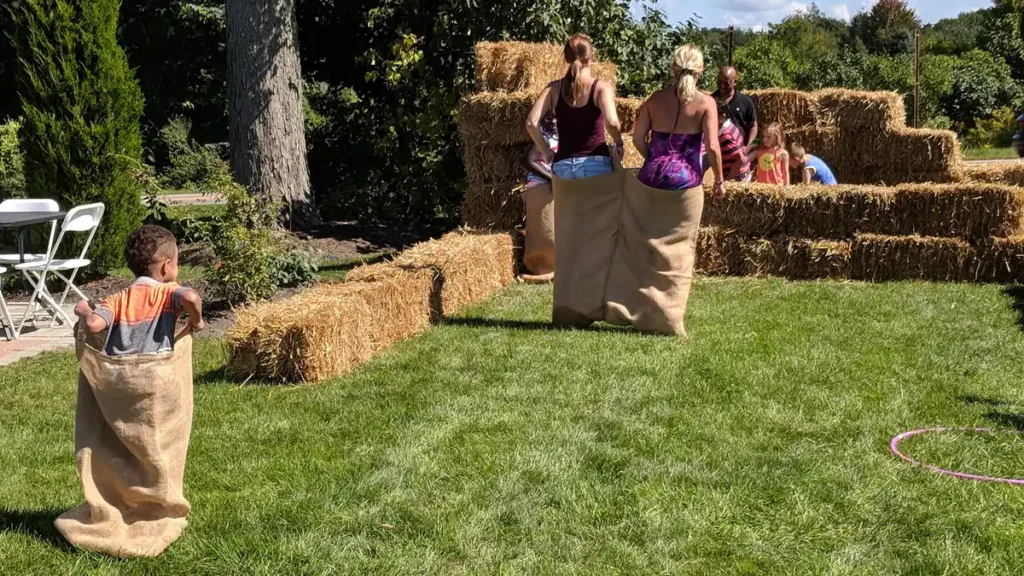
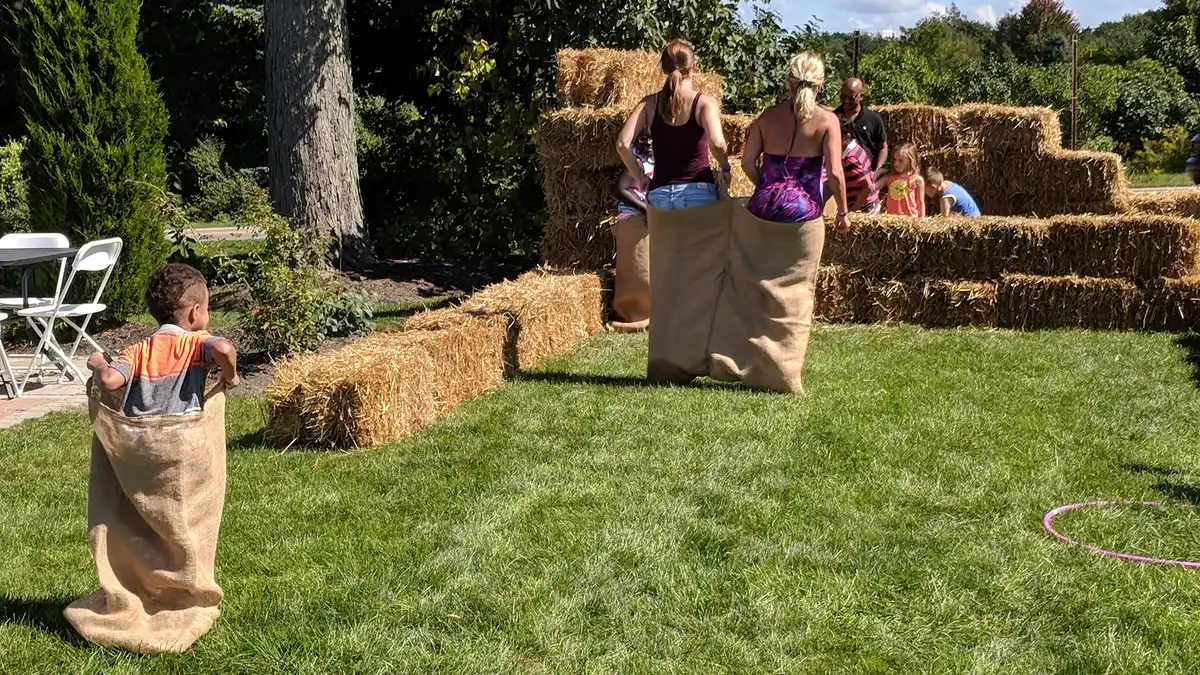
The sack race is the oldest relay game in the world, and it scales better than almost anything else. Two players from a team stand in their sacks at the start line, hop to the far marker, and hop back to tag the next pair, while the rest of their squad shouts them home. There is no skill to learn, no turn to wait for, and no quiet player left standing on the edge, because every hop matters and every fall gets a cheer. The noise alone is worth it, since a whole field of supporters shouting for their team sets the tone for the rest of the day.
2. Giant Ring Toss Championship
Ring toss turns a patch of grass into a quiet corner of calm in a loud day. Each team gets the same set of rings and the same row of pegs, and the task is simple: throw the ring, land it over a peg, and collect the points marked on each peg. It works at this size because teams play in small groups at many stations at once, and because the game rewards a steady hand rather than strong legs, so grandparents and small children can beat the fastest runners. Set up ten ring toss stations in a row, one team per station, with a starter who calls the start and a scorer at each table.
3. Giant Dodgeball Tournament
Dodgeball is the loudest team game in this guide, and it earns its place because it turns defence into a team skill. Two teams of six face each other across a marked court, and players must dodge, catch, or block the soft foam balls flying their way. A caught ball brings a team-mate back into play, so even a team down to its last player is never really beaten. Run it as a knockout bracket with four courts side by side, so eight teams play at once and a full round takes about fifteen minutes.
Use soft foam balls only, never hard rubber ones, and mark the centre line and the side lines with tape so there is no argument about who crossed where. Give every team a short rest between matches and rotate the referees so no one team feels hard done by. The same station and heat rhythm works at a very similar scale in the guide to party games for 442 players, where 34 larger teams rotate through the same kind of plan. Award the winners of each match three points and the losers one point for playing, so every team keeps collecting points even on a bad run.
4. Giant Limbo Challenge
Limbo needs nothing but a long pole, two holders, and a field full of players who are willing to bend backwards in front of a crowd. When the music plays, every team sends players under the bar one at a time, and anyone who touches the bar or the ground is out. With 446 players, run it as a whole-squad game: all eight squads gather in a marked area, and judges walk the edges watching for wobbles, giggles, and sneaky ducks under the bar. This game works beautifully in the middle of the day because it needs no running and rewards pure flexibility.
5. Giant Obstacle Course Relay
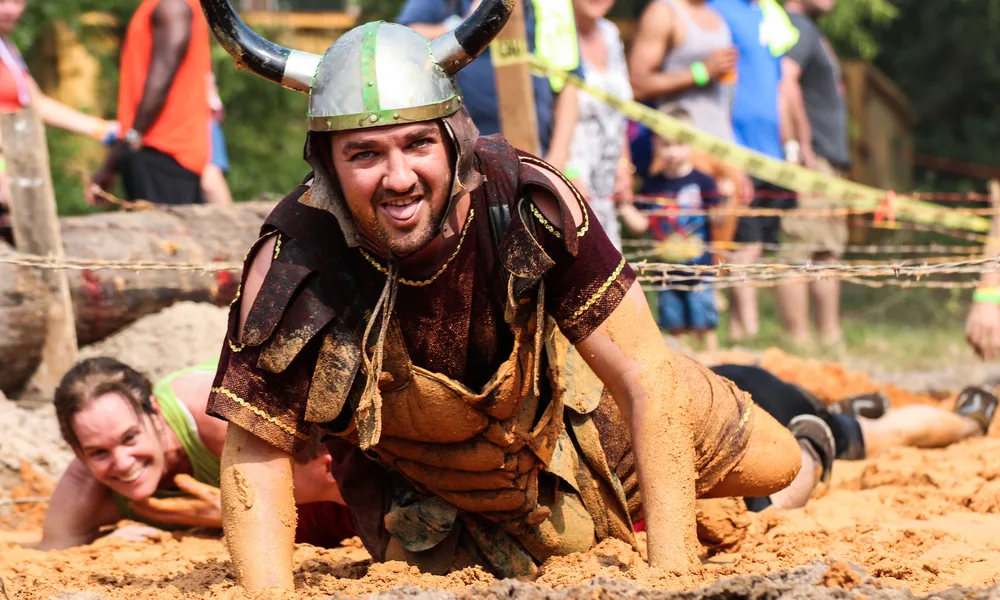
An obstacle course turns a whole field into the game board. Each team sends one pair at a time through the same short course: crawl under a net, climb over a hay bale, carry a ball on a spoon, jump through a row of hoops, and sprint to the finish line. It works at this size because teams spread out along the course instead of queuing, and because the course can mix easy obstacles with tricky ones so that clever teams can catch up to fast ones. Send pairs out in waves of four at a time so the start line never jams, and give each team the same course in the same order.
6. Giant Beach Ball Volleyball Tournament
Beach ball volleyball is the gentlest ball game in this guide, and that is exactly why it works for 446 players of every age and ability. Two teams of six stand on either side of a low net, and the task is to keep a giant beach ball in the air and land it on the other side. The ball moves slowly, so nobody needs fast reflexes, and a team that talks to each other will always beat a team that stays silent. Run it as a round robin with four courts side by side, so eight teams play at once and a full round takes about twenty minutes.
7. Giant Simon Says Championship
Simon Says is the simplest game in this guide, and at this size it becomes a whole-crowd spectacle. One caller stands on a raised platform with a loudspeaker, and forty players at a time stand in a marked area waiting for instructions. When the caller says Simon Says, everyone obeys, and when the caller leaves those words out, anyone who moves is out. It works at this size because it needs no equipment at all, and because the game rewards listening more than speed, so the most careful player in the crowd can outlast the fastest.
8. Giant Newspaper Island Challenge
Newspaper Island is a balance game with a simple rule: your whole team must stand on a sheet of newspaper, and the sheet gets folded in half after every round. Each team starts on a full sheet, then a half sheet, then a quarter sheet, and the team that stays on its island longest wins. It works at this size because teams play in small groups at many stations at once, and because the game rewards trust and close teamwork rather than strength, so a team that plans its feet carefully will beat a team that just piles on. Set up ten stations in a shaded area, one team per station, with a judge at each one.
9. Giant Human Bingo Rally
Human Bingo turns a whole crowd into the game board. Each team gets the same bingo card, but the squares are people, not numbers: find someone who has climbed a mountain, find someone who can juggle, find someone born in another country, and so on. The first team to complete a full row wins, and the first team to fill the whole card takes the bonus. It works at this size because teams spread out across the whole venue instead of queuing, and because the game rewards talking to strangers, which is the whole point of a party this big.
Your 446-Player Party Checklist
- Count the crowd twice. Confirm the headcount the night before and again at the gate, because 446 players means 223 teams of two, and a team with no partner cannot play the relay games.
- Mark every zone before anyone arrives. Tape the field games, signpost the shaded games, and put the leaderboard where every zone can see it, so teams never have to ask where to go next.
- Pack spares for everything that breaks. Bring extra sacks, rings, beach balls, and newspaper sheets, because a game that stops for a missing ball loses the whole heat.
- Brief every volunteer in ten minutes. One short meeting, one page of rules per station, and one named marshal per zone keeps the day running without constant questions.
- Plan water, shade, and rest first. A crowd this size tires faster than it looks, so water stations and shaded rest areas matter more than any single game, as the guide to party games for 440 players also shows with its own rest and rotation plan.
- Test the sound before the first game. Check the loudspeaker from the farthest corner of the field, because a caller nobody can hear will lose a crowd of 446 in minutes.
Frequently Asked Questions
How do you split 446 players into fair teams?
Split the crowd into 223 teams of two, then sort those teams into eight colour squads of about fifty-six players each. Pairs keep every game small enough to manage, while the squads give the whole-crowd games, like the Limbo Challenge and Simon Says, a cheering section and a shared identity. Give every pair a colour, a name, and a captain, and keep the pairs fixed all day so scoring stays simple.
How many volunteers do you need for 446 players?
Plan for one zone host per zone, plus a master of ceremonies, a scorer, and at least four floaters, which usually means about ten volunteers in total. One host cannot run 446 players alone, and the floaters are the people who fetch spare equipment, settle disputes, and cover a station when a marshal needs a break. Brief them all together for ten minutes before the first game, and give each one a single page of rules for their station.
What if it rains on the day?
Move the accuracy and listening games, like ring toss, Simon Says, and Newspaper Island, into a hall or marquee, and keep the running games on the field only if the grass is safe. Sack races and obstacle courses on wet grass get slippery fast, so shorten the course, slow the heats down, and add extra marshals. Have the indoor plan written down before the day, because deciding it in the rain wastes the hour you need most.
How long does a 446-player party day last?
Plan for about four hours of play, with a short break after the first four games and a longer lunch break before the finals. Each heat takes fifteen to twenty minutes, and nine games across parallel stations fit into that window if teams rotate on a fixed clock. Add an hour for arrival, team sorting, and the final scores, and the whole day runs to about five hours from gates opening to the last cheer.
Can small children and older players join every game?
Yes, because the nine games mix running, accuracy, listening, and balance, so every kind of player gets a game that suits them. Ring toss, Simon Says, beach ball volleyball, and Human Bingo need no running at all, while the sack race and obstacle course can be shortened for younger players. Let teams swap in a rest player for the physical games, and keep the scoring the same for everyone, so nobody feels left out of the day.
What equipment should you buy first?
Buy the sacks, rings, foam dodgeballs, beach balls, and newspaper first, because those five items cover five of the nine games and they are cheap to buy in bulk. Borrow the hay bales, nets, cones, and hoops from a school or sports club, and hire only the loudspeaker and the marquee if you do not already own them. Check the full equipment list against each game section before you order anything, because several games share cones, tape, stopwatches, and a loudspeaker.
Bottom Line
Party games for 446 players work when you stop picturing one giant circle and start picturing a festival. Split the crowd into 223 teams of two, sort them into eight colour squads, run nine fresh games in heats at parallel stations, and keep the scoring simple and visible. The sack race will open the day with noise, the ring toss will calm it down, and the Human Bingo Rally will end it with strangers talking like old friends.
Plan the zones before the games, brief the volunteers before the crowd arrives, and keep water, shade, and rest at the top of the list. Do that, and 446 players will feel like one party, not a crowd waiting for something to happen.