Running puzzle games for 399 players sounds impossible the first time someone suggests it. Three hundred and ninety-nine people, one room, one set of puzzles, and a clock that keeps ticking whether you are ready or not. Yet events of exactly this size run every year at schools, company offsites, and festivals, and the ones that work share one secret: nobody makes 399 people do the same thing at the same moment.
The trick is to stop thinking of 399 as a crowd and start thinking of it as a system. Three hundred and ninety-nine players break down into teams of five, six, or seven, and those teams rotate through stations, compete in heats, or feed into a tournament bracket. The games that succeed give every player something in hand within five minutes.
This guide gives you a complete step-by-step plan, from the first planning meeting to the final scores. You will learn which formats scale and which collapse, how to divide 399 players into teams that work, how to set up stations and tournaments, and how to score fairly without an army of judges.
Key takeaways
- Split 399 players into teams of six, giving you 66 teams with three players spare to act as floaters or judges.
- Use stations and heats so no single puzzle or table ever has to serve the whole crowd at once.
- Pick nine formats that run in parallel, such as Sudoku relays, tangram races, and escape-room boxes.
- Score with a simple points system and a live leaderboard the whole room can see.
- Rehearse the rotation once with your volunteers before a single player arrives.

Why Puzzle Games Work for 399 Players
Puzzle games suit very large groups because they need no stage, star performer, or silence. A quiz needs everyone to hear the same question at once, which is a sound problem at 399 players. A puzzle only needs a table, a set of pieces, and a clear goal, and you simply run many copies at once.
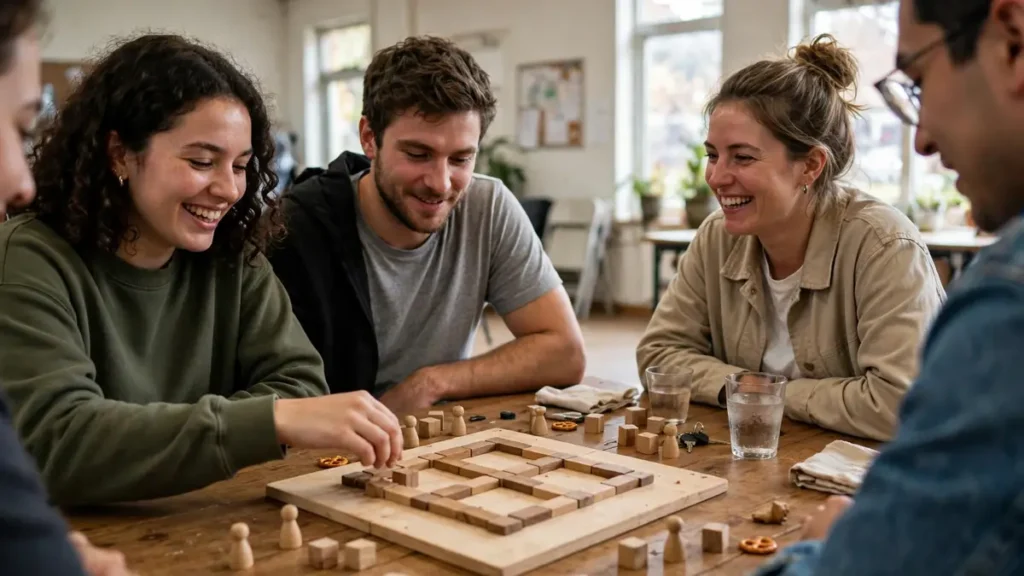
There is also a social reason puzzle games work at this size. In a group of 399 strangers, most people will not speak outside their own table unless the format gives them a reason to. A shared puzzle gives them that reason within seconds: someone spots a number pattern, someone else remembers a word, and suddenly six strangers are a team.
Scale also makes puzzle games cheaper than most large-group entertainment. Printed grids, card sets, tangram pieces, and dominoes cost very little per player, and the same sets can be reused round after round. For a near-identical field, the guide to running puzzle games for 397 players shows the same team-and-station thinking in action.
The 3-to-399 Range
Every plan here is built around the 3-to-399 range, the honest way to think about an event this size. At the small end, three players sit at one table and solve a single puzzle together. At the large end, 399 players fill a hall. The bridge is the team: divide 399 into teams of six and you get 66 teams with three spare, each just a small group around a table. The event is big, but nobody experiences it as big.
This thinking also protects you from the most common planning mistake: designing for 399 as if it were one group. A single puzzle with 399 people touching it is a queue, not a game. But 66 teams each solving their own puzzle is a real competition, run with ordinary tables and a realistic number of volunteers.
The 9 Puzzle Games for 399 Players
The nine games below can each be set up in identical copies, finish in a fixed time, and be scored without a judge watching every move. Run them as stations so every team meets every game, or as heats so the fastest teams advance to a final. Together they cover numbers, words, pictures, memory, and hands-on building, so every kind of thinker gets a game that suits them.
1. Sudoku Relay
In a Sudoku relay, each team gets the same partially filled grid, and players take turns filling in one row before passing the pen on. Instead of one quiet person solving alone, six people argue, check, and correct each other under a ten-minute timer. Print grids large enough to read across a table, at the same difficulty for every team.
Score by counting correct cells, with a bonus for a completed grid. Rushing teams score worse than careful ones, which teaches the room that accuracy beats speed. All you need is printed grids and pens.
2. Tangram Team Race
A tangram race gives each team the same seven flat pieces and a silhouette to build, such as a house, a bird, or a running figure. The first team to match it exactly wins. Tangrams are silent and visual, and they work for every age because no reading or arithmetic is involved. Buy identical sets in bulk so no team gains from worn pieces.
Run five-minute rounds with a new silhouette each time. Early finishers can attempt a harder bonus shape for extra points. The physical pieces also give restless players something to hold.
3. Escape-Room-in-a-Box Challenge
An escape-room box packs a whole puzzle hunt into one container: a locked box, clue cards, a combination lock, and a small prize inside. Teams open it by solving a chain of clues, each answer unlocking the next step. Build boxes from cheap cash boxes, padlocks, and printed clues, and prepare 66 identical ones.
Keep the chain to four or five clues so a team can finish inside fifteen minutes. Test every box yourself first, because one wrong clue strands a whole team. The click of a lock opening is a finish line the whole room can hear.
4. Word Ladder Relay
A word ladder asks players to change one word into another by changing one letter at a time, with every step a real word. Cold becomes cord, then card, then ward, then warm. In relay form, each player writes one rung before passing the sheet on, so the team must think ahead together. Print ladders of the same length and difficulty, and set a twelve-minute limit.
Word ladders suit mixed-age teams, because a child who knows short words and an adult with a large vocabulary both contribute. Score one point per correct rung, with a bonus for the shortest valid ladder. Keep a dictionary at the judging table to settle disputes fast.
5. Maze Runner Relay
A maze runner relay uses large printed mazes solved in stages, with each player tracing one section before handing the pen on. The maze is printed in pieces: a team only gets the next section when the current one is finished correctly, so nobody races ahead alone. Print sections on separate cards, sealed in envelopes.
Choose mazes that take about ten minutes, and make the final section the hardest so the finish stays close. Mazes suit younger players and anyone who prefers pictures to words or numbers.

6. Domino Pattern Puzzle
A domino pattern puzzle gives each team a set of dominoes and a target pattern to build, such as a square where every row and column adds to the same total. Teams must use every domino exactly once, which turns a familiar game into a genuine logic problem. Standard double-six sets are cheap and durable, and the tiles are big enough for a whole team to see.
Allow twelve minutes per round, with a simple total for beginners and a harder target for confident teams. Score by completed rows, so a team that solves half the pattern still earns points. Dominoes also survive being dropped.
7. Riddle Relay Race
In a riddle relay, each team works through a chain of ten riddles, and each correct answer earns the next clue card. Mix wordplay, logic, and lateral thinking so different members shine on different cards. Print each riddle on its own card so teams cannot peek ahead.
Set a fifteen-minute limit and score one point per solved riddle, with a time bonus for finishing the whole chain. Riddle relays are the noisiest station: teams argue, laugh, and groan, and the groan when an answer is revealed is half the fun.
8. Memory Match Tournament
A memory match tournament lays out a grid of face-down cards, and players take turns flipping two to find matching pairs. In team form, players rotate turns, and the team must remember card positions between turns, which tests communication as much as memory. Use picture cards so the game works across ages and languages.
Play eight-minute heats, with the team holding the most pairs advancing. Early heats are friendly, semifinals are tense, and the final is played on a stage table in front of the whole room. Memory match needs no power and almost no judging.
9. Tower of Hanoi Team Challenge
The Tower of Hanoi asks players to move a stack of discs from one peg to another, one disc at a time and never placing a larger disc on a smaller one. In team form, players take turns making one move each, so the team must plan aloud and agree on every move. A five-disc tower takes at least thirty-one moves, fitting neatly into ten minutes.
Build towers from cheap wooden discs and dowels, or buy classroom sets in bulk. Score by fewest moves, with a time bonus for finishing under the limit. The game looks simple and plays hard, which keeps competitive players humble and quiet thinkers in the spotlight.
| Game | Players per team | Time per round | Equipment needed | Best for |
|---|---|---|---|---|
| Sudoku relay | 5 to 7 | 10 minutes | Printed grids and pens | Number lovers and steady focus |
| Tangram team race | 5 to 7 | 5 minutes | One tangram set per team | Visual thinkers of all ages |
| Escape-room-in-a-box challenge | 5 to 7 | 15 minutes | Locked box, clues, and padlock | Drama and big reactions |
| Word ladder relay | 5 to 7 | 12 minutes | Printed ladders and pens | Word lovers and mixed-age teams |
| Maze runner relay | 5 to 7 | 10 minutes | Printed maze sections | Younger players and picture thinkers |
| Domino pattern puzzle | 5 to 7 | 12 minutes | One double-six set per team | Logic and hands-on building |
| Riddle relay race | 5 to 7 | 15 minutes | Printed riddle cards | Laughs and lateral thinking |
| Memory match tournament | 5 to 7 | 8 minutes | Picture card sets | A big staged final |
| Tower of Hanoi team challenge | 5 to 7 | 10 minutes | Discs and pegs per team | Careful planning and debate |
A Step-by-Step Plan for 399 Players
A good plan turns 399 players from a crowd into a timetable. Work through the six steps below in order, and do not skip the rehearsal: it is the step that saves every large event from its own schedule.
Step 1: Fix the Numbers and the Room
Confirm the final headcount, then divide 399 players into 66 teams of six, with three spare players assigned as floaters who can fill gaps or help judge. Book a hall with nine station areas plus a central scoring table, and check every table can be seen from the host microphone position.
Step 2: Choose Nine Formats and Buy in Bulk
Pick the nine games above, or swap in your own, but keep the rule of identical copies: every team gets the same puzzle, the same difficulty, and the same time limit. Order materials at least three weeks ahead, and buy ten percent extra to cover losses and damage.
Step 3: Recruit and Brief Your Volunteers
You need about eighteen volunteers: nine station judges, four floaters, two scorers, two registration helpers, and one host. Brief them in writing a week ahead, and give each station judge a one-page sheet with the rules, the scoring, and the answers.
Step 4: Rehearse the Rotation
Walk the rotation with volunteers playing teams, and time every move between stations. If a move takes more than three minutes, move stations closer or stagger start times. The rehearsal is your chance to find the wrong clue, the misprinted grid, and the lock with the wrong combination before players do.
Step 5: Run the Day in Four Blocks
Split the day into four blocks: registration and warm-up, two station blocks with a break between them, and a finals block. Announce the block times on a visible board and stick to them, because a late start in block one becomes a missing final in block four. The same four-block shape keeps the huge field in puzzle games for 396 players moving on time.
Step 6: Score Simply and Show the Scores
Use one point per solved item and small bonuses for full completions, and update a live leaderboard after every round. A visible scoreboard keeps teams honest: a team ten points behind pushes harder, and a team ahead guards its lead.
Scoring That Keeps 399 Players Honest
Fair scoring at this scale depends on simple rules and visible results. Every station should use the same scoring idea: points for correct answers, a bonus for a complete solution, and nothing for a guess. Judges should never judge a half-correct answer, so write the scoring rule on the station sheet in one sentence.
Collect answer sheets at the end of each round and score them at the central table, so judges stay free to run the next round. Post the running totals where everyone can see them, and announce the top five teams before the final block. When 399 people can see the scores, nobody needs to argue about them.
Common Mistakes That Sink Large Puzzle Events
The first mistake is designing for the average player instead of the slowest team. If your hardest station takes some teams forty minutes, your schedule is gone by midday. Test every puzzle with a slow team and set the time limit from their result.
The second mistake is buying one beautiful puzzle instead of 66 identical ones: a showcase puzzle becomes a queue, while identical copies become a competition. The third is skipping the rehearsal, which is how wrong clues and missing pieces are discovered in front of a live audience. Fix these three, and most other problems stay small enough to solve on the day.
Checklist: Ready for 399 Players?
- Final headcount confirmed and 66 teams of six formed, with three floaters assigned.
- Nine stations set up with identical puzzles, spare sets, and printed answer sheets.
- Eighteen volunteers briefed in writing, with one-page rules for every station.
- Rotation rehearsed once with volunteers, and every move timed at under three minutes.
- Live leaderboard ready, scoring rules printed, and prizes bought for the top three teams.
- Microphone, timers, and spare batteries tested the day before the event.
Frequently Asked Questions
How many teams do 399 players make?
Teams of six give you 66 teams with three players spare, who can act as floaters or help judge. Teams of five give you 79 teams, which is harder to manage, and teams of seven give you 57 teams, which makes each station slower.
How long does a 399-player puzzle event take?
Plan for four to five hours, including registration, two station blocks, a break, and a finals block. Each round runs five to fifteen minutes, and rotation takes two to three minutes. Do not cut the break: tired teams make mistakes and stop enjoying the day.
What is the best team size for puzzle games?
Six is the best team size for 399 players: large enough for a mix of skills, small enough that everyone gets a turn. Smaller teams move faster but run out of ideas, while larger teams leave quiet players with nothing to do.
Do I need identical puzzles for every team?
Yes, identical puzzles are essential for fair scoring. If one team gets an easier grid, the results mean nothing, and the losing teams will know it. Buy or print in bulk, test one copy yourself, then copy that exact version for every team.
How do I keep 399 players from getting bored?
Keep rounds short, rotate stations often, and make sure nobody waits more than a few minutes for a turn. While one team solves, every other team is solving something else, and a live leaderboard keeps teams invested until the final round.
What prizes work for a 399-player puzzle event?
Give the top three teams a shared prize they can split, such as puzzle books, board games, or vouchers, and give every player a small take-home puzzle or certificate. Teams remember winning together far longer than they remember what they won. A similar prize plan worked well for puzzle games for 395 players, where small shared prizes kept the finals competitive without a large budget.
Bottom Line
Running puzzle games for 399 players is a logistics job dressed up as a games day. Split the crowd into 66 teams of six, run nine identical stations in parallel, score simply, show the scores, and rehearse the rotation once. Do those five things and 399 strangers will spend the day as 66 teams, solving, arguing, laughing, and finishing together.