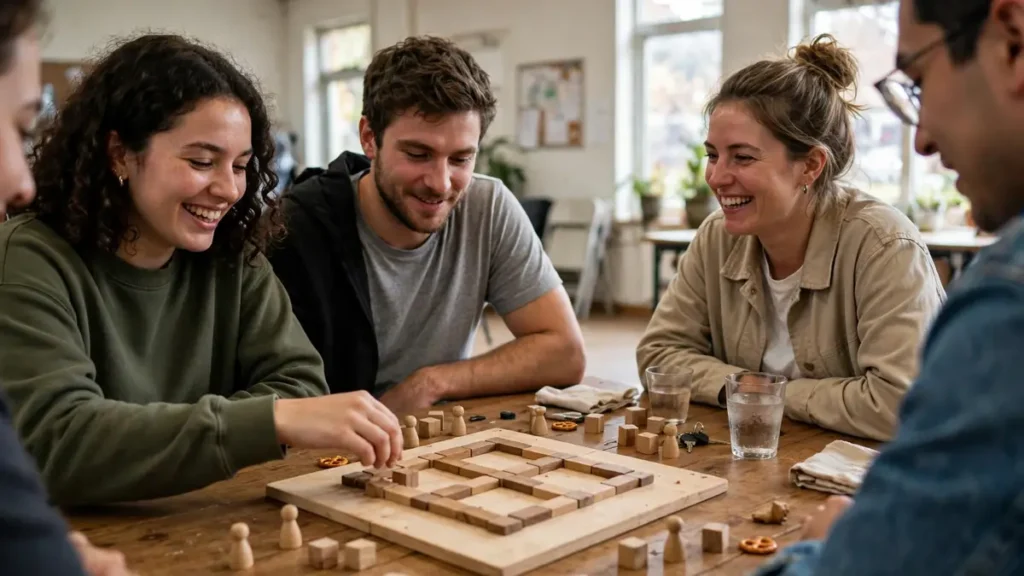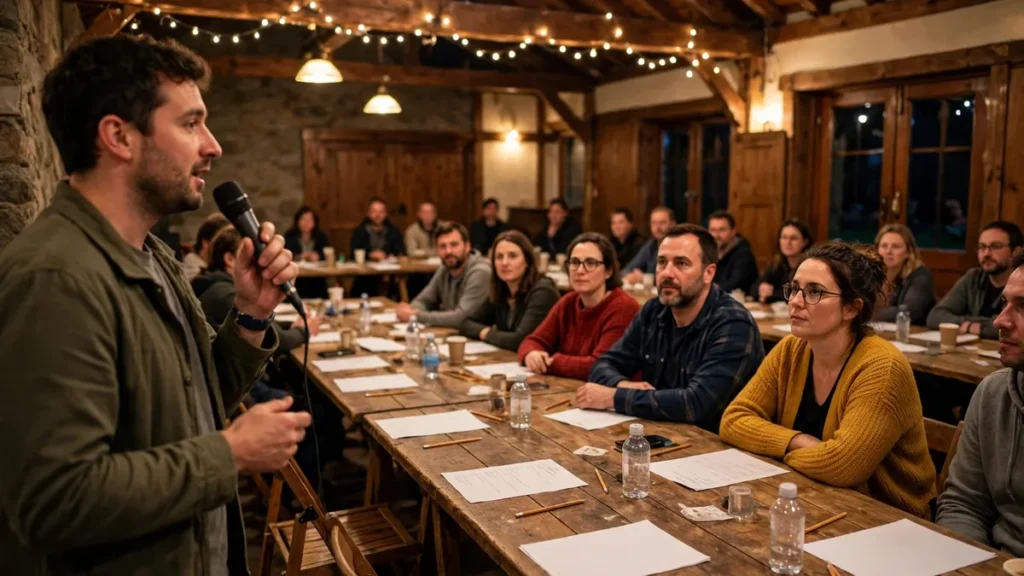
Trivia games for 552 players work when the room stops behaving like one giant crowd and starts behaving like many small teams sharing one host, one clock, and one clear way to hand in answers. Five hundred and fifty-two people is a hall full of tables, not a single circle, so the plan has to fit the hall: short rounds, questions a whole table can argue about in under a minute, and scoring that never leaves a team waiting to learn where it stands.
The nine rounds below were built for exactly that scale. Each one takes a single famous subject and turns it into questions that reward noticing, remembering, and talking things through together. A table of six can answer a grasshopper question by pooling what four different people half-remember, and that pooling is the whole point. Nobody needs to know everything. Everybody needs a reason to lean in, compare notes, and write something down before the host moves on.
What follows is a full evening plan: how to seat 552 players, how long each part takes, how the nine rounds run in order, how to keep the score honest, and how to close the night without a long argument about one disputed answer. Bring printed answer sheets, plenty of pencils, and a visible scoreboard.
Key takeaways
- Split 552 players into teams of six, which gives 92 teams and keeps every table small enough to talk.
- Run nine rounds of ten questions, with a short pause between rounds for collecting sheets and updating the scoreboard.
- Ask questions a table can answer together in under a minute, and keep every round to one famous subject.
- Collect answer sheets after each round, so no team can change an answer once the next round has started.
- End with a tie-break round of five questions, read one at a time, so a tied night ends cleanly.

How 552 Players Fit Into One Day
Five hundred and fifty-two divides neatly into teams of six, which gives 92 teams. Ninety-two teams need 92 places to sit, so book a hall with long tables rather than round ones: long tables hold six on one side and six on the other, and the host can walk the aisles between them. Put a number sign on every table, hand every team a different coloured answer sheet for each round, and keep one extra table near the host for the scoring helpers.
The evening runs for about three hours. Doors open half an hour before the opening question, so late arrivals can find their table without holding up the room. The host reads ten questions in each round, allows about forty seconds of thinking time after each one, and then collects the sheets while the next round is introduced. A short pause after round five lets people stretch, refill a glass, and check the scoreboard. The animal rounds in our trivia games for 549 players, built around anteaters, binturongs, jerboas, kinkajous and quolls show the same shape at a slightly smaller scale, and the rhythm transfers cleanly to a hall of 552.
Helpers matter more than microphones at this size. Recruit at least twelve helpers: two to collect sheets, two to score them, two to update the scoreboard, and the rest to walk the aisles answering quiet questions about the rules. Scoring happens while the next round runs, so the scoreboard is never more than one round behind.
The Nine Rounds
Each round below has its own famous subject, a short introduction that tells the host how to frame it, and one sample question to show the level. The sample questions are the right difficulty for a mixed hall: a team that knows nothing about the subject can still land one or two by talking, and a team that knows the subject well will not sweep all ten. Read the questions slowly, repeat each one once, and never rush the thinking time.
Round 1: Famous Grasshoppers
Grasshoppers are the leaping insects of warm meadows and dry grassland, and they turn up in stories, songs, and science in surprising numbers. This round asks teams to name famous grasshoppers from books and screens, and to recall the plain facts that make the real insect easy to picture: the long hind legs, the chirping, and the way a grasshopper can jump many times its own body length.
The host can warm the room up by asking teams to picture a summer field before the opening question. A grasshopper round works because almost everyone has seen one, even if nobody in the hall has studied one. Mix one question about a famous fictional grasshopper with questions about how the insect moves, eats, and sings, and the table talk will carry the round on its own. Try this: which long-legged insect is famous for chirping by rubbing its hind legs against its wings?
Round 2: Famous Tarantulas
Tarantulas are the large, hairy arachnids that most people know from films and nature programmes, and they make a strong following round because the subject feels daring without being obscure. This round asks about famous tarantulas kept as pets, famous tarantulas in stories, and the plain facts about how these animals live: slow movement, long lives, and a quiet life spent mostly in a burrow. A little drama in the subject keeps the room listening after the gentler opening round.
The best tarantula questions are the ones that correct a common myth, such as the idea that these animals are always dangerous to people, or that they all live in hot deserts. Ask about where different kinds live, how long females can live, and which famous tarantula appeared in a well-known film scene. Try this: which large, hairy arachnid is famous for living for decades in a burrow?
Round 3: Famous Iguanas
Iguanas are the scaly, sun-loving animals of warm coasts and islands, famous for their crests, their long tails, and their habit of basking on rocks and branches. This round asks teams to name famous iguanas from wildlife programmes and island stories, and to recall how these animals eat, swim, and warm themselves in the sun. The subject is visual and easy to picture, which helps teams that learn by imagining rather than by memorising lists.
Ask about island iguanas, about the green kind kept as a pet, and about the marine kind that swims in cold sea water off volcanic islands. The marine kind is a good question subject because it surprises people who think of these animals as purely land creatures. Try this: which scaly sun-bather is famous for swimming in the sea around volcanic islands?
Round 4: Famous Scallops
Scallops are the fan-shelled shellfish of cold, clean seas, famous on menus, in kitchens, and in the hands of divers who gather them by hand. This round asks about famous scallops in cooking, about the places where they are gathered, and about the plain facts of the animal itself: the fan-shaped shell, the rows of small eyes along the shell edge, and the way a scallop swims by clapping its shell shut. A food round in the middle of the night gives the hall a change of pace.
Keep the questions concrete. Ask which coastal waters produce the best-known scallops, what the round white muscle on a plate is called, and how a scallop moves through the water. The shell itself is worth a question: its fan shape and ridged surface make it one of the most recognisable shells in the sea. Try this: which fan-shelled shellfish is famous for swimming by clapping its shell shut?
Round 5: Famous Catfish
Catfish are the whiskered river fish found in fresh water on every continent except one, famous for their barbels, their size, and their habit of feeding along the river bed. This round asks about famous catfish in fresh water, about record-sized catches, and about how these fish find food in muddy water where eyesight counts for little.
The barbels are the heart of the round: the whisker-like feelers around the mouth that taste and touch the river bed. Ask how many barbels a typical river catfish has, which great river holds the largest kinds, and which catfish is famous for walking across damp land between pools. That closing question always sparks a debate at the tables, and a short debate is exactly what a good middle round should produce. Try this: which whiskered river fish is famous for tasting the river bed with its barbels?

Round 6: Famous Shawarmas
Shawarma is the slow-roasted, thinly sliced meat of Middle Eastern street stalls, layered on a turning spit and served wrapped in flatbread with salad and sauces. This round asks about famous shawarma stalls, about the cities where the dish is a late-night favourite, and about how the meat is seasoned, stacked, and carved. A food round with a street-food subject brings the room back to life after the fish round, because everyone has an opinion about the best filling.
Ask about the turning spit itself, about the flatbread wrap, and about the sauces that teams argue over most. The best questions here are the ones that ask teams to picture a busy stall at midnight: the glow of the spit, the carver’s long knife, and the line of hungry people waiting for a wrap. Try this: which slow-roasted street food is famous for being carved from a turning spit?
Round 7: Famous Enchiladas
Enchiladas are the rolled tortillas of Mexican cooking, filled, sauced, and baked until the edges crisp and the filling bubbles. This round asks about famous enchiladas from different regions, about the sauces that colour them red, green, or white, and about the fillings that teams will argue about long after the round ends.
The sauces are the natural focus: a red sauce made with chillies, a green sauce made with tomatillos, and a white sauce made with a creamy base. Ask teams to match the sauce to its colour, to name the rolled tortilla at the heart of the dish, and to recall which region is famous for its own version. The insect rounds in our trivia games for 550 players, built around hyenas, coyotes, condors, ostriches, dragonflies, cicadas, ants and termites use the same mix of picture questions and memory questions, and that mix works just as well for a food round. Try this: which rolled tortilla dish is famous for its red, green, and white sauces?
Round 8: Famous Goulash
Goulash is the slow-cooked, paprika-rich dish of Hungary, famous far beyond its home as a hearty bowl served with bread or dumplings. This round asks about famous goulash from different kitchens, about the spice that gives it its colour, and about the long, slow cooking that turns tough meat tender. A one-pot dish makes a good late round because the questions are simple, warm, and easy to talk through when the hall is starting to tire.
The spice is the heart of the round: paprika, ground from dried peppers, gives goulash its deep red colour and its gentle heat. Ask where paprika comes from, how long a proper goulash simmers, and what it is usually served with. Keep the pace steady here, because the hall needs a calm round before the closing one. Try this: which slow-cooked dish is famous for its deep red paprika colour?
Round 9: Famous Pavlovas
Pavlova is the crisp-shelled, soft-centred dessert of Australia and New Zealand, famous for its light topping and its long-running friendly argument about which country invented it. This round asks about famous pavlovas, about the crisp shell and soft centre, and about the topping that crowns it. A dessert round is the right way to close the night, because it leaves the hall smiling even if the scoreboard did not favour its team.
The argument about origins is the best question material in the round, and the host should handle it with a smile: both countries claim the dessert, and the honest answer is that the claim is shared and argued over to this day. The food-led rounds in our trivia games for 551 players, built around dim sum, ramen, paellas, lasagnes, lizards, jackals, guacamole, orcas and weasels close on the same note, and a warm closing round sends a big hall home happy. Try this: which crisp-shelled dessert is famous for a friendly argument about where it was invented?
How to Score a Night This Big
Score one point per correct answer, with no half points and no bonus points during the nine rounds. Ninety questions means a maximum of ninety points, and a winning total in a hall this size usually lands between sixty and seventy. Helpers score each sheet against a printed answer key, initial the total at the top, and hand the sheet back to the team so everyone can see what was missed. Transparency matters: a team that can see its own sheet will accept a low total far more readily than a team that only hears a number read out.
Read the answers aloud after each round, slowly, with the correct answer repeated once. Do not take questions about the answers during the reading; instead, invite teams to raise a query on a small slip of paper, and let the host rule on the slips during the pause after round five. This keeps the evening moving and stops one disputed answer from eating ten minutes of the night.
The Round Table
| Round | Subject | Sample question | Questions |
|---|---|---|---|
| Round 1 | Grasshoppers | Which long-legged insect chirps by rubbing its hind legs? | 10 |
| Round 2 | Tarantulas | Which large, hairy arachnid lives for decades in a burrow? | 10 |
| Round 3 | Iguanas | Which scaly sun-bather swims in the sea around volcanic islands? | 10 |
| Round 4 | Scallops | Which fan-shelled shellfish swims by clapping its shell shut? | 10 |
| Round 5 | Catfish | Which whiskered river fish tastes the river bed with its barbels? | 10 |
| Round 6 | Shawarmas | Which slow-roasted street food is carved from a turning spit? | 10 |
| Round 7 | Enchiladas | Which rolled tortilla dish is famous for red, green, and white sauces? | 10 |
| Round 8 | Goulash | Which slow-cooked dish is famous for its deep red paprika colour? | 10 |
| Round 9 | Pavlovas | Which crisp-shelled dessert is famous for an argument about its origins? | 10 |
Checklist
- Book a hall with long tables for 92 teams of six, plus one extra table for the scoring helpers.
- Print ninety-two answer sheets per round, each round on a different colour, with pencils on every table.
- Recruit twelve helpers and brief them on collecting, marking, and updating the scoreboard.
- Test the microphone and the scoreboard display before the doors open.
- Prepare a printed answer key for the helpers and five tie-break questions in a sealed envelope.
- Announce the three rules at the start: no phones during a round, one answer per question, and the host’s ruling stands.
Frequently Asked Questions
How long does a trivia night for 552 players take?
About three hours, including the doors opening half an hour early and a short pause after round five. Nine rounds of ten questions take roughly two and a half hours, and the pause plus the closing tie-break fill the rest.
How many teams should 552 players form?
Ninety-two teams of six. Six is the largest team that can still talk around one sheet without splitting into side conversations, and ninety-two teams fill a hall neatly without leaving awkward single players looking for a home.
Do we need special equipment for a crowd this size?
A microphone and a visible scoreboard are the two essentials, plus printed answer sheets and pencils for every table.
How do we stop teams from cheating?
Collect the sheets after each round, ban phones during play, and walk the aisles with helpers who can see every table. Most cheating in a big hall is quiet phone use, so a clear announcement at the start and a helper walking past each table is usually enough.
What happens if teams tie at the top?
Read a tie-break round of five questions, one at a time, to the tied teams only, while the rest of the hall watches. The team that answers the most tie-break questions correctly takes the top place, and if the tie survives all five, read one sudden-death question at a time until one team pulls ahead.
Can children play in a 552-player trivia night?
Yes, if they sit with adults and the host keeps the questions friendly. The rounds here are built for a mixed hall, and a child who knows about grasshoppers, shawarma, or pavlova can contribute real answers. Keep the evening under three hours so younger players stay fresh to the end.
The Bottom Line
Trivia games for 552 players work when the night is built around small teams, short rounds, and honest scoring. Nine rounds of ten questions, ninety-two teams of six, and a host who reads slowly and rules fairly will fill a hall for three hours without a dull stretch. Print the sheets, brief the helpers, trust the questions, and let the tables do the talking.