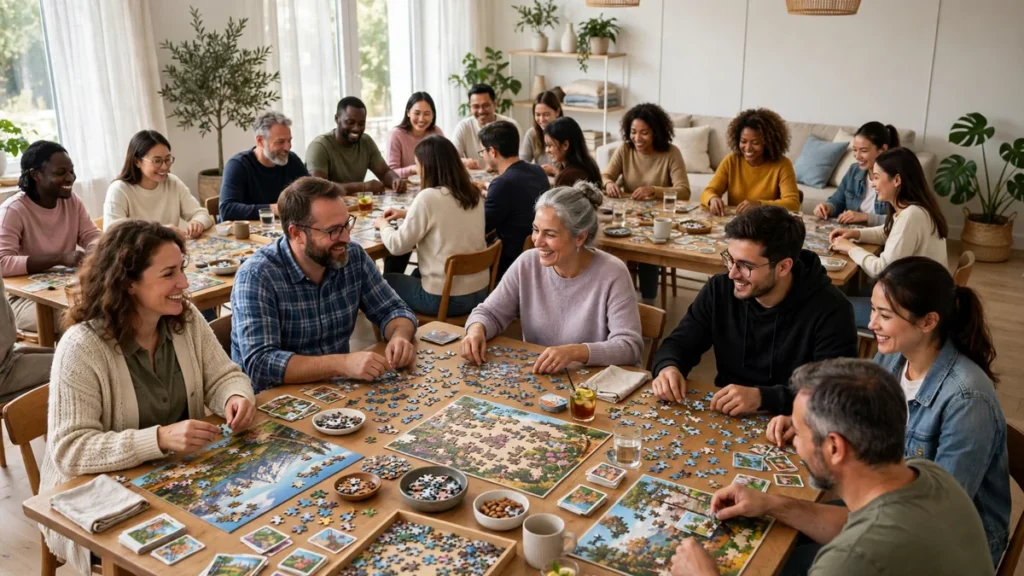
Finding the best board games for 64 players is a different challenge from picking a game for a quiet evening with friends. Almost no boxed board game seats 64 people around a single table. The games that handle huge groups do it by splitting players into teams, running several tables at once, or turning the whole room into one big contest. A 64-player game night can be one of the most memorable events you ever host, as long as you choose games built for scale.
The best board games for 64 players share three qualities: simple rules that can be explained in under five minutes, turns that keep everyone involved at the same time, and a structure that works in teams or in parallel. Party games, word games, drawing games, and social deduction games dominate this list for a reason. They do not ask 64 people to wait quietly while one person takes a turn. They ask everyone to guess, shout, draw, vote, or bluff together, and that shared energy is exactly what makes a giant game night work.
This guide covers the games that genuinely work at this scale, the formats that make them work, and a practical plan for running the night itself. You will find a comparison table to help you choose quickly, a game-by-game breakdown with honest player counts and setup notes, a checklist for the evening, and answers to the questions hosts ask most often. These picks will help 64 players actually play together instead of watching from the sidelines.
Key takeaways
- No single boxed game seats 64 players at one table, so the best board games for 64 players use teams, parallel tables, or whole-room play.
- Choose games with rules you can explain in under five minutes and turns where everyone plays at the same time.
- Split 64 players into eight tables of eight, with a host at each table, for the smoothest evening.
- Team word games, drawing games, and social deduction games scale far better than strategy games at this size.
- Buy or borrow multiple copies of your headline game so every table plays the same game at the same time.

What Makes a Board Game Work for 64 Players
A game that works for four people can fall apart completely with 64, and the reasons are practical. The first problem is downtime. In a game where players take turns one at a time, 63 people are waiting while one person thinks, and after ten minutes of that, half the room has drifted away. Games that work at this scale let everyone act at once, whether that means writing down a guess, drawing a picture, voting, or discussing a clue as a team.
The second problem is rules. With 64 players, you cannot teach the game table by table for twenty minutes each. The rules need to be simple enough to explain once, loudly, to the whole room. Look for games where the core loop is one sentence long: guess the word, draw the clue, find the spy, vote for the answer. The third problem is scoring, which needs to be visible and simple: team points, table winners advancing to a final, or a tally on a whiteboard.
Teams Beat Single Tables Every Time
The single most important decision for a 64-player night is to organise players into teams. Eight teams of eight is a natural fit for most rooms and most games. Teams give shy players a group to warm up in, they let strong players help newcomers without taking over, and they turn every round into a small contest with a clear winner. Team sizes of six to eight work best: smaller teams mean more teams to manage, and larger teams mean some players stop contributing.
Parallel Tables Keep Everyone Playing
The other format that works well is parallel tables: eight tables of eight, each playing the same game at the same time, with a host at each table. This format suits games designed for six to ten players, such as social deduction and party games, because each table runs a complete game while the room shares the same schedule. Parallel tables need more copies of the game and more hosts, so recruit your hosts in advance and let them play a practice round before the guests arrive.
How to Run a 64-Player Board Game Night
A 64-player game night is an event, not just a game, and a little planning goes a long way. Start with the venue: you need room for eight tables of eight, plus a central area for announcements and the final round. Plan the evening in blocks: a warm-up game, two rounds of table games, a break, and a final whole-room game. Three hours is a comfortable length.
Split Into Tables and Appoint Hosts
Do not leave seating to chance. Pre-assign players to tables or teams before the night begins, and put a name card or a team colour at each table. Each table needs a host who knows the rules and keeps the pace moving. Choose hosts from your most enthusiastic players, brief them the day before, and give them a one-page cheat sheet. The simplest dispute rule is that the host decides and the game moves on.
Run in Rounds and Keep Score Simple
Rounds give the night its shape. Keep each round to 20 or 30 minutes, and use a timer everyone can hear. When the timer sounds, the round ends, even if a table is mid-game. For scoring, a whiteboard works better than any app, because everyone can see it. Award points per round, announce the standings after each round, and keep the final round worth double points.
Plan the Final Round as a Whole-Room Game
The final round is the part people remember, so make it a whole-room game rather than another table round. Bring the table winners, or the team captains, to the front, and let the whole room play along or vote. Keep the final to 20 minutes, make the prize visible, and end on a high note. If you are looking for a similar large-group format to compare, the best board games for 62 players follow the same team and parallel-table structure, and the ideas there transfer directly to a group of 64.
The Best Board Games for 64 Players Compared
The table below compares the strongest options for a 64-player night. Player counts are the official per-game counts, and the format column explains how each game scales to 64. No game on this list seats 64 people at one table. These games scale cleanly through teams, parallel tables, or whole-room play.
| Game | Players per game | Best format for 64 | Setup time | Why it works |
|---|---|---|---|---|
| Codenames | 2 to 8 or more | Teams, whole room | 5 minutes | One-word clues, team discussion, easy to scale |
| Wavelength | 2 to 12 | Teams, whole room | 5 minutes | Everyone debates one target, huge fun at scale |
| Two Rooms and a Boom | 6 to 30 | Two parallel games | 10 minutes | Hidden roles, fast rounds, big social energy |
| One Night Ultimate Werewolf | 3 to 10 | Parallel tables | 5 minutes | Quick rounds, easy to run many tables at once |
| Telestrations | 4 to 8 | Parallel tables | 5 minutes | Drawing and guessing, hilarious reveals |
| Monikers | 4 to 16 or more | Teams, whole room | 5 minutes | Three rounds, teams guess together, very scalable |
| Dixit | 3 to 6 | Parallel tables | 5 minutes | Beautiful cards, creative clues, quiet tables love it |
| The Resistance | 5 to 10 | Parallel tables | 5 minutes | Bluffing and voting, tense and replayable |
| Herd Mentality | 4 to 20 | Teams, whole room | 3 minutes | Match the majority, simple and fast |
| Green Team Wins | 3 to 8 or more | Teams, whole room | 3 minutes | Guess the most popular answer, great warm-up |
The Best Board Games for 64 Players in Detail
Codenames
Codenames is the strongest choice for a 64-player night, and it is the game to build the evening around if you only pick one. Two teams compete to find their secret agents on a grid of 25 word cards, guided by one-word clues from their spymaster. The game scales beautifully because the guessing is a team discussion. With 64 players, split the room into eight teams of eight, and run the same grid at every table or one giant grid for the whole room on a projector. A single game takes 15 to 20 minutes.
Wavelength
Wavelength is a guessing game built around a single target on a spectrum, such as hot to cold or boring to exciting. One player gives a clue that points to a hidden target, and their team debates where on the spectrum the target sits. The debate scales to any number, because the whole team discusses every clue together. With 64 players, run it as a whole-room game with two large teams, or as a parallel game at eight tables.
Two Rooms and a Boom
Two Rooms and a Boom is a social deduction game designed for large groups, with an official player count of six to 30. Players are split between two rooms, each with a secret role, and they have five minutes per round to share information, swap players between rooms, and work out who holds the bomb and who holds the president. For 64 players, run two parallel games of 32, or run it as the headline event with half the room playing and half watching, then swap. Allow 10 minutes for setup and plan for three rounds of five minutes each.
One Night Ultimate Werewolf
One Night Ultimate Werewolf is a fast social deduction game for three to 10 players per game, and it is the best choice for parallel tables. Each round lasts about 10 minutes: players receive a secret role, look at their cards, and then discuss who the werewolves are before voting. For 64 players, you need eight copies of the game or eight printed role sets, one per table. The free companion app handles the narration.
Telestrations
Telestrations is a drawing and guessing game for four to eight players per set, and it is the funniest game on this list at scale. Each player draws a word, passes the sketchbook on, and the next player guesses what the drawing shows. The chain drifts further from the original word with every pass, and the reveal at the end of the round produces the biggest laughs of the night. With 64 players, run eight sets in parallel, one per table. Drawing ability does not matter: bad drawings are often funnier than good ones, and the game gives quiet players a way to contribute without speaking.
Monikers
Monikers is a team guessing game for four to 16 or more players, and it scales better than almost any other game here. The game is played in three rounds with the same set of cards: first players describe the name, then they can only use one word, and finally they can only use gestures. With 64 players, split into eight teams of eight and run the same card set across the room. The game needs just the card deck and a timer, and the rules take two minutes to explain.
Dixit
Dixit is a creative clue game for three to six players per set, and it is the calmest game on this list, which makes it a good choice for tables that prefer a quieter evening. Each round, one player gives a clue for a beautifully illustrated card, and everyone votes on which card was the original. The scoring rewards clues that are clever but not obvious. For 64 players, Dixit works as a parallel-table game, with one set per table and a host who can explain the scoring.
The Resistance
The Resistance is a bluffing and voting game for five to 10 players per game, and it is the most tense game on this list. Players go on missions together, but some of them are secretly spies trying to sabotage the mission. After each mission, the group discusses who to trust and votes on the next team, and the discussion between missions is where the game lives. For a 64-player night, run it as a parallel-table game with one copy per table.
Herd Mentality
Herd Mentality is a simple party game for four to 20 players, and it is the easiest game on this list to explain. The host reads a question, everyone writes down an answer, and players score by matching the majority. If your answer is different from everyone else, you get the pink cow, and you cannot win until someone else takes it from you. The rules take one minute to explain, a round takes 20 minutes, and the game works as a whole-room game with teams or as a parallel game at tables. It is an excellent warm-up for the start of the evening.
Green Team Wins
Green Team Wins is a guessing game for three to eight or more players, and it is another strong warm-up choice. Each round, a question is read out, such as the best pizza topping or the worst superpower, and each team secretly writes down its answer. Teams score points by guessing the most popular answer, and the game rewards knowing the room rather than knowing trivia. The official player count is modest, but the team format scales easily to 64, because each team only needs one answer per round. Run it first while guests are still arriving.
Choosing the Right Mix for Your Group
No single game suits all 64 players, so the smartest plan is a mix: one whole-room word game, one social deduction game at parallel tables, and one drawing or creative game for the quieter tables. For a group that includes children, lean on Telestrations, Dixit, and Herd Mentality. For an all-adult group, add The Resistance and Two Rooms and a Boom. For a different angle on large-group play, the best party games for 62 players cover the faster, louder end of the spectrum, and they pair well with the board games in this guide.
Checklist: Setting Up Your 64-Player Game Night
- Book a venue with room for eight tables of eight, plus a central area for announcements and the final round.
- Buy or borrow enough copies so every table has the game it needs, and test each copy before the night.
- Recruit eight table hosts, brief them in advance, and give each one a one-page rules cheat sheet.
- Pre-assign teams or tables with colour codes or numbered cards handed out at the door.
- Prepare a visible scoreboard, a timer everyone can hear, and a microphone or speaker for announcements.
- Plan the schedule in 30-minute rounds with a break for food and a whole-room final, and print it for every table.
Frequently Asked Questions
Can one board game really seat 64 players?
No boxed board game seats 64 players at a single table, and you should be suspicious of any list that claims otherwise. The games in this guide work for 64 players through teams, parallel tables, or whole-room play. Codenames, Wavelength, Monikers, Herd Mentality, and Green Team Wins work as team or whole-room games, while One Night Ultimate Werewolf, Telestrations, Dixit, and The Resistance work as parallel games with one copy per table.
How many copies of each game do I need?
For parallel-table games, you need one copy per table, which usually means eight copies for 64 players. For whole-room team games, one copy is enough if the game is displayed on a projector or a large board, though two copies are useful as a backup. Buying eight copies is a real cost, so ask guests to bring copies, borrow from a local game group, or choose games that only need one copy for the whole room.
What is the best game to start the night with?
Start with Herd Mentality or Green Team Wins. Both take one minute to explain, get the whole room laughing within five minutes, and help strangers relax before the competitive games begin. Avoid starting with a social deduction game, because players need to warm up before they are comfortable bluffing each other.
How long should a 64-player game night last?
Three hours is the sweet spot. Plan for a 15-minute welcome and warm-up, two 30-minute game rounds, a 20-minute break, and a 20-minute final, with buffer time between each block. Nights shorter than two hours feel rushed, and nights longer than four hours lose energy, especially for players who are new to board games.
What if some players have never played board games?
Mix experienced players across the teams so every table has someone who can explain the rules, and choose games with rules that take under five minutes to explain. Codenames, Herd Mentality, and Telestrations are the safest choices for beginners, because the core idea is obvious within one round. Avoid strategy games with long rulebooks, and avoid games with player elimination.
Do I need a prize for the winners?
A prize helps, but it does not need to be expensive. A small trophy, a board game for the winning team to share, or a simple certificate is enough to make the final round feel like it matters. The prize works best when it is visible from the start of the night, so teams have something to aim for. If you are planning a slightly smaller gathering next time, the best board games for 58 players use the same team structure at a slightly smaller scale.
The Bottom Line
The best board games for 64 players are the ones that let everyone play at the same time, with rules simple enough to explain once to a whole room. Codenames is the strongest all-round choice, Wavelength is the best whole-room showpiece, and One Night Ultimate Werewolf and Telestrations are the best parallel-table games. Mix one whole-room game with one or two parallel-table games, split the room into eight teams of eight with a host at each table, and finish with a whole-room final.