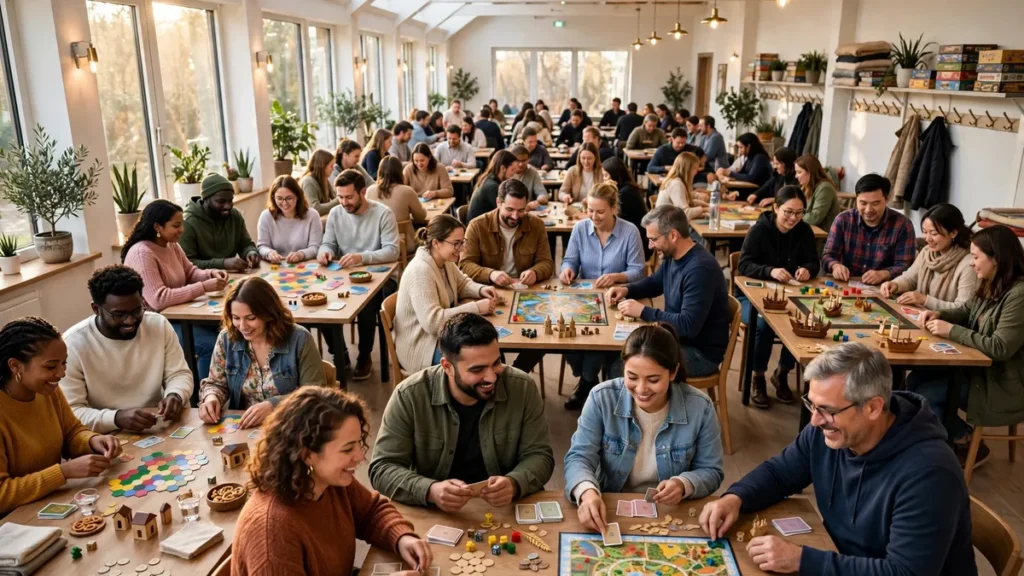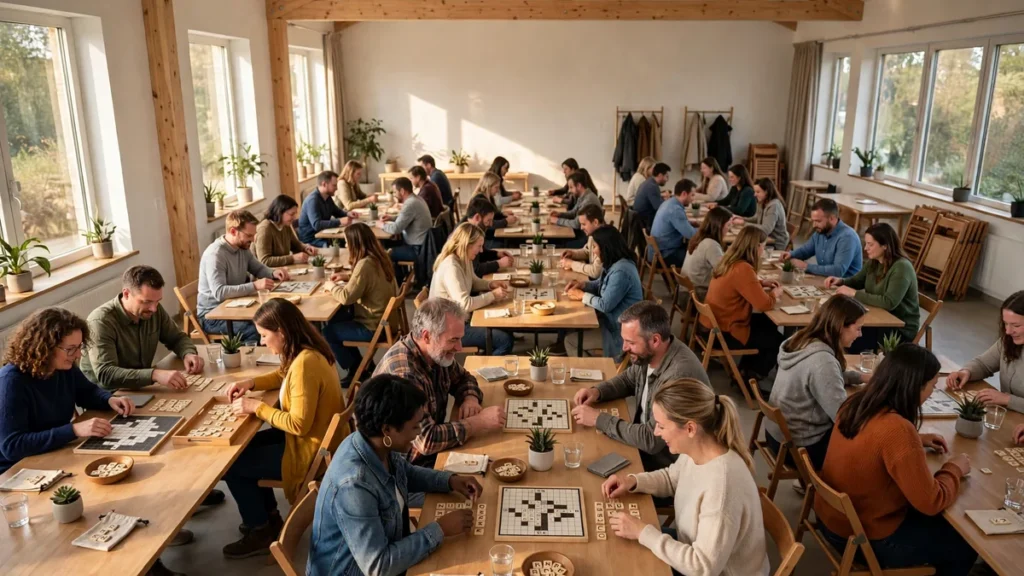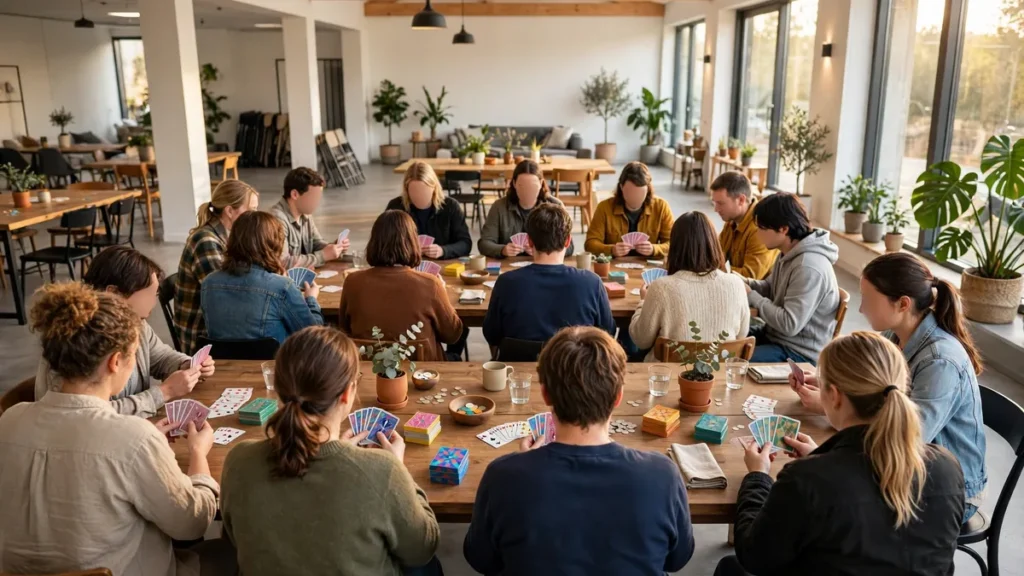
Best card games for 67 players are not about finding one deck that somehow stretches across sixty-seven hands. They are about choosing games that split cleanly into tables, run in short rounds, and keep every player involved while the score moves forward. A group this large needs structure more than it needs a clever rulebook, because sixty-seven people waiting for a turn will drift away long before the first hand ends. The best choices here are familiar card games with simple rules, fast turns, and a clear way to compare results across tables.
When a group reaches this size, the format matters as much as the game itself. The most successful large-group card nights use several tables of four to eight players, a shared scoring sheet, and rounds that last ten to twenty minutes. Players rotate between tables, winners move up, and the whole room stays in step because every table finishes at roughly the same time. That rhythm turns a crowd into a single event instead of a collection of separate games happening in the same room.
This guide covers the card games that work best for 67 players, how to organise them, and what to avoid. It includes quick party games for mixed-age groups, longer strategy games for experienced players, team formats that suit a hall or a classroom, and a simple tournament plan that a single host can run without extra helpers. Every game below can be played with standard decks, widely available commercial sets, or a mix of both, and each one has been chosen because it stays fair, fast, and fun when the player count is very large.
Key takeaways
- Split 67 players into tables of four to eight and run short rounds of ten to twenty minutes so nobody waits long for a turn.
- Choose games with simple rules that new players can learn in two minutes, such as Uno, Spoons, Golf, and Rummy.
- Use one shared scoring sheet and a rotation plan so results from every table count toward one overall winner.
- Bring enough decks and sets for every table, plus spares, because a missing deck stops a whole table.
- Mix quick party games with one longer strategy game so the night has energy at the start and a satisfying finish.

Why 67 Players Changes the Game
A card game for four people and a card game for sixty-seven people are different problems. With four players, the host can explain the rules once, deal one deck, and watch every hand. With sixty-seven players, the host must explain the rules once to the whole room, deal many decks at once, and keep a dozen tables moving at the same speed. The game that wins in this setting is the one that survives that scale without slowing down.
The first change is table size. Most card games play best with four to eight people at a table. Fewer than four can feel empty, and more than eight makes turns slow and hands hard to manage. Sixty-seven players therefore divide naturally into nine or ten tables: eight tables of seven and one table of eleven is awkward, so a better split is nine tables of seven with four players floating as substitutes, or ten tables with six or seven players each. Either arrangement works, provided the host decides the split before anyone sits down.
The second change is time. A single hand of a slow game can take forty minutes, which is too long when ten tables must stay together. Short rounds solve this. A round of Uno, Spoons, or Golf usually finishes in ten to fifteen minutes, which means the host can run four or five rounds in an hour and a half. Longer games still have a place, but they work best as a final round or as one table among many, not as the only game of the night.
The third change is scoring. In a small game, the winner is obvious. In a large game, the host needs a way to compare a win at one table with a win at another. Points solve this cleanly. Award points for finishing first, second, and third at each table, add a small bonus for the lowest score in games such as Golf, and keep a visible leaderboard on a whiteboard or a printed sheet. Players care more when they can see their position change after every round.
How to Organise 67 Players in One Evening
Organisation is the difference between a lively card night and a confusing one. The plan below fits a two-hour session and needs only one host, a printed score sheet for each table, and enough decks for every table. It works for a school event, a community hall, a family reunion, a youth group, or a workplace social, and it can be shortened to ninety minutes by dropping one round.
Set Up the Room First
Arrange ten tables before guests arrive, with six or seven chairs at each table and a deck or a game set in the centre. Place a score sheet, a pen, and a simple printed rules card on every table so players can check the rules without asking the host. Keep spare decks, extra pens, and a few blank score sheets at the host table. Label the tables with numbers so players can find their starting table quickly and move to the next table without confusion.
Welcome and Explain the Format
Take five minutes at the start to explain the format, not the rules of every game. Tell players how many tables there are, how long each round lasts, how scoring works, and how rotation works. Explain that winners move up one table and other players stay or move down, so tables mix and nobody plays the same opponents all night. Then explain the first game only, deal the cards, and start. Players learn faster by playing than by listening to a long speech.
Run Short Rounds and Rotate
Run rounds of fifteen minutes. When time ends, the host calls time, each table records its scores, and players rotate to their next table. A simple rotation is to move the top two players at each table up one number and the bottom two down one number, while the middle players stay. Over four rounds, most players will meet several different opponents, which keeps the night social and stops one strong table from deciding the whole event.
The Best Card Games for 67 Players
The games below are grouped by style so a host can pick a balanced set. A good evening uses two or three quick games and one longer game, with at least one game that suits children and beginners and one that suits experienced players. All of them are widely available, easy to teach, and proven at large gatherings.
Uno
Uno is the most reliable large-group card game because almost everyone already knows it. Each table needs one Uno deck, and a standard game takes ten to fifteen minutes with six or seven players. The rules are simple: match a card by colour or number, use action cards to skip, reverse, or draw, and call Uno when one card remains. The game stays lively because action cards change the order constantly and no lead is ever safe. For 67 players, buy ten decks, one per table, and use the same scoring rule at every table so results compare fairly. The same approach works for the best card games for 65 players, where ten tables and short rounds keep a large group moving at the same pace. Uno also works well as the opening game because it warms the room up quickly and gives shy players something familiar to do.
Spoons
Spoons is a fast, noisy game that suits large groups perfectly. Each table needs one standard deck of playing cards and one spoon fewer than the number of players. Players pass cards around the table, trying to collect four of a kind, and then grab a spoon as quietly as they can. The last player without a spoon is out, or loses a letter in a longer version. A round takes five to ten minutes, which makes Spoons ideal between longer games or as a high-energy finish. It needs little table space, no special equipment beyond spoons, and it creates the kind of laughter that carries a whole evening. Keep spare spoons handy, because they slide off tables and disappear under chairs.
Golf
Golf is a quiet, thoughtful game that balances the energy of Spoons and Uno. Each player has six cards face down in two rows of three, turns over two cards at the start, and then draws and discards to lower the total of their hand. Pairs in a column cancel out, which gives the game a small puzzle to solve on every turn. A round takes about fifteen minutes with six players, and the lowest total wins. Golf suits players who like a calm game, and it works well as the second or third round, when the room has settled and people want a change of pace. It needs only one standard deck per table, plus a score sheet.
Rummy
Rummy is a classic that rewards planning and memory. Players draw and discard to build sets of three or four cards of the same rank and runs of three or more cards in the same suit. A hand usually takes fifteen to twenty minutes, so Rummy fits best as a longer round or as the main game for experienced tables. With 67 players, Rummy works well when the host runs it at a few tables while other tables play quicker games, then brings everyone together for a final round. Use two decks shuffled together for tables of six or seven, because one deck runs out too quickly with that many hands.
Exploding Kittens
Exploding Kittens is a light party game with simple rules and a lot of humour. Players draw cards, play action cards to skip turns, peek at the deck, or steal from opponents, and try to avoid the Exploding Kitten card. A round takes about fifteen minutes with five or six players, and the party pack supports larger tables. The game suits mixed-age groups, because the rules take two minutes to explain and the pictures do most of the teaching. For 67 players, use the party edition at each table and keep the tone friendly, since the game works best when players enjoy the surprises rather than taking the competition too seriously.
Presidents
Presidents, also known as Scum or Asshole in some groups, is a shedding game that scales well and creates a natural ranking. Players try to get rid of all their cards first, and the order in which they finish decides their title for the next hand, from President down to the lowest rank. The game takes ten to fifteen minutes per hand, needs only one standard deck per table, and works with five to eight players. It is social, easy to learn, and the ranking system gives players a reason to care about every hand. For a family or school group, use the name Presidents and keep the tone friendly.
Comparison Table
Use this table to pick the right mix for your group. Quick games suit the start of the night, longer games suit the finish, and a mix of both keeps every kind of player engaged.
| Game | Players per table | Time per round | Difficulty | Best for |
|---|---|---|---|---|
| Uno | 4 to 7 | 10 to 15 minutes | Easy | Opening round, all ages |
| Spoons | 4 to 8 | 5 to 10 minutes | Easy | High energy, quick bursts |
| Golf | 4 to 7 | About 15 minutes | Easy | Calm play, mixed ages |
| Rummy | 4 to 7 | 15 to 20 minutes | Medium | Strategy, experienced players |
| Exploding Kittens | 5 to 6 | About 15 minutes | Easy | Party atmosphere, families |
| Presidents | 5 to 8 | 10 to 15 minutes | Easy | Social play, ranking fun |
Team Formats That Work for 67 Players
Individual tables are the simplest format, but team formats add variety and help shy players feel part of something larger. A team format also solves the problem of odd numbers, because a team can have an uneven size without breaking the game. The three formats below have all been used successfully at large card nights.
Table Teams
Divide the room into teams of six or seven, with each team sitting at one table. The team plays together for the whole evening, and the team score is the total of its members’ points. This format suits workplaces and schools, because it builds team spirit and works alongside the ideas in our guide to party games for 65 players, which covers the same kind of large-group planning and gives quieter players teammates to talk to. It also makes scoring simple, since the host only needs to track ten team totals instead of sixty-seven individual scores.
Tips for a Smooth Night
A few small habits make a large card night run well. First, start on time, even if a few players are late, because waiting for everyone wastes the energy of the players who arrived early. Second, keep the rules visible on each table so players can check them without stopping the game. Third, keep rounds short and call time clearly, because a round that runs long throws the whole schedule out. Fourth, walk the room during play and help tables that are stuck, rather than standing at the front waiting for a problem to reach you. Fifth, take a short break halfway through for drinks and snacks, because sixty-seven people in one room get thirsty and tired. A ten-minute break refreshes the room and gives the host time to update the leaderboard. Hosts planning a wider game night can also borrow the table layout from our guide to board games for 65 players, which uses the same ten-table setup.
Checklist for Hosting 67 Players
- Confirm the venue, tables, and chairs for 67 players before the day of the event.
- Pack ten standard decks, ten Uno decks, spare decks, score sheets, pens, and a bell or timer.
- Print a rules card for each game and place one on every table.
- Plan the table split, the rotation order, and the scoring system in advance.
- Prepare a visible leaderboard and simple prizes for the winner, the best team, and the most improved player.
- Arrive early, set up the tables, test the timing signal, and welcome players at the door.
Frequently Asked Questions
Can 67 players play one card game at the same time?
No single standard card game plays well with 67 people at one table. The practical answer is to split the group into tables of four to eight players, run the same game at every table, and compare scores across tables. That way everyone plays at the same time, and the event still has one overall winner.
How many decks do you need for 67 players?
Plan on one deck or set per table for each game, which means about ten decks for a ten-table setup. Rummy tables need two decks each, and Uno tables need one Uno deck each. Bring two or three spare decks, because decks get damaged, lost, or mixed up during a busy night.
What is the best card game for a large group of beginners?
Uno is the best starting point for beginners, because most people already know the rules and a round takes only ten to fifteen minutes. Spoons and Golf are also strong choices for beginners, since both take two minutes to explain and keep every player involved from the first hand.
How long should a card night for 67 players last?
Two hours works well, with four or five rounds of fifteen minutes, a short welcome, and a ten-minute break in the middle. A ninety-minute version works if you drop one round, while a three-hour evening suits a group that wants a longer final game such as Phase 10 or Canasta.
How do you keep score across ten tables?
Use one simple system for the whole night, such as three points for first place at a table, two for second, and one for third. Record the points on a score sheet at each table, add them up after every round, and post the leading players on a visible leaderboard so everyone can follow the contest.
What if the group size changes during the night?
Keep two or three floating seats for late arrivals and a spare player at the host table to fill gaps. If players leave early, merge the smallest tables so no table drops below four players. The rotation plan can absorb small changes without breaking the scoring, provided the host updates the leaderboard after each round.
The Bottom Line
The best card games for 67 players are the ones that split easily into tables, finish in short rounds, and let every player contribute to one shared score. Uno, Spoons, Golf, Rummy, Exploding Kittens, and Presidents all earn a place on that list, because each one is easy to teach, fair across tables, and fun at scale. Plan the room, bring enough decks, keep the rounds short, and post the scores where everyone can see them, and sixty-seven players will feel like one lively game night rather than a crowd waiting for a turn.