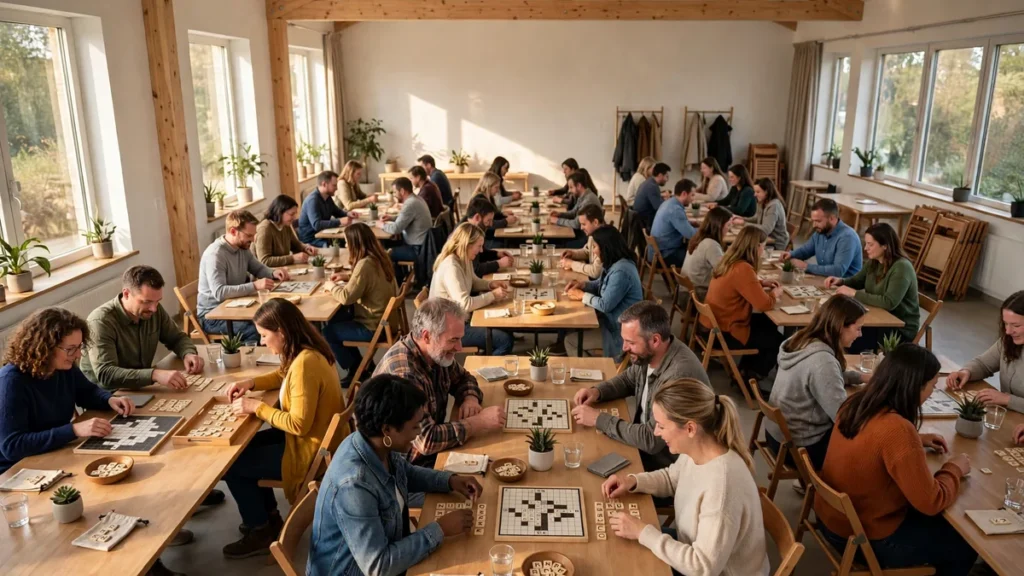
Finding the best word games for 70 players is a very different challenge from picking a game for a family of four. With seventy people in the room, a single board, a single deck of cards, or a single timer will leave most of the group watching instead of playing. The best word games for 70 players solve that problem by splitting the crowd into teams, running several rounds at once, and giving every player a word to solve, a letter to place, or a clue to shout out within the first few minutes.
Word games suit huge groups better than almost any other kind of party game. They need little equipment, they work for mixed ages and mixed abilities, and they can be scaled up simply by adding more teams, more rounds, or more stations. The key is structure: clear teams, a visible scoreboard, short rounds, and a host who keeps the pace moving.
This guide covers the nine best word games for 70 players, how to set each one up for a crowd this size, and how to run the whole evening without long waits or confusion. Every game here has been chosen because it works with ten teams of seven, needs only basic supplies, and keeps all seventy players involved from the first clue to the final score.
Key takeaways
- Split 70 players into ten teams of seven so every game runs as a team contest, not a single-player turn.
- Use short rounds of five to ten minutes and rotate teams through stations to keep waiting time near zero.
- Pick games that need only paper, pens, letter tiles, or a projector, so setup stays simple at this scale.
- Keep a visible scoreboard and a clear points system so all ten teams can follow the contest.
- Mix quiet puzzle rounds with loud shouting rounds so energy stays high across the whole evening.

Why Word Games Work So Well for 70 Players
Word games scale in a way that many party games do not. A board game designed for four players cannot simply be stretched to seventy, but a word puzzle can. One puzzle can be solved by ten teams at once, and the host only needs to manage time and scoring.
They are also fair across a mixed crowd. In a group of seventy, ages, interests, and experience levels will vary widely. Word games reward vocabulary, pattern spotting, and quick thinking rather than speed of movement or knowledge of one narrow topic. A teenager who reads widely can contribute as much as a retired teacher, and a quiet player who is strong at anagrams can carry a round for a team that is weaker at spelling. That balance matters when the goal is a fun evening, not a contest only a few people can win.
Cost and setup are the third advantage. Most of the games in this guide need printed sheets, pens, a whiteboard or projector, and a set of letter tiles. A host can prepare the whole evening with a printer, a stack of answer sheets, and a simple scoreboard, which makes word games one of the most practical choices for school events, church socials, office parties, and community nights.
How to Run Word Games for 70 Players
Start by forming ten teams of seven players. Seven is a good team size because it is large enough that every team has a mix of strengths, yet small enough that everyone can hear each other around one table. Give every team a name, a table, and a coloured score sheet so the host can call teams by name and the scoreboard stays easy to read.
Plan the evening in rounds of five to ten minutes. Short rounds keep energy high and limit the damage if one game does not suit a team. A good structure is six rounds of eight minutes with a two-minute break between rounds, which fills about an hour, followed by a final round and a prize ceremony. Announce the rules once before the timer starts and display them at each table.
Scoring should be simple and visible. Award ten points to the winning team in a round, then nine, eight, and so on down to one point for the last team, or use a flat points-per-answer system for puzzle rounds. Update a large scoreboard after every round so teams can see the standings. Appoint one scorekeeper who is not playing, and ask each team to choose a captain who hands in the answer sheet and settles disputes. For a crowd this size, the host should also keep a whistle or a bell, because seventy voices can drown out a spoken announcement. If you are planning a smaller version of the same evening first, the ideas in our guide to word games for 67 players show how the same team format works with a slightly smaller crowd.
The Best Word Games for 70 Players
1. Team Scrabble Relay
Team Scrabble Relay turns a slow two-player board game into a fast team race. Set up one Scrabble board per team, or one board per pair of teams if boards are limited, and give each team a rack of seven tiles. Teams take turns placing words, but every player must place at least one word before the round ends, and the team has a five-minute limit to use as many tiles as possible. The twist is the relay: after each word, the next player takes over, so no single strong player can dominate. Award bonus points for words of six letters or more and for using high-value letters such as Q, Z, and X. This game works well as an opening round because the rules are familiar and the boards give every table something to gather around.
2. Giant Crossword Race
For the Giant Crossword Race, print or project one large crossword grid and give every team the same set of clues. Teams race to complete the grid, with points for each correct answer and a time bonus for the first three teams to finish. A fifteen-by-fifteen grid with about thirty clues is the right size for a ten-minute round. The best approach is to mix easy clues that every team can answer with a handful of harder clues that separate the leaders. Print the grid large enough to read from across a table, and give each team a different coloured pen so the host can check answers quickly. This is one of the quietest games in the guide, so it pairs well with a loud game straight after it.
3. Word Bingo
Word Bingo is the easiest game on this list to run for seventy people, and it is ideal when the group includes players of very different ages. Prepare bingo cards with words instead of numbers, using a theme such as animals, food, travel, or everyday objects. The host calls out definitions rather than the words themselves, so players must work out the matching word before they can mark it. For example, the host says a fruit that keeps the doctor away, and players look for apple. The first team to complete a full row shouts bingo, and play continues until three teams have won. Print cards in advance, use a different card layout for each team, and keep the definitions short so the pace stays quick.
4. Anagram Tournament
An anagram tournament is pure vocabulary under pressure, and it scales beautifully. Give every team the same list of ten scrambled words, such as TRANE for train or PELAS for please, and set a timer for five minutes. Teams earn one point per correct unscramble, with a bonus point for the first team to finish the whole list. Run three short lists in a row, increasing the difficulty each time, so teams that start slowly can catch up. Anagrams are a good choice for the middle of the evening because they need no equipment beyond printed sheets, they are easy to score, and they reward the quiet puzzle solvers who may have been overshadowed in louder rounds.
5. Boggle Battle
Boggle Battle adapts the classic letter-grid game for ten teams. Give each team the same four-by-four grid of letters, either printed or shown on a screen, and set a three-minute timer. Players write down as many words as they can find by joining adjacent letters, with a minimum word length of three letters. When time is up, teams read out their lists and cross off any word that another team also found, so only unique words score. Longer words earn more points: three and four-letter words earn one point, five-letter words earn two, and words of six letters or more earn three. Run two grids back to back with different letters so teams can adjust their strategy between rounds.
6. Scattergories Showdown
Scattergories Showdown is one of the loudest and funniest games in this guide. The host announces a letter and a list of categories, such as a vegetable, a country, a job, and a film title. Every team has two minutes to write one answer per category beginning with that letter. When time is up, teams compare answers, and any answer shared by two or more teams is crossed out. Only unique answers score, which pushes teams toward creative choices rather than obvious ones. A team that writes kumquat instead of kale for a fruit beginning with K earns the point, while every team that wrote kale loses it. Play three letters in one round, and let the host read out the funniest answers between rounds to keep the room laughing.
7. Team Spelling Bee
A team spelling bee works far better for seventy players than a traditional one-by-one bee. Each team sends one player to the front per word, and the team may confer quietly for ten seconds before the player spells. Words start easy and grow harder across ten rounds, from words such as neighbour and rhythm to words such as mnemonic and onomatopoeia. A correct spelling earns a point, and a team that misses a word sits out only that word, not the whole game. Use a microphone so the whole room can hear each word, and display the word on a screen after it is spelled so everyone can check it. The team format removes the fear of failing alone in front of a crowd, which is what makes this version suitable for a mixed group.
8. Bananagrams Team Sprint
Bananagrams is normally a fast, free-form tile game, and the team sprint version keeps that speed while adding structure. Give each team a set of letter tiles, face down, and on the word go, teams flip their tiles and race to build a connected crossword grid using all of their letters. The first team to use every tile shouts peel and wins the round, but every other team keeps playing for second and third place. Use twenty-one tiles per team for a five-minute round, and increase the tile count for later rounds. This game is noisy, physical, and fast, so it is best placed after a quiet puzzle round. It also works as a warm-up game, since the rules take less than a minute to explain. For a crowd that also enjoys non-word games, the format pairs naturally with the team setup in our guide to party games for 68 players, which uses the same ten-team layout.
9. Taboo-Style Word Guessing
Taboo-style word guessing closes the evening with energy. One player from each team stands at the front and describes a secret word to their team without using a list of forbidden words. For example, to get the word beach, the player cannot say sand, sea, sun, or holiday. Each team gets sixty seconds and as many words as they can guess, with one point per correct guess. Rotate the describer each round so different players take the spotlight. This game rewards quick thinking and clear communication more than vocabulary alone, and it produces the funniest moments of the night when a describer runs out of allowed words. Keep the forbidden lists short and fair, and use a buzzer or bell when a forbidden word slips out.
Word Games for 70 Players Compared
Choosing the right mix matters more than choosing a single best game. The table below compares all nine games on the factors that matter most for a crowd of seventy: how much equipment they need, how long a round takes, and how much noise and movement to expect.
| Game | Round length | Equipment needed | Energy level | Best for |
|---|---|---|---|---|
| Team Scrabble Relay | 10 minutes | Scrabble boards and tiles | Medium | Opening round |
| Giant Crossword Race | 10 minutes | Printed grids and clues | Low | Quiet concentration |
| Word Bingo | 10 minutes | Printed bingo cards | Medium | Mixed ages |
| Anagram Tournament | 5 minutes | Printed word lists | Low | Vocabulary skill |
| Boggle Battle | 3 minutes | Printed letter grids | Medium | Fast thinking |
| Scattergories Showdown | 10 minutes | Answer sheets | High | Creativity and laughs |
| Team Spelling Bee | 15 minutes | Microphone and word list | Medium | Showpiece round |
| Bananagrams Team Sprint | 5 minutes | Letter tile sets | High | Speed and energy |
| Taboo-Style Word Guessing | 10 minutes | Word cards and timer | High | Closing round |
A practical evening might open with Team Scrabble Relay, move through Anagram Tournament and Word Bingo, take a break, then run Scattergories Showdown, the Team Spelling Bee, and close with Taboo-Style Word Guessing. If time is short, pick any six games from the table and run them in the same alternating pattern.
Checklist for Running Word Games for 70 Players
Use this checklist in the week before the event so nothing is left to the last minute. Most of the work is preparation: once the teams, sheets, and scoreboard are ready, the evening itself should run itself.
- Form ten teams of seven players in advance and assign each team a table, a name, and a captain.
- Print answer sheets, grids, and bingo cards for all ten teams, plus ten spare sets for mistakes.
- Prepare a large visible scoreboard and appoint one scorekeeper who is not playing.
- Test the microphone, projector, timer, and bell before the first guest arrives.
- Choose six to eight games from this guide and print their rules on a sheet for each table.
- Buy small prizes for the top three teams and a fun prize for the best team name.
Frequently Asked Questions
How many teams should 70 players form?
Ten teams of seven is the best split for seventy players. Seven is large enough for a mix of strengths on each team and small enough that everyone can talk around one table.
How long does a word game night for 70 players take?
Plan for about two hours, including a short break. Six rounds of eight to ten minutes, plus introductions, scoring, and a prize ceremony, fills an evening without dragging.
What equipment do I need for 70 players?
You need printed sheets and pens for every team, a timer, a microphone, and a scoreboard. Add letter tile sets and Scrabble boards if you are running those games, and a projector or large screen for crosswords and hangman.
Can children and adults play together?
Yes, word games are one of the best choices for a mixed-age group. Mix ages within each team so adults can help younger players with hard words and children can bring fresh ideas to creative rounds such as Scattergories.
Do word games work outdoors for 70 players?
They can, but paper games need shelter from wind and rain. Giant versions work best outdoors: a crossword on a large board, letter tiles on a table, or a hangman game on an easel. Loud games such as Scattergories and Taboo-style guessing work well outdoors because noise is less of a problem.
What is the best word game for 70 players?
There is no single best game, because the right choice depends on the group. For a mixed crowd, Scattergories Showdown is the safest pick: it is easy to explain, funny, and rewards creativity over knowledge. Most hosts get the best result by mixing three or four games from this guide rather than relying on one. The team format itself matters more than any single game, and a similar ten-team setup works just as well for the games in our guide to board games for 68 players if you want to add a non-word round to the evening.
The Bottom Line
The best word games for 70 players are the ones that turn a huge crowd into ten small teams, keep rounds short, and give every player a word to solve in every round. Team Scrabble Relay and the Giant Crossword Race open the evening well, Scattergories Showdown and Taboo-style guessing bring the energy, and quiet rounds such as anagrams and word searches keep the pace balanced. Prepare the teams, the sheets, and the scoreboard in advance, and alternate loud and quiet games.


