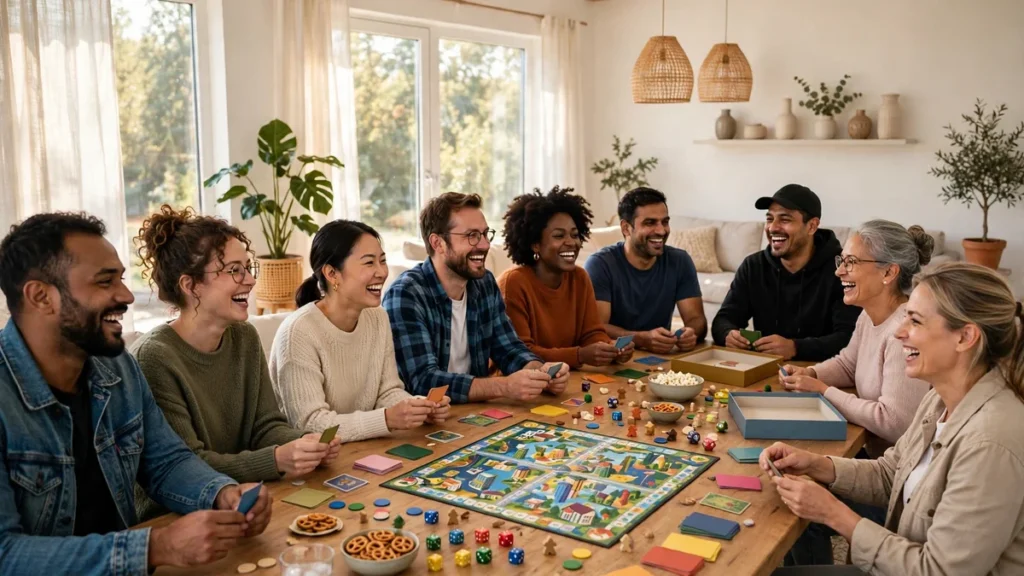
Finding the best board games for 62 players is a different challenge from picking a game for four friends. Almost no board game is designed for 62 people around one table. A group of 62 is a whole event: a school hall, a company offsite, a wedding weekend, or a big family reunion.
The good news is that 62 players is not too many for board games. It is simply too many for one box. The best board games for 62 players scale in one of three ways: team games where two giant teams face off, party games that run in parallel across several tables, or host-led games where the whole room plays together at once. Once you understand those three formats, a group of 62 becomes an advantage.
This guide covers all three formats: team games that split 62 people into two sides of 31, parallel-play games that work when you buy three or four copies, and whole-room games a single host can run for everyone. Every game below includes how many copies you need and how long a round takes.
Key takeaways
- Split 62 players into teams or parallel tables: two teams of 31, or six to eight tables of eight.
- Team games such as Codenames and Wavelength are simplest: one copy serves the whole room as two big teams.
- Parallel-play games such as Telestrations and Herd Mentality need three to six copies, one per table, with a shared scoreboard.
- Host-led games such as Werewolf, trivia, and bingo let all 62 players take part at once with no extra copies.
- Keep rounds short, rotate tables between games, and use a simple scoreboard so the night feels like one event.
How Board Games Work for 62 Players
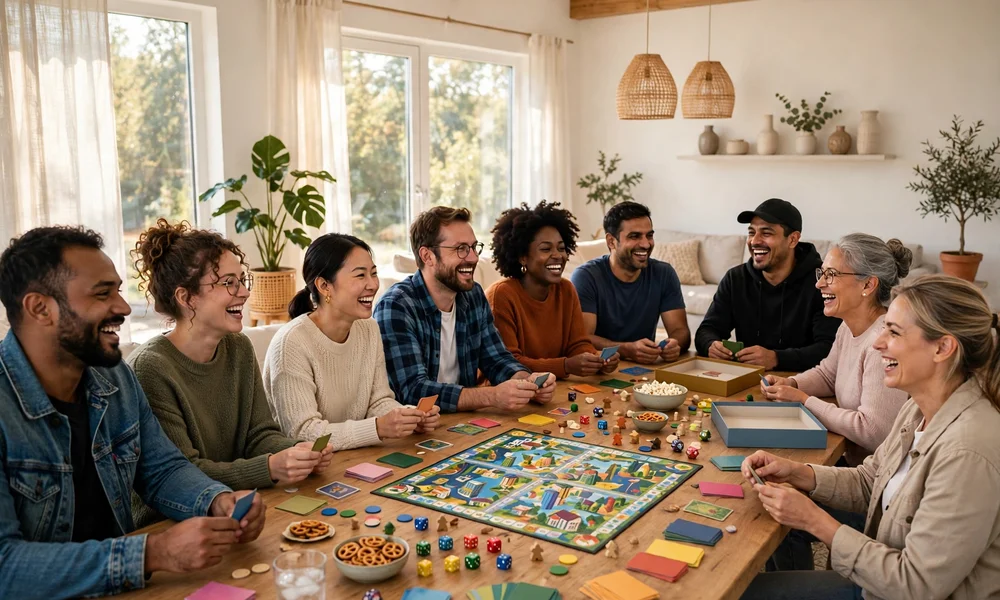
The first decision is format, and it matters more than which game you buy. A group of 62 has three workable shapes: two teams of 31 playing one shared game, six to eight parallel tables of seven or eight running the same game at once, or whole-room play where one host runs a game for all 62 people together.
Team play is the easiest to organise: one copy, one rules explanation, and one shared moment of tension when the final clue lands. The trade-off is downtime: in a team of 31, most people watch while a few speak. That suits short, punchy games such as Codenames, where every clue is debated by the whole team, and not games where only one person acts at a time.
Parallel tables keep everyone busy, which is the biggest advantage of this format. The cost is copies and hosts: a game that seats eight needs eight copies for 62 players, and each table needs someone who knows the rules. Buy the copies in advance, print a one-page rules sheet for each table, and appoint a table host who has played before. A shared scoreboard turns eight separate games into one tournament. Whole-room games such as Werewolf, trivia, and bingo need one host and no copies at all, and they suit the opening or closing game of the night. The strongest 62-player evenings mix all three formats, and these party games built for 61 players pair well with the board games on this list.
The Best Board Games for 62 Players
The games below are ranked by how well they scale to 62 players, how easy they are to teach, and how much fun they create. Each entry explains the format, how many copies you need, and how to run it.
1. Codenames
Codenames is the single best board game for 62 players, because it is a team game that genuinely works with two teams of 31. One grid of 25 word cards sits in the middle, each team has a spymaster giving one-word clues, and the whole team debates every guess together. The debate is the game, and the loudest moments of the night usually happen here. You need one copy and a way for everyone to see the cards, such as a projector. Split the room into two teams of 31, give each team a spymaster, and play best of three rounds of about 20 minutes each.
2. Werewolf and Ultimate Werewolf
Werewolf is built for large groups. The classic version supports up to 40 players, and Ultimate Werewolf stretches to 75, so 62 fits one game with one narrator. Everyone gets a secret role: the werewolves try to survive, and the villagers try to work out who is lying. Accusations, bluffing, and dramatic reveals keep all 62 people involved at once. You need one copy and a strong narrator who keeps the pace brisk and debates to a time limit. Allow 30 to 45 minutes per game, and play two or three rounds with different role mixes.
3. Telestrations
Telestrations is the telephone game in drawing form: each player sketches a word, passes the sketchbook on, and the next player guesses what the drawing shows. The results get funnier with every pass. One box seats 12, so 62 players need five or six copies at six tables. It needs almost no explanation, it works for all ages, and bad drawings are better than good ones. Give each table a copy, a timer, and a host who has played before. Run two 20-minute rounds, then bring everyone together for a best-of-the-night reveal where each table shares its funniest sketchbook chain.
4. Wavelength
Wavelength is a team guessing game: one player gives a clue placing a hidden target on a spectrum between two opposites, such as hot and cold, and their team guesses where it sits. It is a conversation game, which is why it works so well with big teams. With 62 players, split into two teams of 31 and let each team argue about where the target sits. One copy serves the whole room if everyone can see the target wheel, so project it or print a large version. A game takes 20 to 30 minutes, and the discussion about each clue is where the fun lives, so rotate the clue-giver each round.
5. Two Rooms and a Boom
Two Rooms and a Boom is designed for big groups and works best with 20 or more players, which makes it a natural fit for a 62-player event. Players split between two rooms, each with a secret role and team, get five timed rounds to work out who belongs where. The game ends with a hostage exchange and a reveal that decides everything. A single set supports up to 30 players, so run two parallel games of 31 in separate rooms, or split the group into three games of about 21. You need two rooms, a timer, and a host per game. Each game takes about 30 minutes.
6. Monikers
Monikers is a team guessing game in three rounds: describe the card, give one word, then act it out without speaking. The cards feature famous people, characters, and ideas, and because the same cards return every round, the jokes build through the game. It is loud, fast, and very funny with a big group. One box supports 16 players, so run four parallel games of 15 or 16, or a whole-room version with two teams of 31 taking turns at the front. Allow 30 to 45 minutes, and check the card deck suits your group, since some cards reference pop culture some players may not know.
7. Herd Mentality
Herd Mentality asks one simple question at a time, such as the best pizza topping, and every player writes down the answer they think the rest of the group will give. Matching the majority earns points, and the odd one out gets the pink cow. It is simple, quick to teach, and it works because big groups make the majority harder to predict. A box seats 20, so three or four copies cover 62 players. It takes about 20 minutes, and it is an excellent opener because the rules take two minutes to explain. End with a table winners final: each table winner plays one deciding round in front of the room.
8. Just One
Just One is a cooperative word game: one player guesses a mystery word, and everyone else writes a one-word clue, but any clue written by more than one person is removed first. It is gentle, clever, and cooperative, which makes it a good change of pace between competitive games. A box seats seven players, so 62 players would need eight or nine copies. Instead, run it as a whole-room game with two teams of 31: one team writes clues together and the other guesses, then swap. The team version needs only one copy and takes about 20 minutes.
9. Dixit
Dixit is a storytelling and guessing game built around beautiful illustrated cards. One player gives a clue about a card, everyone else plays a card that could match the clue, and the group votes on which card was the original. It rewards imagination rather than knowledge, so it suits mixed groups where ages and backgrounds vary widely. A box seats 12 with the Odyssey version, so five or six copies cover 62 players. Each game takes about 30 minutes. Dixit is quieter than the party games on this list, so it suits the second half of the evening, when the room wants something calmer.
10. 6 Nimmt! (Take 6!)
6 Nimmt! is a fast card game where players secretly choose a numbered card, reveal them together, and place them in rows without taking the dreaded sixth card. The rules take two minutes to learn, a round takes 15 minutes, and the game is pure tension: every reveal can change who takes a pile of penalty points. A box seats ten, so six or seven copies cover 62 players. The simultaneous reveal means nobody waits for a turn, and the game is cheap enough that buying several copies is realistic. Use a shared scoreboard across tables and run three quick rounds to find an overall champion.
11. Scattergories
Scattergories is a classic for large groups: roll a letter, get a list of categories, and race to write an answer nobody else writes. It is simple, it works for all ages, and it scales easily because the game is really a race against the timer. Run it as a whole-room game with two teams of 31, or as parallel tables with one copy per table and a shared timer. The team version is better for 62 players because the debate over whether an answer counts is half the fun. Allow 30 minutes for three rounds, and appoint a judge per round to settle disputes quickly.
12. Trivia Night
A hosted trivia night is one of the most reliable ways to entertain 62 people at once. Split the room into teams of six to eight, hand out answer sheets, and run five or six rounds of ten questions on general knowledge, music, films, food, sport, and the group itself. The host reads the questions, teams write their answers, and scores are tallied between rounds. You need no game box at all, just questions, answer sheets, and a confident host with a microphone. A full trivia night takes 60 to 90 minutes, so it works best as the main event of the evening. Mix in a picture round and a music round, and add questions about the group itself, because those always get the biggest reaction. These word games designed for 61 players work well as a warm-up before trivia begins.
Comparison Table: Best Board Games for 62 Players
Team games need one copy, parallel games need several, and whole-room games need one host.
| Game | Format for 62 | Copies Needed | Time per Game | Best For |
|---|---|---|---|---|
| Codenames | Two teams of 31 | 1 | 20 minutes | Opening team game |
| Werewolf | Whole room | 1 | 30 to 45 minutes | Social deduction fans |
| Telestrations | Six tables | 6 | 20 minutes | All ages, big laughs |
| Wavelength | Two teams of 31 | 1 | 20 to 30 minutes | Debate lovers |
| Two Rooms and a Boom | Two or three parallel games | 2 to 3 | 30 minutes | High-energy events |
| Monikers | Four tables or two teams | 1 to 4 | 30 to 45 minutes | Party atmosphere |
| Herd Mentality | Three to four tables | 3 to 4 | 20 minutes | Quick warm-up |
| Just One | Two teams of 31 | 1 | 20 minutes | Cooperative break |
| Dixit | Five to six tables | 5 to 6 | 30 minutes | Calmer second half |
| 6 Nimmt! | Six to seven tables | 6 to 7 | 15 minutes | Fast tournament rounds |
| Scattergories | Two teams of 31 | 1 | 30 minutes | Mixed ages |
| Trivia Night | Teams of six to eight | 0 | 60 to 90 minutes | Main event |
How to Run a 62-Player Board Game Night
A 62-player game night fails or succeeds on organisation, not on the games. Confirm your numbers a week ahead: 62 players means eight tables of eight for parallel games, or two teams of 31 for team games. Book a room with space to move between tables, because players need to rotate and hosts need to reach every group.
Buy or borrow the copies early. Parallel games need the most: six for Telestrations, six or seven for 6 Nimmt!, five or six for Dixit. Many game cafes and libraries lend multiple copies. Print a one-page rules sheet for each table, and set a visible timer so every table starts and finishes each round together.
Plan the running order before the night. Open with a whole-room game such as Herd Mentality or Werewolf to warm the room up. Move into parallel tables for the main session, with two or three rounds of 20-minute games and a rotation so players meet new people. Finish with a two-team final, such as Codenames or a trivia showdown, that brings the whole room back together. Keep scoring simple: award points per table per round, post them on a whiteboard, and offer a small prize for the winners. Make sure the room has enough tables and chairs for 62 people, good lighting, and a microphone for announcements. For more ideas, these card games that work for 60 players are a strong addition to any large game night.
Checklist for a 62-Player Board Game Night
- Confirm the player count a week ahead and plan the format: two teams of 31, parallel tables, or whole-room play.
- Buy or borrow the right number of copies: one for team games, three to seven for parallel games, none for host-led games.
- Appoint a host for every table and give each a printed one-page rules sheet.
- Set up a shared scoreboard so all 62 players can follow the tournament.
- Print a running-order schedule and post it on the wall.
- Bring spares: extra pens, paper, timers, dice, and one backup game.
Frequently Asked Questions
Can one board game really handle 62 players?
Yes, but not in the usual way. No single box seats 62 people around one table. The games that work use one of three formats: two teams of 31 sharing one game, several copies running in parallel across six to eight tables, or a host-led game where all 62 people play at once.
How many copies of a game do I need for 62 players?
It depends on how many players one box supports. A game that seats eight needs eight copies for 62 players, while a game that seats 20 needs three or four. Team games such as Codenames and Wavelength need only one copy because the whole room plays as two teams. Buy one spare copy of your main parallel game in case a set goes missing.
What is the best board game for 62 players overall?
Codenames is the best single choice: one copy serves two teams of 31, the rules take two minutes to explain, and the team debate keeps everyone involved. Werewolf is best for social deduction, Telestrations is best for parallel tables, and trivia is best for filling a whole evening.
How long does a 62-player game night take?
Plan for three hours. Allow 20 minutes for a warm-up game, 90 minutes for two or three rounds of parallel-table games with rotations between them, and 30 to 45 minutes for a team final. Add 15 minutes at the start for seating and rules, and 15 minutes at the end for scoring and prizes.
Do 62-player board game nights work for mixed ages?
Yes, if you choose the right games. Telestrations, Herd Mentality, Scattergories, and Dixit work well for children, teenagers, and grandparents together, because they rely on drawing, guessing, and imagination rather than specialist knowledge. Seat families together, and keep trivia rounds mixed so no age group has an unfair advantage.
What should I do if some players arrive late?
Build late arrivals into the plan. Start with a whole-room game that latecomers can join without missing anything, such as Herd Mentality or trivia, rather than a game that needs a fixed team from the first round. For parallel tables, keep one or two spare seats at each table for late arrivals.
The Bottom Line
The best board games for 62 players turn a huge group into an advantage. Codenames and Wavelength split the room into two teams of 31, Telestrations, Herd Mentality, and 6 Nimmt! run in parallel across six to eight tables so everyone plays every minute, and Werewolf and trivia bring all 62 people together for one whole-room event. Pick one game from each format, confirm your numbers, buy the copies early, and post a simple schedule on the wall, and 62 players stops being a logistical problem and becomes the best game night your group has ever had.


