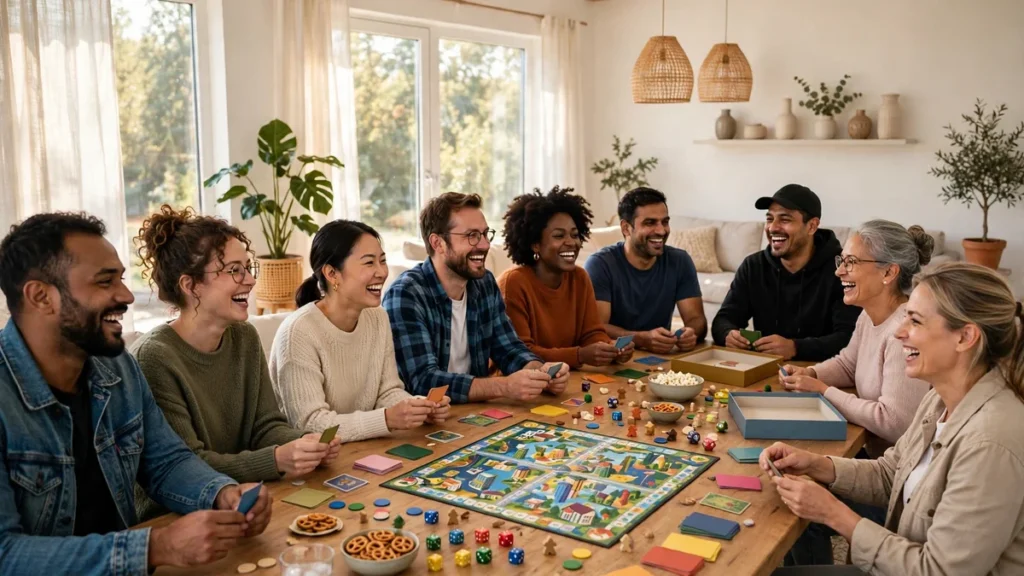
Finding the best card games for 60 players is a very different challenge from picking a game for a family of four. A standard deck holds 52 cards, most card games are designed for two to eight people, and a single table can only seat so many players comfortably. When sixty people show up for a game night, a school event, or a community gathering, you cannot simply deal everyone in. You need games that scale and a plan for tables, decks, and scoring.
The secret is to stop thinking of one giant game and start thinking in terms of tables, teams, and rounds. With ten tables of six players, or fifteen tables of four, a room of sixty becomes a lively tournament where everyone plays at the same time, winners advance, and the whole evening builds toward a final table that the entire room can watch.
This guide covers eight card games that work for sixty players, with notes on decks, round length, and the crowd each game suits, plus a comparison table, a running plan, a setup checklist, and answers to the questions hosts ask most often.
Key takeaways
- No single card game seats sixty people at one table, so the best card games for 60 players all use multi-table tournaments, team play, or rotation formats.
- Plan on ten tables of six players or fifteen tables of four, with at least one standard deck per table and spares for games that need two decks.
- Fast, easy-to-learn games such as Spoons, Cheat, and Uno work best when many players are new to card games.
- Tournament games such as Rummy, Texas Hold’em, and duplicate bridge suit competitive groups and reward skill over a full evening.
- Appoint one host or referee per four to five tables, keep rounds short, and publish a simple scoring sheet so everyone can follow the standings.

Why 60 Players Changes the Card Game Completely
A card game for four people and a card game for sixty people are barely the same activity. With four players, everyone can see every card and wait only seconds between turns. With sixty, nobody can follow sixty hands at once. The answer is to run many small games in parallel: each table becomes its own game, and the room becomes a tournament.
The host’s job changes too. At a small game night, the host is just another player. At a sixty-player event, the host is an organiser, a timekeeper, and a referee, with clear start times, a way to record winners, and a plan for tables that finish early. The games below were chosen partly because they make that job easy: short rounds, simple scoring, and rules explained in two minutes or less.
The choice of game matters more than anything else. Games with simultaneous play, quick turns, and simple rules scale well. Games with long turns or heavy negotiation do not, so the list below leans toward fast, flexible games that work in parallel across many tables.
How to Choose a Card Game for 60 Players
Start by knowing your crowd. Experienced players will enjoy a Rummy or poker tournament with real strategy and a final table. A mixed crowd will have far more fun with fast party games where luck matters as much as skill and nobody is eliminated early.
Age range matters too. If children are part of the sixty, pick games with simple rules and no betting: Uno, Spoons, and Cheat all work for mixed-age groups, while poker suits an adults-only evening.
Time and equipment are the final factors. A full evening allows four to six rounds of twenty to thirty minutes each, plus a final. Every table needs its own deck or decks, and you should always bring spares. Ten tables of Rummy need at least ten decks, and ideally twenty, since Rummy is often played with two decks per table. If you are comparing formats, the best card games for 59 players use almost identical table layouts, so anything that works for fifty-nine players will work for sixty with one extra seat.
The Best Card Games for 60 Players at a Glance
The table below compares all eight games on players per table, decks needed, round length, and difficulty. Use it to shortlist two or three games, then read the detailed entries to make your final choice.
| Game | Players per table | Decks needed for 60 players | Round length | Difficulty | Best for |
|---|---|---|---|---|---|
| Rummy tournament | 4 to 6 | 20 to 24 | 30 minutes | Medium | Competitive groups |
| Texas Hold’em tournament | 8 to 10 | 7 to 8 | 45 minutes | Medium | Adults-only evenings |
| Uno multi-deck party | 6 to 10 | 10 to 12 sets | 20 minutes | Easy | Mixed-age crowds |
| Spoons | 5 to 8 | 10 to 12 | 10 minutes | Easy | High-energy parties |
| Cheat | 4 to 8 | 10 to 12 | 15 minutes | Easy | Social, chatty groups |
| President | 5 to 7 | 10 to 12 | 20 minutes | Easy | Regular game nights |
| Exploding Kittens multi-deck | 4 to 6 | 10 to 12 sets | 20 minutes | Easy | Fun, casual crowds |
| Duplicate bridge | 4 | 15 | 30 minutes | Hard | Serious card clubs |
The 8 Best Card Games for 60 Players
Each game below includes the table setup, the decks required, and practical advice for running it with sixty players. All eight work in parallel across many tables and produce a clear winner at the end of the night.
1. Rummy Tournament
Rummy is one of the strongest choices for a sixty-player event because it is widely known, genuinely skilful, and easy to run as a tournament. Set up ten tables of six players, with two decks per table including jokers. Each table plays a timed round of thirty minutes, and the two highest scorers advance. After three rounds, the top twelve players meet at two semi-final tables, and the winners play a final.
Rummy works so well at this scale because every table plays the same game at the same pace, and the scoring is simple: players earn points for the sets and runs they lay down, and lose points for cards left in hand when the round ends. Print a scoring card for each table. A full Rummy tournament for sixty players takes about two and a half hours, ideal for an evening event with a break in the middle.
2. Texas Hold’em Multi-Table Tournament
A Texas Hold’em tournament is the classic large-group card event, and it scales to sixty players with almost no changes. Seat six to eight tables of eight to ten players, give every player the same starting stack of chips, and raise the blinds every fifteen to twenty minutes. As players are eliminated, tables merge until one final table remains.
Appoint a tournament director who calls out blind increases, manages table merges, and settles disputes. Use play chips rather than money unless every player has agreed in advance to a small buy-in. A sixty-player poker tournament usually takes three to four hours, so it suits a dedicated evening.
3. Uno Multi-Deck Party
Uno is the easiest game on this list to explain, which makes it perfect when many of your sixty players have never played cards together before. Shuffle two Uno sets together for each table of six to ten players, and play short rounds of about twenty minutes. The winner of each table advances, and eliminated players can join a casual side table.
Uno’s strength is its energy: the cards are colourful, the reverses and skips keep everyone involved, and shouting Uno at the right moment is exactly what a big party needs. The drawback is luck, so treat Uno as a party game rather than a serious competition, and award points for finishing first, second, and third at each table across several rounds.
4. Spoons
Spoons is the fastest game on this list and the best choice when you want pure energy. Each table of five to eight players needs one deck of cards and one fewer spoon than the number of players. Players pass cards around the table, trying to collect four of a kind, and the moment one player grabs a spoon, everyone scrambles for the rest. The player left without a spoon is out, one spoon is removed, and the next round begins.
A round lasts about ten minutes, so you can run five or six rounds in a single hour. That speed makes Spoons ideal as the opening game, when you want to break the ice and get sixty people laughing. It is noisy and physical, so give each table room to grab without knocking over drinks, and use sturdy metal spoons rather than plastic ones.
5. Cheat
Cheat, also known as I Doubt It, is a bluffing game that turns a room of sixty strangers into a room of sixty friends. Each table of four to eight players shares a single deck. Players take turns discarding cards face down while announcing their value, and they may lie. Any player can call Cheat: if the liar is caught, they pick up the pile, and if the accuser is wrong, they pick it up instead.
Cheat works brilliantly at scale because it is almost entirely social: the cards matter far less than the performance and the timing of a challenge. It is also one of the cheapest games to run, at one deck per table. A fifteen-minute round is enough for a full game, and winners can advance while the rest rotate to a new table.
6. President
President is a climbing game where players shed their cards as quickly as possible, and the order in which they finish decides their rank for the next round. The first player out becomes the President, the second the Vice President, and the last player out the lowest rank. The President gets advantages in the next round, such as receiving the best cards from the lowest-ranked player.
President suits a sixty-player night because the ranking system carries naturally from one round to the next. Winners move to a higher table while lower-ranked players move down, so the room sorts itself by skill without complicated seeding. A round takes about twenty minutes, and the game is easy enough to teach in two minutes.
7. Exploding Kittens Multi-Deck Party
Exploding Kittens is a modern card game with a simple idea: players draw cards until someone draws an Exploding Kitten and is eliminated, unless they have a Defuse card. The standard set supports up to five players, but combining two or three sets lets you seat four to six per table and run ten tables at once.
This game suits a fun, casual crowd: the artwork is funny, the rules take about three minutes to learn, and every draw creates tension. Eliminated players can join another table for the next round, so nobody sits out for long. You will need ten to twelve sets in total. Keep rounds to twenty minutes and run four or five rounds, with the table winners meeting for a grand final.
8. Duplicate Bridge
Duplicate bridge is the most serious game on this list and the best choice for a card club or a group of experienced players. In duplicate bridge, every table plays the same hands, so the result depends on skill rather than the luck of the deal. Sixty players form fifteen tables of four, and pairs move between tables after each round while the boards move the other way.
Duplicate bridge needs more preparation than any other game here: fifteen pre-dealt boards, printed score sheets, and a director who understands the movement pattern. The reward is a genuinely fair competition where the best pair wins. Allow thirty minutes per round and three hours for the full event. If your group has never played bridge, choose an easier game on this list instead.
How to Run a 60-Player Card Night
A great sixty-player card night is planned before anyone arrives. The games matter, but the organisation matters just as much. The plan below covers the four decisions that make or break the evening: seating, equipment, scoring, and the schedule.
Seating and Table Layout
Arrange ten tables of six players for most games, or fifteen tables of four for bridge. Leave space between tables for rotation, place a number card on each table, and put the final table in a visible spot, such as the centre of the room, so everyone can gather around it for the last game. Seat players randomly for the first round, then use results to seed later rounds. If you are mixing card games with other activities, the best puzzle games for 60 players offer a useful comparison for how to organise the same number of people around a different kind of game.
Equipment and Decks
Count your decks twice and bring spares. A single missing card can ruin a table’s game, so check every deck the day before and replace any that are incomplete. Bring at least two decks per Rummy table, one deck per table for Spoons, Cheat, and President, and enough Uno or Exploding Kittens sets for every table. You will also need score sheets, pens, a timer, and a whiteboard or printed sheet showing the standings after each round. Provide water and snacks at a separate table away from the cards, with a proper break halfway through.
Scoring and Rotation
Keep scoring simple enough that any player can work it out. Award three points for first place at a table, two for second, and one for third, and add the points across rounds to find the overall winners. Publish the standings on a whiteboard after every round so everyone can see how they are doing. For elimination games such as poker, record the finishing order at each table instead of points. Announce each rotation clearly and give players two minutes to move. A loud timer or a bell works better than shouting. Appoint one referee for every four or five tables to answer rules questions and keep rounds on schedule.
Schedule for the Evening
A typical three-hour schedule: thirty minutes for arrival, seating, and rules, four rounds of twenty-five minutes with short breaks, a thirty-minute final, and ten minutes for prizes. Start on time even if a few players are late, because a delayed start shortens every round that follows.
Checklist: Your 60-Player Card Night Setup
Use this checklist in the week before your event, and do a final check on the morning of the event.
- Confirm the venue, the table layout, and the seating plan for sixty players, with space between tables for rotation.
- Count and check every deck of cards, plus spares, and confirm you have enough sets for games such as Uno or Exploding Kittens.
- Print score sheets, table number cards, and a simple one-page rules sheet for each game you plan to play.
- Appoint a host and one referee for every four to five tables, and brief them on the schedule, the scoring, and the rotation pattern.
- Prepare a timer, a bell, a whiteboard for standings, and a small prize for the overall winner and the final table.
- Arrange water, snacks, and a separate refreshment table away from the cards, with a scheduled break halfway through the evening.
Frequently Asked Questions
Can sixty people play one card game at the same time?
Yes, but not at a single table. Sixty people play together through a multi-table tournament, where each table runs its own game and winners advance between rounds. Ten tables of six players is the most common setup.
How many decks of cards do I need for sixty players?
Plan on one deck per table for Spoons, Cheat, and President, two decks per table for Rummy, and one Uno or Exploding Kittens set per table. For ten tables, that means ten to twenty-four standard decks. Always bring two or three spares, and check every deck for missing cards before the event.
What is the easiest card game for sixty players?
Spoons is the easiest game to run for sixty players, because the rules take about one minute to explain and a round lasts only ten minutes. Uno is a close second: almost everyone already knows it, and the colourful cards make it welcoming for new players. Both games work well as icebreakers at the start of the evening.
How long does a sixty-player card night take?
Most sixty-player card nights take between two and a half and three and a half hours, including arrival, rules, four rounds, and a final. Fast party games such as Spoons or Cheat can be run in under two hours, while a poker tournament can take four hours. Plan your schedule around the game you choose.
What prizes should I offer for a sixty-player card night?
Keep prizes simple and fun: a small trophy or medal for the overall winner, a deck of premium cards for each final-table player, and a light-hearted prize for the player who finishes last. Avoid cash prizes unless the event is an adults-only tournament where everyone has agreed to a buy-in in advance.
Can I mix card games with other games at the same event?
Yes, and it often makes the evening better. Many hosts run card tournaments for the first half of the night and switch to party games for the second half, which keeps the energy up and gives eliminated players something to enjoy. For ideas on mixing formats, the best board games for 60 players show how the same sixty-player setup works with a different type of game.
The Bottom Line
The best card games for 60 players are the ones that turn a crowd into a tournament. Rummy and Texas Hold’em reward skill and suit competitive evenings, Uno, Spoons, Cheat, and President keep mixed crowds laughing with fast rounds and simple rules, Exploding Kittens adds humour to a casual night, and duplicate bridge gives serious card clubs a fair contest. Pick the game that matches your crowd, set up ten tables, bring more decks than you think you need, and keep the rounds short and the scoring simple.