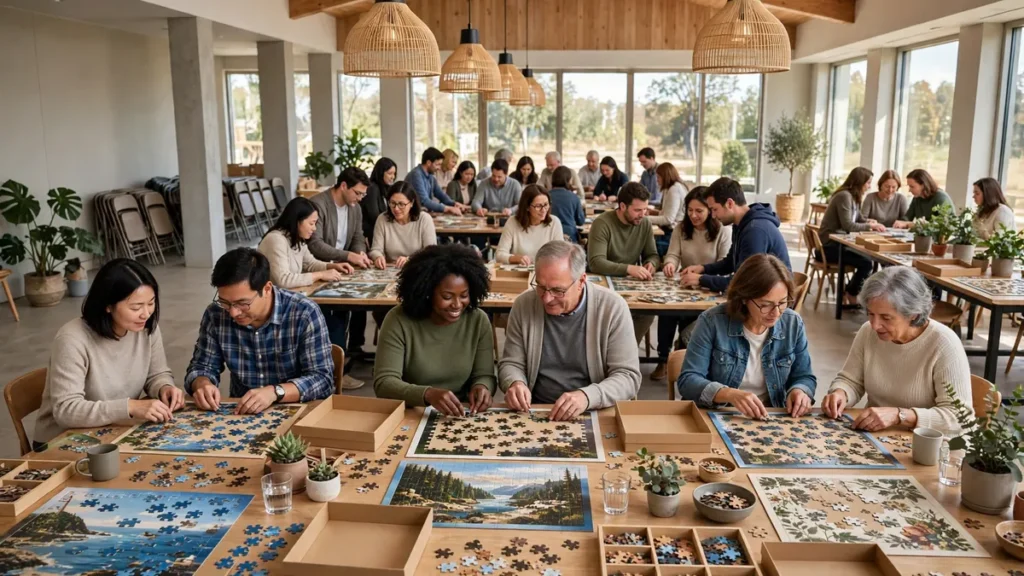
Finding the best puzzle games for 63 players is a very different challenge from choosing a puzzle for a quiet evening at home. With 63 people in the room, a single jigsaw on a single table will not work, and a puzzle that only two or three people can touch at once will leave most of the group watching from the sidelines. The best puzzle games for 63 players are the ones that split a large crowd into active teams, give every team a clear task, and bring everyone back together for a shared finish that feels fair and exciting.
A group of 63 is large enough to fill a hall, a school gym, a community centre, or a company event space, yet it is still small enough to organise well with a little planning. The number works neatly in teams of three, seven, or nine, and it also divides into nine teams of seven, seven teams of nine, or three large groups of 21. That flexibility is a real advantage, because it lets a host match the puzzle format to the room, the time available, and the mix of ages and abilities in the group.
This guide explains how to choose, set up, and run puzzle games for 63 players without confusion or long waits. It covers jigsaw races, escape-room style challenges, logic and word puzzles, picture hunts, building challenges, and digital puzzle rounds, and it compares them honestly so you can pick the format that fits your event. Every idea here is designed for a large group, with clear roles, simple rules, and a finish that everyone can enjoy together.
Key takeaways
- Split 63 players into teams of seven or nine so every person has a real job and no one waits on the sidelines.
- Choose puzzles with parallel tasks, so several teams can work at the same time instead of queuing for one puzzle.
- Use a mix of jigsaw, logic, word, and picture puzzles to suit different strengths and keep energy high.
- Set a clear time limit, a visible scoreboard, and one simple scoring rule that every team understands before play starts.
- Plan the room first: enough tables, good light, clear walkways, and a central point where teams collect clues and hand in answers.
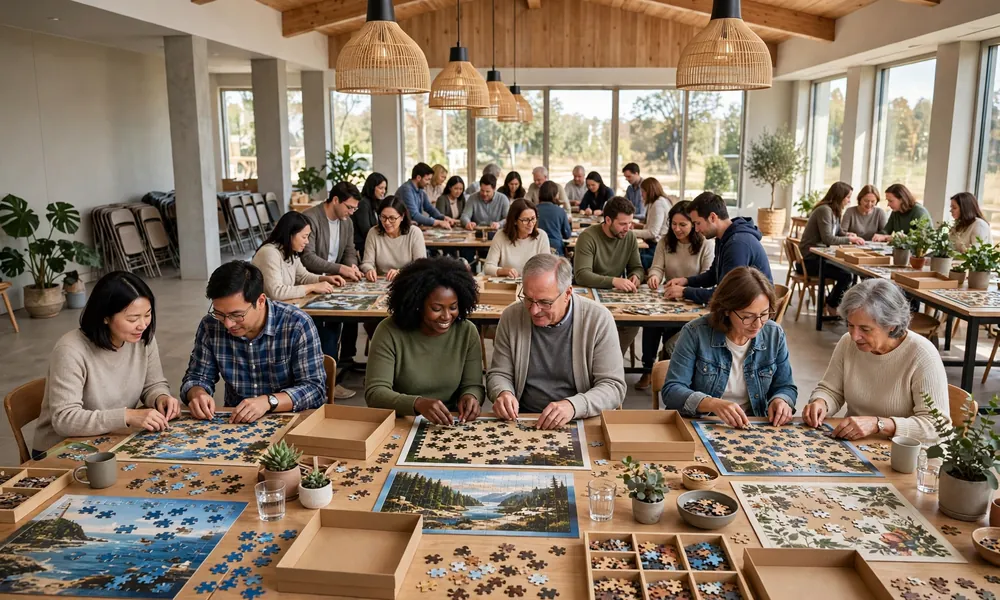
Why Puzzle Games Work So Well for 63 Players
Puzzle games work for a large group because they reward thinking, talking, and teamwork rather than speed or physical strength alone. A quiet player who is good at spotting patterns can be just as valuable as a confident speaker, and a team that listens well often beats a team with one fast solver. That balance matters when 63 people of different ages and backgrounds are playing together, because everyone can contribute in a different way.
Another strength is control: a host can run several puzzle stations at once and keep the event moving with only printed sheets, puzzle pieces, envelopes, or a projector. The same idea works for a family gathering, a school event, a youth group, a company team day, or a community fundraiser.
How to Split 63 Players Into Teams That Work
The first decision is team size, and for 63 players the best choices are teams of seven or nine. Nine teams of seven is often the sweet spot, because seven is small enough for everyone to see the puzzle and speak up, yet large enough to split jobs between sorting, searching, solving, and checking. Seven teams of nine also works well when tables are large and the puzzles are bigger, although nine people around one jigsaw can feel crowded unless roles are clear.
Teams of three give 21 teams, which is too many to manage in a single room unless the game is a simple quiz with automatic scoring. Teams of 21 give only three teams, which can work for a big relay or a hall-wide treasure hunt, but it leaves many players with little to do at each station. For most events, aim for seven to nine teams and keep the team list visible on a simple scoreboard.
Mix the teams on purpose. Put different ages, skills, and personalities together rather than letting friends form one strong team and leaving another team short of confidence. Hand out coloured wristbands, numbered cards, or puzzle-piece badges as people arrive, then call each colour or number to a table. Give every team a name and a captain who keeps time, collects clue envelopes, and hands in the final answer, while other members sort pieces, read clues aloud, and check answers. When roles rotate between rounds, no one person dominates and every player gets a turn at the part they enjoy most.
Best Puzzle Games for 63 Players at a Glance
The table below compares the strongest formats for a group of 63. Use it to pick one main game and one or two shorter supporting rounds, rather than trying to run every format in a single session.
| Game format | Best for | Time needed | Setup level | Why it suits 63 players |
|---|---|---|---|---|
| Jigsaw team race | Calm, visual play | 30 to 45 minutes | Medium | Every team has its own puzzle and works at the same time. |
| Escape-room stations | Energy and variety | 45 to 60 minutes | High | Teams rotate through short puzzle stations on a timer. |
| Logic and code puzzles | Thinking and teamwork | 20 to 30 minutes | Low | Printed sheets are cheap and easy to score. |
| Word puzzle rounds | Mixed ages | 20 to 30 minutes | Low | Word games are familiar and quick to explain. |
| Picture and photo hunts | Active groups | 30 to 40 minutes | Medium | Teams move around the room or building in squads. |
| Building challenges | Hands-on fun | 30 to 45 minutes | Medium | Blocks and simple materials suit large teams. |
| Digital puzzle quiz | Fast scoring | 20 to 30 minutes | Medium | One screen serves the whole hall and answers are instant. |
A good event usually pairs one longer main game with one shorter round. A jigsaw race followed by a quick logic round, or escape-room stations followed by a word puzzle final, gives variety without tiring the group or overloading the host.
Jigsaw Team Races
A jigsaw team race is the simplest large-group puzzle to run well, and it is often the best starting point for 63 players. Each team gets the same puzzle, or a puzzle of the same size and difficulty, and the first team to finish wins. Because every team works in parallel, no one waits, and the room fills with focused, friendly competition.
Choose puzzles with 300 to 500 pieces for a 30 to 45 minute race with teams of seven. Smaller puzzles finish too quickly and feel rushed, while 1,000-piece puzzles take too long and leave slower teams far behind. Buy the same picture for every team if you want a strictly fair race, or buy different pictures of equal difficulty if you want variety and a more interesting display at the end.
Set up each table the same way: a puzzle board or a large tray, the pieces sorted into edge pieces and middle pieces, and enough space for four or five people to work at once while others sort and search. Start every team at the same moment, use a visible timer, and announce the time every ten minutes so teams can pace themselves. Add a twist to keep the race fair, such as a hint card earned by answering a quick riddle, or one chance to trade a small set of pieces with another team.
Escape-Room Style Puzzle Stations
Escape-room style stations bring variety and movement to a large-group event. Instead of one long puzzle, teams rotate through five or six short stations, each with a different challenge: a code lock, a pattern puzzle, a hidden message, a matching task, a logic grid, or a short riddle chain. Each station takes eight to ten minutes, and teams collect points or clue words as they go.
This format suits 63 players because it uses the room well. Nine teams of seven can start at nine different stations, or seven teams of nine can rotate through seven stations, and no team has to wait for another team to finish. A whistle or a bell marks each rotation, and a simple map on the wall shows where each team goes next.
Keep each station self-contained. Put the instructions on a clear card, include all the pieces and props in a tray or box, and make the answer a single word, number, or short code that the team writes on its score sheet. The final station can bring all the clue words together into one last puzzle, such as a phrase, a combination, or a hidden location in the room. That shared finish gives the event a clear climax, and it lets every team feel part of the same story even if they scored differently at earlier stations.
Logic, Code, and Riddle Puzzles
Logic puzzles are ideal when space, budget, or time is limited, because they need little more than printed sheets and pencils. A well-chosen set of logic grids, number patterns, coded messages, and short riddles can fill a 20 to 30 minute round and can be scored quickly at the end.
For 63 players, print one set per team rather than one per person, and ask teams to discuss each puzzle before writing an answer. That discussion is the point: a logic puzzle solved together teaches people to share ideas, test guesses, and check each other’s work, which is exactly the teamwork a large-group event should encourage.
Mix easy, medium, and hard puzzles in each set. Start with two quick wins so every team gains confidence, then add a harder code or pattern puzzle that needs real teamwork. If a team gets stuck, offer a hint card that costs a small number of points, so teams can choose between struggling on or trading points for help. Coded messages work especially well here: give each team a short coded sentence and a simple key, and let the decoded message lead to the next round or reveal the final challenge.
Word Puzzle Rounds for a Large Group
Word puzzles are familiar, quick to explain, and easy to adapt for mixed ages, which makes them a strong choice for 63 players. Anagrams, word ladders, crosswords, word searches, and category games all work in a team format, and they need very little equipment.
A good word round has three short parts. First, an anagram race where teams unscramble five words on a theme. Second, a word ladder or a missing-letter puzzle where teams fill in answers together. Third, a category game where teams list as many words as they can in a set time. Each part takes five to eight minutes, and the whole round fits neatly into half an hour.
For a large group, word games also pair well with other party formats. If you want more ideas for lively large-group play alongside puzzles, the guide to best party games for 61 players shows how party games can be organised for a crowd of a similar size, with team sizes and timing that transfer easily to a puzzle night. Keep the word list fair, avoid obscure words that only a few players will know, and choose themes that everyone can enjoy, such as food, animals, places, films, or everyday objects.
Building, Hands-On, and Digital Puzzle Rounds
A digital puzzle round uses one projector or large screen to serve the whole hall. The host shows a puzzle, teams discuss it at their tables, and each team writes its answer on a card or holds up a letter or number. Good screen puzzles include spot-the-difference pictures, pattern sequences, missing-number grids, picture riddles, and short logic questions. Keep each puzzle on screen for 60 to 90 seconds, then show the answer and move on. Ten to twelve puzzles make a lively 20 minute round.
Check the technology before the event. Test the projector, the sound, the laptop, and the slides in the actual room, and keep a printed backup of the puzzles in case the screen fails. Word games are a useful bridge between ages in these rounds, because they can be played at different levels in the same room. If you are planning a word-heavy evening, the guide to best word games for 61 players offers team formats and timing ideas that work well alongside puzzle stations for a crowd of this size.
Planning the Room, Time, and Materials
Room planning matters more for 63 players than for a small group, because a crowded or poorly lit room will slow every game down. Aim for one table per team, with chairs on at least three sides, and leave a clear walkway between tables so the host and helpers can move around. Put a central table near the front for clue envelopes, score sheets, and spare materials. Light is important for jigsaws and picture puzzles, so choose a room with good daylight or bright overhead lights, and avoid tables in dark corners.
Plan the timing in blocks. Allow 15 minutes for arrival and team sorting, 10 minutes for rules and a warm-up puzzle, 40 to 60 minutes for the main game, 20 minutes for a second round, and 10 minutes for scoring, prizes, and photos. A two-hour event with clear breaks feels relaxed, while a packed schedule with no pauses will tire the group.
Your 63-Player Puzzle Night Checklist
- Confirm the room, tables, chairs, and lighting, and test the layout with one full team table before guests arrive.
- Sort 63 players into teams of seven or nine, and prepare name cards, score sheets, and a visible scoreboard.
- Prepare one complete puzzle set per team, plus two spare sets in case pieces are lost or damaged.
- Print clear rule cards for every station, and brief two or three helpers on scoring, timing, and rotations.
- Test the timer, projector, and sound in the actual room, and keep a printed backup of any screen puzzles.
- Plan prizes for the winning team and small rewards for teamwork, creativity, and the best team name.
Scoring, Prizes, and Keeping It Fair
Simple scoring keeps a large-group puzzle night fair and fun. Use one point per correct answer for logic and word rounds, finish order points for a jigsaw race, and station points for an escape-room rotation. Write the scoring rule on the score sheet and on a poster at the front, so no team has to guess how points work. Card games can also add a relaxed closing round after the main puzzles, and for a similar-sized crowd the guide to best card games for 60 players shows how card games can be organised in teams.
Give every team a chance to catch up. A final round worth double points, or a bonus puzzle that any team can solve, keeps the ending exciting even if one team led from the start. Prizes do not need to be expensive: a small trophy, a puzzle book, or a simple certificate can be enough, especially when every team also gets a small thank-you prize. Consider extra awards for the best team name, the most creative solution, and the best teamwork, so more than one team goes home feeling proud. Be ready for ties with one tie-breaker puzzle, such as a short riddle or a quick pattern question, explained before the final round.
Frequently Asked Questions
What is the best puzzle game for 63 players?
The best puzzle game for 63 players is a jigsaw team race or an escape-room style station rotation, because both formats give every team its own task at the same time. Jigsaw races suit calm, visual groups, while station rotations suit active groups that enjoy variety and movement.
How do you split 63 players into teams?
Split 63 players into nine teams of seven or seven teams of nine. Nine teams of seven is usually best, because seven people can gather around one table and share roles without crowding.
How long should puzzle games for 63 players last?
Allow two hours for a full puzzle night, including arrival, rules, a main game of 40 to 60 minutes, a second round of 20 to 30 minutes, and time for scoring and prizes. A single puzzle round can last 20 to 45 minutes, depending on the format and the difficulty of the puzzles.
What equipment do you need for 63 players?
You need one table per team, chairs, good light, printed score sheets, pencils, a visible timer, and one complete puzzle set per team. For a jigsaw race, add puzzle boards; for stations, add clue envelopes; for a digital round, add a projector and printed backups.
Can children and adults play puzzle games together in a group of 63?
Yes, children and adults can play together if the puzzles include easy and hard parts and if teams mix ages on purpose. Choose large-piece jigsaws, picture hunts, and word puzzles with familiar themes, and give younger players clear roles such as sorting pieces, searching for clues, or reading answers aloud.
How do you keep puzzle games fair for 63 players?
Keep puzzle games fair by giving every team the same materials, the same time limit, and the same scoring rule. Start all teams together, use a visible timer, offer hint cards at the same cost to every team, and prepare a tie-breaker puzzle in advance. Simple, written rules prevent most arguments.
The Bottom Line
The best puzzle games for 63 players are the ones that turn a large crowd into active, mixed teams with clear tasks, fair rules, and a shared finish. Split the group into teams of seven or nine, choose a main format such as a jigsaw race or escape-room stations, add a shorter word or logic round for variety, and plan the room, timing, and scoring before the event starts. With that simple structure in place, 63 players can enjoy a puzzle night that is lively, inclusive, and memorable for everyone in the room.


