Finding the best word games for 61 players is a very different challenge from picking a game for a family of four. With sixty-one people in the room, you cannot simply hand everyone a board and hope for the best. You need games that scale, rules that are easy to explain in under two minutes, and a format that keeps every single person involved from the first clue to the final score. The best word games for 61 players do exactly that: they turn a huge crowd into teams, turn quiet thinking into loud cheering, and turn a simple love of words into an evening nobody forgets.
Sixty-one is an awkward number in the best possible way. It is too many for one table and too many for a single board, but it is just right for a tournament. It divides neatly into teams of five or six, it fills a hall without feeling empty, and it creates the kind of energy that only a big group can produce. Whether you are planning a school event, a corporate away day, or a community game night, the games in this guide are built for exactly this size of crowd.
In this guide you will find team word games, fast party games, quiet puzzle rounds, and tournament formats, all tested against the same question: does it still work when 61 people are playing? We cover setup, timing, scoring, and the mistakes that ruin large-group games, so you can walk in confident that nobody will be left with nothing to do.
Key takeaways
- Split 61 players into ten teams of six plus one floating host or judge, so every team is balanced and nobody sits out.
- Choose word games with simultaneous play, where all teams answer at the same time instead of waiting for a turn.
- Mix fast rounds with slower puzzle rounds to keep energy high and give quieter players a chance to shine.
- Use a simple points system, one point per correct answer and bonus points for speed, so scoring stays fair and easy to follow.
- Plan for ninety minutes of play, with three or four different games and a short break in the middle.

How to Run Word Games for 61 Players
The secret to running word games for 61 players is structure. A game that works beautifully for eight people can collapse for sixty-one if everyone has to wait their turn. The fix is simple: make teams the unit of play, make rounds simultaneous, and make the host the centre of the room. When ten teams solve the same clue at the same time, there is no waiting and no chance for the energy to drain away.
Start by dividing your 61 players into ten teams of six, with one person left over. That extra person makes an excellent host or scorekeeper. A good host keeps the pace, reads the clues clearly, settles disputes with a smile, and makes sure the quieter teams are heard. Give every team a name, a table, and a simple answer sheet. Team names turn strangers into teammates and give the scoreboard something fun to show.
Arrange ten tables in rows or in a wide circle, with space for the host to walk between them, and put the scoreboard where everyone can see it. Sound is the detail organisers forget most often, so use a small speaker and a microphone, and test them before anyone arrives. Keep the scoring simple: one point per correct answer, two bonus points for the fastest team in speed rounds, and a single sudden-death clue to settle any tie.
Best Word Games for 61 Players Compared
Not every word game survives contact with a crowd of 61. The table below compares the strongest options by group size, pace, preparation, and the kind of player each game suits best, so you can build a balanced evening instead of guessing.
| Game | Players per team | Round length | Preparation | Best for |
|---|---|---|---|---|
| Team Anagrams | 5 to 6 | 10 minutes | Low | Quick thinking and teamwork |
| Word Bingo | Individual within teams | 15 minutes | Medium | Mixed ages and abilities |
| Crossword Relay | 5 to 6 | 20 minutes | Medium | Patient solvers and word lovers |
| Twenty Questions Words | 5 to 6 | 15 minutes | Low | Logic and deduction |
| Word Chain Race | 5 to 6 | 10 minutes | Low | Speed and vocabulary |
| Hangman Tournament | 5 to 6 | 15 minutes | Low | Classic fun for all ages |
| Category Sprint | 5 to 6 | 10 minutes | Low | Fast recall and creativity |
| Spelling Bee Teams | 5 to 6 | 20 minutes | Medium | Confident spellers |
| Word Search Race | 5 to 6 | 15 minutes | Medium | Visual scanning and focus |
| Story Word Build | 5 to 6 | 20 minutes | Low | Creative and funny players |
The strongest evenings combine one fast game, one puzzle game, and one creative game. That mix means the quick thinkers, the careful solvers, and the funny storytellers all get a round where they can lead their team, and no single skill decides the whole night. If your group is almost this size, the guide to Best Word Games for 60 Players shows how the same formats adapt when one fewer player is in the room. If your group includes children and adults together, lean towards the low-preparation games and keep the vocabulary friendly. If your group is mostly adults who love wordplay, add the crossword relay and the spelling bee, and let the competition get serious.
Team Anagrams
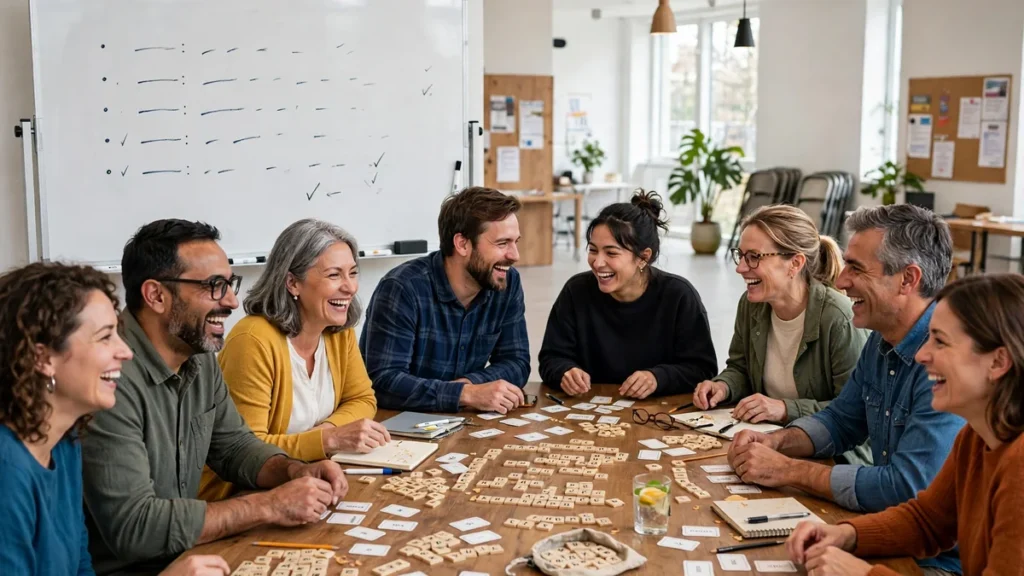
Team anagrams is the perfect opening game for 61 players because it needs almost no explanation and gets every team working together within seconds. The host reads out a scrambled word, and each team has thirty seconds to unscramble it and write the answer down. Ten words make a round, and the whole game takes about ten minutes including scoring. Start with five-letter words such as table, plant, and music, then move to six and seven letters, and avoid words with more than one common answer, because disputes slow the game down. Encourage teams to whisper rather than shout, so neighbouring tables cannot overhear answers, and award two bonus points to the first team to hand in a correct sheet in the final round.
Word Bingo for a Big Crowd
Word bingo scales beautifully to 61 players because everyone plays at the same time and nobody waits for a turn. Each player gets a bingo card printed with words instead of numbers, and the host calls out definitions or clues. Players mark the matching word, and the first to complete a row, column, or full card wins points for their team. It is the rare large-group game where a quiet player can win the round on their own while still helping their team. You need 61 different cards, or at least ten designs, one per team, filled with words from a theme such as food, animals, or travel. Call each clue slowly, repeat it once, and keep a numbered list of clues called so you can check a winning card quickly.
Crossword Relay
The crossword relay is the thinking game of the evening, and it suits 61 players because it rewards patience and teamwork rather than speed alone. Each team receives the same blank grid and the same clues, and the team that completes the most correct answers in twenty minutes wins. Teams can divide the clues between members, so everyone contributes even if they are not the fastest solver. Build your crossword with fifteen to twenty answers using words your group will know, and test it yourself first to make sure every clue has one clear answer. Announce the time at ten, five, and one minute, collect the sheets when time runs out, and read out the answers afterwards.
Twenty Questions Words
Twenty Questions Words turns a classic guessing game into a team sport, and it is ideal for 61 players because the whole room plays together. The host thinks of a word, and each team takes it in turns to ask a yes-or-no question. After twenty questions, or when a team thinks it knows the answer, any team can guess the word, and a correct guess wins five points. Choose words with clear yes-or-no answers, such as a piano, a lighthouse, or a pineapple, and keep a list of thirty prepared words so you can play three or four rounds. A similar large-group setup is covered in Best Word Games for 59 Players, which uses the same team sizes and simultaneous rounds.
Word Chain Race
The word chain race is the fastest game in this guide, and it is the one that produces the most laughter. Each team starts with a word, and the next word must begin with the last letter of the previous word. Cat leads to tiger, tiger leads to rabbit, and so on. Teams have two minutes to build the longest correct chain they can, and the longest chain wins. Set the rules clearly: proper names do not count, words cannot repeat, and every word must be a real English word. Play three short rounds with a different starting word each time, and announce the longest chain after each round.
Hangman Tournament
Hangman is the game everyone already knows, which makes it the easiest tournament to run for 61 players. The host plays the same word against all ten teams at once: each team guesses a letter in turn, the host fills in every correct letter on the shared board, and draws the hangman for every wrong guess. Teams score for each correct letter and a bonus for solving the word, and the team with the most points after five words wins. Choose words of six to nine letters, include one with a repeated letter such as balloon, and limit each team to five seconds per guess so the pace stays brisk.
Category Sprint
Category sprint is a test of fast recall, and it works for 61 players because every team plays every round at once. The host names a category and a letter, such as animals beginning with B, and each team has sixty seconds to write down as many correct answers as it can. One point per correct answer, with a bonus for any answer no other team wrote down, keeps scoring simple and rewards original thinking. The best categories are broad enough for everyone to contribute: countries, jobs, sports, films, and foods. Prepare twelve combinations before the event, keep a dictionary nearby for disputed words, and settle disputes quickly and kindly.
Spelling Bee Teams
A team spelling bee takes the tension of the classic contest and shares it across six people, which makes it far friendlier for a crowd of 61. Each team nominates a speller for each round, the host reads out a word, uses it in a sentence, and repeats it, and the team scores a point for each correct spelling. Rotating the speller each round means everyone gets a turn and nobody carries the team alone. Choose a ladder that rises in difficulty, from garden and pencil through rhythm and necessary to embarrass and questionnaire. If children play alongside adults, offer two word lists, with harder words worth two points and easier words worth one.
Word Search Race
The word search race is the quiet game of the evening, and every large group needs one. Each team receives the same printed grid and the same list of hidden words, and the first team to find all of them wins. It is calm, focused, and absorbing, which makes it the perfect game after the noise of the word chain race, when the room needs a few minutes to breathe. Build your grid with fifteen hidden words, placed across, down, and diagonally, and test it yourself to make sure every word is findable. Teams that work well split the list between members. For a change of pace, Best Puzzle Games for 60 Players offers puzzle formats that fit the same team structure. Set a fifteen-minute limit and award points per word found if no team finishes.
Story Word Build
Story word build is the creative finale of the evening, and it is the game players remember longest. Each team is given five random words, such as castle, umbrella, detective, banana, and rocket, and has fifteen minutes to write a short story using all five. The stories are read aloud, and every team votes for the funniest, the most surprising, and the best written. It is the only game in this guide where being silly is a genuine strategy. Set a limit of about one hundred words per story so the readings do not take all evening, ask one person from each team to read, and let the room applaud each story before voting begins.
Planning a 90 Minute Word Games Evening
A ninety-minute evening for 61 players works best as four games with a short break in the middle. Start with team anagrams for ten minutes, follow with the word chain race for ten minutes, take a ten-minute break, then play the crossword relay for twenty minutes, and finish with story word build for twenty minutes including the readings. Prepare a simple running order on one sheet of paper and keep it in your hand all evening. Prizes do not need to be expensive: a small trophy, a box of chocolates, or a silly certificate is enough, and a fun prize for the last-placed team, such as a dictionary, often gets the biggest laugh of the night.
Common Mistakes With Large Word Game Groups
The most common mistake is choosing games that need turns. Any game where one team plays while nine teams watch will lose the room within ten minutes, so choose simultaneous games or adapt turn-based games so all teams play at once. The second mistake is making the vocabulary too hard or too easy: know your audience, test your words beforehand, and keep a few easier backup clues ready. The third mistake is poor timekeeping, so use a visible timer, announce the time remaining, and stop each game when the timer ends. Watch for quiet players too, and rotate the roles of writer, spokesperson, and speller around the table.
Checklist for Your 61 Player Word Games Night
- Divide 61 players into ten teams of six, with one host or scorekeeper, and give every team a name and a table.
- Print answer sheets, bingo cards, crossword grids, and word search sheets before the event, with spares for mistakes.
- Test the microphone, speaker, timer, and scoreboard in the room before the first player arrives.
- Prepare a printed answer key for every game, plus a tie-breaker clue for each round.
- Choose three or four games that mix speed, puzzles, and creativity, and plan a ninety-minute running order.
- Announce the scores after every round, keep the prizes ready, and finish with a short ceremony for the winners.
Frequently Asked Questions
What are the best word games for 61 players?
The best word games for 61 players are team anagrams, word bingo, crossword relay, word chain race, hangman tournament, and category sprint. They all work because every team plays at the same time, the rules take less than two minutes to explain, and the scoring is simple enough to follow in a noisy hall. Mix one fast game, one puzzle game, and one creative game for the most balanced evening.
How do you split 61 players into teams?
Split 61 players into ten teams of six, with one person acting as host or scorekeeper. If you prefer eleven teams, make five teams of six and six teams of five, and give the smaller teams one bonus point per round to keep the contest fair. Give every team a name, a table, and an answer sheet before the first game begins.
How long should a word games evening for 61 players last?
Ninety minutes is the ideal length, with three or four games and a short break in the middle. That gives each game enough time to be satisfying without tiring the room, and it leaves time for introductions, scoring, and a prize ceremony. If your group is very keen, you can extend to two hours by adding a spelling bee or a word search race.
What equipment do you need for word games with 61 players?
You need printed answer sheets, pens, a visible timer, a scoreboard, and a microphone with a small speaker. Most games also need printed grids, cards, or clue sheets, which you should prepare before the event. You do not need expensive equipment, but good lighting and clear sound make a bigger difference than any decoration.
Can children and adults play these word games together?
Yes, children and adults can play together very well when the games are team based. Choose friendly vocabulary, let teams rotate roles such as writer and speller, and offer easier and harder word lists where the game allows it. Team play means a child can contribute a good answer while an adult handles the spelling, and everyone enjoys the shared win.
How do you keep score fairly with 61 players?
Keep the scoring simple: one point per correct answer, with two bonus points for the fastest correct team in speed rounds. Announce the scores after every round, keep a printed answer key for checking, and settle ties with a single sudden-death clue. Simple scoring prevents arguments and keeps the evening moving at a good pace.
The Bottom Line
The best word games for 61 players are the ones that let everyone play at once, reward teamwork over individual brilliance, and mix speed, puzzles, and creativity into a single evening. Split your crowd into ten teams of six, choose three or four games from this guide, keep the scoring simple, and let a friendly host keep the pace. Do that, and 61 players will not feel like a crowd to manage. They will feel like a room full of people having the same wonderful time together.