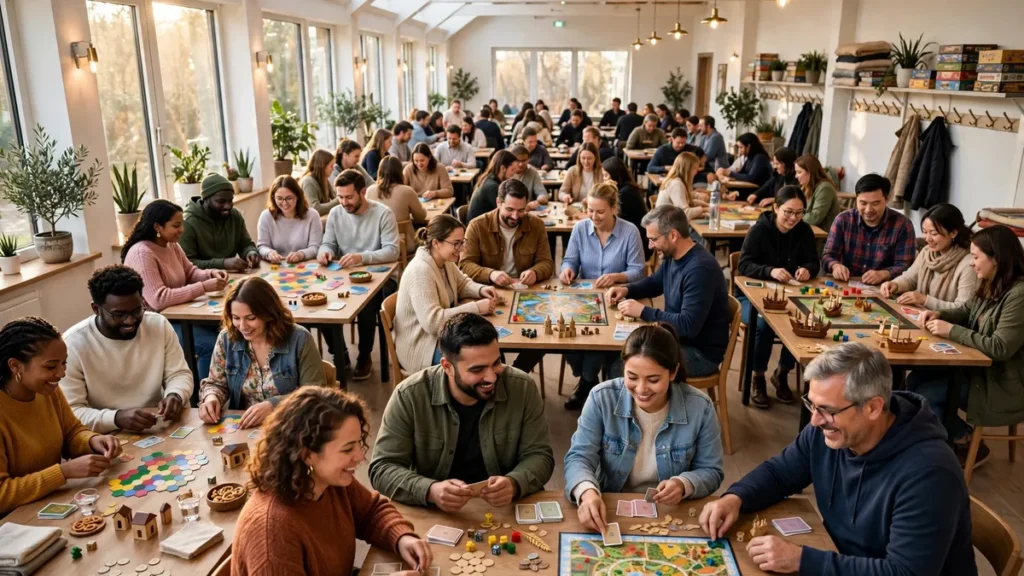
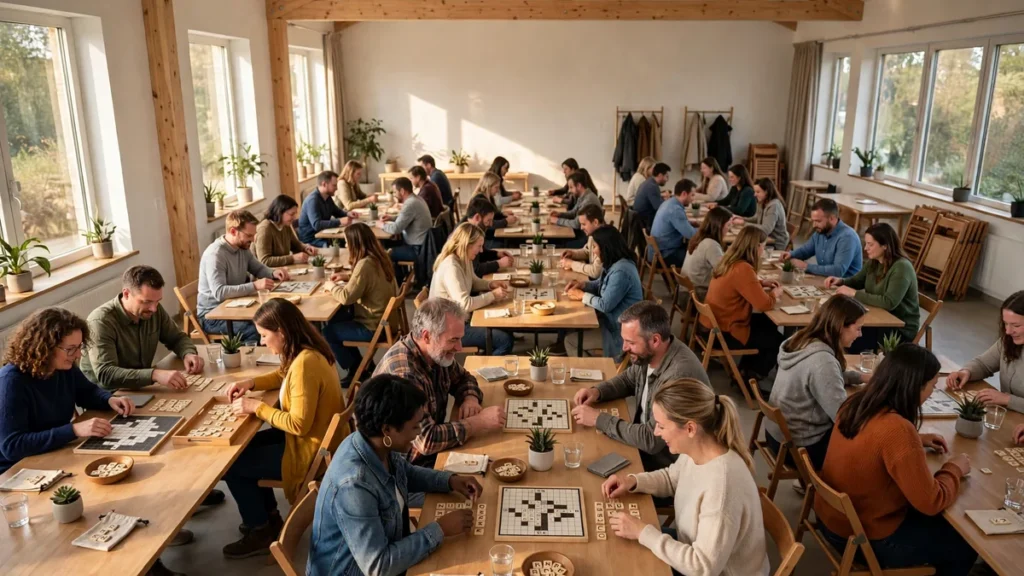
Finding the best dice games for 66 players is a different challenge from picking a game for a quiet night with four friends. With sixty-six people in the room, a game has to be easy to learn, quick to play in short rounds, and fair when dozens of players compete at once. The good news is that dice are the perfect tool for a crowd this size: they are cheap, portable, impossible to misread from across a table, and they turn every roll into a small moment of suspense that the whole room can share.
Most classic dice games were designed for small tables, but almost all of them scale beautifully once you change the format instead of the rules. Rather than seating sixty-six people around one table, you run the same game at many tables at once, rotate players between rounds, or split the crowd into teams that share one score. Only the organisation changes, and this guide covers that organisation in detail.
In this guide you will find nine dice games that work for sixty-six players, a comparison table, a step-by-step plan for running the night, and a checklist of everything you need. Every game below uses standard dice or a common dice set, needs no special board, and can be taught in a single demonstration round.
Key takeaways
- Dice games scale to 66 players best through table rotation, team scoring, or short tournament rounds, not by squeezing everyone around one table.
- Bunco, Tenzi, and Left Center Right are the easiest games to run for a very large group because the rules take less than two minutes to explain.
- Plan on at least one set of dice per table of four to six players, plus printed score sheets and pencils for every participant.
- Keep rounds short, between ten and fifteen minutes, so nobody waits long between turns and energy stays high all evening.
- Mix one fast game, one strategy game, and one team game across the night.

Best Dice Games for 66 Players at a Glance
Use this table to compare the nine games in this guide before you read the full descriptions.
| Game | Players per table | Time per round | Difficulty | Best format for 66 players |
|---|---|---|---|---|
| Bunco | 4 | 15 minutes | Easy | Table rotation tournament |
| Farkle | 4 to 6 | 15 minutes | Easy | Table heats, top scorers advance |
| Tenzi | 2 to 6 | 5 minutes | Very easy | Simultaneous speed rounds |
| Liar’s Dice | 5 to 6 | 15 minutes | Medium | Table heats, winners meet in a final |
| Left Center Right | 4 to 8 | 10 minutes | Very easy | Whole-room play with tokens |
| Yahtzee-style | 4 to 6 | 20 minutes | Easy | Scorecard tournament |
| Dice Bingo | Unlimited | 15 minutes | Very easy | Whole-room play, one caller |
| Qwixx-style | 2 to 5 | 15 minutes | Medium | Shared-dice scorecard rounds |
| Dice Relay Race | Teams of 6 | 10 minutes | Very easy | Team relay across the room |
What Makes a Dice Game Work for 66 Players
A great small-group dice game can fail badly at sixty-six players if it needs constant attention from every person, takes a long time between turns, or depends on quiet conversation. Before you choose, check each game against four simple tests. First, can the rules be explained in two minutes or less? If the answer is no, half the room will still be confused when the first round starts.
Second, does the game keep everyone busy at the same time? Games where all players roll or mark a scorecard together are far better than games where one person plays while sixty-five people watch. Third, is the game short enough to finish a round in about fifteen minutes? Short rounds let you rotate tables and keep the evening moving. Fourth, is scoring simple and visible? A score sheet any player can add up avoids arguments.
Cost matters too. For sixty-six players you will need roughly twelve to seventeen table sets, but standard dice are inexpensive and printable score sheets cost almost nothing, so a full evening of dice games is one of the cheapest large-group events you can run.
The 9 Best Dice Games for 66 Players
1. Bunco
Bunco is the classic large-group dice game. Players sit in groups of four and roll three dice trying to match the number of the current round. Rolling three of a kind in the target number scores a Bunco, and after each round the winning pair moves up a table while the losing pair moves down.
The rotation is what makes Bunco perfect for sixty-six players. Nobody stays with the same partner all night, so a shy guest meets a dozen new people by the end of the evening. You need three dice per table, a bell to signal the end of each round, and a simple score sheet for every player. A full game of six rounds takes roughly ninety minutes including breaks.
2. Farkle
Farkle is a push-your-luck scoring game played with six dice. On each turn a player rolls all six dice, sets aside scoring combinations, and then decides whether to bank the points or roll the remaining dice again. Rolling with no scoring dice is a Farkle, and the player loses every point from that turn. That single decision creates the tension that makes the game so watchable.
For sixty-six players, run Farkle as table heats of four to six players, racing to ten thousand points. The top scorer at each table advances to a final table while everyone else starts a fresh heat. You need six dice per table and a printed scoring guide at every seat. Farkle works best as the second game of the night, once the room is warmed up.
3. Tenzi
Tenzi is the fastest game on this list and the best icebreaker for a crowd of sixty-six. Every player gets ten dice, and on the signal everyone rolls at once, over and over, trying to get all ten dice to show the same number. There are no turns and no waiting, just pure speed. A round lasts three to five minutes.
Because everyone plays at the same time, Tenzi scales to any number of players without any changes at all. Give each player ten dice in a single colour so sets do not get mixed up, and run five or six quick rounds with a small prize for each winner. Tenzi is ideal for the first fifteen minutes of your event, while late arrivals are still finding seats.
4. Liar’s Dice
Liar’s Dice is a bluffing game that turns a quiet room loud within minutes. Each player rolls five dice behind a cup, looks at them in secret, and then bids on how many dice of a certain number are showing across the table. The next player must either raise the bid or call the previous player a liar, and then all the dice are revealed. It is part maths and part acting.
For sixty-six players, run Liar’s Dice at tables of five or six, with each table playing until one player remains. Those table winners then meet in a grand final the whole room can watch. You need five dice and a cup per player, and the cups can be simple paper cups. Keep the bidding simple for beginners by allowing only bids on the number of dice, not the face value.
5. Left Center Right
Left Center Right, often called LCR, is the simplest game on this list and one of the best for a mixed-age crowd. Each player starts with three tokens and rolls three special dice marked L, C, R, and dots. An L means pass a token left, R means pass a token right, C means put a token in the centre pot, and a dot means keep your tokens. The last player still holding tokens wins the pot, and the game takes about ten minutes.
LCR is unusual because it works at almost any table size, from four players to twelve or more, so you can seat people wherever there is space and start immediately. For sixty-six players, run it at tables of eight and let each table crown its own winner. You need one set of three LCR dice per table plus three tokens per player, and tokens can be coins, beads, or small wrapped sweets.
6. Yahtzee-Style Scorecard Game
The Yahtzee-style scorecard game is the most strategic game on this list, and it rewards careful thinking over pure luck. Each player rolls five dice up to three times per turn, trying to fill thirteen scoring boxes such as three of a kind, full house, straights, and the famous five of a kind. Every box can only be used once, so players must decide when to take a safe score and when to gamble.
For a crowd of sixty-six, run the game as a scorecard tournament. Every player gets their own score sheet and dice set, and all tables play the same thirteen rounds at the same time, called by a host over a speaker. At the end, the highest total score in the room wins. You need five dice and a printed score sheet per player, which is more preparation than the other games here, but the payoff is a calm, thoughtful game that balances the faster, noisier games on the list. If you enjoy the format, you will also like the other large-group classics in our guide to board games for 65 players, which use the same tournament style.
7. Dice Bingo
Dice Bingo is the easiest game in this guide to run for sixty-six people, because it needs only one caller and one set of dice for the entire room. The host rolls two dice and calls out the total, and every player marks that number on their card if it appears. The first player to complete a row, column, or full card shouts Bingo and wins the round. The rules take thirty seconds to explain.
Print a different bingo card for each player, or at least a dozen different card designs shuffled through the room, so that no two neighbours share the same card. A round takes about fifteen minutes, and you can play three or four rounds in an hour with a fresh card each time. Dice Bingo works brilliantly as a calm opener while guests arrive, or as a wind-down game at the end of the night.
9. Qwixx-Style Shared-Dice Game
A Qwixx-style game uses shared dice and individual score sheets, which makes it one of the fairest games for a large group. Two white dice are rolled for the whole table, and every player may use the total, while the active player also combines one white die with one coloured die. Players cross off numbers on their own sheet, trying to complete rows from left to right.
For sixty-six players, the shared-dice design is a major advantage: you need only six dice per table instead of a set for every player, and every table plays the same game at the same pace. Print one score sheet per player and place a scoring guide at each table, because the locking rule is the one part new players forget. A full game takes about fifteen minutes, and it is the best choice on this list for players who enjoy a quiet puzzle with a little competition. It pairs well with a trivia round, so if your group enjoys quiz-style play, look at our trivia games for 66 players for a second activity that uses the same table layout.
10. Dice Relay Race
The Dice Relay Race is the most physical game on this list and the best way to end the night with the whole room on its feet. Split the sixty-six players into eleven teams of six, with a rolling station at each end of a relay course. One player from each team runs to the station, rolls until they score a target combination, then runs back to tag the next teammate. The first team to get all six members through the course wins.
You can change the target combination to match the age and energy of your group: rolling a six is the easiest target, while rolling a pair is harder and makes the race last longer. The relay needs open floor space, so push the tables to the edges of the room and mark clear lanes with tape. It is loud, chaotic, and very funny to watch, and it works as a grand finale because every team member gets a turn.
How to Run Dice Games for 66 Players
Running dice games for sixty-six players is mostly about organisation, and a little planning before the event saves a lot of stress on the night. Start by choosing your venue and layout. You need roughly seventeen tables of four, or eleven tables of six, plus space for a host table, a prize table, and clear walkways between tables. Visit the venue in advance and sketch the layout on paper.
Next, decide on your format. The three formats that work best are table rotation, tournament heats, and whole-room play. Table rotation moves players between tables after every round and is the most social format. Tournament heats let table winners advance to a final. Whole-room play has everyone playing at the same time and needs the least organisation. Most successful evenings mix two formats, for example a whole-room opener followed by table rotation.
On the night, appoint one host and at least three helpers. The host explains each game, calls the start and end of rounds, and keeps the energy up. Helpers hand out dice and score sheets and answer rules questions at the tables. Keep a visible schedule on a board, with the name of each game and its start time, so nobody has to ask what happens next. If your group has played together before, the dice games for 65 players guide has a similar structure you can borrow for the timetable.
Timing is the last piece of the plan. Aim for four to six games across a two to three hour evening, with a ten-minute break in the middle. Start with the fastest game while late arrivals settle in, put the longest game in the middle, and finish with something loud and physical such as the Dice Relay Race.
What You Need: Dice Game Checklist for 66 Players
Tick each item off as you buy or borrow it, and pack everything the night before.
- Dice in bulk: at least 150 standard six-sided dice, plus the special sets for LCR and Qwixx-style games. Buy one colour per table.
- Dice cups or trays: one cup per player for Liar’s Dice and Tenzi, and one rolling tray per table to stop dice rolling onto the floor.
- Printed score sheets: one per player for every scoring game, plus ten spare copies. Print the scoring rules on the back of each sheet.
- Pencils and pens: at least eighty pencils, sharpened, with spares at the host table. Short golf pencils work well.
- Timer, bell, and microphone: a loud timer or bell to end rounds cleanly, and a microphone or speaker so the host can be heard at the far tables.
- Prizes and a scoreboard: small prizes for each round winner and a visible scoreboard where the host records table winners.
Frequently Asked Questions About Dice Games for 66 Players
How many dice do I need for 66 players?
Plan on about 150 standard six-sided dice for a full evening. Tenzi needs ten dice per player, so run it in waves if you do not have enough sets. Buying dice in bulk bags of one hundred is the cheapest option.
What is the best dice game for a large group of mixed ages?
Left Center Right and Dice Bingo are the best choices for mixed-age groups, because both take under a minute to explain and nobody needs to read a score sheet or do quick maths. Tenzi is a close third. For more depth, add Farkle or the Yahtzee-style scorecard game after the easy games.
How long does a dice games night for 66 players take?
Plan for two to three hours including a break. A typical evening runs four to six games of ten to twenty minutes each, with five minutes of changeover between games. Add thirty minutes at the start for arrivals and seating. If you have less time, pick three games and run each one twice.
Can I play dice games with 66 players in one room?
Yes, if the room is large enough for seventeen tables of four with walkways between them. A community hall or large function room works well, while a small living room does not. If space is tight, split the group across two rooms and bring everyone together for the final. Whole-room games such as Dice Bingo and Tenzi need the least space per player.
Do I need special dice for these games?
Most games on this list use ordinary six-sided dice. Only two games need special dice: Left Center Right needs its own marked dice, and the Qwixx-style game needs coloured dice. Everything else works with standard dice you can buy in any toy shop.
What prizes work best for a 66-player dice night?
Small, fun prizes work better than one large prize. Good choices include wrapped sweets, small gift cards, funny trophies, and dice sets. Keep one slightly larger prize for the overall champion. Keep the total prize budget modest, since the games themselves are the real entertainment.
The Bottom Line
The best dice games for 66 players are the ones that are quick to learn, fast to play, and fair across many tables at once. Bunco is the safest all-round choice, Tenzi is the best opener, and the Dice Relay Race is the liveliest way to finish. Pick three or four games from this guide, gather your dice and score sheets the night before, and keep the rounds moving. With a little organisation, sixty-six players and a bag of dice are all you need.