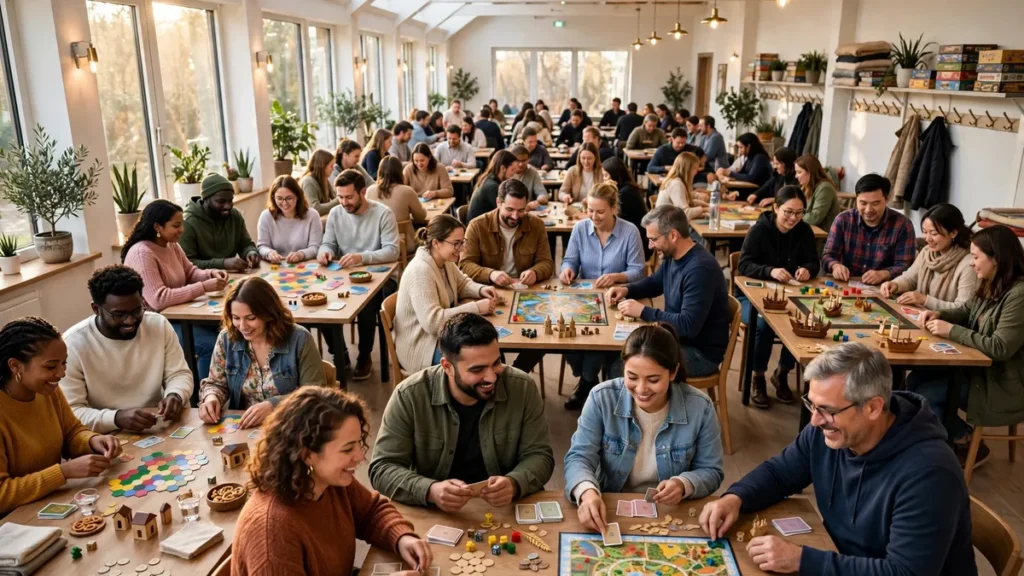
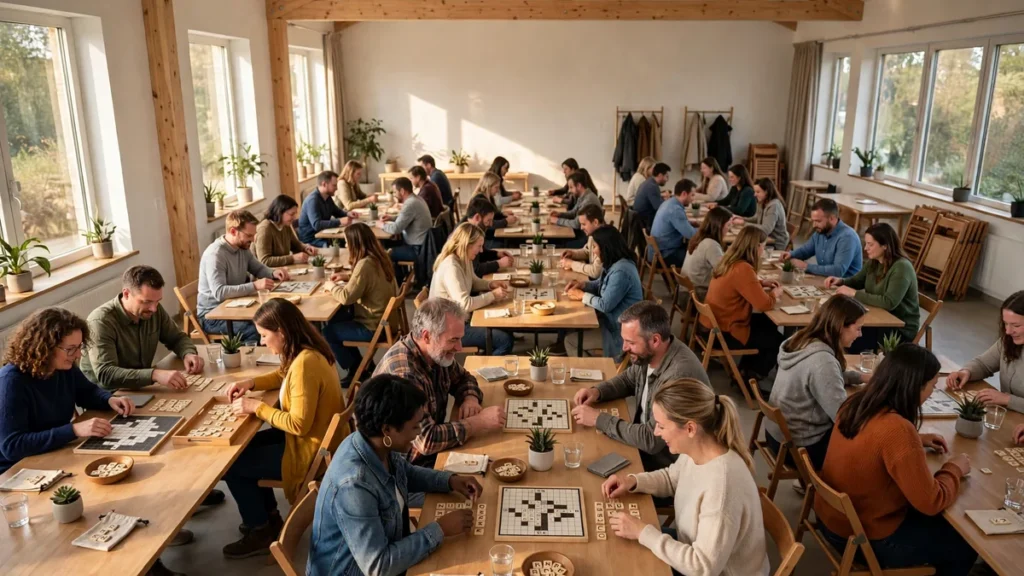
The best board games for 67 players are not the games with the biggest box or the longest rulebook. They are the games that survive being split across teams, tables, and rounds without losing their energy. Sixty-seven people cannot sit around one table and play one game together, and any guide that pretends otherwise is selling a fantasy. What works instead is a format: several games running at once, teams competing for a shared score, and a schedule that keeps everyone playing rather than watching.
That honest starting point matters, because the wrong plan ruins a large game night before it begins. A game designed for six players becomes a slow, confusing crowd scene when thirty people try to join in. A game designed for teams, on the other hand, barely notices the difference between twelve players and sixty. The trick is to pick games whose core idea scales — guessing, drawing, shouting answers, or filling in a score sheet — and organise the people around that idea.
This guide covers exactly that: ten board games that work brilliantly for 67 players as team games, station games, or tournaments, plus the formats that make a crowd this size manageable, a comparison table, a planning section, and a checklist for the night.
Key takeaways
- No single boxed board game seats 67 players around one table; team play, multiple tables, and tournaments are the formats that make it work.
- Roll-and-write games such as Welcome To… and Cartographers genuinely scale to 67 players, because everyone plays at once with their own sheet.
- Team guessing games such as Codenames, Wavelength, and Monikers work best when split into teams of five to eight players.
- Plan for at least eight to ten tables, one host per table, and a shared scoreboard so the whole room stays in one competition.
- Keep rounds short, rotate stations every twenty to thirty minutes, and finish with one big final round the whole room can join.

How Board Games Work at 67 Players
Sixty-seven players is a small crowd, not a table. Almost no board game on the market lists more than twenty players on its box, and the games that do claim huge player counts are almost always party games, quiz games, or roll-and-write games, where players are not taking turns around one board.
The practical answer is to divide the room without dividing the event. Split 67 players into teams of five to eight, and suddenly you have eight to twelve teams, which is a perfectly normal tournament size. Give each team a table, a game, and a host, and run the same game at every table at the same time. Scores from each table feed into one shared leaderboard, and the room is playing one competition even though nobody is sharing a board.
That structure also solves the two problems that sink most large game nights: waiting and confusion. Nobody waits twenty minutes for a turn, because every table plays at its own pace. Nobody is confused about the rules, because each table has a host who explains them once to a small group. If your group is slightly smaller, the same structure still applies, and the best board games for 65 players follow the same team and tournament logic. The player count changes by two; the planning does not change at all.
Team Play
Team play is the simplest format and the best starting point. Each team of five to eight players acts as one player in the game. In Codenames, the team discusses each clue together and agrees on its guesses. In Pictionary, one person draws while the rest of the team shouts answers. The game itself does not change; only the number of minds behind each move grows. Team play also lets shy players contribute without being put on the spot, since the team answers together.
Multiple Tables
Multiple tables are the second pillar. Instead of one game for 67 people, run eight to ten copies of the same game, one per table, all at the same time. Every table plays the same number of rounds, and the best score from each table goes on the leaderboard. Many games in this guide need only a score sheet or a single board per table.
Tournament Brackets
A tournament bracket adds drama to a long evening. Teams play a short game at their table, the winners move up, and the losers move to a different table for the next round. After three or four rounds, the top two teams meet in a final that the whole room watches. Tournaments work best with short games that take fifteen to twenty minutes, such as Wavelength, Herd Mentality, or a single round of Wits and Wagers. The bracket also gives the evening a clear shape and ending.
The 10 Best Board Games for 67 Players
The games below are ranked by how well they handle a crowd of 67. At the top are the games that genuinely scale to dozens of players at once; further down are the games that shine as team games or tournament games across many tables.
1. Welcome To…
Welcome To… is the single best board game for 67 players, because it barely notices how many people are playing. Every player has their own neighbourhood sheet and fills in houses, parks, and pools based on the same three cards turned over each turn. One set of cards serves the whole room, so whether you have six players or sixty-seven, the game runs exactly the same way. Each player needs only a printed sheet and a pen, a game takes about twenty-five minutes, and the rules take five minutes to explain.
2. Cartographers
Cartographers works on the same principle as Welcome To… and is the prettiest game on this list. Each player draws terrain on their own map sheet as cards are revealed, trying to satisfy the scoring goals of the season. Like Welcome To…, it supports up to one hundred players with a single deck of cards, so 67 players is comfortably within its limits. It takes thirty to forty minutes and rewards careful planning, a calm contrast to the louder games on this list.
3. Codenames
Codenames is the best team game ever made, and the natural centrepiece of a 67-player night. Two teams compete to find their secret words on a grid of twenty-five cards, guided by one-word clues from their spymaster. With teams of six to eight players, the discussion around each clue becomes the whole game: half the team argues for one word, the other half argues for another, and the spymaster watches in silence. Run it as a tournament across tables, or as one giant game with the grid projected onto a screen.
4. Wavelength
Wavelength is a guessing game built around a single sliding scale, and it is made for a crowd. One player gives a clue that places a hidden target somewhere on a spectrum — hot to cold, boring to exciting, underrated to overrated — and their team debates where the target sits. The arguments are the game, and with seven or eight people debating, every round produces a story worth retelling. At 67 players, run it as a tournament game with short rounds of ten minutes, or as a whole-room game where two teams take turns. The rules take two minutes to explain.
5. Herd Mentality
Herd Mentality is a party game with one rule that makes it perfect for large groups: the best answer is the most popular answer. Each round poses a question, every player writes down an answer in secret, and anyone whose answer matches the majority scores. The odd one out earns the dreaded pink cow. The game officially supports up to twenty players, so run it across four tables of sixteen or five tables of thirteen, and compare the winning scores on the leaderboard. Rounds take about a minute each, and the whole game fits into twenty minutes. It is the best warm-up on this list.
6. Monikers
Monikers is a team guessing game played in three rounds with the same set of cards: first describe the name, then give a single word, then act it out in silence. The cards feature famous people, fictional characters, and historical figures, and the shared deck means the jokes build on each other as the rounds go on. A team that struggled in round one often dominates round three, because by then everyone knows the cards. For 67 players, split into teams of six or seven and run it as a tournament, with each table playing its own three-round game in about thirty minutes.
7. Telestrations
Telestrations is the telephone game as a drawing game: draw a word, pass the sketchbook, guess the drawing, pass it on, and watch the original word turn into something unrecognisable by the end of the chain. It is pure chaos, and it is funnier with more players, because longer chains produce stranger results. Each copy supports eight players, so nine copies cover 67 players with room to spare — or run it as a relay, with teams passing sketchbooks down a line and scoring the funniest final guesses. The game takes about twenty minutes and needs no skill at drawing.
8. One Night Ultimate Werewolf
One Night Ultimate Werewolf takes the classic social deduction game and compresses it into a single ten-minute round. Each player gets a secret role, there is one night phase, one day of discussion, and one vote. The short length is the point: a bad round costs ten minutes, not an hour, and the next round starts with new roles. Each copy supports up to ten players, so run seven tables of nine or ten players, all playing at the same time, and rotate players between tables after each round. A free companion app handles the night phase, so each table only needs one phone and one copy of the game.
9. Wits and Wagers
Wits and Wagers is a trivia game that fixes the biggest problem with trivia: nobody needs to know the answer. Every question has a numerical answer, players write down their best guess, and then everyone bets on which answer is closest. A player who knows nothing about the topic can still win by betting wisely, which keeps the whole table involved in every question. Run it as a team game with teams of six or seven sharing one answer sheet. Seven rounds take about thirty minutes. If your group loves quiz nights, the best trivia games for 66 players use the same team-and-host structure and pair well with this one.
10. Pictionary
Pictionary is the oldest game on this list and still one of the best for a crowd. One player draws a word while their team guesses against the clock, and the team with the most correct guesses wins. The rules are known by almost everyone, the setup is a board, some cards, and a timer, and the game scales to any number of teams. For 67 players, run it as a team tournament with teams of six to eight, or as a whole-room game with the drawing projected onto a screen so the entire room can shout guesses at once. The whole-room version is the best finale for a game night.
Board Games for 67 Players Comparison Table
| Game | Best Format for 67 | Players per Table | Length | Why It Works at 67 |
|---|---|---|---|---|
| Welcome To… | Whole room at once | Up to 100 | 25 min | One deck serves all; print more sheets |
| Cartographers | Whole room at once | Up to 100 | 30–40 min | One deck serves all; calm contrast |
| Codenames | Team tournament | 6–8 per team | 15–20 min | Team discussion is the game |
| Wavelength | Tournament or whole room | 6–8 per team | 10–20 min | Debates get better with more voices |
| Herd Mentality | Multi-table | 13–20 per table | 20 min | Majority scoring suits big groups |
| Monikers | Team tournament | 6–7 per team | 30 min | Shared cards build jokes across rounds |
| Telestrations | Multi-table or relay | 8 per copy | 20 min | Longer chains are funnier |
| One Night Ultimate Werewolf | Multi-table, rotating | 9–10 per table | 10 min | Short rounds; app runs the night phase |
| Wits and Wagers | Team game, central host | 6–7 per team | 30 min | Betting keeps non-experts involved |
| Pictionary | Tournament or whole-room finale | 6–8 per team | 20–30 min | Known by everyone; great projected finale |
Planning a 67-Player Board Game Night
Planning matters more than the choice of games. Sixty-seven people need space, seating, and a schedule, and all three are easier to arrange in advance than to improvise on the night. Start with the venue: you need room for eight to ten tables, each seating six to eight players, plus space between tables so hosts can move around. A community hall, a large function room, or several connected rooms all work. A single living room does not.
Recruit one host per table, and brief them before the night begins. A host explains the rules, keeps the score, watches the clock, and settles disputes, which frees you to run the evening as a whole. Pick hosts who know the game at their table, and give each one a printed rules summary, a score sheet, and a pen. Print a simple schedule for every table: thirty minutes of welcome and warm-up, two forty-five-minute blocks of play, a fifteen-minute break, and a thirty-minute finale.
Keep score in public. A large whiteboard or a projected spreadsheet lets every team see where they stand, and a visible leaderboard changes how people play: teams in second place try harder, and teams at the bottom stop caring about winning and start playing for fun. Update the board after every round. Put food and drink away from the tables, or the cards and score sheets will end up stained.
Checklist for 67 Players
- Confirm the venue holds ten tables of six to eight players, with space to move between them.
- Recruit and brief one host per table, with a printed rules summary and score sheet for each game.
- Print 67 score sheets for the whole-room games, plus spare sheets, pens, and timers for every table.
- Prepare a shared leaderboard — a whiteboard or projected sheet — and update it after every round.
- Print the schedule for every table, with start times for each round, the break, and the finale.
- Test the projector, the timer, and the sound before guests arrive, and keep spare batteries and chargers handy.
Frequently Asked Questions
Can 67 people really play one board game together?
Yes, but only with the right game and format. Roll-and-write games such as Welcome To… and Cartographers genuinely support up to one hundred players at once, because everyone plays from the same revealed cards with their own sheet. Team games such as Codenames and Pictionary also work, with the room split into teams and the board projected onto a screen.
How many tables do I need for 67 players?
Plan for eight to ten tables, each seating six to eight players. Ten tables of seven gives you seventy seats, which covers 67 players with a few spare places for hosts or late arrivals. Fewer tables mean larger teams, and teams above eight players let quiet people fade into the background. If you are short of tables, run a station rotation so teams share tables in turns.
What is the best game to start with?
Start with Herd Mentality or a whole-room round of Welcome To…. Herd Mentality gets the room laughing within five minutes and needs almost no explanation, which makes it the best icebreaker. Welcome To… is the better choice if you want everyone playing the same game at the same time from the first minute. Avoid starting with a complex strategy game or one that needs a long rules explanation.
How long should a 67-player game night last?
About three hours is ideal: thirty minutes for welcome and warm-up, two blocks of forty-five minutes for tournament or station play, a fifteen-minute break, and a thirty-minute finale. Shorter evenings feel rushed, and longer ones tire people out.
Do I need multiple copies of each game?
It depends on the game. Roll-and-write games need only one copy plus printed sheets, so they are the cheapest option at this scale. Team games such as Codenames, Wavelength, and Pictionary need one copy per table, so eight to ten copies for a full tournament — ask players to bring a copy, borrow from a local game group, or run fewer tables with a rotation instead. Word games are a cheaper way to fill a table, and the best word games for 66 players include several that run well with printed sheets and a single shared set of cards.
What if some players have never played board games before?
Choose games with rules that take less than five minutes to explain, and put at least one experienced player or host at every table. Games such as Herd Mentality, Wavelength, Telestrations, and Pictionary need no prior experience and no strategy, so new players contribute from the first round. Run a short practice round before scoring begins.
Bottom Line
The best board games for 67 players are the ones that treat 67 as a crowd to organise, not a table to squeeze around. Welcome To… and Cartographers let the whole room play at once, Codenames and Wavelength turn team debates into the main event, and Herd Mentality, Telestrations, and Pictionary keep the energy high between rounds. Pick two or three games from this list, split the room into teams of six to eight, give every table a host, and keep the score where everyone can see it. Do that, and 67 players is not a problem to solve — it is the reason the night works.