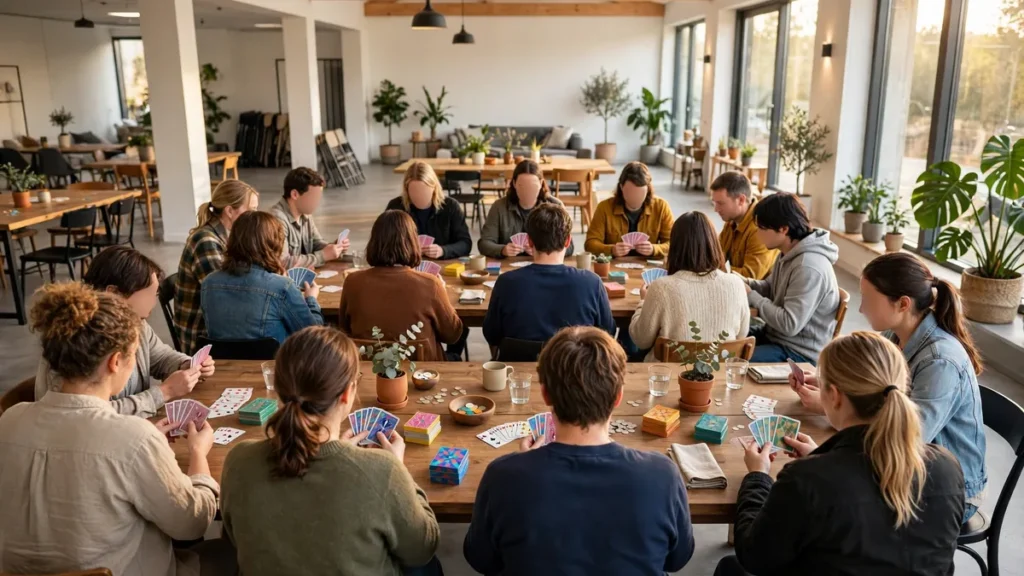
Finding the best board games for 63 players takes a different kind of thinking than picking a game for a quiet evening with four friends. No single board game on the shelf seats 63 people around one table, and any list that pretends otherwise is selling a fantasy. The real answer is a format: games that split cleanly into parallel tables, team games that absorb dozens of players at once, and a simple rotation system that keeps every one of your 63 guests playing instead of watching.
Sixty-three is a wonderful number for a game night, because it divides neatly into nine tables of seven. A school social, a company offsite, a church gathering, a wedding reception activity, or a community fundraiser can all run on this number. The trick is choosing games that work in parallel, that teach in under five minutes, and that finish in a predictable window so tables stay in sync.
This guide gives you exactly that: a comparison table of the strongest options, a tested format for running 63 players at once, detailed picks for every taste, a sample schedule, and a checklist of the supplies you will need.
Key takeaways
- No board game seats 63 players at one table, so the winning format is nine tables of seven running the same game at the same time, with a points ladder to crown an overall winner.
- Team party games such as Codenames, Wavelength, and Two Rooms and a Boom absorb the most players per copy, which keeps your supply list short and your budget low.
- Social deduction games like Ultimate Werewolf are the strongest choices when the whole group wants to play together in one room.
- Classic strategy games including Catan, Ticket to Ride, and Azul work beautifully as a tournament, with winners advancing to a final.
- Keep every round under 45 minutes, teach each game in under five minutes, and run a simple rotation so nobody sits out for more than one round.

Why 63 Players Changes Everything
A normal board game night has one problem: choosing a game everyone likes. A 63-player night has three: choosing games that scale, keeping 63 people organised, and making sure nobody spends the evening watching. Solve those three and the size of the group becomes an advantage, because a big room full of competing tables creates an atmosphere a small game night can never match.
The first thing to accept is that your group will not play one game together at one table. Even the largest party games top out at around twenty players, and most board games are designed for two to six. The format below turns that limit into the structure of the evening.
The second thing to accept is that variety matters more than perfection. With 63 players you will have complete beginners, casual players, and a few serious strategists in the same room, and a single game cannot please all of them. A menu of three or four games, each running at several tables, lets people choose the style they enjoy. Time discipline matters just as much: every pick in this guide finishes in 45 minutes or less with seven players.
How to Run Board Games for 63 Players
The simplest format that works is parallel tables. Divide your 63 players into nine tables of seven. Give every table the same game for round one, run a 40-minute round, record the winners, then rotate players to new tables for round two. After three rounds, the players with the most table wins meet at a final table.
An alternative for very social crowds is the team format. Split the group into two teams of about 31 and 32 and run team party games where the whole team plays at once, such as Codenames, where one spymaster gives clues to a whole team. Team games need fewer copies and less table space, but they suit loud, confident groups better than quiet ones. If you are planning a mixed evening, the best board games for 62 players guide uses the same table maths and offers a useful second set of picks for a group one player smaller.
Split Into Tables of Seven
Seven is the sweet spot for a 63-player night. Most party and family games play best with five to eight players, and seven keeps every table lively without making turns drag. Nine tables of seven also makes the arithmetic clean: nine copies of one game, or three copies each of three different games, covers the whole room. Assign tables in advance with name cards, and mix friend groups so each table has at least one confident player who can teach the rules.
Seat one volunteer host at each table. The host does not need to be an expert, only to know the rules well enough to teach them in five minutes and settle the occasional question. Give each host a one-page rules summary and a timer.
Run a Points Ladder
A points ladder turns nine separate tables into one shared competition. Award three points for a table win, two for second place, and one point for taking part, and post the standings on a whiteboard or a projected screen between rounds. That shared scoreboard is what makes the evening feel like one event instead of nine separate games in the same room.
Keep the scoring simple enough to explain in one sentence. If a game has no clear second place, award points for the win only and use total points scored as the tiebreaker.
Keep Rounds Under 45 Minutes
Set a timer for every round and stick to it. When the timer sounds, tables finish the current turn and record their standings, even if the game is not quite over. This prevents the most common failure of large game nights: one slow table holding up 56 other people. Every game in the comparison table below finishes in 30 to 45 minutes, so the timer rarely has to bite.
Build in a ten-minute break between rounds for snacks, scoreboard updates, and table changes. Three rounds of 40 minutes plus two breaks plus a 30-minute final fits neatly into a two-and-a-half-hour evening, and a two-hour version works if you run two rounds instead of three.
Best Board Games for 63 Players: The Comparison Table
| Game | Players per table | Time | Type | Why it works for 63 |
|---|---|---|---|---|
| Codenames | 4 to 8+ | 15 minutes | Team word game | Whole teams play at once |
| Ultimate Werewolf | 5 to 30 | 30 to 45 minutes | Social deduction | Seats huge groups in one game |
| Two Rooms and a Boom | 6 to 30 | 15 to 30 minutes | Team deduction | Built for very large groups |
| Wavelength | 2 to 12 | 20 to 40 minutes | Team guessing | Everyone contributes every turn |
| Telestrations | 4 to 8 | 30 minutes | Drawing and guessing | Simultaneous play, no waiting |
| Catan | 3 to 4 | 60 minutes | Strategy | Classic tournament game |
| Ticket to Ride | 2 to 5 | 30 to 60 minutes | Family strategy | Easy to teach, mixed tables love it |
| Azul | 2 to 4 | 30 to 45 minutes | Abstract strategy | Fast, elegant, beginner-friendly |
| Herd Mentality | 4 to 20 | 20 minutes | Party guessing | Scales to twenty, teaches in two minutes |
| Wits & Wagers | 3 to 7 | 25 minutes | Trivia betting | Everyone answers every question |
Team Party Games: The Easiest Way to Cover 63 Players
If you want the lowest-effort route to a great night, start with team party games. A whole team plays together, which means one copy can entertain ten, twenty, or even thirty people at once. You need fewer copies and fewer hosts, and the games are built around talking and laughing, which is exactly the energy a big room needs.
Codenames is the best starting point. Two teams compete to find their secret agents on a grid of word cards, guided by one-word clues from their spymaster. A team of fifteen can play together, debating each clue, and a round takes about fifteen minutes. It gets better as the team gets bigger, because more minds means livelier debates and funnier wrong answers.
Wavelength is the other essential team game for a group this size. One player gives a clue that places a hidden target on a spectrum between two opposites, such as hot and cold, and their team debates where the target sits. The discussion is the game. It teaches in three minutes and produces moments guests talk about afterwards.
Two Rooms and a Boom deserves a place on any 63-player list because it was designed for large groups. Players are split into two rooms, trade members between rounds, and try to work out who holds the bomb and who holds the president. It plays six to thirty people per game, so two copies cover your whole group, and a full game takes under half an hour.
Social Deduction Games for the Whole Room
Social deduction games are the only category where all 63 players can genuinely play one game together. In Ultimate Werewolf, a large group sits in a circle, closes their eyes at night while the werewolves choose a victim, and then debates by day to find the hidden wolves. It seats up to thirty players per game, so two copies run the whole room.
Werewolf works best with a confident moderator who keeps the pace brisk and the accusations friendly. Choose your moderator in advance and give them the rules the day before. A good moderator explains the roles in five minutes and keeps discussions moving so quiet players get a chance to speak. Set one rule at the start: accuse the role, not the person.
Blood on the Clocktower is the premium option here and the right choice if your group includes experienced players. It takes the werewolf formula, adds deeper roles and a storyteller, and lets eliminated players keep playing as ghosts with limited powers, which removes the worst part of social deduction games: sitting out after an early elimination. It plays five to twenty players and suits a group that wants one long, memorable game. For a different flavour of large-group play, the best dice games for 63 players list covers fast, luck-driven options that pair well with a deduction round in the same evening.
Drawing and Guessing Games That Keep Everyone Busy
The quiet killer of large game nights is downtime. Any game where players wait for their turn will lose a table of seven within twenty minutes. Drawing and guessing games solve this because everyone acts at the same time. In Telestrations, every player draws a word, passes the sketchbook, and guesses the next drawing, all simultaneously. There is no waiting and the results get funnier with every pass. A table of eight finishes in thirty minutes, and you will need nine copies to cover 63 players.
Monikers is the other guessing game that scales well. Teams take turns describing, gesturing, and giving one-word clues for famous names across three rounds: careful description, then single words, then silent gestures. It plays four to sixteen per copy, so four or five copies cover the room.
Herd Mentality is the simplest game here and the best warm-up for the evening. Players answer a question on paper, and anyone whose answer matches the majority scores points, while the odd one out earns the pink cow. It teaches in two minutes, plays up to twenty per copy, and works as a whole-room opener.
Classic Strategy Games as a Tournament
Not every table wants a party game, and a 63-player night should always include a strategy option for the players who prefer thinking to shouting. Run Catan, Ticket to Ride, Azul, or Carcassonne at several tables at once, record the winners, and bring the table winners together for a final. The final gives the whole room a shared climax.
Catan is the most famous tournament game on this list. Players trade resources, build settlements, and race to ten points on a board that changes every game. It plays three to four per copy, and a full game can run to an hour, so give Catan tables a longer round or run it as a single feature game.
Ticket to Ride is the friendlier strategy choice and the better pick for mixed tables. Players collect coloured train cards and claim routes across a map, and the rules take about three minutes to explain. It plays two to five, finishes in 30 to 60 minutes, and works beautifully as a tournament because the scoring is simple. Azul is the fastest strategy game here, at 30 to 45 minutes for two to four players, and a complete beginner can play competitively in their first game. Carcassonne rounds out the set with tile-laying and a gentle pace that suits players who want a calm table away from the noise.
The trade-off with strategy games is copies and time. A Catan table needs four players and an hour, so covering 63 players would take sixteen copies. That is why the best structure mixes formats: run strategy games at three or four tables for the players who want them, and party games at the rest. Everyone chooses their style and the points ladder still unites the room. If word lovers in your group want their own table, the best word games for 63 players guide has picks that run on the same rotation and the same table sizes.
A Sample 63-Player Game Night Schedule
A two-hour evening for 63 players needs a schedule everyone can see and follow. Print it on the scoreboard and announce it at the start. The sample below assumes nine tables of seven, but it adapts easily to two rounds or to a team format.
Open with ten minutes of welcome and a whole-room warm-up game of Herd Mentality, which settles late arrivals and breaks the ice. Then run round one for 40 minutes, take a ten-minute break, run round two for 40 minutes, and finish with a 30-minute final at the feature table while the other tables play a relaxed closer.
Prizes do not need to be expensive. A small trophy or a silly certificate is enough. What matters is that the final is visible: set the final table in the centre of the room and let everyone watch the last game.
Checklist: Your 63-Player Board Game Night
- Nine tables with seven chairs each, plus a centre table for the final, with name cards already placed so seating takes two minutes instead of fifteen.
- One copy of each game per table that needs it, counted in advance, with nine copies of your round-one game or three copies each of three different games.
- A volunteer host at every table with a one-page rules summary, a scorecard, a pen, and a phone timer set for 40 minutes.
- A visible scoreboard, whiteboard, or projected screen showing the points ladder, the schedule, and the rules for scoring, updated between rounds.
- Snacks and drinks within reach of the tables, plus a ten-minute break between rounds so nobody has to leave a game to find refreshments.
- A small prize for the overall winner, a backup game at every table in case a group finishes early, and spare dice, pens, and scorecards.
Frequently Asked Questions
Can one board game really seat 63 players?
No single board game seats 63 players around one table. The largest party games top out at around twenty to thirty players. The format that works is nine tables of seven running games in parallel, or team games such as Codenames where whole teams play together, with a points ladder joining the tables into one competition.
What is the best board game for 63 players?
Codenames is the best all-round choice because whole teams play at once and a round takes fifteen minutes. Ultimate Werewolf is the best choice if the whole room wants to play one game together, and Ticket to Ride is the best choice for a strategy tournament.
How many copies of each game do I need for 63 players?
It depends on the game. A game that plays seven per copy needs nine copies to cover the room. A game that plays twenty per copy, such as Herd Mentality, needs only four copies. Team games such as Codenames need one copy per team table, so three to five copies can cover the whole group.
How long should a 63-player game night last?
Two to two and a half hours is the right length. That allows a ten-minute warm-up, two or three 40-minute rounds, a ten-minute break, and a 30-minute final. Shorter nights feel rushed, and longer nights lose players to fatigue.
What if some players have never played board games before?
Choose games that teach in under five minutes, seat a confident host at every table, and open with a whole-room warm-up such as Herd Mentality. Ticket to Ride, Azul, and Wits & Wagers are the most beginner-friendly picks on this list.
How do I keep 63 players organised without chaos?
Assign tables in advance with name cards, give every table a host with a timer and a scorecard, keep every round under 45 minutes with a hard stop, and post the schedule and the points ladder where everyone can see them. Organisation comes from the structure, not from shouting.
The Bottom Line
The best board games for 63 players are not the games with the biggest player counts on the box. They are the games that split cleanly into tables of seven, teach in five minutes, finish in under 45 minutes, and keep every player involved on every turn. Codenames and Wavelength cover the team rounds, Ultimate Werewolf and Two Rooms and a Boom bring the whole room together, and Catan, Ticket to Ride, and Azul give the strategists a tournament worth winning.
Pick three games, assign nine tables of seven, run a points ladder, and keep the rounds on a timer. Do that, and 63 players stops being a logistics problem and becomes the best game night your group has ever had.