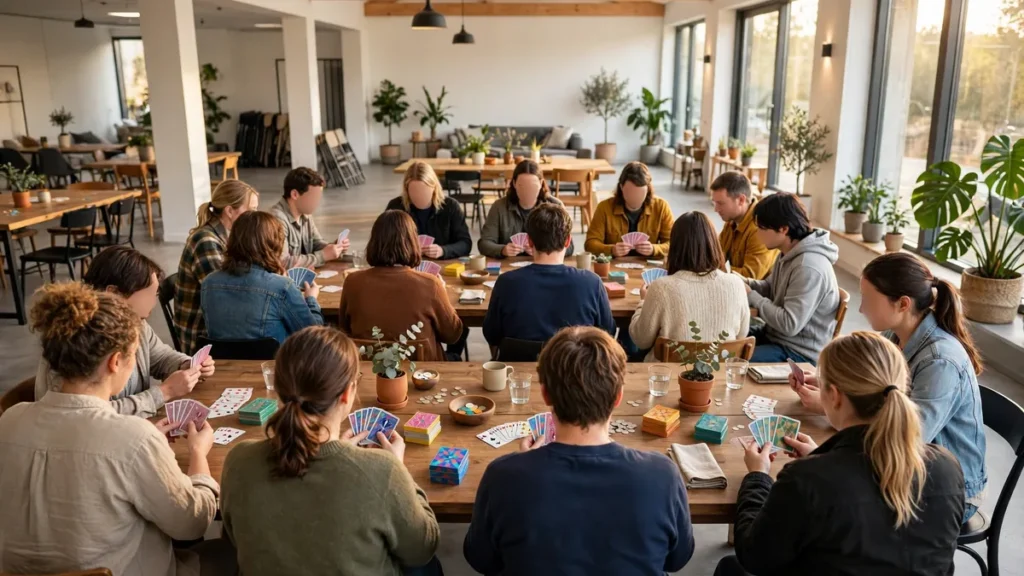
Finding the best trivia games for 63 players is very different from picking a quiz for a small dinner party. With 63 people in the room, a single buzzer and one question at a time will leave most of the group sitting quietly while two confident players dominate every round. The games that work at this scale are built around teams, simultaneous answers and rounds that keep everyone involved.
A group of 63 is actually a gift for a trivia host. You have enough people for seven teams of nine or nine teams of seven, and that scale creates an atmosphere a small quiz can never match. The room buzzes when teams huddle over an answer, the cheering is louder when a long-shot guess turns out to be right, and a well-run leaderboard turns a friendly evening into a genuine event.
Every game in this guide scales cleanly to 63 players without expensive equipment or complicated rules. You will find classic team quizzes, picture rounds, music rounds, speed rounds and relay-style trivia, plus a comparison table, a setup checklist and answers to the questions hosts ask most often. Pick four or five formats, run them in rotation, and your trivia night will take care of itself.
Key takeaways
- Split 63 players into seven teams of nine or nine teams of seven so every round runs in parallel.
- Choose trivia formats with simultaneous written answers, so no team waits for a turn.
- Use a mix of question types, including picture, music, general knowledge and themed rounds.
- Appoint one host plus a scorekeeper for each team to keep rounds moving and scoring honest.
- Plan 20 to 30 minutes per game, with short breaks between rounds for scores and refreshments.

Why 63 Players Changes the Way Trivia Works
Trivia for a dozen people can be casual: one person reads questions aloud, everyone shouts out answers, and the loudest voice usually wins. That approach collapses with 63 players. Shouted answers become noise, quieter players stop contributing, and the host spends more time restoring order than asking questions. A large-group quiz needs structure, and the structure is what makes it fun.
The first change is written answers. When every team writes its answer on a sheet, all 63 players think at the same time. Nobody waits for a buzzer, nobody is talked over, and the host can mark a whole round in minutes. Scoring is fair too, because a team wins a point by knowing the answer, not by shouting first.
The second change is team size. Teams of seven to nine work best because they are large enough to cover a wide range of knowledge and small enough that everyone still gets a say. A team of nine will usually have someone who knows sport, music, geography and food. Smaller teams leave gaps in knowledge, while one giant team of 20 leaves half its members with nothing to do.
The third change is pacing. A 63-player night needs a clear number of rounds and a host who keeps the energy up. Long pauses kill the atmosphere, because 63 people with nothing to do will start their own conversations. Short rounds of ten questions, with scores announced after each one, keep the whole room focused.
How to Organise 63 Players Into Trivia Teams
Decide your team structure before anyone arrives. Seven teams of nine is the simplest split, and it works well when you want a single league table and one overall winner. Nine teams of seven is better if you want more teams in play and a tighter competition, because smaller teams mean every member matters more. Choose the split that fits your tables and room layout.
Seat each team at its own table with a team name, an answer sheet and a pen for every player. Team names matter: a team called The Know-It-Alls will cheer louder and remember the night better than a team called Table Three. Give teams five minutes to pick a name and a captain, and the room will warm up before the first question.
Appoint a scorekeeper for each team. The scorekeeper writes the answers, hands the sheet to the host at the end of the round and double-checks the marked sheet when it comes back. This spreads the work across the room, stops the host becoming a bottleneck, and keeps scoring honest, because every team can see its own marked sheet.
Setting Up the Room for a Big Quiz
Room layout decides whether a 63-player quiz feels exciting or chaotic. Arrange tables in rows facing the host, with enough space between them that teams cannot overhear each other. Place the host at the front with a microphone, a screen for picture rounds and a visible scoreboard, even if it is just a whiteboard updated after each round. Teams need good lighting to read answer sheets and see the pictures clearly.
Sound is the most common problem at a large trivia night. A host without a microphone will be inaudible at the back of a room of 63 people. Test the microphone before guests arrive, check that music rounds reach every table, and keep background music low between rounds so teams can talk. A five-minute sound check saves the whole evening.
Timing Each Round for 63 Players
Plan ten questions per round with about 30 seconds of thinking time per question, plus a minute at the end for teams to finalise answers. That gives a round of roughly eight to ten minutes, including marking time if the host reads the answers aloud while teams swap sheets. Four rounds plus a picture round and a music round fills about ninety minutes, which is the sweet spot before energy dips.
Build in two ten-minute breaks, one after the second round and one before the final round. Breaks let players stretch, refill drinks and compare scores, and give the host time to update the leaderboard. A final round worth double points keeps every team in contention until the last question, so announce that rule at the start.
The Best Trivia Games for 63 Players
The games below are ranked for large groups, not small ones. Each one keeps all 63 players involved, needs little or no special equipment, and can be explained in under a minute. Mix formats across the night so different kinds of knowledge get their moment.
1. Classic Team Quiz
The classic team quiz is the backbone of any large trivia night. The host reads ten general knowledge questions, every team writes down its answers, and sheets are swapped for marking. Questions should span history, geography, science, sport, food and current affairs, so every team has a chance to shine. Keep the difficulty mixed, with three easy, four medium and three hard questions per round, and avoid questions with debatable answers.
2. Picture Round
A picture round is the easiest way to involve players who are not confident with word-based questions. Show ten images on a screen, one at a time, and ask teams to identify the person, place or object in each one. Famous buildings, flags, film stills and album covers all work well. Give teams about 20 seconds per image, and show the full set again at the end for a final check. Everyone can see the screen at the same time.
3. Music Round
A music round asks teams to name the song, the artist or both from a short clip of ten to fifteen seconds. Play ten clips across different decades and genres, from classic rock and pop to film themes and television jingles. Give a point for the title and a point for the artist, so a team that recognises the tune but not the singer still scores. Music rounds are the loudest and most joyful part of the night, so schedule yours mid-evening when energy is high. If you are running a similar quiz for a slightly smaller crowd, the format in our guide to the best trivia games for 62 players adapts to 63 players with no changes at all.
4. Themed Rounds
Themed rounds give a trivia night its personality. Devote a whole round to one subject, such as films, food, sport, science or the decade the guests grew up in. A films round might ask teams to name the film from a quote or the actor who played a famous role. Themed rounds let players who are quiet in general knowledge rounds become the heroes of their team. Pick themes with broad appeal: a round on 1990s pop culture will involve far more players than a round on 18th-century poetry.
5. Speed Round
A speed round is a burst of twenty quick questions with only ten seconds per question, and it is the best cure for a room that is starting to drift. The host fires questions rapidly, teams scribble answers as fast as they can, and the round is over in five minutes. Speed rounds favour quick thinking over deep knowledge, giving different players a chance to lead. Use simple questions with short answers, such as capitals, colours and famous names, and read each question twice.
6. True or False Round
A true or false round asks teams to decide whether twenty statements are true or false, and it is one of the fairest formats for a large group. Every team has a fifty per cent chance on every question, so even a team with little specialist knowledge can score well, and nobody is ever stuck on a question they cannot answer at all. Write statements that sound plausible either way, such as surprising animal facts and science claims. The real fun is the reveal, when teams discover which confident guesses were wrong.
7. Multiple Choice Round
A multiple choice round gives every team four options per question, which keeps weaker teams in the game and speeds up marking. The host reads the question and the four options, teams write down a letter, and the answers can be marked in under a minute. It works especially well for science, geography and history, where the wrong options can be plausible enough to make teams think. Write options that are all believable, and avoid making the correct answer obviously longer than the others.
8. Trivia Relay
A trivia relay mixes questions with movement, and it is the best format for a group that has been sitting for an hour. Set up three or four stations around the room, each with a different type of question, such as a word puzzle and a timed category challenge. Teams rotate through the stations, earning points at each one, and the highest total wins. Relays need more space and helpers than a seated quiz, so ask two or three volunteers to run the stations in two waves.
9. Family Feud Style Survey Round
A survey round asks teams to guess the most popular answers to a question, in the style of a television game show. Ask a question such as naming something people do before bed, and teams write down the answer they think the most people gave. Points go to the teams that match the most popular answers, not the cleverest answer. Survey rounds reward everyday knowledge and social instinct rather than book learning, so players who never win a general knowledge round often win one.
10. Trivia Bingo
Trivia bingo gives every player their own card, which makes it the most individual format in this guide. Each card has a grid of answers, such as numbers, words or names, and the host calls out questions. Players mark the square that matches the correct answer, and the first to complete a line shouts bingo. With 63 players, print enough unique cards that no two players share the same layout. It works well as a closing game, because it is fast, noisy and easy to follow after a long evening. If you want more ideas for keeping a big crowd entertained between quiz rounds, the best party games for 62 players guide has formats that pair well with a trivia night and need no extra equipment.
Comparison Table: Best Trivia Games for 63 Players
| Game | Best for | Time needed | Equipment | Difficulty |
|---|---|---|---|---|
| Classic team quiz | Opening round, all ages | 20 minutes | Answer sheets, pens | Medium |
| Picture round | Visual learners, mixed groups | 15 minutes | Screen or projector | Easy to medium |
| Music round | Energy, mid-evening lift | 15 minutes | Speakers, playlist | Medium |
| Themed rounds | Specialist knowledge | 20 minutes | Answer sheets | Medium to hard |
| Speed round | Quick thinking, late energy | 5 minutes | Answer sheets, timer | Easy |
| True or false round | Fairness, mixed ages | 15 minutes | Answer sheets | Easy |
| Multiple choice round | Fast marking, close scores | 15 minutes | Answer sheets | Medium |
| Trivia relay | Movement, memorable finale | 30 minutes | Stations, helpers | Medium |
| Survey round | Social instinct, fun | 20 minutes | Answer sheets | Easy |
| Trivia bingo | Closing game, individuals | 20 minutes | Printed bingo cards | Easy |
Choosing the Right Trivia Format for Your Group
The best trivia night for 63 players is not the one with the cleverest questions. It is the one that matches the people in the room. A corporate team event needs different rounds from a family reunion, and a group of close friends needs different questions from a room of strangers. Choose rounds that let the most people contribute.
For a mixed-age group, lean on picture, music, true or false and survey rounds, because none depends on academic knowledge. For competitive colleagues, add a speed round and a themed round on a subject they care about, such as sport or film. For a relaxed evening, keep the questions easier than you think they should be.
How Many Rounds Should a 63-Player Night Have?
Five or six rounds is the right number for a 63-player trivia night, including one picture round and one music round. Fewer than four feels too short for the effort of gathering 63 people, while more than seven risks dragging the evening past two hours. A good schedule is a classic quiz, a picture round, a themed round, a music round, a speed round and a final double-points round, with two short breaks. Settle a tie with a single tie-break question rather than an extra round.
Trivia Night Checklist for 63 Players
- Confirm the team split in advance: seven teams of nine or nine teams of seven, with a table for each team.
- Print answer sheets, score sheets and team name cards, and bring spare pens for every table.
- Test the microphone, speakers and projector from the back of the room before guests arrive.
- Prepare six rounds of ten questions each, with answers written out and a tie-break question ready.
- Appoint a host and a scorekeeper for each team, and brief them on the rules before the first round.
- Buy or prepare small prizes for the winning team, the best team name and the highest-scoring individual round.
Frequently Asked Questions About Trivia Games for 63 Players
How do you split 63 players into trivia teams?
Split 63 players into seven teams of nine or nine teams of seven. Seven teams of nine gives a simple single league table, while nine teams of seven makes the competition tighter because every member matters more. Seat each team at its own table, give each team a name and a captain, and appoint a scorekeeper before the first round.
How long does a trivia night for 63 players take?
A trivia night for 63 players takes about two hours, including breaks. Plan five or six rounds of ten questions, each lasting fifteen to twenty minutes including marking, plus two ten-minute breaks. A final double-points round adds excitement without adding much time, and a single tie-break question settles a draw.
What equipment do you need for a 63-player trivia night?
You need answer sheets, pens, a microphone, a speaker system and a screen or projector for picture rounds. A whiteboard or printed scoreboard helps everyone follow the leaderboard. For a relay you will also need station materials and two or three volunteers, and for bingo you will need printed cards. Most formats need nothing more than paper and pens.
Can you play trivia with 63 players without a host?
You can, but it is much harder. A host keeps the pace, reads the questions clearly, announces scores and settles disputes, and without one the evening tends to drift. If no one wants to host, rotate the role between rounds so each team takes a turn, or use a pre-recorded quiz with a timer. A confident host is the single biggest factor in a successful large-group night.
How do you keep scoring fair with 63 players?
Use written answers and swap sheets between teams for marking, so no team marks its own work. Read the correct answers aloud after each round, give teams a chance to challenge a marking error, and update a visible leaderboard after every round. A scorekeeper for each team keeps the process transparent.
What prizes work best for a large trivia night?
Small, fun prizes work best, because the real reward is the win itself. A trophy, a box of chocolates, a gift voucher or a silly certificate for the winning team is enough, plus a small prize for the best team name. Avoid expensive prizes, because they turn a friendly quiz into a serious competition. If you want to add variety, the best puzzle games for 63 players guide offers team challenges that work well as a prize round or a warm-up before the quiz begins.
The Bottom Line
The best trivia games for 63 players are the ones that keep all 63 people playing at the same time. Split the group into teams of seven or nine, use written answers so nobody waits for a turn, mix classic quizzes with picture, music, speed and survey rounds, and keep the pace brisk with a visible leaderboard and a double-points final round. Prepare your questions in advance, test your sound and screen from the back of the room, and appoint a scorekeeper for every team.