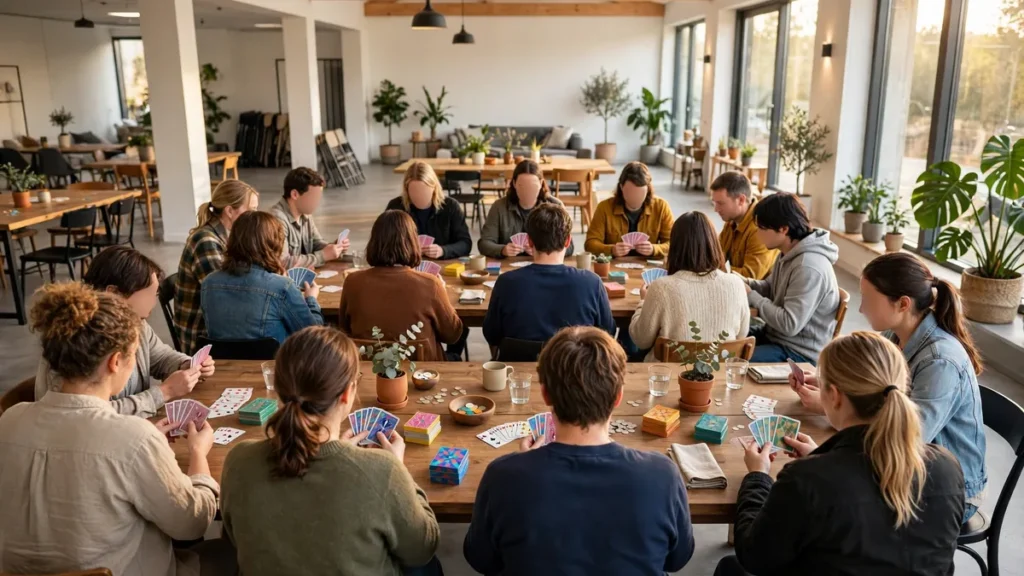
Finding the best card games for 64 players is a very different challenge from picking a game for a quiet evening with four friends. Sixty-four players means sixteen tables of four, or eight tables of eight, or one enormous room where everyone plays at once. Most card games were never designed for a crowd that size, so the games that work best are the ones that scale: games that split neatly into tables, games that run as tournaments, and games that turn a whole room into a single team event.
Every pick in this guide has been chosen because it genuinely works at a 64-player scale, not because it is merely popular. You will find classic trick-taking games that run beautifully as multi-table tournaments, fast party games that keep dozens of people laughing at once, and simple elimination games that need nothing more than a few decks of cards and a clear set of rules.
Whether you are planning a company social, a school event, a family reunion, or a community fundraiser, this list will help you pick the right mix. The best card games for 64 players keep everyone involved, finish on time, and leave people asking when the next night will be.
Key takeaways
- Split 64 players into tables of four to eight and run a tournament, rather than trying to seat everyone at one table.
- Stock at least sixteen standard decks, plus spare decks for the games that use two decks per table.
- Choose games with short rounds, around fifteen to thirty minutes, so players rotate and nobody waits long between games.
- Mix one quiet strategy game, one fast party game, and one team game so every kind of player has something to enjoy.
- Appoint a scorekeeper and a timekeeper before the first card is dealt, because clear scoring and a firm schedule are what make a big night run smoothly.

What Makes a Card Game Work for 64 Players
A great small-group card game can fail badly at a 64-player scale. The first thing to check is whether the game splits cleanly into tables. Games that play best with four players, such as Spades, Hearts, and Euchre, are natural fits: sixteen tables of four gives you exactly sixty-four players, and every table plays the same game at the same pace. Games that only work with six to ten players need a different structure, usually a tournament with rotating tables.
The second thing to check is round length. A game that takes ninety minutes per round will drag a big event to a halt, because half the room finishes early and the other half is still playing. The strongest choices for a crowd finish a round in fifteen to thirty minutes. Short rounds let you run three or four rounds in an evening, rotate partners, and keep the energy up.
The third thing to check is how much equipment the game needs. A game that requires a special deck or a large set of tokens becomes expensive when you need sixteen copies of everything. Standard playing cards are cheap, easy to replace, and familiar to almost everyone, which is why most of the games on this list use ordinary decks. Finally, consider the mix of skill and luck. A room of sixty-four people will include serious card players and complete beginners, so a good lineup includes at least one game that rewards skill, at least one that is mostly luck and laughter, and at least one team game where a weaker player can lean on a stronger partner.
The Best Card Games for 64 Players
The twelve games below are grouped by style so you can build a balanced evening. Pick two or three from different groups, and you will have a full night that suits everyone in the room.
1. Two-Deck Rummy Tournament
Rummy is one of the easiest games to scale, because every table plays the same simple rules and the scoring is straightforward. With sixty-four players, set up sixteen tables of four. Each table plays with two standard decks, and each round lasts about twenty minutes. After every round, the two highest scorers at each table move up a table, and the two lowest move down, a format that keeps the competition balanced all evening.
2. Hearts Across Sixteen Tables
Hearts is a classic trick-taking game for four players, which makes it a perfect fit for sixteen tables. Each table plays a full game to one hundred points, which usually takes about thirty minutes. The player with the lowest score at each table wins the round, and the table winners can then play a short final at a single table while everyone else watches or plays a side game. Serious players love the strategy of shooting the moon and passing cards, while casual players can enjoy it as a relaxed social game.
3. Spades Team Tournament
Spades is a partnership game, and partnerships make a big night friendlier. Sixty-four players form thirty-two pairs, and each table seats two pairs. Play a series of short games to two hundred and fifty points, which take about twenty-five minutes each. After each game, winning pairs move up a table and losing pairs move down, so the strongest pairs gradually meet each other. Spades rewards teamwork and communication, which makes it a great choice for company events and family gatherings.
4. Euchre for a Crowd
Euchre is fast, loud, and social, and it is one of the best card games for 64 players who want energy rather than quiet concentration. Euchre uses only twenty-four cards per deck, so games move quickly, usually fifteen to twenty minutes per round. Set up sixteen tables of four, play to ten points per game, and rotate partners after every game so everyone plays with different people. In a single evening, a player can sit at six or seven different tables and meet two dozen new people.
5. Canasta at Eight Tables
Canasta plays best with four players, but it also works with six, which gives you flexibility. With sixty-four players, you can run sixteen tables of four or eleven tables of six with a few spare players rotating in. Each game takes thirty to forty minutes, so plan for two or three games per evening rather than four or five. Canasta needs two decks per table, so stock at least thirty-two decks if every table plays at once.
6. Team Uno Relay
Uno is one of the most widely known card games in the world, and its simple rules make it ideal for a mixed crowd. For sixty-four players, run eight tables of eight, with each table playing a standard game of Uno using two decks shuffled together. The winner of each table advances to a final table of eight, and the overall winner takes the title. If you have played the best card games for 62 players, you will recognize the same tournament structure, and it works just as well here with a slightly larger field. Rounds last about fifteen minutes, and you will need sixteen Uno decks.
7. Exploding Kittens Party Edition
Exploding Kittens is a fast, funny card game that works well when you combine several decks. The party edition supports up to ten players per deck set, so seven sets will cover sixty-four players at seven tables. Each game lasts about fifteen minutes, and the rules take less than three minutes to explain, which makes it perfect for groups with many first-time players. The humor is the main attraction: the cards are illustrated with jokes, and the gameplay is a mix of luck and light strategy that never feels serious.
8. Codenames as a Whole-Room Card Game
Codenames is a word-and-picture card game that turns a whole room into two teams, and it scales better than almost any other game on this list. Split sixty-four players into two teams of thirty-two. Each team picks a spymaster, and the rest of the team shouts out guesses together. A single game takes about fifteen minutes, and you can run three or four games in an hour with different spymasters each time. What makes Codenames special for a crowd is that nobody is ever eliminated and nobody sits out.
9. Apples to Apples for Big Groups
Apples to Apples is a comparison card game where one player judges which answer card best fits a prompt card. It plays well with eight to ten players per table, so seven or eight tables will cover sixty-four players. Each round takes about twenty minutes, and the judge rotates after every card, so everyone gets a turn in the spotlight. The rules fit on a single page, the cards do the entertaining, and the judging sparks the kind of friendly arguments that make a game night memorable.
10. Spoons Tournament
Spoons is a fast, physical card game that is pure fun. Players pass cards around a circle, trying to collect four of a kind, and then grab a spoon from the center of the table. The player left without a spoon is out. For sixty-four players, run eight tables of eight, with seven spoons per table. Each round lasts about five minutes, and eliminated players move to a new table to start again, so nobody sits out for long. You will need eight decks and fifty-six spoons, which makes it one of the cheapest games on this list to organize.
11. Cheat, Also Known as I Doubt It
Cheat is a bluffing game that works with any number of players, from four to twenty at a single table. For sixty-four players, run eight tables of eight with one deck per table, or four tables of sixteen with two decks each. Players take turns playing cards face down and announcing what they played, and anyone can call out a bluff. A successful challenge makes the liar pick up the pile, while a wrong challenge means the challenger picks it up. Cheat needs almost no equipment and no one needs to know any complicated rules.
12. War Tournament with a Twist
War is the simplest card game of all, and a tournament format turns it into a genuine event. Split sixty-four players into thirty-two pairs, each playing a head-to-head game of War with a single deck. The winner of each pair advances, and after five rounds you have a champion. Each round takes about ten minutes, so the whole tournament fits into an hour. The twist is to add a small rule that keeps it interesting: when a tie occurs, players play a double war, turning over three cards instead of one. For a different kind of large-group energy, the best party games for 62 players offer similar tournament formats that pair well with a War bracket.
Best Card Games for 64 Players Compared
Use this table to pick the right mix for your evening. The times shown are for a single round at one table, and the deck counts cover all sixty-four players.
| Game | Players per table | Decks needed | Round length | Best for |
|---|---|---|---|---|
| Two-Deck Rummy | 4 | 32 | 20 minutes | All-round tournament play |
| Hearts | 4 | 16 | 30 minutes | Strategy lovers |
| Spades | 4 | 16 | 25 minutes | Team play |
| Euchre | 4 | 16 | 15 minutes | Fast, social rounds |
| Canasta | 4 to 6 | 32 | 35 minutes | Longer, thoughtful games |
| Team Uno Relay | 8 | 16 Uno decks | 15 minutes | Families and mixed ages |
| Exploding Kittens | 10 | 7 party sets | 15 minutes | Fun and laughter |
| Codenames | Whole room | 1 to 2 sets | 15 minutes | Icebreakers and teamwork |
| Apples to Apples | 8 to 10 | 7 to 8 sets | 20 minutes | Relaxed, funny evenings |
| Spoons | 8 | 8 | 5 minutes | High-energy openers |
| Cheat | 8 to 16 | 8 to 16 | 20 minutes | Bluffing and drama |
| War Tournament | 2 | 32 | 10 minutes | Beginners and children |
How to Organize a 64-Player Card Night
Good organization is what separates a smooth evening from a chaotic one. Start by choosing your venue. You need enough table space for sixteen tables of four, or fewer larger tables, plus room for people to move between tables. A community hall, a school gym, or a large restaurant function room all work well. Arrange the tables in rows with wide aisles, and put a number card on each table so players can find their seats quickly.
Next, plan your schedule. A typical evening runs for about three hours: thirty minutes for arrival, seating, and a welcome game of Spoons or War, followed by two hours of main games in three or four rounds, and thirty minutes for finals and prizes. Print the schedule and post it on the wall. When everyone knows the plan, the night runs itself, and the timekeeper only needs to call out the round changes.
Scoring needs to be simple and visible. Use a single score sheet per table, with columns for player names and round scores. Collect the sheets at the end of every round and post the standings on a board or a screen. Finally, think about supplies. Beyond the decks, you will need score sheets, pens, table numbers, a timer, and a small prize for the overall winner. The best board games for 62 players use the same kind of setup, so if you have organized a board game night at this scale before, the same tables, timing, and scoring will work for cards too.
Checklist for a 64-Player Card Night
Work through this checklist in the week before your event, and you will have everything covered.
- Confirm the venue and the table layout, with numbered tables and wide aisles for moving between rounds.
- Buy or borrow at least sixteen standard decks, plus extra decks for the games that use two per table.
- Print the rules, the score sheets, and the schedule, with one copy of the rules at every table.
- Appoint a scorekeeper, a timekeeper, and one experienced player per table to help beginners.
- Plan the food and drinks, keeping snacks away from the cards or serving them in bowls with lids.
- Prepare a small prize for the overall winner and a short closing ceremony to end the night on a high note.
Frequently Asked Questions
Can 64 people really play card games together?
Yes, but not at a single table. The practical way is to split into tables of four to ten players and run the same game at every table, either as a tournament with movement between rounds or as parallel games with a final.
How many decks of cards do I need for 64 players?
It depends on the game. A four-player game at sixteen tables needs sixteen decks, or thirty-two if the game uses two decks per table. A game like Uno needs about sixteen Uno decks for eight tables of eight. As a safe starting point, buy twenty standard decks and two or three spare decks, then add the special decks for any party games you plan to run.
What is the best card game for 64 players who have never played before?
Uno, Spoons, and War are the best choices for complete beginners, because the rules take less than five minutes to learn and nobody needs prior experience. Codenames is also excellent, because the whole team helps with every guess. Start the evening with one of these games, then introduce a slightly more complex game like Rummy or Hearts once everyone is comfortable.
How long does a 64-player card night take?
Plan for about three hours. That covers arrival and seating, three or four rounds of fifteen to thirty minutes each, a short break, and a final round or prize ceremony. If you only have two hours, choose fast games like Euchre, Uno, and Spoons, and run three rounds instead of four.
What if the number of players changes on the night?
Choose games that flex. Rummy, Hearts, and Euchre work with three or four players per table, so a missing player simply means one table plays with three. Codenames, Cheat, and Apples to Apples absorb extra players easily.
Do I need prizes for a 64-player card night?
Prizes are not essential, but they make the evening more exciting. A small prize for the overall winner, a fun prize for the best bluff in Cheat, and a prize for the most improved player are all good options. Keep the prizes light and inexpensive: a trophy, a gift card, or a special deck of cards is more than enough.
The Bottom Line
The best card games for 64 players are the ones that split cleanly into tables, finish rounds in under thirty minutes, and keep everyone playing instead of waiting. Rummy, Hearts, Spades, and Euchre are the strongest tournament choices, Uno and Exploding Kittens are the best options for families and mixed ages, and Codenames, Spoons, and Cheat bring the whole room together. Pick two or three games from different groups, print the rules, appoint a scorekeeper and a timekeeper, and your 64-player card night will run smoothly from the first deal to the final prize.