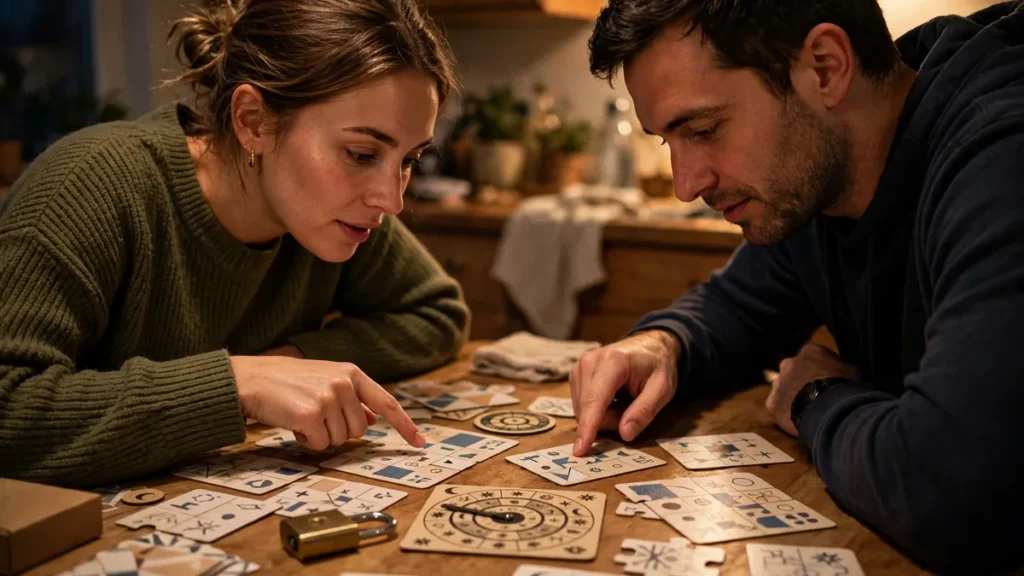
Your team is standing in a draughty hall with a sheet of paper, a pencil, and a puzzle that makes no sense at all. Somebody reads the clue aloud. Somebody else turns it upside down. A third person starts counting letters, while a fourth wanders off to look at the poster on the wall, because the poster might be part of it. Then, all at once, somebody sees it. Pens move faster, voices overlap, and an answer that looked impossible a minute ago suddenly feels obvious.
A puzzle hunt for adults is a team event built around linked puzzles. Each puzzle you solve hands you something you need for the next step: a word, a number, a place, or a small piece of a larger answer. You keep going until the pieces come together at the end. It is not a race to find hidden objects or a test of what you already know. It is a slow-burn contest of noticing, connecting, and thinking sideways.
The short answer
Put simply, a puzzle hunt is an event where teams work through a series of puzzles in sequence, and every solved puzzle moves the team forward. The puzzles are deliberately different from one another. One might be a tangle of words, the next a picture with something wrong in it, and the one after that a string of numbers that only makes sense once you spot the pattern. The variety is the point: no single talent carries a team through, and everyone gets a turn to be the person who cracks one.
Most hunts for adults are played in teams of three to six people. The puzzles are written for clever generalists rather than specialists, so you do not need a degree in mathematics or a shelf of puzzle books to take part. Curiosity and patience matter far more than formal knowledge, and a team that talks well together will usually beat a team of brilliant individuals who never compare notes.
The setting can be almost anywhere: one room with teams at tables, a town or park where answers lead from one location to the next, or online, with teams in different cities working together over video calls. The shape changes, but the core stays the same: solve, advance, solve again.
How a hunt unfolds for the players
From a player’s side, a hunt usually begins with a briefing and a first puzzle. The opening puzzle tends to be gentle, a warm-up that shows you the style of the event and lets your team find its rhythm. Somebody takes notes, somebody keeps track of the answers you have collected, and somebody else does the talking when your team needs to check something with the organisers.
As the event goes on, the puzzles get tougher and the connections between them start to show. An answer from an early puzzle might turn out to be a word you need later, and the final stage often gathers everything your team has found into one last challenge that only works if you have been paying attention all along.
Not every puzzle will fall to your team, and that is expected. Most hunts offer a nudge from the organisers or a small time penalty in exchange for help, so no team stays stranded for an hour on one problem.
The puzzles you are likely to meet
Every hunt has its own flavour, but the same broad families of puzzles appear again and again.
Word puzzles are the most common: anagrams, hidden words, cryptic-style clues, and wordplay that turns on a double meaning. If you enjoy wordplay in general, the word puzzles adults reach for when they want a real challenge will feel familiar, though hunt puzzles tend to hide their answers behind an extra twist.
Logic puzzles ask you to reason through a set of conditions until only one answer survives, such as ordering a list or matching people to places. They reward careful note-taking, and they are the puzzles where the quietest member of a team often saves the day.
Visual puzzles hide their answers in pictures, patterns, or diagrams: a photograph with one detail out of place, or a grid of shapes that changes by a rule. These suit people who think in images rather than words.
Codes and ciphers turn up often, from simple letter shifts to puzzles where the key is hidden in the wording of the clue itself. You are rarely expected to know a cipher by name; the hunt gives you enough to work it out. Observation puzzles, meanwhile, send your attention outward: a puzzle might depend on something in the room, a detail on a building, or a line in a song.
Finally, there is usually a closing puzzle that draws on the answers you have already collected, perhaps by taking one letter from each answer, and the result is the final answer of the hunt. If you have ever wondered how a single puzzle fits into a wider evening of play, our guide to what a puzzle game is and how it works is a useful companion piece.
Puzzle hunt or scavenger hunt?
People often mix the two up, because both involve teams, clues, and a finish line. The difference is what the players spend most of their time doing. In a scavenger hunt, the main task is finding things: objects, places, photographs, or people on a list. In a puzzle hunt, the main task is solving things: each step is a problem, and the answer tells you where to go or what to do next.
A scavenger hunt rewards sharp eyes and fast feet. A puzzle hunt rewards sharp thinking and steady teamwork. They simply test different strengths, and many adults enjoy both for different reasons.
There is also a difference in pace. A scavenger hunt often feels like a dash, with teams scattering at the start. A puzzle hunt feels more like a long conversation punctuated by bursts of excitement, because most of the time is spent sitting together, thinking, and trying ideas. If you would rather sit with a puzzle than sprint down a street, the puzzle version is the one for you. For the other side of the comparison, see what a scavenger hunt is.
Puzzle hunt or escape room?
Escape rooms are the closest cousins of puzzle hunts, and many adults discover hunts after enjoying an escape room with friends. The two share a love of codes, hidden compartments, and that satisfying click when something falls into place. But they are built differently.
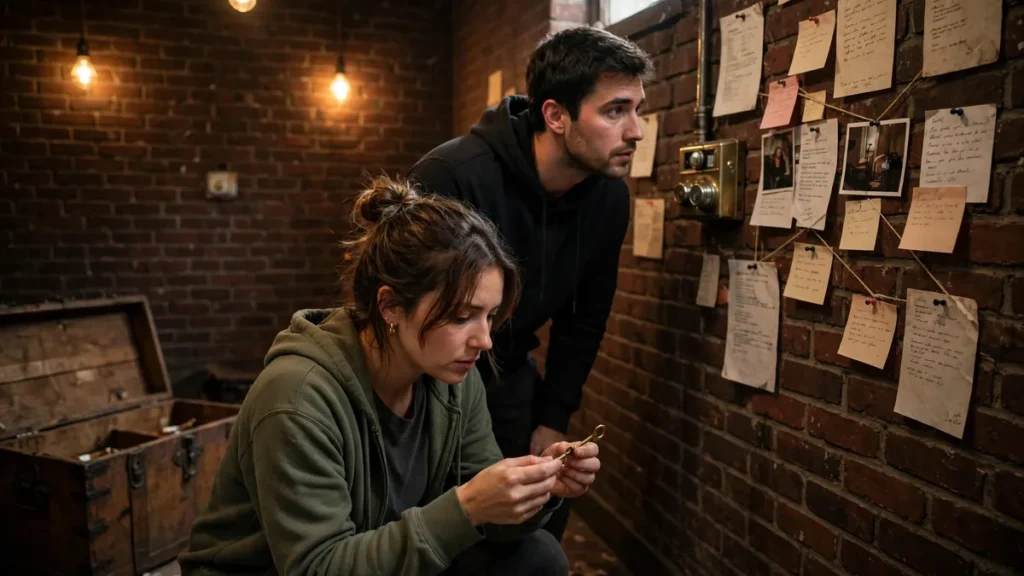
An escape room locks a small group inside a themed space for about an hour. The puzzles are physical as well as mental: you search drawers, turn keys, and find objects tucked into the scenery, with the countdown always visible. A puzzle hunt, by contrast, usually lasts much longer and spreads its puzzles over a wider area. The pressure is gentler, because there is time to sit with a hard problem, take a break, and come back to it. Think of it this way: an escape room is a short, sharp sprint through a story, while a puzzle hunt is a longer ramble through a series of problems.
Who plays, and what teams look like
Puzzle hunts attract a wide crowd: seasoned solvers who travel to big events, and friends or colleagues who signed up on a whim and have never solved anything harder than a newspaper crossword. Most hunts welcome both.
Age is rarely a barrier. Hunts for adults are written with grown-up references and a grown-up level of difficulty, but they do not demand youth or speed; experience and patience count for so much.
Team size shapes the experience. A pair has to do everything between two people, while a team of four or five can split up, with one person on a word puzzle while another tackles a visual one. Very large teams can struggle, because too many voices make it hard to settle on a single idea, which is why most hunts cap team sizes. Nobody needs to be good at everything.
How long does one last?
There is no single answer, because hunts come in very different sizes. A short evening hunt might run for two to three hours, with perhaps six to ten puzzles and a sociable finish. That is the most common format for a first hunt.
A day-long hunt is a bigger commitment, often running for five to eight hours with a lunch break in the middle. These hunts usually cover more ground, sometimes across a whole town, and they include harder puzzles that would be too much for a short evening.
At the far end of the scale sit the famous multi-day events, where hundreds of teams play through dozens of puzzles over a weekend. The best-known example is the long-running hunt at a famous American university, where teams gather every year for a weekend of fiendish problems. Online hunts are more flexible: some run for a few hours on a single evening, while others stay open for days, letting teams dip in and out around work and family.
Where hunts take place
The setting is part of the charm. A hunt held in a single hall feels like a big, friendly puzzle night, with teams at neighbouring tables. A hunt that sends you outdoors feels more like an adventure, with the town or park itself becoming part of the game.
City hunts use streets, statues, shop signs, and public art as part of their puzzles: an answer might depend on a date carved above a doorway or the number of windows on a particular building.

Countryside and park hunts trade buildings for landmarks: a distinctive tree, a bridge, a viewpoint, or a trail marker. They are slower and more relaxed, and they suit teams who want fresh air with their problem-solving. Online hunts remove the geography entirely: teams meet on video calls and work on puzzles together from different places.
What a first-timer should know
If you are thinking of joining your first hunt, a few expectations will help. First, you will not solve everything, and neither will anyone else. Even strong teams leave some puzzles unfinished, and the organisers know that. The aim is to enjoy the ones you do crack, not to complete a perfect scorecard.
Second, bring the basics: pens, paper, a notebook, and a charged phone. Some hunts allow phones for searching, while others ask teams to play without them, so check the rules before the day. Snacks and water are worth carrying, especially for a long hunt.
Third, expect to pay something: small local hunts may charge only a small amount per person to cover printing and prizes, while larger events cost more, and online hunts are sometimes free. Finally, talk to your team. The single best habit in a puzzle hunt is saying your half-formed ideas out loud. A wrong guess often contains the seed of the right one. Silent teams solve slowly. Chatty teams solve fast, and they have more fun doing it.
Is a puzzle hunt for you?
A puzzle hunt suits you if you like problems that take a while, if you enjoy working in a team, and if you find a good puzzle more satisfying than a quick win. It suits crossword and board-game fans alike, and people who have never thought of themselves as puzzle fans but enjoy a challenge with friends.
It may not suit you if you dislike being stuck, because every hunt includes puzzles that will resist you, or if you prefer solo play, since the team is central to the experience. If you want fast, physical excitement, an escape room or an active scavenger hunt might fit better. The easiest way to find out is to try a short one: pick a local evening hunt or an online event, gather three or four friends, and give it a go.
Frequently asked questions
Do I need to be good at puzzles to join a hunt? No. Most hunts are written for mixed-ability teams, and the variety of puzzle types means everyone can contribute.
Can I play alone? A few hunts allow solo players, but the format is built for teams. Many events will match single players together, which is a good way to meet fellow enthusiasts.
Are puzzle hunts competitive? Some are, with prizes for the fastest teams, but many are played for fun. Check the event description to see which kind you are joining.
What happens if my team gets stuck? Almost every hunt offers help: a hint from an organiser, a clue sheet, or a way to move on with a small penalty. Getting stuck is part of the game, not a failure.
So, what is a puzzle hunt for adults? It is an evening, a day, or a weekend of linked puzzles, played in a team, where the pleasure comes from thinking together and watching scattered answers click into place. It is not about being the cleverest person in the room; it is about discovering, puzzle by puzzle, that you love a good problem too.