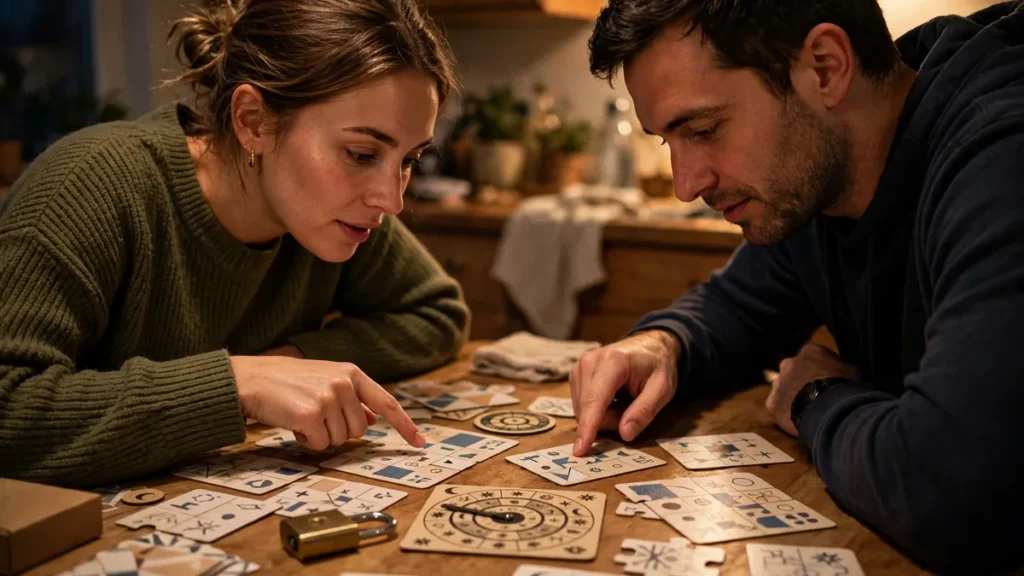
A hunt made for a crowd does not shrink neatly down to two players. With a group, someone else always spots the thing you missed, someone else reads the map while you think, and a clue that stumps one person gets cracked by another. With just the two of you, every clue lands on both of you at once, and that changes the game completely. The list below is built around that fact. Each idea is designed for a pair who play as a team, with clues one person writes for the other, or a shared list the two of you tackle side by side. No idea here needs a crowd, a referee, or a scoreboard on a wall. Most of them need little more than paper, a phone, and an hour to spare.
Before you pick one, settle the one question that decides whether a two-player hunt feels like a date or a chore: are you working together, or against each other? Almost every idea below works best as a shared effort, where a find belongs to both of you and a stuck clue is a problem you solve together. A gentle forfeit for the slower solver is fine, if you agree it first. A hunt that turns into a race between partners rarely ends well, and the ideas here are written with that in mind. If you are still weighing whether the format suits you at all, our look at whether scavenger hunts work for couples runs through the trade-offs honestly.
1. The Favourites Swap
Each of you builds a short trail from the other person’s favourites: their favourite snack, their favourite film, a song they hum in the shower, a colour they always reach for. Hide five or six clues around the house, and make every clue point at one of those favourites without naming it outright. A clue might sit inside a biscuit tin, tucked into a book by a beloved author, or folded into the pocket of a coat in their favourite colour. The hunt works because the clues are personal without being private — the solver needs to know their partner, not to remember a date or a place from years ago. Score it simply: one point per clue found, and a bonus point if the solver can name the favourite the clue was built around. Allow about forty-five minutes, including the time it takes each of you to hide your half of the trail.
2. The Kitchen Cupboard Hunt
This one never leaves the kitchen, and it ends with dinner, which is half the point. One partner writes clues in the form of recipe steps, and each clue hides among the shelves, the fridge, and the drawers. “Find the thing that turns flour into cake” leads to the baking powder; “the coldest corner of the house” leads to the back of the freezer. The final clue reveals the dish the two of you will cook together that evening, with the ingredients already gathered along the way. It suits a rainy night and a couple who like cooking, and it costs nothing beyond the shopping you were doing anyway. Give yourselves an hour from the first clue to the first chopped onion.
3. The Photo Dare Trail
Instead of finding objects, you capture them. Write a list of ten photographs to take together around your neighbourhood: your two shadows holding hands, a reflection of both of you in a shop window, a red door with the two of you framed in it, the strangest street name you can find, a stranger’s dog that looks like it is smiling. The phone stays in one hand and the list in the other, and the two of you decide together which shot counts. Scoring is by nerve and invention, not speed: at the end of the walk, each of you picks your three favourites, and the shot that appears on both lists wins. It suits a sunny afternoon, and you come home with something to keep.
4. The Riddle Relay
Take turns being the clue writer. One of you writes a riddle whose answer is a spot in the house — the kettle, the bookshelf, the drawer where the spare keys live — and hides the next riddle there. The other solves it, finds the spot, and writes the next riddle in return, so the trail zigzags back and forth between you. The rule that makes it work is simple: a riddle must be solvable from the words on the page, with no private knowledge needed. Test each one by reading it aloud and asking whether a guest could crack it. That keeps the game fair and stops one partner’s cleverness from becoming the other’s frustration. Six riddles each is plenty, and the whole relay takes about an hour. The winner is whoever solves the most riddles without asking for a hint, and the prize is choosing what you do next.
5. The Sunset Chase
Pick a viewpoint — a hill, a riverbank, a rooftop you are allowed to use — and work backwards. The hunt must end there as the light goes down, so every clue is timed to the walk. Start about ninety minutes before sunset, and make the clues short: a colour to spot, a sound to follow, a bench to sit on for two minutes and watch the street. The last clue should be the simplest of all, something like a note that says look up. There is no score here beyond arriving together before the sky changes, which is exactly the point. It suits couples who like walking and want an evening with a shape to it, rather than a game with a winner.
6. The Numbers Hunt
Build the whole trail from numbers that belong to the two of you: the day of the month you moved in together, the number of the bus that runs past your street, your house number, the year you both left school, the number of steps from your front door to the corner shop. Each clue is a number, and each number points at a place — a house number, a bus stop, a page in a book, a shelf in a shop. The solver’s job is to work out which number means what, and the trail only makes sense to the pair who chose the numbers. Score it by the clock: thirty minutes to find all six numbers, with one hint allowed, and a small treat waiting at the final stop.
7. The Film Night Hunt
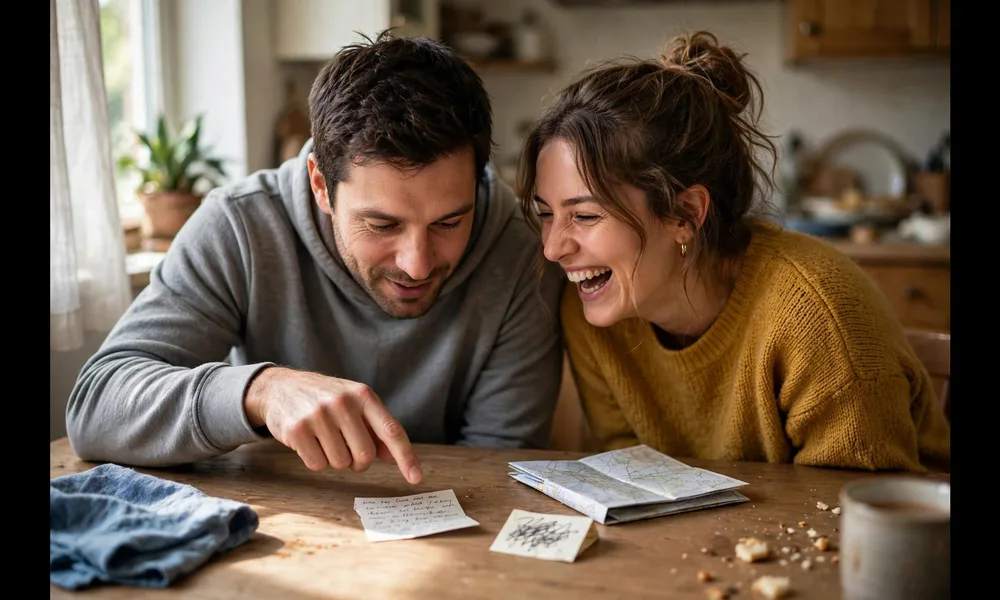
Hide the clues where your films live. Tuck a clue inside a DVD case, slip one between the pages of a film guide, or leave one as a note on the streaming watchlist you share. Each clue is a line of dialogue, a scene description, or a character name, and the answer is the next hiding spot. A clue that quotes a famous line about a journey might point at the hallway; one about a kitchen scene might point at the fridge. The final clue picks the film you watch together that night, which means the hunt and the evening flow into one another without a gap. Allow about an hour for hiding and hunting. Keep the quotes to films you have both actually seen, or half the clues will feel like a test.
8. The Picnic Basket Trail
Stash the makings of a picnic around a park, one item per clue, and let the trail build the meal as you go. The first clue leads to the blanket, the second to the bread, the third to the cheese, and so on, until the last clue reveals the spot where you will sit and eat it all. The clues can be simple — a tree with a crooked branch, a bench facing the pond, a lamp post with a missing number — because the pleasure is in the gathering, not in the difficulty. It suits a warm weekend and a couple who like being outdoors without a long walk. Allow two hours from the first clue to the first sandwich, including the time spent sitting in the sun at the end.
9. The Text-Message Hunt
One of you stays put and sends clues by text; the other follows them around the house, the street, or the town. The sender can watch the hunt unfold from the replies — a photograph of each find, a guess at the next clue — and can send a hint when the trail goes cold. It also works across distance: a partner away for the weekend can run a hunt in their own home while the other plays along from the sofa, and the two of you compare notes on a call afterwards. The clues should be short enough to type and clear enough to follow without a map, so riddles of two or three lines work best. Score it by finds rather than time, and let the hunter ask for two hints across the whole trail. It takes about an hour, and it turns an ordinary evening of messaging into something the two of you actually did together.
10. The Know-Your-Partner Quiz Trail
Every stop on this trail is a question about the other person. Write eight questions each — the best meal they ever cooked, the song they would pick for a desert island, the job they dreamed of as a child, the place they would move to tomorrow — and hide them in envelopes around the house or along a short walk. Each correct answer earns the next envelope; each wrong answer earns a forfeit, such as doing the washing up or making the next cup of tea. The questions should be things a partner could reasonably know, not trivia from a forgotten conversation years ago, or the game turns into an argument about memory. Keep the forfeits light and the questions kind, and the trail ends with the two of you knowing each other a little better than when it began.
11. The Dream Trip Map Hunt
Spread a map on the table — a paper one, or a printout — and build a trail across the places the two of you dream of visiting. Each clue is a fact about a place: a city famous for its bridges, an island with more sheep than people, a town where a beloved film was shot. Solve the clue, mark the place on the map, and the next clue hides beneath the marker. By the end of the trail you have a shortlist of dream destinations, and the final clue reveals a small travel surprise: a guidebook, a saved fare alert, or a date in the diary to start planning properly. Allow an hour, and keep the clues to places you have both heard of, so the hunt stays a pleasure rather than a geography exam.
12. The Torchlight Garden Hunt
Wait until dark, hand each other a torch, and take the hunt into the garden or a familiar park. Mark the clue spots with glow sticks or small jars with candles in them, so the trail glimmers as you follow it. The clues should be easy to spot in torchlight — a bright ribbon tied to a branch, a white envelope on a dark fence, a chalk arrow on a path — because the darkness does the hard work of making everything feel mysterious. Keep the route short and the ground familiar, and agree the boundary before you start, so nobody wanders into a neighbour’s flowerbed. It takes about forty-five minutes, and it suits a warm summer night or a garden you both know well.
How to Score a Hunt for Two
Whatever idea you choose, keep the scoring light enough that it never becomes the point. One point per find, a bonus for the cleverest solution, and a single hint each is enough for most of the hunts above. If you want a little competition, play the same hunt twice — once with each of you writing the clues — and compare the totals, which keeps things fair because both of you get a turn at setting the trail. Agree the finish before you start: a drink, a meal, or simply sitting down together to look at the photographs. A hunt for two works when it ends with the pair of you in the same place, in a good mood, with something to talk about. If you want a bigger list to borrow from, our list of scavenger hunt ideas for adults has twelve themes built for groups, several of which shrink down to a two-player version with a little trimming. And if the hunt is for a February date night, our guide on planning a Valentine’s Day scavenger hunt shows how to shape a home-based trail around a romantic finish. Pick the idea that made you smile while reading it, set aside an hour, and write the first clue.