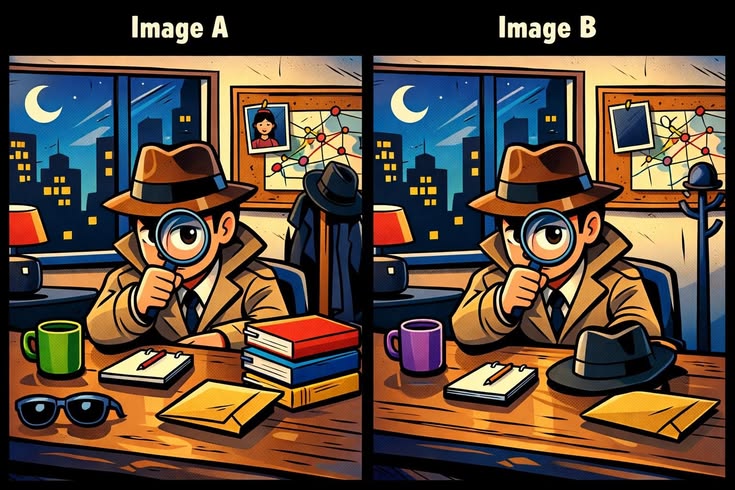
This 2026 guide from riddlepuzzle.com explores how spot-the-difference puzzles challenge visual intelligence and focus. It explains concepts like change blindness and how the brain processes details, while highlighting benefits such as improved memory, attention, and stress relief. With tricky puzzle types and expert tips, it offers a fun yet powerful mental workout.
Welcome to the ultimate test of your visual intelligence. If you’ve ever found yourself staring at two nearly identical pictures, convinced that the artist is playing a prank on you, you’re in the right place. Spot the difference puzzles are a timeless tradition in the world of visual puzzles, but in 2026, they have evolved from simple children’s games into high-stakes picture brain teasers designed to challenge even the sharpest adult minds.
At riddlepuzzle.com, we believe that your brain is like a muscl, if you don’t flex it, you lose that edge. Today, we’re presenting 10 tricky images that will push your “visual discrimination” to the limit. Whether you call it a find the difference game or a classic observation test, prepare to have your concentration tested.
1. The Science of the “Glitch”: Why Spotting Differences is Hard
Have you ever wondered why you can look right at a missing button or a changed color and not “see” it? This is a neurological phenomenon known as Change Blindness.
How Your Brain Processes Visual Puzzles
When you engage in a find the difference game, your brain isn’t just looking; it’s performing a complex series of “Saccades”—rapid, jerky eye movements that scan for anomalies.
-
The Predictive Gap: Your brain tries to save energy by “filling in” details it expects to see. If it expects a tree to have 50 leaves, it might ignore the fact that the second image only has 48.
-
Cognitive Load: The more complex the background (like a busy city street or a crowded kitchen), the higher the “noise.” This noise makes it significantly harder for your visual cortex to isolate the “signal” (the difference).
-
The Dopamine Loop: Every time you circle a difference, your brain releases a small burst of dopamine. This is why these picture brain teasers are so addictive, they are literally wired into your reward system.
2. Benefits of Spot the Difference Puzzles for All Ages
In 2026, we are seeing a resurgence in “analog” style games as a way to combat “digital fatigue.” Spot the difference puzzles are leading the charge because they provide massive cognitive value without requiring a high-speed internet connection.
| Benefit Category | Impact on the Brain | Real-World Application |
| Attention to Detail | Strengthens the Occipital Lobe. | Better at proofreading and catching errors at work. |
| Short-Term Memory | Enhances “Visual Working Memory.” | Remembering where you put your keys or phone. |
| Patience | Encourages “System 2” thinking (slow & logical). | Improved focus during long meetings or study sessions. |
| Stress Reduction | Provides a “Flow State” similar to meditation. | Lowering cortisol levels after a busy day. |
3. Top 10 Tricky Image Categories for 2026
At riddlepuzzle.com, we’ve analyzed the most “unsolvable” puzzles of the year. Here are the 10 types of tricky images you’ll encounter in our latest collection:
-
The Symmetrical Mirror: Two images of a butterfly where only the wing-vein patterns differ slightly.
-
The Urban Jungle: A busy New York City intersection where the color of a single pedestrian’s shoelaces has changed.
-
The Masterpiece Remix: A classic Van Gogh painting where one “swirl” of paint is rotating in the wrong direction.
-
The Minimalist Challenge: Two seemingly blank rooms where the angle of a shadow is off by just 5 degrees.
-
The Nature Camouflage: A forest floor covered in leaves; you have to find the one leaf that is a slightly different species.
-
The Digital Glitch: An AI-generated image where one pixel-level detail (like the number of teeth on a zipper) is different.
-
The Grocery Shelf: A wall of 100 soup cans where one label has a typo in the “Ingredients” section.
-
The Underwater Abyss: A coral reef scene where the number of bubbles coming from a scuba diver is reduced.
-
The Architecture Flip: A blueprint of a house where one window is 2 centimeters higher than the other.
-
The Starfield: A night sky where one star is missing from a constellation of thousands.
4. Pro Tips: How to Win Every “Find the Difference” Game
If you find yourself stuck on the 10th image, don’t give up! Use these “cheat codes” for your brain to master visual puzzles.
The “Cross-Eye” Method (The 2026 Hack)
There is a trick used by pros called the “Stereogram Technique.”
-
Place the two images side-by-side.
-
Relax your eyes and try to “overlap” the two images until they create a third, blurry image in the middle.
-
The Magic: Any differences between the two images will appear to “shimmer” or vibrate in your field of vision, making them instantly visible.
The Quadrant Scan
Don’t just scan the image randomly. Divide the picture into four quadrants (Top-Left, Top-Right, Bottom-Left, Bottom-Right). Spend two minutes on each quadrant before moving to the next. This prevents “Visual Fatigue” where your eyes stop looking for new information.
5. Visual Puzzles: More Than Just “Spot the Difference”
While spot the difference puzzles are the gold standard, 2026 has introduced several other picture brain teasers that work similar parts of the brain.
-
Hidden Object Challenges: Where you must find a list of items buried in a chaotic scene (like the famous Where’s Waldo style).
-
Anamorphic Art Puzzles: Images that only make sense when viewed from a specific angle or through a cylindrical mirror.
-
Luminance Illusions: Puzzles that challenge you to identify which of two colors is brighter (often, they are the same!).
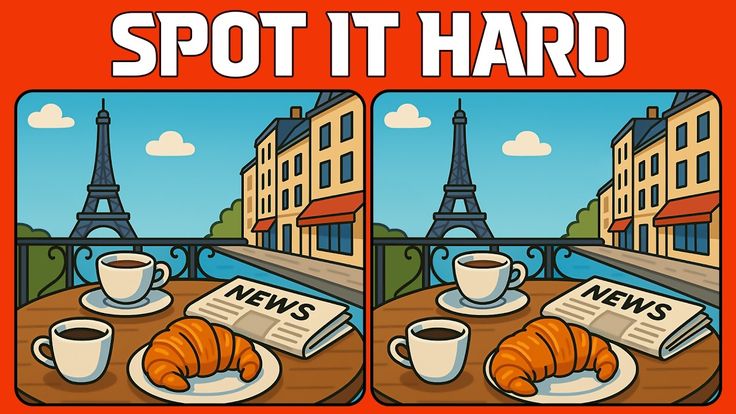
6. Digital vs. Paper: Which is Better for Your Brain?
At riddlepuzzle.com, we get asked this often. In 2026, the answer is “both,” but they offer different experiences.
-
Digital Puzzles: Usually have a timer, which adds a layer of “Processing Speed” training. They often include “haptic feedback” (a vibration when you find a difference), which keeps you engaged.
-
Paper Puzzles: Offer a tactile experience that is better for “Deep Focus.” Without the backlight of a screen, your eyes can often pick up on subtle texture differences more easily.
7. The Social Side of Puzzles
Believe it or not, spot the difference puzzles are becoming a social media staple in 2026. “Live Solving” streams on platforms like RedNote and TikTok are drawing millions of viewers who race to find the differences in the comments. It has become a collaborative sport where the community works together to solve “The Impossible Ten.”
Conclusion: Ready to Test Your Eyes?
The world is full of details, and most people miss them. By practicing spot the difference puzzles, you aren’t just playing a game—you are training your brain to see what others overlook. Whether you’re a veteran of visual puzzles or a newcomer to picture brain teasers, the 10 tricky images waiting for you at riddlepuzzle.com are sure to provide the mental workout you need.
So, take a deep breath, sharpen your focus, and get ready to find the difference. Your brain will thank you for it!
FAQs
Q1: How long should it take to find 10 differences in a “tricky” image?
For an intermediate-level puzzle, a healthy “brain time” is between 3 and 5 minutes. If you can do it in under 60 seconds, you are in the top 1% of visual processors!
Q2: Why do I find some differences easily but struggle with others?
This is usually due to “Color vs. Shape” preference. Some brains are better at detecting changes in geometry (like an extra arm on a chair), while others are more sensitive to chromatic changes (like a blue shirt turning slightly purple).
Q3: Are these puzzles good for seniors?
Absolutely. Research in 2026 suggests that “Neurobic” exercises like find the difference games can help maintain cognitive plasticity and slow down age-related memory decline.
Q4: Can I make my own “Spot the Difference” puzzles?
Yes! With modern AI image tools, you can generate an image and then ask the AI to “modify three subtle details.” It’s a great way to create custom puzzles for friends and family.
Q5: What is the hardest part of a “Spot the Difference” puzzle?
Usually, it’s the “Negative Space” differences, where something is missing rather than changed. Our brains are better at seeing “new” things than noticing when something familiar has disappeared.