From simple animal riddles to funny questions, tricky brain teasers, and school-related puzzles, there are plenty of options for children of different ages. Parents can use riddles during family time, while teachers can include them in classroom activities to make learning more interactive.
The best part is that kids do not need special equipment or complicated instructions to enjoy riddles. You can simply ask a question, give them time to think, and reveal the answer when they are ready.
In this article, you’ll find a collection of easy, funny, challenging, and educational riddles for children, along with answers and tips for making puzzle time more enjoyable.
Why Are Riddles Good for Kids?
Riddles are more than simple questions designed to make children laugh. They encourage kids to explore language, understand clues, and approach problems from different perspectives.
When children try to solve a riddle, they must listen carefully, consider different possibilities, and connect information to find an answer.
Here are some ways riddles can support children’s learning and development.
1. Encourage Creative Thinking
Many riddles have unexpected answers. Children must think beyond the most obvious explanation and consider different possibilities.
This encourages imagination and creative problem-solving.
2. Build Vocabulary
Word-based riddles introduce children to new words, meanings, and expressions. They also help young learners understand how the same word can have different meanings depending on the context.
3. Support Logical Reasoning
Some riddles contain clues that must be examined carefully. Children learn to connect information and use reasoning rather than guessing immediately.
4. Improve Listening Skills
When parents or teachers read riddles aloud, children must pay attention to every word. Missing a small detail can completely change the meaning of a question.
5. Make Learning Entertaining
Riddles turn learning into a game. Children can enjoy answering questions while practicing important thinking skills without feeling like they are completing a traditional lesson.
Easy Riddles for Kids with Answers
Easy riddles are perfect for younger children and beginners. They usually involve familiar objects, animals, food, and everyday activities.
Here are some simple questions to get started.
1. Riddle: What has four legs but cannot walk?
Answer: A table.
2. Riddle: What has a face and two hands but no arms or legs?
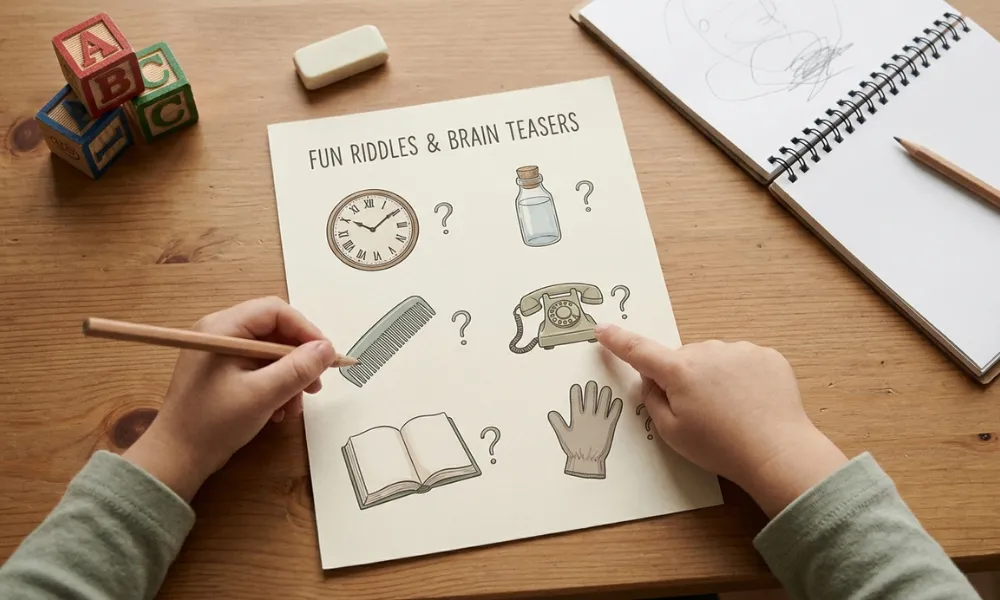
Answer: A clock.
3. Riddle: What gets wetter the more it dries?
Answer: A towel.
4. Riddle: What has a neck but no head?
Answer: A bottle.
5. Riddle: What has teeth but cannot bite?
Answer: A comb.
6. Riddle: What has one eye but cannot see?
Answer: A needle.
7. Riddle: What has pages but is not a newspaper?
Answer: A book.
8. Riddle: What goes up but never comes down?
Answer: Your age.
9. Riddle: What has a thumb and four fingers but is not alive?
Answer: A glove.
10. Riddle: What has a ring but no finger?
Answer: A telephone.
These easy riddles are suitable for quick games at home, classroom warm-ups, or fun conversations with friends.
Funny Riddles for Kids
Funny riddles are a favorite among children because they combine clever questions with silly or surprising answers. Some are based on wordplay, while others use unexpected situations to make kids laugh.
Try these funny riddles with your children.
1. Riddle: Why did the student eat his homework?
Answer: Because the teacher told him it was a piece of cake!
2. Riddle: What kind of room has no doors or windows?
Answer: A mushroom.
3. Riddle: Why can’t your nose be 12 inches long?
Answer: Because then it would be a foot!
4. Riddle: What has four wheels and flies?
Answer: A garbage truck.
5. Riddle: Why did the banana go to the doctor?
Answer: Because it wasn’t peeling well.
6. Riddle: What do you call a bear with no teeth?
Answer: A gummy bear.
7. Riddle: Why did the cookie go to the hospital?
Answer: Because it felt crummy.
8. Riddle: What kind of tree can you carry in your hand?
Answer: A palm tree.
9. Riddle: What has ears but cannot hear?
Answer: A cornfield.
10. Riddle: Why was the math book sad?
Answer: Because it had too many problems.
Funny riddles are excellent for family game nights and classroom entertainment. They can also help children become more comfortable sharing answers and participating in group activities.
Animal Riddles for Kids with Answers
Children naturally enjoy learning about animals, making animal riddles a popular choice. These questions use clues about animal sounds, appearances, habitats, and behavior.
See how many your child can answer!
1. Riddle: I have four legs, a tail, and I bark. What am I?
Answer: A dog.
2. Riddle: I am the king of the jungle and have a big mane. Who am I?
Answer: A lion.
3. Riddle: I have a long neck and can reach leaves high in trees. What am I?
Answer: A giraffe.
4. Riddle: I carry my house on my back and move very slowly. What am I?
Answer: A snail.
5. Riddle: I can fly at night and use echolocation to find my way. What am I?
Answer: A bat.
6. Riddle: I have black and white stripes and look like a horse. What am I?
Answer: A zebra.
7. Riddle: I live in water, have eight arms, and can change my color. What am I?
Answer: An octopus.
8. Riddle: I hop around, have long ears, and love carrots. What am I?
Answer: A rabbit.
9. Riddle: I am very tall, have a trunk, and big ears. What am I?
Answer: An elephant.
10. Riddle: I live in cold places, cannot fly, and waddle when I walk. What am I?
Answer: A penguin.
Animal riddles help children connect clues with familiar creatures while making learning about nature more enjoyable.
Math Riddles for Kids
Math riddles are a fun way to introduce children to numbers, counting, patterns, and simple calculations. Instead of solving ordinary equations, kids must understand the question and figure out the correct solution.
Here are some math riddles suitable for young learners.
1. Riddle: I am an odd number. Take away one letter, and I become even. What number am I?
Answer: Seven. Remove the letter “S” and it becomes “even.”
2. Riddle: What number comes next: 2, 4, 6, 8, ___?
Answer: 10.
3. Riddle: If you have five candies and give two to your friend, how many candies do you have left?
Answer: 3 candies.
4. Riddle: I am a number between 1 and 10. I am even and greater than 6. What number am I?
Answer: 8.
5. Riddle: Two cats catch two mice in two minutes. How many cats are needed to catch 100 mice in 100 minutes, assuming they work at the same rate?
Answer: 2 cats.
6. Riddle: What comes next in this pattern: 5, 10, 15, 20, ___?
Answer: 25.
7. Riddle: A basket contains six apples. You take away two. How many apples do you have?
Answer: 2 apples.
8. Riddle: If you multiply me by 2 and add 4, the answer is 12. What number am I?
Answer: 4.
9. Riddle: How many sides do three triangles have altogether?
Answer: 9 sides.
10. Riddle: What is half of 100?
Answer: 50.
These challenges are useful for making basic mathematics more interesting while encouraging children to read questions carefully.
Hard Riddles for Kids
Once children become comfortable with simple questions, they can try more challenging riddles with answers. These puzzles require deeper thinking, careful reading, and a little creativity while helping children develop their problem-solving skills.
Here are ten tricky riddles for kids.
1. Riddle: The more you take, the more you leave behind. What are they?
Answer: Footsteps.
2. Riddle: I have cities but no houses, forests but no trees, and rivers but no water. What am I?
Answer: A map.
3. Riddle: What can travel around the world while staying in one corner?
Answer: A stamp.
4. Riddle: What belongs to you but other people use it more than you do?
Answer: Your name.
5. Riddle: What has many keys but cannot open a single door?
Answer: A piano.
6. Riddle: What can you catch but cannot throw?
Answer: A cold.
7. Riddle: What has a head and a tail but no body?
Answer: A coin.
8. Riddle: I speak without a mouth and hear without ears. I have no body, but I come alive with the wind. What am I?
Answer: An echo.
9. Riddle: What has branches but no fruit, trunk, or leaves?
Answer: A bank.
10. Riddle: What can fill a room but takes up no space?
Answer: Light.
These harder riddles are great for older children who enjoy solving brain teasers and discovering clever answers.
School Riddles for Kids
School-related riddles are especially useful for classroom activities. They feature familiar objects such as books, pencils, desks, teachers, and school supplies.
Teachers can use these questions as warm-up exercises, while parents can ask them during homework breaks. Adding logic puzzles with answers to these activities can also help children strengthen their reasoning skills and develop logical thinking.
1. Riddle: I have many words but never speak. What am I?
Answer: A book.
2. Riddle: I become shorter as I work. What am I?
Answer: A pencil.
3. Riddle: I have a board, but I am not a game. Teachers write on me. What am I?
Answer: A chalkboard or whiteboard.
4. Riddle: I carry books, pencils, and lunch, and I travel on your back. What am I?
Answer: A schoolbag.
5. Riddle: I have numbers and hands but cannot clap. What am I?
Answer: A clock.
6. Riddle: I erase mistakes but cannot fix them myself. What am I?
Answer: An eraser.
7. Riddle: I am full of questions but never give answers. What am I?
Answer: A test paper.
8. Riddle: Students sit on me, but I never go to school. What am I?
Answer: A chair.
9. Riddle: I have lines but no words, and students write on me. What am I?
Answer: A notebook.
10. Riddle: I help you measure things, and I have numbers along my side. What am I?
Answer: A ruler.
How to Make Riddle Games More Fun for Kids
Riddles become even more enjoyable when children can participate in online riddle games and friendly competitions that encourage teamwork, creative thinking, and problem-solving.
Here are a few simple ideas to make puzzle time exciting.
1. Create a Riddle Challenge
Prepare a list of questions and give children a limited amount of time to solve each one. Award one point for every correct answer.
2. Use Riddle Cards
Write individual riddles on small cards and place them in a box. Children can pick a card, read the question, and try to solve it.
3. Organize Team Competitions
Divide children into small teams and ask each group the same riddles. The team with the most correct answers wins.
4. Give Hints When Needed
If a child cannot solve a riddle, provide a small clue instead of immediately revealing the answer. This gives them another opportunity to think independently.
5. Let Kids Create Their Own Riddles
Encourage children to write questions about animals, objects, food, or everyday activities. They can then challenge their friends and family to solve them.
Frequently Asked Questions (FAQs)
1. What are the best riddles for kids?
Some of the best riddles for children involve animals, everyday objects, numbers, food, and funny situations. Simple questions about clocks, books, dogs, and household items are excellent starting points.
2. At what age can children start solving riddles?
Children can begin enjoying simple riddles around preschool age. The questions should match their vocabulary, understanding, and developmental level. Older children can explore more complicated logic and math riddles.
3. Do riddles help children learn?
Riddles provide opportunities to practice vocabulary, listening, logical reasoning, and creative thinking. They can also make learning more enjoyable when included in classroom or family activities.
4. What are some easy riddles for young children?
Easy riddles include questions such as “What has four legs but cannot walk?” with the answer being a table, or “What has a neck but no head?” with the answer being a bottle.
5. How can teachers use riddles in classrooms?
Teachers can use riddles as warm-up activities, group competitions, language exercises, or short breaks between lessons. They can also ask students to create their own riddles.
6. Are funny riddles suitable for all children?
Most simple funny riddles are suitable for children, but the wording and difficulty should match their age and understanding. Parents and teachers can choose age-appropriate questions.
7. Where can I find more riddles for kids with answers?
You can find additional riddles in children’s puzzle books, educational websites, printable activity collections, and online brain teaser platforms.
Final Thoughts
Riddles are a simple yet entertaining way to bring learning and laughter into children’s daily routines. From easy questions and funny puzzles to challenging math problems and animal riddles, there are countless ways to keep young minds engaged.
The best riddles for kids with answers are those that match a child’s age and encourage them to think without making the activity feel difficult or stressful.
Parents can use riddles during family time, while teachers can introduce them as classroom games or learning exercises. Children can also challenge their friends, create their own questions, and enjoy friendly competitions.
So, choose a few riddles, give children time to think, and see how many clever answers they can discover!