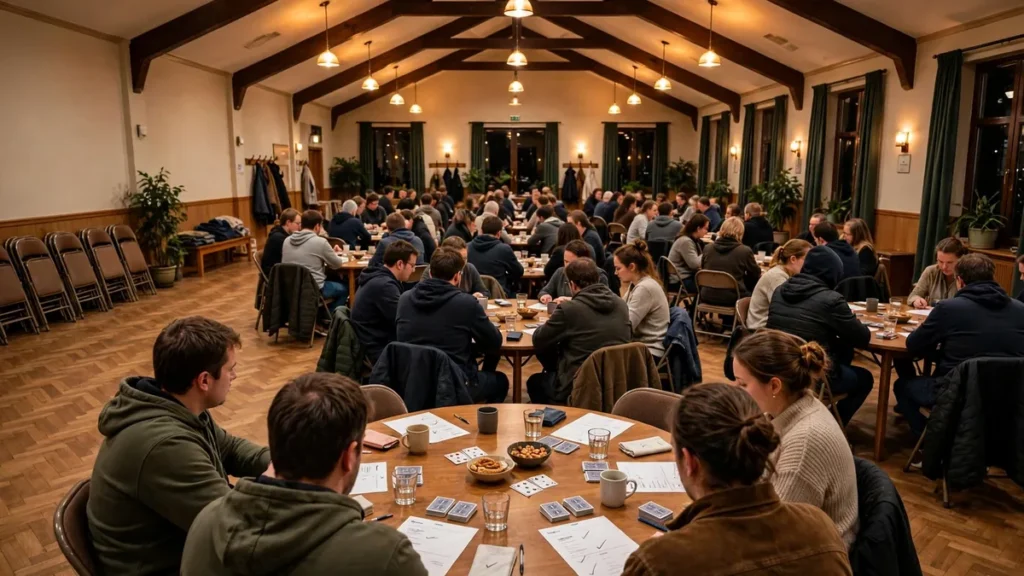
Maths trivia questions and answers are a brilliant way to test what you really know about numbers, shapes and the people who shaped mathematics. This collection has 30 maths trivia questions and answers, grouped into six rounds of five, so you can run a whole quiz night or pick a single round for a family evening, a classroom or a party.
Every question has one clear answer, and every fact is a well-established piece of maths knowledge. The aim is a fair quiz: easy enough that everyone scores, with a few questions that make confident players pause and think.

Key takeaways
- This collection has 30 maths trivia questions and answers, split into six rounds of five.
- The rounds cover arithmetic, geometry and shapes, numbers, famous mathematicians, measurements, and a fun final round.
- Each question has one clear answer, so marking is quick and disputes are rare.
- Mix easy and harder questions in every round so every player scores.
- One point per correct answer, with a bonus point for an answer nobody else gets, keeps scoring simple.
- A calculator-free round keeps the quiz honest, and mental maths makes it far more fun.
How to run this quiz
Running a maths trivia quiz is simple. Read each question aloud, give every team time to write down an answer, and read the answers out at the end of each round. One point per correct answer is all the scoring you need, with no penalty for a wrong answer.
Match the difficulty to the room. A family quiz needs questions children and adults can both answer, while a quiz for keen mathematicians can include the deeper questions in the famous mathematicians and numbers rounds. The rounds below move from familiar facts to slightly harder ones, so start with arithmetic and save the trickier rounds for later.
If you are planning a full evening around these rounds, our guide on how to host a quiz night covers teams, scoring and timing in detail. If you enjoy general knowledge quizzes too, our general knowledge trivia collection is a natural next round.
Arithmetic trivia questions
1. What is 7 multiplied by 8? Answer: 56. Seven times eight is one of the times tables that every player should know, and it is a useful building block for harder sums.
2. What is 15 plus 27? Answer: 42. Fifteen plus twenty is 35, and adding the remaining seven gives 42.
3. What is 100 minus 37? Answer: 63. One hundred minus thirty is 70, and taking away the remaining seven leaves 63.
4. What is 144 divided by 12? Answer: 12. Twelve multiplied by twelve is 144, so 144 divided by 12 must be 12.
5. What is 9 squared? Answer: 81. Nine squared means nine multiplied by itself, and nine times nine is 81.
Geometry and shapes trivia questions
6. How many degrees do the three angles inside a triangle add up to? Answer: 180 degrees. The angles of any triangle, whatever its size or shape, always add up to 180 degrees.
7. How many sides does a hexagon have? Answer: Six. A hexagon is a polygon with six sides and six angles, and a regular hexagon has all its sides the same length.
8. How many sides does a pentagon have? Answer: Five. A pentagon is a polygon with five sides, and the most famous example is the Pentagon building in the United States.
9. How many degrees are there in a right angle? Answer: 90 degrees. A right angle is the angle you see at the corner of a square or a rectangle.
10. What is the area of a rectangle that is 5 centimetres long and 4 centimetres wide? Answer: 20 square centimetres. The area of a rectangle is its length multiplied by its width, so five multiplied by four is 20.
Numbers trivia questions
11. What is pi, rounded to two decimal places? Answer: 3.14. Pi is the ratio of a circle’s circumference to its diameter, and it is often rounded to 3.14 for everyday calculations.
12. What number does the Roman numeral X stand for? Answer: 10. In Roman numerals, X stands for ten, V stands for five, and I stands for one.
13. What is 10 per cent of 200? Answer: 20. Ten per cent is one tenth of a number, and one tenth of 200 is 20.
14. What number comes next in the sequence 2, 4, 8, 16? Answer: 32. Each number in the sequence is double the one before it, so the next number after 16 is 32.
15. How many zeros are there in one million? Answer: Six. One million is written as 1,000,000, which has six zeros after the one.

Famous mathematicians trivia questions
16. Which ancient Greek mathematician is famous for the theorem about right-angled triangles? Answer: Pythagoras. His theorem states that in a right-angled triangle, the square of the longest side equals the sum of the squares of the other two sides.
17. Which ancient Greek mathematician is known as the father of geometry? Answer: Euclid. His book Elements, written around 300 BC, set out the rules of geometry that were taught for more than two thousand years.
18. Which English scientist wrote the Principia and helped to develop calculus? Answer: Isaac Newton. His Principia, published in 1687, described the laws of motion and universal gravitation.
19. Who is often called the first computer programmer? Answer: Ada Lovelace. In the 1840s she wrote notes on Charles Babbage’s Analytical Engine that described how it could be programmed.
20. Which Italian mathematician gave his name to the number sequence 1, 1, 2, 3, 5, 8? Answer: Fibonacci, also known as Leonardo of Pisa. In the sequence, each number after the first two is the sum of the two numbers before it.
Measurements trivia questions
21. How many minutes are there in three hours? Answer: 180 minutes. There are 60 minutes in one hour, so three hours contain three times 60, which is 180.
22. How many millilitres are there in one litre? Answer: 1,000 millilitres. A litre is made up of one thousand millilitres, so half a litre is 500 millilitres.
23. How many grams are there in one kilogram? Answer: 1,000 grams. A kilogram is made up of one thousand grams, so half a kilogram is 500 grams.
24. How many pence are there in one pound? Answer: 100 pence. One pound is made up of one hundred pence, so fifty pence is half a pound.
25. What is the perimeter of a square with sides of 6 centimetres? Answer: 24 centimetres. A square has four equal sides, so four multiplied by six centimetres is 24 centimetres.
Fun maths trivia questions
26. What do you call a three-dimensional shape with six square faces? Answer: A cube. A cube has six faces, and every face is a square of the same size.
27. How many sides does a dodecagon have? Answer: 12. A dodecagon is a polygon with twelve sides, and its name comes from the Greek word for twelve.
28. What is the square root of 169? Answer: 13. Thirteen multiplied by thirteen is 169, so the square root of 169 is 13.
29. How many days are there in a leap year? Answer: 366 days. A leap year has one extra day, 29 February, so it has 366 days instead of the usual 365.
30. What is 1,000 multiplied by zero? Answer: 0. Any number multiplied by zero is zero, however large the other number is.
How to build your quiz from these rounds
| Format | Questions | Time | Best for |
|---|---|---|---|
| Quick round | One round of five | About 10 minutes | A party game or a classroom warm-up |
| Family quiz | Three rounds of five | About 30 minutes | A family evening with mixed ages |
| Full quiz night | All six rounds | About one hour | A quiz night with teams and scoring |
For a family quiz, start with arithmetic or the fun final round, because those rounds use facts everyone has met. Put the hardest round, usually famous mathematicians, in the middle.
Score simply: one point per correct answer, with no penalty for a wrong answer. If scores are close, a final “nearest wins” question makes a fine finish. A good tie-break is to ask how many zeros there are in one million, and the closest guess wins.
Your maths quiz checklist
Use this checklist before you play, especially with a new group or a mixed-age room.
- I have the six rounds printed or written out, with the answers on a separate sheet
- I have a pen and paper ready for every player or team
- I have agreed whether calculators are allowed, or whether all answers must be worked out mentally
- I have mixed the easy and hard questions so everyone scores
- I have a small prize or a fun title ready for the winners
- I have a tie-break question ready in case of a draw
Frequently asked questions
How many maths trivia questions should I ask in one round?
Five questions make a neat round, and six rounds give you 30 questions in total. For a short game, use one or two rounds. For a full evening, use all six and add a speed round of times tables between them.
What age is a maths quiz suitable for?
A maths quiz can work from about age seven, as long as the questions suit the youngest player. Use arithmetic and the fun final round for younger children, and add geometry, numbers and famous mathematicians for older children and adults.
Should I allow calculators in a maths quiz?
It is usually more fun without calculators, because mental maths keeps every player thinking and makes the answers feel earned. Allow calculators only for the measurements round if younger players are still learning those conversions.
How do I make a maths quiz fair for mixed ages?
Use teams that mix ages, so younger and older players help each other, and choose questions from several rounds so no single player dominates. Written answers are fairer than shouting out, because they give every team the same thinking time.
Where can I find more quizzes like this?
You will find more rounds and question sets in our science trivia collection, which uses the same friendly format with facts from the world of science. Younger players may also enjoy our math riddles for kids, which turn number puzzles into brain teasers.
Can I use these questions in a classroom?
Yes, these questions work well in a classroom, because each one has a single clear answer and the rounds cover topics from the maths curriculum. Use one round as a starter activity, or run all six rounds as a team competition at the end of term.
A quiz worth playing again
A maths quiz works best when it feels like a game, not a test. The questions here are short, fair and grouped by topic, so the youngest player scores early and the strongest player still has something to think about.
So pick one round, write down five questions, and play tonight. Add a second round next time, then a third, until you have a quiz night the whole family asks for.