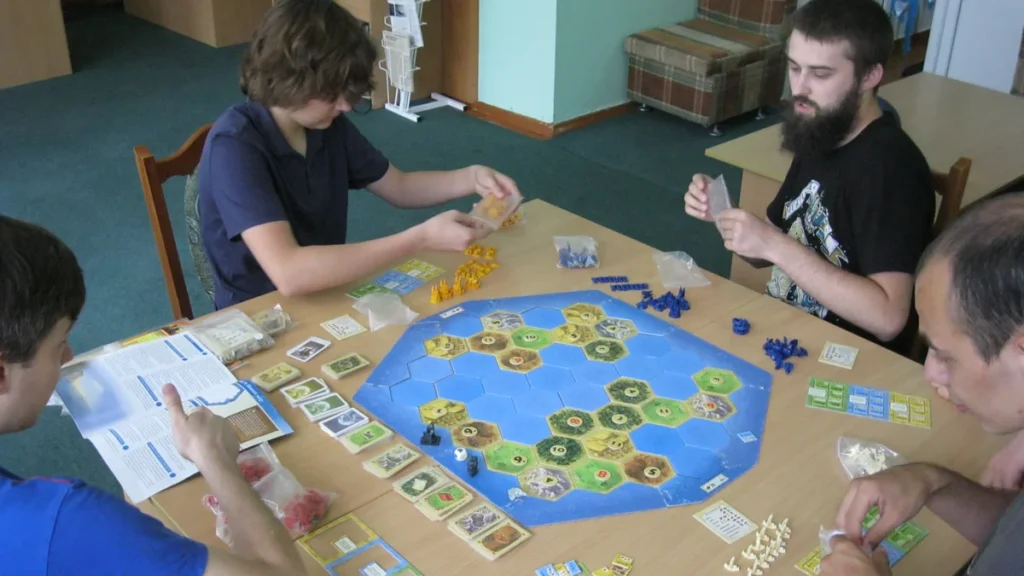
Finding the best word games for 137 players starts with an honest fact: no single word game seats 137 people around one table. A standard board game handles four to eight players, and even the biggest party games top out long before triple digits. That does not mean a 137-player word game night is impossible. It means the format has to change, and once it does, a room of 137 people can play word games together brilliantly.
The secret is to split the room into teams of five to seven, set up multiple tables, and run the same word game at every table at the same time. Scores flow to a central leaderboard, the best teams advance to a final round, and 137 people end up playing the same game together. Tournaments, relays, and whole-room formats turn a logistical headache into the main event.
This guide covers the word games that actually work at this scale, how to set each one up for 137 players, and the practical details that keep a huge group moving: team sizes, timing, scoring, and equipment.
Key takeaways
- No single word game seats 137 players, so every format here uses teams, multiple tables, or whole-room play.
- Teams of five to seven work best, giving 137 players about twenty to twenty-seven teams across the room.
- Tournament and relay formats keep everyone involved, with scores from every table feeding one leaderboard.
- Whole-room games like word bingo and hangman need almost no equipment and scale to any crowd size.
- Plan one host, one scorekeeper per table, and a simple scoring sheet before the first round begins.

How Word Games Work With 137 Players
Word games scale to 137 players through three formats. The first is the multi-table tournament, where the same game runs at twenty or more tables and the winners of each table advance. The second is the relay, where teams take turns completing word challenges and pass the task along like a baton. The third is the whole-room game, where one host runs a single game for everyone at once.
Team size matters more than anything else. Teams of five give you twenty-seven teams with two players left over, teams of six give you twenty-two teams with five left over, and teams of seven give you nineteen teams with four left over. The cleanest option is a mix of fives, sixes, and sevens, so nobody sits out and nobody is stuck in a team too large for a turn.
Timing matters too: a five-minute round takes five minutes at twenty tables if they all run at once, so three rounds plus a final fit inside an hour. The games below are ordered from the easiest to run to the ones needing the most preparation. The same team principles behind word games for 135 players apply here, with only the team count adjusted for two extra players.
The Best Word Games for 137 Players
1. Word Bingo
Word bingo is the easiest whole-room word game for 137 players, and it needs almost nothing to run. Every player gets a bingo card printed with words instead of numbers, the host calls out definitions or clues, and players mark the matching word. The first player to complete a row, column, or full card calls out and wins the round. Because every player has their own card, the game scales perfectly from ten players to 137 without changing a rule.
Preparation is simple: print 137 unique bingo cards from a word list of about seventy-five words, plus a matching set of clue cards for the host. Use a theme such as food words or animal words to make it more fun. A full game takes about fifteen minutes, and you can run three rounds in under an hour. Word bingo works for mixed ages, needs no teams, and keeps every player involved from the first clue to the last.
2. Hangman Tournament
Hangman works beautifully for 137 players as a tournament. Set up a large whiteboard or projector at the front of the room, divide players into teams, and let one team at a time guess letters while the rest of the room watches and cheers. Each team gets one word and a limited number of wrong guesses, earning points for every correct letter and a bonus for solving the whole word.
Each team gets ninety seconds at the board, then the next team steps up. With twenty-odd teams, a full round takes about thirty-five minutes, and the top four teams advance to a final with longer, harder words. Choose words that fit your group, from everyday vocabulary for families to technical terms for a workplace event. Hangman needs almost no equipment, everyone knows the rules, and the whole room stays engaged.
3. Team Scrabble Tournament
Scrabble is the classic word game, and a multi-table tournament makes it work for 137 players. Set up one Scrabble board per table, with each table hosting one team of five to seven players. Teams play together, discussing every move as a group, and the team score is the board score at the end of a fixed time limit, usually thirty minutes. The highest-scoring teams advance to a semi-final, and the winners meet in a final played on a board projected for the whole room.
You will need about twenty Scrabble sets for the first round, the main cost of this format, though many schools, clubs, and libraries already own several. Keep a dictionary at every table for challenges, and appoint one scorekeeper per table. Team Scrabble rewards discussion and vocabulary equally, so quiet players who know unusual words become their team’s heroes.
4. Boggle Relay
Boggle is a natural fit for a relay because every round is short and self-contained. Each team gets its own Boggle grid and three minutes to find as many words as possible, writing them on a shared sheet. When the timer ends, teams swap grids with the next table, so every team plays every grid. Points are awarded for each valid word, longer words worth more, and words found by more than one team on the same grid score only once, which keeps teams hunting for unusual words.
The relay solves Boggle’s biggest problem at scale: needing a grid and timer at every table. With teams rotating through grids, you need only as many Boggle sets as there are tables, and the rotation itself becomes part of the fun. A full relay of four grids takes about twenty minutes including swaps, making it an ideal second game after a whole-room warm-up.
5. Crossword Relay Race
A crossword relay turns a solitary puzzle into a team sprint. Print the same large crossword for every team, one per table, and give each team a single pen. Only one person may write at a time, and the pen must pass to the next player every sixty seconds, so everyone contributes and no single expert can dominate. The first team to complete the grid correctly wins, with points for each correct answer if nobody finishes in the time limit.
The relay rule is what makes this game work for 137 players: without it, the strongest solver on each team would do all the work while everyone else watched. With the pen passing every minute, weaker solvers take the easy clues while stronger solvers tackle the hard ones. Use a crossword with a mix of easy and hard clues and a twenty-minute limit, and keep the answer key ready.
6. Word Association Chain
Word association is a whole-room game that needs no equipment at all, which makes it perfect for 137 players. The host starts with a word, and each team in turn must call out a word associated with the last one within five seconds, without repeating a word already used. A team that hesitates, repeats a word, or gives a word the room judges unrelated loses a point, and the chain continues. After three rounds, the team with the fewest penalties wins.
The five-second limit is essential: without it, teams overthink and the game drags. With it, the game moves fast, the answers get funny, and the room stays loud. Word association needs no setup, no printing, and no explanation beyond one example round, and it works as a filler between longer games.
7. Anagram Race
An anagram race gives every team the same set of jumbled letters and challenges them to find the most real words before the timer ends. Hand each table a card with a long word or nine random letters, give teams five minutes, and award one point per valid word, with a bonus for the longest word found. Run three rounds with different letter sets, and the highest total wins.
Anagram races work well for 137 players because the materials are just printed cards, and every team plays the same letters at the same time, so results are directly comparable. Vary the difficulty by choosing letters carefully: common letters like A, E, R, S, and T produce dozens of words, while Q, Z, and X produce very few. This game pairs well with the broader collection of word games for adults, which includes more anagram and vocabulary challenges suited to grown-up players.
8. Codenames-Style Team Word Game
Codenames is a team word game built around clues, and its structure adapts well to a large room. A spymaster gives a one-word clue that links several words on a grid, and their team must guess which words the clue points to. For 137 players, run the game at every table with a printed word grid, one spymaster per team, and a thirty-minute limit. Teams score a point for every correct word, lose a point for every wrong guess, and the highest score after three grids wins.
The spymaster role is the heart of this game, so rotate it every round. A good spymaster thinks about connections between words, such as linking OCEAN, SHIP, and ANCHOR with the clue SEA, while a careless clue can send a team straight to the wrong words. The game rewards creative thinking more than vocabulary size, which suits a crowd with very different word skills. You need one word grid per table per round, easy to print in advance.
9. Bananagrams Team Play
Bananagrams is a fast, tile-based word game where players race to build crossword grids from a shared pool of letter tiles. For 137 players, each table plays as one team with a single shared tile pool, building one grid together and rearranging tiles as new letters arrive. When a team finishes its grid, it calls out, every other team draws a new tile, and the race continues. The first team to use all its tiles in a valid grid wins the round.
Team Bananagrams is loud, fast, and slightly chaotic, exactly what a big room needs after a quieter game. A round takes about ten minutes, and you can run four or five rounds in an hour. You need one Bananagrams set per table, and teams of five to seven share the tiles, so it works best when players are comfortable grabbing tiles and arguing about spelling. Keep a dictionary at each table, because a quick check settles tile arguments.
10. Group Wordle Challenge
A group Wordle challenge projects one five-letter puzzle for the whole room and lets every team guess together. The host shows the grid on a screen, each team writes down its guess, and the host reveals which letters are correct, misplaced, or absent. Teams have six guesses to find the word, and the teams that solve it in the fewest guesses score the most points. Run five words in a row, and the highest total wins.
This format works for 137 players because it needs only a screen, a set of prepared words, and an answer sheet per team. Everyone plays the same puzzle at the same time, so the room reacts together to every reveal, and the tension builds with each guess. Choose words common enough to be guessable but not so obvious that every team solves them in three guesses. It is an excellent closing game: short, dramatic, and easy for the host to run while final scores are added up.
Word Games for 137 Players Compared
The table below compares all ten games on the factors that matter most when planning for 137 players: how many people can play at once, how much equipment you need, and how long a round takes.
| Game | Format | Equipment needed | Round length | Best for |
|---|---|---|---|---|
| Word Bingo | Whole room | Printed cards and clue sheets | 15 minutes | Warm-ups and mixed ages |
| Hangman Tournament | Whole room | Whiteboard or projector | 35 minutes | Low-cost, high-energy rounds |
| Team Scrabble Tournament | Multi-table | About 20 Scrabble sets | 30 minutes | Serious word lovers |
| Boggle Relay | Multi-table relay | One Boggle set per table | 20 minutes | Fast, focused team play |
| Crossword Relay Race | Multi-table relay | Printed crosswords and pens | 20 minutes | Mixed-ability groups |
| Word Association Chain | Whole room | None | 10 minutes | Openers and fillers |
| Anagram Race | Multi-table | Printed letter cards | 15 minutes | Quick competitive rounds |
| Codenames-Style Team Game | Multi-table | Printed word grids | 30 minutes | Creative thinkers |
| Bananagrams Team Play | Multi-table | One set per table | 10 minutes | High-energy finales |
| Group Wordle Challenge | Whole room | Projector and answer sheets | 20 minutes | Dramatic closing rounds |
How to Set Up a 137-Player Word Game Event
Good setup turns a chaotic crowd into a smooth event. Arrange tables in rows with space between them so the host and scorekeepers can move freely, seat five to seven players per table, and mix ages and abilities at each table rather than letting the strongest players cluster together. Put the leaderboard where everyone can see it and update it after every round.
Staffing is simple but important. You need one host to run the whole-room games and keep time, plus one scorekeeper per table to record results and settle disputes. The host should have a microphone, a timer, and a printed schedule with round lengths and break times. Print everything in advance, with spares for mistakes. The best large-group nights borrow their structure from trivia games for 100 players, where the same mix of team tables, a central host, and a visible leaderboard keeps a huge room playing together.
Plan the running order before the day. Open with word association or word bingo, follow with two table games such as the anagram race and the Boggle relay, take a short break, then run the Scrabble tournament or the Codenames-style game, and close with the group Wordle challenge while final scores are counted. Three hours is enough for five or six games with breaks. Announce the prizes early and explain the scoring before the first round starts.
Checklist for a 137-Player Word Game Night
- Split 137 players into teams of five to seven, with a mix of ages and abilities at every table.
- Appoint one host with a microphone and one scorekeeper per table before the event starts.
- Print all cards, grids, crosswords, and score sheets in advance, with spare copies for mistakes.
- Put a visible leaderboard at the front of the room and update it after every round.
- Explain the scoring rules before the first game begins, and keep a dictionary at every table.
- Plan a running order that mixes whole-room games with table games and ends with a short closing game.
Frequently Asked Questions
Can 137 people play one word game at the same time?
Yes, but not around a single board. Whole-room games like word bingo, hangman, and the group Wordle challenge let all 137 players take part at once, while table games run the same game at twenty or more tables simultaneously and combine the scores on one leaderboard.
What is the best team size for 137 players?
Teams of five to seven work best. With 137 players, teams of six give you twenty-two teams with five players left over, so use a mix of fives, sixes, and sevens to make sure every player has a team and no team is too large for a turn.
How many tables do I need for 137 players?
Plan for about twenty to twenty-five tables, depending on team size. Teams of six need twenty-three tables, while teams of seven need twenty. Leave space between tables so the host and scorekeepers can move around easily.
How long should a 137-player word game event last?
Three hours is a good length for five or six games with breaks. Whole-room games take ten to twenty minutes each, table rounds take twenty to thirty minutes, and a tournament with a final needs about an hour. Shorter events work with just three games.
What equipment do I need for word games with 137 players?
It depends on the games you choose. Word bingo needs printed cards, hangman needs a whiteboard or projector, Scrabble and Boggle need one set per table, and word association needs nothing at all. A microphone, a timer, and printed score sheets help every format.
Do word games work for 137 players of mixed ages?
Yes, especially if you mix ages and abilities at each table. Word bingo, word association, and the crossword relay work well for mixed-age groups, while team formats let stronger players help younger ones without taking over.
The Bottom Line
The best word games for 137 players embrace the size of the crowd instead of fighting it. Split the room into teams, run the same game at many tables, keep one leaderboard everyone can see, and mix whole-room games with table tournaments. Word bingo and hangman warm a room up, Scrabble and Boggle reward real word skill, and a group Wordle challenge closes the night with everyone playing the same puzzle. With a host, a scorekeeper per table, and printed materials ready in advance, 137 players is not a problem to solve.