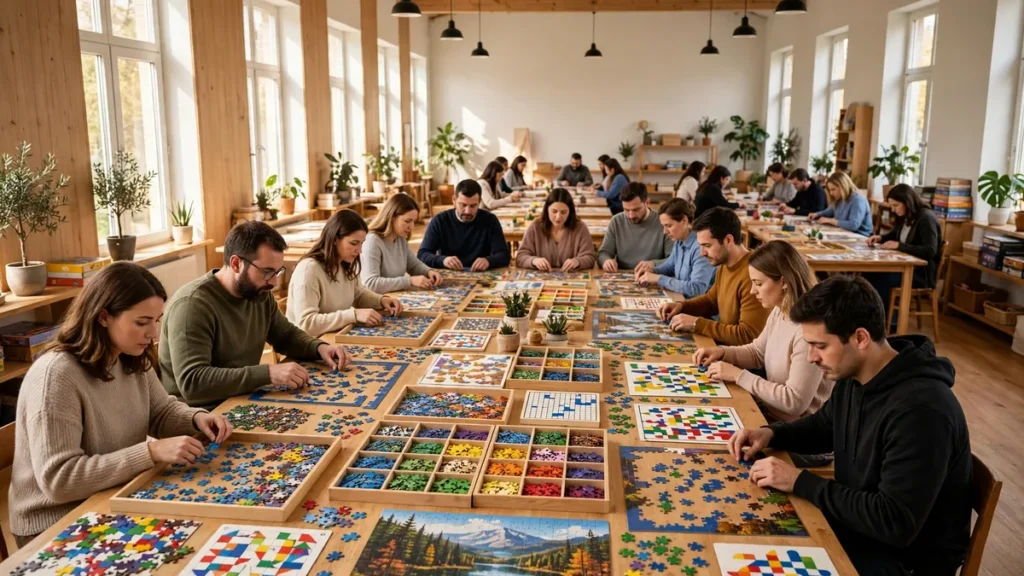
Finding the best word games for 65 players is a different challenge from picking a game for a family of four. Most boxed word games seat between two and eight people, so a group of 65 needs team play, tournament brackets, relay rounds, and whole-room formats where everyone plays at the same time.
The best word games for 65 players share three qualities. First, they let everyone take part at once, so nobody sits out watching for twenty minutes. Second, they use simple rules a host can explain in under two minutes, because a large group loses patience fast when instructions drag on. Third, they create moments worth talking about, like a team guessing an impossible word on the last clue or a quiet player winning the round with a brilliant answer.
You do not need 65 copies of anything. You need teams of five to eight players, a clear rotation, a visible scoreboard, and games chosen for the room you have.
Key takeaways
- Split 65 players into 8 to 13 teams of 5 to 8 people so every game runs as team play, not as 65 individual turns.
- Choose games where all teams play at the same time, such as word bingo, anagrams, and crossword relays, to avoid long waits between turns.
- Use a visible scoreboard and a strict time limit per round, because large groups drift quickly without a clock and a clear score.
- Mix quick party games with deeper thinking games so fast talkers and quiet word lovers both get rounds that suit them.
- Print one answer sheet per team, not per person, and appoint one scorekeeper per team to keep the night moving.

Best Word Games for 65 Players at a Glance
The games are ranked by how smoothly they run with a very large group, not only by how fun they are with four players.
| Game | Best for | Format for 65 players | Time per round |
|---|---|---|---|
| Codenames team edition | Teamwork and clever clues | 8 to 10 teams, one board per table | 20 to 30 minutes |
| Giant Scrabble relay | Classic word building | Relay teams at shared boards | 25 to 30 minutes |
| Word bingo | Whole-room play | Everyone plays at once | 15 to 20 minutes |
| Scattergories tournament | Quick creative thinking | Teams answer the same lists | 15 minutes |
| Anagram race | Fast letter play | Teams race the same letters | 10 to 15 minutes |
| Crossword relay | Puzzle lovers | Relay teams, one clue at a time | 20 minutes |
| Taboo team challenge | Laughs and fast talk | Teams take turns on stage | 20 to 25 minutes |
| Hangman tournament | Simple, low-cost fun | Bracket of team matches | 15 to 20 minutes |
| Boggle letter blitz | Speed word finding | Teams share one grid per table | 10 minutes |
| Group Wordle round | Modern crowd favourite | Whole room guesses together | 10 to 15 minutes |
Why 65 Players Changes the Game
A word game designed for six people assumes everyone can see the board, hear every clue, and take a turn every few minutes. With 65 players, none of those assumptions hold. Someone at the back cannot read small cards, a single board cannot serve a whole hall, and a game that gives each person a two-minute turn would take over two hours to complete one round. The fix is not to buy a bigger version of the same game. The fix is to change the structure so the game fits the crowd.
Teams are the single most important change. Eight teams of eight players, or thirteen teams of five, turn 65 individuals into a manageable number of playing units. Each team needs one table, one answer sheet, and one spokesperson, and the host only has to manage the teams, not 65 separate players. Teams also protect shy players, who can contribute ideas inside a small group instead of performing in front of a hall, and the best large-group games use simultaneous play, so every team acts at the same moment.
How to Run Word Games for 65 Players
Running a smooth night for 65 players is mostly logistics. The games themselves are simple, but the room, the teams, and the timing need a plan before anyone arrives. The steps below cover a two-hour event, which is a comfortable length for a large group.
Split the Room Into Teams First
Decide the teams before the first game starts. Pre-assign teams of five to eight players and put a team number and a colour on each table, or let people count off around the room if the group is informal. Give each team a name, a captain, and a scorekeeper, and write the team names on a visible scoreboard before play begins.
Use One Host and One Timekeeper
One person should host the whole night, with a microphone if the room holds more than 40 people. The host explains each game in under two minutes, starts the timer, and calls time clearly. A second person keeps score and updates the board between rounds, so the host never has to stop the energy to do maths.
Keep Rounds Short and Scores Simple
Aim for ten to twenty minutes per game, with a two-minute break between games for scoring and setup. Score simply: one point per correct word, three points for a bonus answer, or a flat ten points for a round win. Complicated scoring slows everything down and creates disputes.
The 10 Best Word Games for 65 Players
1. Codenames Team Edition
Codenames is one of the best word games for 65 players because it is already a team game, and it scales by adding tables rather than by changing the rules. Each team of five to eight players gets its own board of 25 word cards, and the spymaster gives a one-word clue like “ocean, three” while the team debates which words it connects. To run it for 65 players, set up one board per table and run all tables at the same time, with a 25-minute limit. You can buy several copies of the game, print your own word grids, or project a single grid and let every team play against the same words. It rewards creative thinking over vocabulary size, so a mixed-ability team can still win with a clever clue.
2. Giant Scrabble Relay
Scrabble is the classic word game, but a standard board cannot serve 65 players. The relay version turns each team into a relay squad: each team gets a board, a set of letter tiles, and a rack, and players take turns in sequence, with one player placing a word and then passing play to the next. A 25-minute round with a 60-second limit per turn keeps the pace brisk and stops one slow player from holding up the whole team. Score the standard Scrabble way, with letter and word bonuses counting as printed, and add a five-point bonus for any word of six letters or longer. Agree before play whether proper nouns and abbreviations count, and keep a dictionary at each table to settle challenges quickly.
3. Word Bingo for the Whole Room
Word bingo is the easiest whole-room game on this list, and it is the best opener for 65 players because everyone plays from the first minute. Each player gets a bingo card printed with words instead of numbers, the host calls out definitions or clues, and players mark the matching word. The first player to complete a row, column, or full card shouts bingo and wins the round. Three short rounds of about five minutes each fit neatly into a 20-minute slot. Print the cards with large, clear type and use a different layout for each table so not everyone wins on the same call. Word bingo needs almost no setup and costs very little to print, which makes it the safest choice when you are unsure how much space or equipment you will have.
4. Scattergories Tournament
Scattergories is a fast creative word game that works beautifully as a team tournament. Each round gives every team the same list of twelve categories, such as things in a kitchen or famous singers, and a three-minute timer. Teams write one answer per category, unique answers score two points, and shared answers score one. The twist is that obvious answers earn less, so teams argue happily over whether “kangaroo” or “kiwi” is the smarter answer for animals beginning with K. For 65 players, print one answer sheet per team and use a letter die or a phone app to pick the round letter. Run three rounds with different letters and add the scores together.
5. Anagram Race
An anagram race is pure speed wordplay: the host reveals a set of jumbled letters, and every team races to build as many real words as possible before the timer ends. Use seven-letter sets for a standard round and nine-letter sets for a hard round, with three minutes per set. A set like “LISTEN” can produce listen, silent, enlist, and inlets, so even a short letter set rewards teams that keep looking after the obvious words are found. Score one point per valid word, with a three-point bonus for the longest word in each set. Run five sets in a 15-minute game, changing the letters each time and showing the answers on a screen afterwards so teams can see what they missed. If you enjoy this format, the best word games for 64 players show how the same race works with a nearly identical group size.
6. Crossword Relay Race
A crossword relay turns a quiet solo puzzle into a team sport. Each team gets the same crossword grid, and players take turns in relay order: one player solves a single clue, writes in the answer, and passes the pencil to the next player. Only one player holds the pencil at a time, which keeps the relay fair and stops the strongest player from doing the whole puzzle alone. A 20-minute limit and a grid of 20 to 30 clues fits the format well. Choose a themed crossword that suits the occasion, such as food, travel, or music, and print it large enough to read from across a table. Score one point per correct answer, with a five-point bonus for the first team to finish.
7. Taboo Team Challenge
Taboo is the loudest game on this list, and it works for 65 players as a stage game with the audience involved. One player from a team stands at the front, draws a card with a target word and a list of forbidden words, and must get their team to guess the target without saying any of the banned words. Each turn lasts 60 seconds, and the team scores one point per word guessed. The rest of the room watches, laughs, and plays along silently, which makes it great entertainment between quieter rounds. Run it as a rotation, with each team sending one clue-giver to the front in turn, while the other teams hold prediction cards and guess how many words the team will solve. Award a bonus point to any team that predicts the exact score, so waiting teams stay involved.
8. Hangman Tournament
Hangman is the simplest game on this list, and its simplicity is exactly why it works for 65 players. Set up a bracket of team matches: two teams face each other, one team picks a secret word and the other guesses letters, and the team that solves the word with the fewest wrong guesses wins the match. Winners advance, and the tournament produces a champion in about four rounds. Each match takes about five minutes, so a full tournament fits into a 20-minute slot. Use a whiteboard or a projector so the whole room can follow each match, and choose words that suit the group: themed words for a party, curriculum words for a school event, or industry words for a work social. Let eliminated teams play a consolation round of word bingo so nobody sits idle.
9. Boggle Letter Blitz
Boggle is a timed word hunt that scales well because every team can play the same grid at the same moment. Each table gets a 4 by 4 grid of letters, either from a Boggle set, a printed grid, or a projected image, and teams have three minutes to find as many words as possible. Words must be at least three letters long, formed from adjacent letters, and each letter cube can be used only once per word. Score one point for three-letter words, two points for four-letter words, and three points for five letters or more. Run four grids in a ten-minute game, with a fresh grid each round and a one-minute break to compare answers. Unique words score double, which pushes teams to look past the obvious words that every table will find.
10. Group Wordle Round
A group Wordle round brings a modern favourite to a room of 65 players. The host picks a five-letter word, and the whole room guesses together, with each team submitting one guess per round. After each guess, the host marks the letters green for correct place, yellow for correct letter in the wrong place, and grey for letters not in the word, using a screen or a whiteboard. Teams have six guesses to find the word, and the team that solves it first wins the round. Play five words in a 15-minute game, and award ten points for solving in three guesses, seven for four guesses, five for five guesses, and three for six guesses. Teams should discuss each guess carefully, because a wasted guess costs the whole room information. The best party games for 64 players include more whole-room formats like this one, which are useful when you want a modern crowd-pleaser for a large group.
Planning Checklist for Game Night
Use this checklist in the week before your event, and run through it again on the day.
- Confirm the room layout, with one table per team, space to move between tables, and a clear view of the host and the scoreboard from every seat.
- Print one answer sheet per team per game, plus spare sheets, and pack pens, pencils, timers, and a microphone with spare batteries.
- Pre-assign teams of five to eight players, and place a team number, a colour, and a name card on each table before guests arrive.
- Prepare the scoreboard in advance, with team names written in and a simple points column that the scorekeeper can update between rounds.
- Test the projector, the screen, and the timer before the first game, and keep a printed backup of every puzzle in case the technology fails.
- Pack small prizes for each round and a larger prize for the winning team, and agree the rules for ties before play begins.
Frequently Asked Questions
What is the best word game for 65 players?
Word bingo and the anagram race are the best starting choices, because everyone plays at the same time and the rules take under two minutes to explain. Codenames is the best choice for a longer session, because it rewards teamwork and discussion.
How do you split 65 players into teams?
Split 65 players into eight teams of eight players, with one team of nine, or into thirteen teams of five. Teams of five to eight work best: smaller teams leave people out of the discussion, and larger teams let quiet players hide. Pre-assign the teams where possible, mix strong and new players, and give each team a captain and a scorekeeper.
How long should a word game night for 65 players last?
Plan for about two hours, including breaks. Five or six games of 15 to 20 minutes each, with two-minute breaks between games, fills the time without exhausting the room. Shorter events should use four games, and longer events can add a championship round between the top two teams rather than adding more ordinary rounds.
What equipment do I need for 65 players?
You need one table per team, one answer sheet per team per game, pens, a timer, a microphone, and a visible scoreboard. A projector helps for whole-room games like Wordle and word bingo, but printed sheets work just as well. You do not need a copy of each game for every player, because team play means one set per table is enough.
Can children and adults play these games together?
Yes, with the right word lists. Word bingo, hangman, and anagram races work well for mixed ages when the words are familiar to everyone. Codenames and Scattergories suit older children and adults better, because they need broader vocabulary and quicker thinking. Mixed-age teams work well, because adults and children notice different words and help each other.
How do you keep score fairly with 65 players?
Use simple scoring, one scorekeeper per team, and a host who checks disputed answers. One point per correct word, bonus points for long or unique answers, and a flat ten points for a round win are easy to track and hard to argue about. Announce the score after every game, write it on a visible board, and decide tie-break rules before play begins. The best board games for 64 players also use simple tournament scoring, which is worth copying when you want a competitive structure for a large group.
The Bottom Line
The best word games for 65 players are the ones that let everyone play at once, keep the rules simple, and turn a big crowd into small teams that talk, laugh, and compete together. Start with word bingo to warm the room up, run Codenames and the anagram race as your main events, and finish with Taboo or a group Wordle round so the night ends on a high. Keep the rounds short, keep the scoreboard visible, and the group size that looks like a problem becomes the reason the night works.