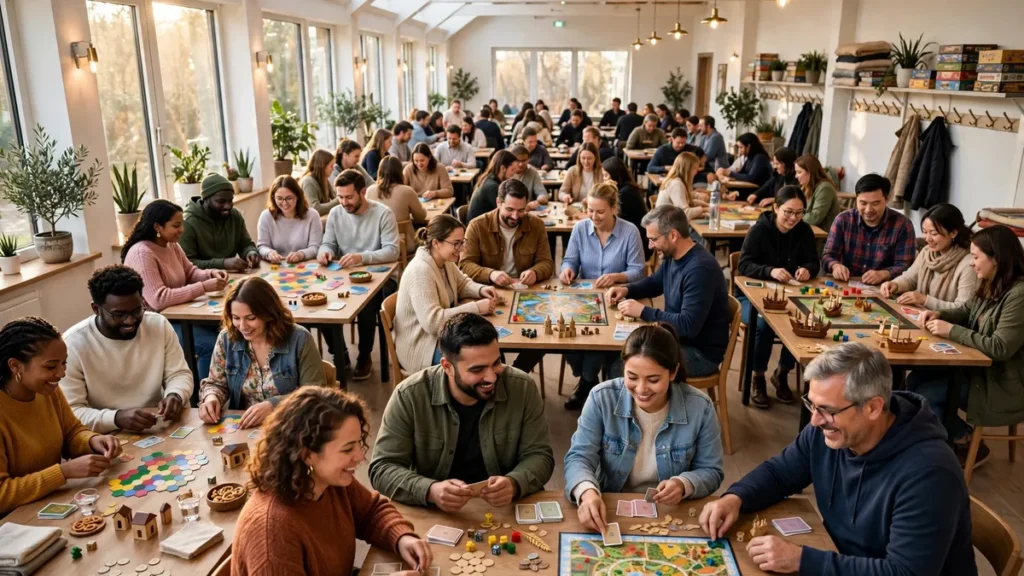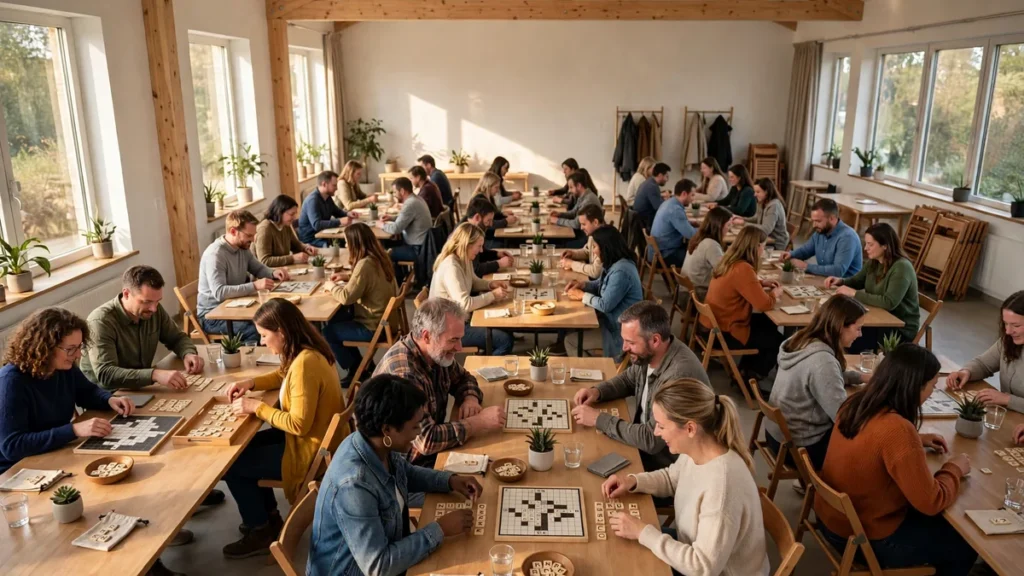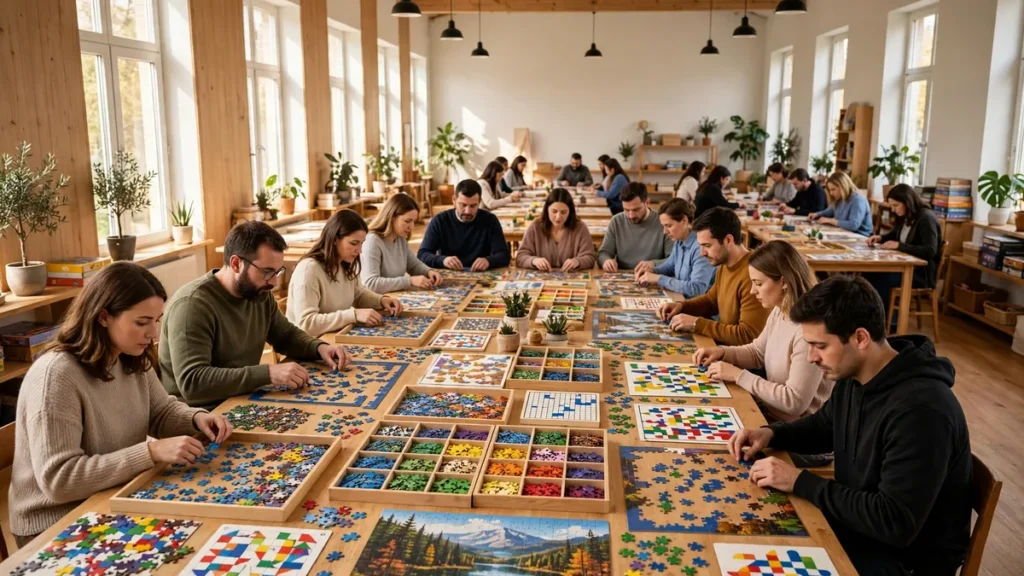
Finding the best puzzle games for 68 players is a very different job from choosing a puzzle for a quiet evening at home. Sixty-eight people will not fit around one table, and no single puzzle box is designed for a crowd that size. The trick is not to look for one giant puzzle, but to build a puzzle night format that lets sixty-eight people play at the same time, in the same room, without anyone sitting out for an hour waiting for a turn.
The best puzzle games for 68 players work because they scale. Some scale through teams, so sixty-eight people become ten or twelve teams of five or six. Some scale through stations, so small groups rotate around a room full of different puzzles. Others scale through a race or a tournament, where everyone works on the same kind of puzzle at the same time and the fastest correct finishers win.
This guide covers the formats that work for a crowd of sixty-eight, a comparison table to help you choose quickly, detailed picks for different kinds of groups, advice on matching the format to your space and your players, a checklist for running the night, and answers to the questions organisers ask most often.
Key takeaways
- No single puzzle seats 68 people, so plan for teams, stations, or a tournament format rather than one shared puzzle.
- Team puzzle games such as Codenames-style word puzzles are the easiest way to include sixty-eight players at once.
- Buy or borrow several copies of the same puzzle so every table plays together in sync.
- Keep rounds short, explain the rules once to the whole room, and use a visible timer so nobody waits too long.
- Mix puzzle types across the night so word lovers, number lovers and visual thinkers all get a round they enjoy.

How to Make Puzzle Games Work for 68 Players
A group of sixty-eight is a small crowd, not a table of friends, so the first decision is about structure, not about which puzzle to buy. A puzzle that is perfect for six people can still be perfect for sixty-eight if you change how it is played. The three structures that work best are teams, stations and races, and most successful puzzle nights use at least two of them across the evening.
Teams are the simplest structure. Divide sixty-eight players into teams of five or six, which gives you eleven or twelve teams, and give every team the same puzzle at the same time. Teams can sit at separate tables, work on identical jigsaw puzzles, crosswords or logic grids, and compare finishing times. This structure is fair, because every team faces exactly the same challenge, and it is easy to score, because the first team to finish correctly wins the round.
Stations suit a longer evening and a bigger room. Set up eight or ten puzzle stations around the hall, with a different puzzle at each one, and let teams rotate every ten or fifteen minutes. One station might hold a jigsaw puzzle, the next a crossword, the next a set of riddles, and the next a Sudoku grid. Teams collect points at every station, and the team with the highest total at the end wins.
Races are the fastest structure and the best choice when time is short. Everyone works on the same puzzle at the same time, individually or in pairs, and the first correct finishers earn points. A crossword race, a Sudoku race or a word search race can be run with printed sheets and a single timer, which makes races cheap and easy to organise.
Teams, Stations or a Tournament
If you are choosing between the three structures, think about your room first. Teams need one table per team. Stations need floor space for people to move between tables, plus a clear rotation plan on a whiteboard or a printed sheet. A tournament needs very little space, because players can sit in rows with a clipboard, but it needs a confident host who can keep the pace and call the scores. If your room is tight, choose teams. If your room is large and you have two hours or more, choose stations. If you have one hour and a single host, choose a tournament.
The Best Puzzle Games for 68 Players Compared
The table below compares the eight puzzle games in this guide by group size, time per round, difficulty and what you need to run them. Use it to pick a shortlist, then read the detailed notes under it to see which games suit your players, your room and your budget.
| Game | Best format | Time per round | Difficulty | What you need |
|---|---|---|---|---|
| Team word puzzle | Teams | 20 minutes | Easy | Word cards and a timer |
| Jigsaw puzzle relay | Teams | 30 minutes | Easy | Identical 500-piece puzzles |
| Crossword race | Race | 15 minutes | Medium | Printed crosswords and pens |
| Sudoku tournament | Tournament | 20 minutes | Medium | Printed grids and a timer |
| Escape-room puzzle stations | Stations | 15 minutes each | Medium | Locks, clues and small props |
| Logic puzzle hunt | Stations | 25 minutes | Medium | Printed clues and a route map |
| Picture puzzle hunt | Teams | 20 minutes | Easy | Printed picture puzzles |
| Mixed puzzle quiz | Tournament | 25 minutes | Easy | Question sheets and a host |
1. Team Word Puzzle
A team word puzzle is the most reliable opener for sixty-eight players, because the rules take two minutes to explain and nobody needs to learn anything new. The best-known format is a Codenames-style game, where each team has a clue giver who links several words with a single hint, and the team must guess the right words without touching the words that belong to the other side. Run it as a team tournament: every table plays the same set of words at the same time, and the first team to guess all of its words wins the round. Word puzzles work for a crowd because talking is the game. Quiet players can listen and point, confident players can argue for a guess, and the whole team shares the win or the loss.
2. Jigsaw Puzzle Relay
A jigsaw puzzle relay is the most visual game on this list, and it is the one that photographs best, which matters if your puzzle night is a fundraiser, a school event or a company social. Buy or borrow eleven or twelve identical 500-piece puzzles, one per team, and give every team the same picture. Teams race to finish first, and the first team with a complete, correct puzzle wins. A 500-piece puzzle is the right size for a team of five or six: it takes about half an hour, which is long enough to feel like a real challenge and short enough to fit into an evening with other games. Sort the pieces by edge and colour first, assign one person to the border, and let the rest hunt for matching shapes.
3. Crossword Race
A crossword race is the cheapest game in this guide, and it is the easiest to run for sixty-eight people at the same time. Print the same crossword for every player or every pair, hand out pens, start the timer, and award points to the first correct finishers. A good race crossword has a mix of easy and hard clues, so beginners can fill in a dozen answers quickly while experienced solvers chase the tricky ones. Fifteen minutes is the right length for a race round. Run the race in pairs if you want more conversation, because pairs talk through clues together, and score by the number of correct answers rather than by finishing first alone, so a careful pair that solves ninety percent of the grid can still beat a fast pair that guesses.
4. Sudoku Tournament
A Sudoku tournament is the best choice when your group includes serious number lovers, because Sudoku is a pure logic puzzle with no general knowledge involved, so nobody is disadvantaged by what they do or do not know. Print the same medium-difficulty Sudoku grid for every player, give everyone fifteen or twenty minutes, and award points for the fastest correct solutions. Run three rounds at increasing difficulty, with an easy grid first, a medium grid second and a hard grid last, so everyone gets a warm-up before the real contest begins. Sudoku needs almost no equipment and no talking, which makes it a calm change of pace after a noisy team game, and it scales perfectly: one printed sheet per player, one timer and one answer key.
5. Escape-Room Puzzle Stations
Escape-room puzzle stations bring the most excitement to a puzzle night, because each station feels like a small adventure. Set up eight or ten stations around the room, each with a different puzzle: a combination lock that opens with a code hidden in a riddle, a jigsaw that reveals a number when it is complete, a picture puzzle that hides a word, or a logic grid that points to a key. Teams rotate every fifteen minutes, solve what they can, and collect points for each station they complete. Stations need more preparation than the other games on this list, so test every station yourself before the night, because a puzzle that looks easy on paper can be impossible in practice, and a station that nobody can solve will hold up the whole rotation.
6. Logic Puzzle Hunt
A logic puzzle hunt turns the whole venue into the game. Write a trail of clues that leads teams from one spot to another, with a logic puzzle at each stop: a grid puzzle that reveals the next location, a set of riddles that spells out a room name, or a code that must be cracked to open the next envelope. Teams of five or six follow the trail together, solving as they walk, and the first team to reach the final puzzle wins. The hunt works for sixty-eight players because it spreads the crowd out, which keeps the noise down and gives every team space to think. Keep the clues fair and test the route in advance, because a clue that points to the wrong room will send half the teams in the wrong direction.
7. Picture Puzzle Hunt
A picture puzzle hunt is the most accessible game on this list, because it needs no reading, no numbers and no general knowledge. Give every team a set of printed picture puzzles: spot the difference, find the hidden object, complete the pattern, match the shapes, or work out what the rebus picture means. Teams race to solve the set, and the first team with all the answers correct wins the round. Picture puzzles suit mixed-age groups, because children, teenagers and adults can all contribute, and they suit players who speak different languages, because the puzzles are visual. Keep each set to about ten puzzles, mix easy and hard ones, and give teams twenty minutes.
8. Mixed Puzzle Quiz
A mixed puzzle quiz is the best closing game for a night with sixty-eight players, because it brings everyone back together for a shared finish. The host reads out a mix of riddles, word puzzles, logic questions, picture rounds and quick number puzzles, and teams write their answers on a sheet. Ten questions per round and three rounds make a good quiz, with a picture round in the middle to change the pace. The quiz works because it rewards a team that has different strengths, rather than a team with one star player. Keep the questions fair and varied, avoid questions that only one age group will know, and include a few light-hearted questions so the quiz stays fun. A mixed quiz also makes a good tie-breaker: if two teams are level at the end of the night, run a sudden-death round until one team pulls ahead.
Choosing the Right Format for Your Group
Choosing well matters more than choosing the most popular game, because the same puzzle can be a triumph with one group and a flop with another. A group of adults who play puzzle games regularly will enjoy hard Sudoku, escape-room stations and a logic hunt. A mixed group that includes beginners will enjoy word puzzles, picture puzzles and a mixed quiz, because those games let everyone contribute from the first minute.
Next, look at your space, your time and your budget. A small room suits seated team games. A large hall suits stations and hunts. A short evening of one hour suits a crossword race and a mixed quiz, because both can be set up in minutes. A long evening of three hours suits a jigsaw relay followed by escape-room stations. Printed puzzles cost almost nothing beyond paper and ink, which makes crossword races, Sudoku tournaments and picture hunts the cheapest options, while identical jigsaw puzzles are the biggest cost, because you need one per team, so borrow from friends, a library or a puzzle club before you buy. For a smaller crowd, the ideas in our guide to the best puzzle games for 67 players use the same team and station formats at a very similar scale.
Checklist for Running a 68-Player Puzzle Night
Use this checklist in the week before your event, and tick each item off as you finish it, so nothing is left to the last minute.
- Confirm the venue, the tables and the chairs for sixty-eight players, with one table per team and space to move between them.
- Choose two or three puzzle games from this guide, print or buy everything you need, and test every puzzle yourself before the night.
- Divide sixty-eight players into teams of five or six in advance, mixing ages and strengths so every team has a fair chance.
- Prepare a visible timer, a score sheet and a simple scoring system, and explain the rules once to the whole room before the first round.
- Appoint a host and at least two helpers, one to keep time and scores and one to hand out puzzles and answer questions.
- Plan the finish, with a tie-breaker ready, small prizes for the winning team, and time for teams to share their favourite puzzle of the night.
Frequently Asked Questions
Can one puzzle game really work for 68 players?
Yes, if you change the format rather than the puzzle. No single puzzle box seats sixty-eight people, but a team version, a station version or a race version of the same puzzle works well. Divide players into teams of five or six, give every team the same puzzle, and score by finishing time or by correct answers. The game stays the same, but the structure makes it fit a crowd.
How many teams should 68 players form?
Aim for teams of five or six wherever possible, because smaller teams mean everyone gets a turn, and larger teams mean some players sit quietly. Ten teams of six and two teams of four is a fair split for sixty-eight players. If a few players arrive late, add them to the smallest teams first.
What is the best puzzle game to start with?
A team word puzzle is the best opener, because the rules take two minutes to explain, nobody needs special knowledge, and talking is the game itself. It warms the room up, gets teams talking to each other, and shows the host how competitive the group is. Save the jigsaw relay and the escape-room stations for the middle of the evening, when teams are settled and ready for a longer challenge. The team formats in our guide to the best board games for 67 players follow the same idea of starting simple and building up.
How long should a puzzle night for 68 players last?
Two hours is a good length for most groups, with three games and a short break in the middle. One hour feels rushed, because you will spend the first fifteen minutes explaining the format and seating teams. Three hours works for a dedicated puzzle club or a fundraiser, but only if you vary the games and include a break with food and drink.
Do I need to buy twelve copies of every puzzle?
No. You only need multiple copies for games where every team plays the same puzzle at the same time, such as a jigsaw relay or a crossword race. For station games, you need one copy per station, not one per team, because teams rotate. For printed puzzles, one print run covers everyone. Borrow puzzles from friends, a library or a puzzle club before you buy, and run heats or a rotation if your budget will not stretch to a full set.
How do I keep slower players from feeling left out?
Mix puzzle types across the night, so word lovers, number lovers and visual thinkers all get a round they enjoy. Score by correct answers as well as by speed, so a careful team can beat a fast team. Use team games for most of the night, because a team win belongs to everyone, and save individual races for short bursts. Finally, celebrate more than the winner: give a small prize for the best team name or the most creative answer, so every group leaves with something to smile about. A lively party format can help too, and the ideas in our guide to the best party games for 67 players show how to keep a big crowd involved between puzzle rounds.
The Bottom Line
The best puzzle games for 68 players are not the biggest puzzles you can buy, but the best formats you can build around ordinary puzzles. Split sixty-eight players into teams of five or six, give every team the same challenge, keep the rounds short, and mix word, number, picture and logic puzzles across the night. Start with a team word puzzle, run a jigsaw relay or a crossword race in the middle, and finish with a mixed quiz that brings everyone together.