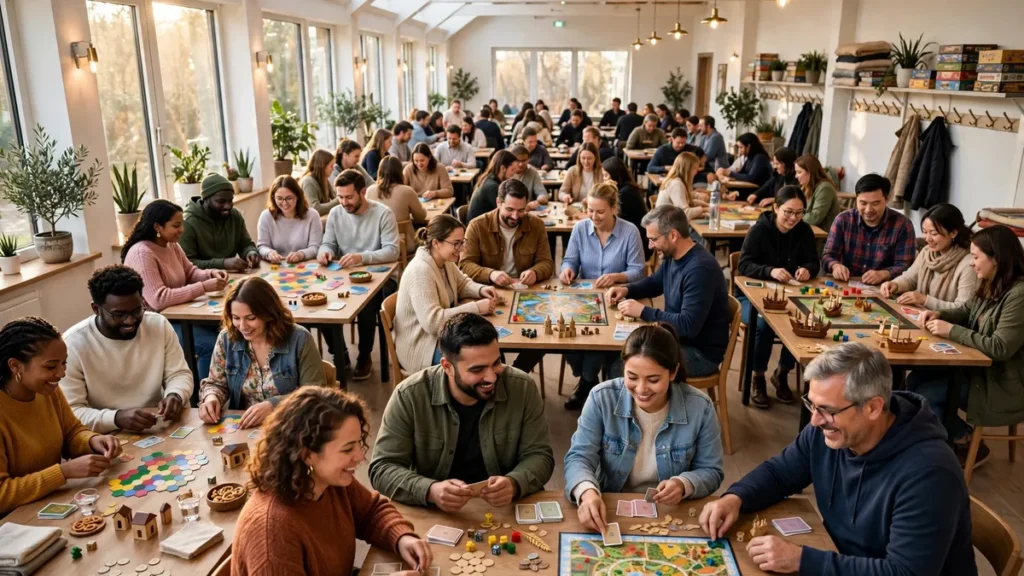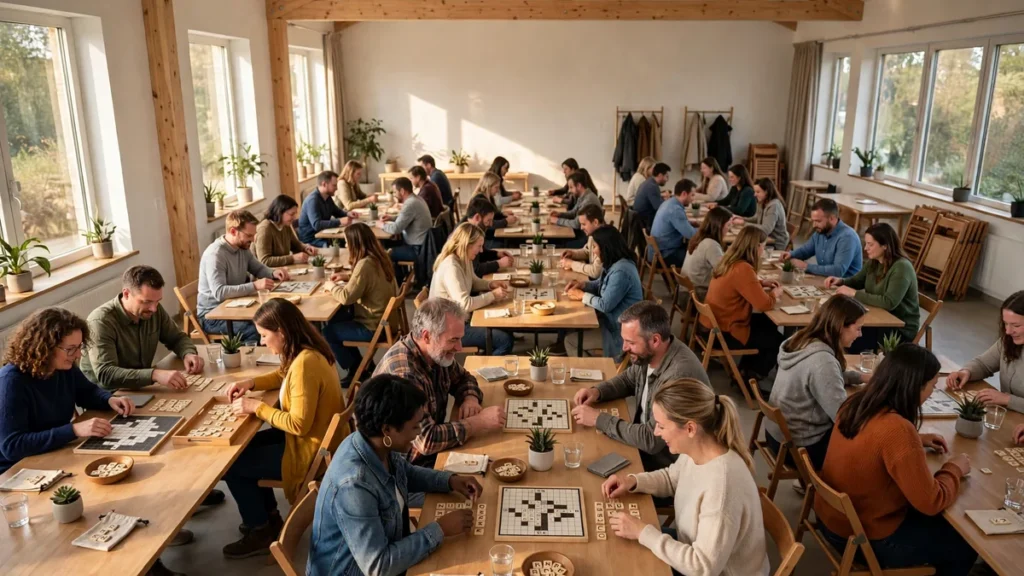
The best trivia games for 68 players are not the games you would pick for a quiet night with four friends. Sixty-eight people cannot crowd around one table, shout answers over each other, or take turns one at a time without the evening collapsing into chaos. A group this size needs a format first and a game second: teams, a host, a clear scoring system, and rounds short enough that nobody waits twenty minutes between turns. Get the format right and 68 players becomes an advantage, because a big room brings energy, rivalry, and a roar when a hard question finally lands.
Sixty-eight is an awkward number in the best possible way. It divides neatly into seventeen teams of four, or eleven teams of six with two players to spare, which means you can seat the whole group without a single odd table. Four-person teams are the sweet spot for trivia: small enough that everyone gets a say, large enough that each team usually holds at least one person who knows a little about sport, one who knows a little about music, and one who remembers the capital of Burkina Faso.
This guide covers the formats that scale to 68 players, a comparison table to help you choose quickly, detailed picks for different kinds of groups, a step-by-step plan for running the night, a checklist, and answers to the questions organisers ask most. Whether you are planning a corporate social, a school fundraiser, a wedding weekend activity, or a community hall night, you will find a setup here that fits your room, your budget, and your crowd.
Key takeaways
- No single trivia game seats 68 people, so build the night around teams of four to six and a host who runs the whole room.
- Seventeen teams of four is the cleanest split for 68 players, with every team the same size and nobody left out.
- Mix question types across rounds, because general knowledge alone rewards the same two or three teams every time.
- Keep rounds to ten questions and score in the open, so the leaderboard stays close and every team stays in the game.
- One host, one scorekeeper, and one clear set of rules matter more than the game you choose.

Why 68 Players Changes the Game
A trivia night for eight people is a conversation. A trivia night for 68 people is an event, and events need structure. The first thing that changes is the sound of the room. Sixty-eight voices talking at once is loud enough that a host reading questions without a microphone will lose half the room by round two. A simple PA speaker, a wireless microphone, or even a portable party speaker makes the difference between a night people remember fondly and a night people spend leaning in and asking their neighbours what the question was.
The second thing that changes is the pace. In a small game, a team answers in seconds and the host moves on. With seventeen teams, every step takes longer: handing out answer sheets, collecting them, marking them, and reading out the scores. A round of ten questions that takes fifteen minutes with eight players can take twenty-five minutes with 68, and a six-round night can easily stretch past three hours if you are not careful. That is why the best trivia games for 68 players are built around short rounds, simple scoring, and as little waiting as possible.
The third change is fairness. In a small group, one strong player can carry a team, and nobody minds much. In a room of 68, one team stacked with trivia veterans can run away with the night while the other sixteen teams stop trying. Mixing the question types, adding picture and music rounds, and including a few rounds where luck and teamwork matter as much as knowledge keeps the leaderboard honest. The goal is a night where every team still believes it can win going into the final round.
The Three Formats That Actually Work
Every successful large trivia night uses one of three formats. You can mix them across the evening, and most good hosts do, but you should pick one as the backbone of the night and build around it.
Team Table Play
Team table play is the classic pub quiz format, scaled up. Each team sits at its own table, the host reads the questions, teams write their answers on a sheet, and the sheets are swapped or collected for marking. This is the simplest format to run for 68 players, because it needs no special equipment beyond paper, pens, and a microphone. It also works in almost any room, from a village hall to a restaurant function room, and it keeps the noise manageable because teams talk quietly among themselves rather than shouting across the room.
The key to making team table play work at this size is the answer sheet. Give every team a fresh sheet each round, printed with the round name and ten numbered lines, and collect them at the end of the round before the next one starts. Marking takes time with seventeen sheets, so either swap sheets between neighbouring tables and let teams mark each other while the host reads the answers, or use a simple scoring system where the host announces the answers and teams mark their own sheets honestly. Swapping sheets is faster and more fun, because it builds a little rivalry between neighbouring tables. The same team-table logic powers the best board games for 60 players, where the room is split into tables that play in sync.
Whole-Room Buzzer Rounds
Buzzer rounds turn the whole room into one game. The host reads a question, teams buzz in, and the first team to buzz gets to answer. You do not need real buzzers: raised hands, coloured cards, or a free buzzer app on one phone per team all work. Buzzer rounds are loud, fast, and dramatic, which makes them perfect as a change of pace between quieter written rounds. They are also the format where a big room shines, because sixty-eight people gasping at the same question is a sound you never get with eight.
The risk with buzzer rounds is that the fastest teams dominate. Fix it by limiting each team to one buzz per question, by making the penalty for a wrong answer a lost point, and by keeping buzzer rounds short, no more than ten questions. You can also run buzzer rounds as a knockout: the first team to five correct answers wins the round, and the other teams play for second place. That way the round ends quickly and nobody sits through twenty minutes of watching the same two teams buzz in.
Best Trivia Games for 68 Players Compared
Use this table to pick the right game for your group. Setup time is for a room of 68 with one host and one helper.
| Game or format | Best for | Setup time | Why it scales to 68 |
|---|---|---|---|
| Classic pub quiz | Mixed-age groups, first-time hosts | 30 minutes | Written answers, no equipment, any room |
| Jeopardy-style board | Competitive groups, staged finals | 45 minutes | One board runs the whole room at once |
| Music round quiz | Parties, mixed knowledge levels | 20 minutes | Everyone recognises songs, no expertise needed |
| Picture round quiz | Quiet rounds, visual thinkers | 20 minutes | Printed sheets, teams work at their own pace |
| Buzzer quiz | High-energy moments, finals | 15 minutes | One question runs the whole room |
| App-based live quiz | Tech-friendly crowds, instant scoring | 40 minutes | Phones do the marking, scores update live |
| Trivia board games in sync | Game-night fans, longer evenings | 30 minutes | Several copies, every table plays together |
Our Top Picks in Detail
Each pick below works for 68 players with the team format described above. Choose two or three and combine them across the evening rather than running one game all night.
The Classic Pub Quiz
The classic pub quiz is still the best trivia game for 68 players, because it asks the least of the room and gives the most back. Six rounds of ten questions, each round on a different theme, with a picture round and a music round in the middle to break up the general knowledge. Themes that work well for a mixed crowd of 68 include food and drink, geography, sport, music through the decades, film and television, and science and nature. Avoid rounds that are too narrow, such as a whole round on one sport or one decade of music, because they hand the round to the two or three teams who happen to know that subject.
Write your questions with a spread of difficulty. In each round of ten, aim for three easy questions that most teams will get, four medium questions that split the room, and three hard questions that only one or two teams will answer. Announce the answers at the end of each round, not at the end of the night, because teams need to know where they stand to stay motivated.
Jeopardy-Style Board Rounds
A Jeopardy-style board works brilliantly as the final of a 68-player night. Project a grid of categories and point values onto a screen, let the leading team pick a square, and read the clue to the whole room. The team that picked the square answers first, and if it gets it wrong, the next team in the standings gets a chance. This format is fair, because the board is the same for everyone, and it is dramatic, because a team can gamble on a high-value square and jump three places in one answer.
You can build a board in a presentation app in under an hour: five categories, five values each, twenty-five clues. Use the categories your crowd knows best, and include one fun category, such as local knowledge, because those answers get the biggest cheer. Keep the final round short, no more than fifteen minutes, so the night ends on a high rather than dragging on.
Music Rounds
Music rounds are the great equaliser in a large trivia night. A team that knows nothing about history might still recognise ten songs from the 1980s, and a team of teenagers might know every chart hit of the last five years. Play ten short clips of ten to fifteen seconds each, and ask teams to name the artist and the song title, one point each. Mix the decades so every age group in the room has a fair share, and include at least one or two songs that almost everyone will know, because a round where every team scores zero is a dead round.
For 68 players, play the clips through the room speakers at a clear volume and print the answer lines on the sheet so teams can write as they listen. Do not replay clips more than once, or the round doubles in length. If your crowd is mostly adults, the best trivia games for adults include music and general knowledge rounds pitched at grown-up players, which pair well with a music round of your own.
Picture Rounds
Picture rounds give the room a breather. Print one sheet per team with ten images: famous landmarks, film stills, food dishes, flags, or celebrity faces from years ago. Teams work through the sheet at their own pace while the host sets up the next round, which makes picture rounds the perfect filler between two fast rounds. They are also the easiest round to mark, because the answers are short and unambiguous.
Buzzer Games
Buzzer games are best used sparingly, as a burst of energy rather than the main event. Ten questions, one per team at most, first to buzz answers. Use them as the opener to wake the room up, or as the tiebreaker when two teams finish level. A tiebreaker buzzer round is the fairest way to settle a draw, because it is fast, public, and impossible to argue with.
How to Run a Trivia Night for 68 Players
A good trivia night is mostly planning. The game itself is the easy part; the room, the teams, and the timing are what decide whether the night works.
Room Layout and Seating
Seat teams at round tables of four to six, with every table facing the host and the screen. Seventeen tables of four is ideal, but if your room has larger tables, eleven tables of six with two spare seats works too. Leave a clear aisle down the middle so the host and the scorekeeper can move between tables to collect sheets. Put the host on a small raised stage or at the front of the room with a microphone, and place the screen or projector where every table can see it without turning around.
Forming Teams
Let people form their own teams where possible, because friends play better together, but cap teams at six and balance the numbers so no team has eight players while another has three. If the group is a work team or a club where people do not all know each other, assign teams in advance and mix departments, ages, and friend groups. Mixed teams are fairer and more fun, because each team ends up with a spread of knowledge.
Scoring That Keeps Everyone Playing
Score in the open. After each round, read out the answers, collect the sheets, and update a visible leaderboard before the next round starts. Teams that can see they are three points behind the leaders will fight for the next round; teams that have no idea where they stand will drift. One point per correct answer is the simplest system, with a bonus point for a perfect round, and a double-points final round to keep the ending close.
Timing the Evening
Plan for two and a half hours, including a break. Six rounds of ten questions at fifteen minutes per round is ninety minutes, plus a fifteen-minute break in the middle and fifteen minutes at the start for seating and rules. That leaves thirty minutes for the final, the prizes, and the goodbye. If the night runs over, cut a round rather than rushing the last three rounds, because a calm finish beats a frantic one.
For a looser, louder evening, mix in party-style rounds between the written ones. The best party games for 66 players use the same large-group team structure, and borrowing one or two of their quick, physical rounds can wake a tired room up after the break.
Checklist for the Night
- Confirm the room, the seating for 68, and the microphone, speakers, and projector at least a day before the event.
- Print seventeen answer sheets per round, plus spares, and pack extra pens for every table.
- Prepare six rounds of ten questions with a spread of easy, medium, and hard, and a picture round and a music round among them.
- Set the teams at four to six players, write the team names on a visible scoreboard, and brief the host on the rules.
- Arrange a scorekeeper, a visible leaderboard, and small prizes for the winners and the best team name.
- Test the music clips, the screen, and any quiz app in the actual room, and keep a paper backup if the technology fails.
Frequently Asked Questions
How many teams should 68 players form?
Seventeen teams of four is the cleanest split, and four is the ideal trivia team size because everyone gets a say. Eleven teams of six also works if your tables are larger, but avoid teams of more than six, because quieter players stop contributing and the team becomes three people answering while the rest watch.
Can one host run a trivia night for 68 players alone?
One host can run the questions, but you should still have a helper for collecting and marking sheets. With seventeen teams, a single person doing everything will lose ten minutes per round to administration. A scorekeeper frees the host to keep the energy up and the night on schedule.
How long does a trivia night for 68 players take?
Plan for two and a half hours, including a break. Six rounds of ten questions take about ninety minutes, plus time for seating, the break, and the final. If you are short on time, cut to five rounds rather than rushing the questions.
What prizes work best for a large trivia night?
Keep prizes simple and shared: a small trophy or a box of chocolates for the winning team, and a fun prize for the best team name. Avoid expensive individual prizes, because the winning team has four to six people and the prize needs to split fairly. A team prize that can be shared, such as a hamper or a voucher, works best.
Do we need buzzers for 68 players?
No. Written answer sheets are the backbone of a large trivia night, and buzzers work best as a short burst of energy or a tiebreaker. If you do want buzzers, a free buzzer app with one phone per team is enough, and raised hands work just as well for a ten-question tiebreaker.
How do you stop teams from searching for answers on their phones?
State the rule clearly at the start: phones away during questions, and any team caught searching is disqualified from the round. Most groups will respect it, especially if the host makes it light-hearted rather than strict. Picture rounds and music rounds also help, because they are hard to search for in the time available.
The Bottom Line
The best trivia games for 68 players succeed because the format fits the room, not because the questions are the hardest or the game is the newest. Seventeen teams of four, six short rounds with a mix of question types, scoring in the open, and a host who keeps the pace moving will give 68 people a night they talk about afterwards. Pick the classic pub quiz as your backbone, add a music round and a buzzer final, and let the size of the room do the rest.