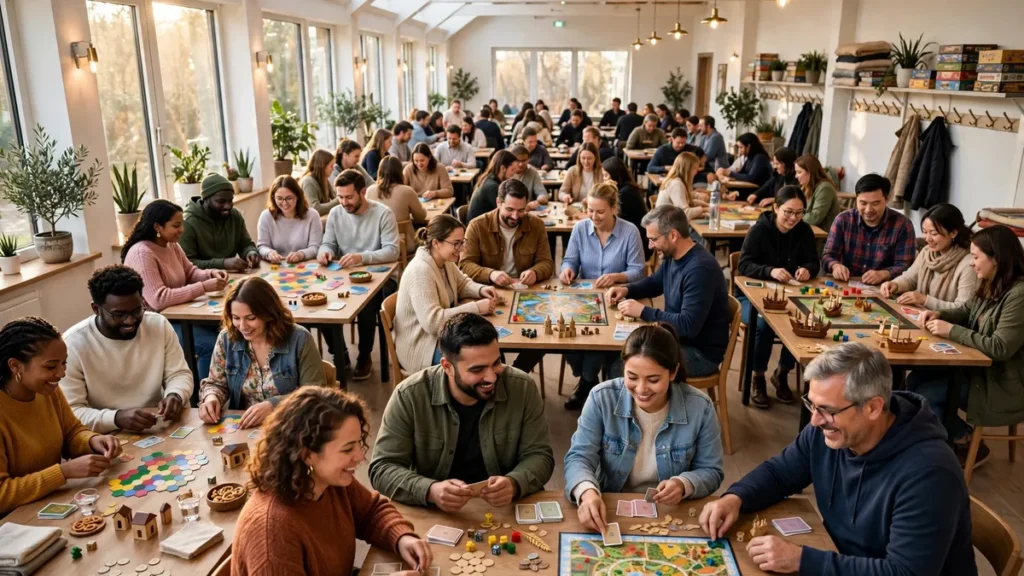
Finding the best dice games for 68 players sounds like a puzzle in itself, but it is simpler than it looks once you stop thinking of one table and start thinking of one room. Sixty-eight people cannot crowd around a single set of dice, yet they can all play the same game at the same time when the format is built for scale. Dice games are ideal for a group this size because the rules are short, the equipment is cheap, and nobody needs to wait long for a turn.
The best dice games for 68 players share three qualities: they use many dice at once so several tables can play in parallel, they keep every round short so energy stays high, and they work in teams so nobody sits out. A game that takes two minutes to explain and five minutes to play will hold a hall full of people far better than a complicated game that takes half an hour to learn. That is why the games in this guide were chosen for speed, simplicity, and the way they scale.
This guide covers the games that work best for 68 players, how to organise them across tables and teams, what equipment you need, and how to run a smooth session from the first roll to the final score.
Key takeaways
- Dice games suit 68 players because the rules are short, the equipment is cheap, and many tables can play the same game at once.
- Split 68 players into 17 teams of four and run the same game in parallel at every table for the fairest and fastest format.
- Bunco, Farkle, Ten Thousand, and Liar’s Dice are the strongest choices because they are quick, easy to learn, and work well in teams.
- Plan on at least one set of five or six dice per table, plus score sheets, pencils, and a visible timer for every round.
- Keep rounds to ten minutes or less, rotate tables between games, and use a simple points system so the whole room stays in the competition.

Why Dice Games Work So Well for 68 Players
Dice games have a natural advantage over most other party games when the group is very large. A board game usually needs one board, one set of pieces, and a small number of players around it. A dice game needs only a handful of dice, a flat surface, and a score sheet. That difference matters enormously when you have 68 people in one room, because you can run the same game at seventeen tables at the same time without buying seventeen expensive board games.
The second advantage is speed of learning. Most dice games can be explained in under two minutes. New players do not need to study a rulebook or remember a long list of exceptions. They roll, they score, and they pass the dice. A short explanation, one demonstration round, and the whole room is playing.
How to Organise Dice Games for 68 Players
Split the Room Into Teams of Four
Sixty-eight divides neatly into seventeen teams of four, which is the ideal size for dice games. Four people can share one set of dice comfortably, everyone gets regular turns, and nobody is left watching for long. Give each team a number or a fun name, and seat each team at its own table. If your tables seat six or eight, put two teams at a table and let them play side by side, keeping their scores separate.
Teams of four also make scoring simple. Each team records one score per round, so the organiser only has to collect seventeen score sheets instead of sixty-eight individual ones. At the end of the evening, add up the team totals and announce the winners. Team play also keeps the social energy high, because teammates cheer each other on and celebrate lucky rolls together.
Run the Same Game at Every Table
The simplest way to manage 68 players is to run the same game at every table at the same time. Announce the rules once to the whole room, demonstrate one round at the front, and then let every table start together. A visible timer on a screen or a whiteboard keeps all the tables in step, and a bell or a whistle signals the end of each round.
Playing the same game everywhere also makes the competition fair. Every team faces the same challenge under the same conditions, so the final scores mean something. It also makes your job easier, because you only need to answer questions about one game at a time. When the round ends, collect the scores, announce the leaders, and move on to the next game.
Use Stations for Variety
If you want more variety, set up stations instead of running one game everywhere. Place a different dice game at each of four or five stations, and rotate the teams through them. Each team spends ten minutes at a station, then moves to the next one when the timer sounds.
Keep Rounds Short and Scores Visible
Ten minutes is the sweet spot for a round with 68 players. It is long enough for every team to play properly and short enough that nobody loses focus. Use a timer that everyone can see, and give a one-minute warning before each round ends. When time is up, teams finish the roll in progress and stop.
Keep a simple leaderboard on a whiteboard or a large sheet of paper where everyone can see it. Update it after each round with the top five teams.
Best Dice Games for 68 Players
The games below are ranked by how well they suit a group of 68. Every one of them works in teams of four, needs only basic dice and score sheets, and can be learned in minutes. Start with the first four if you only have time for a short session, and add the rest for a full evening.
1. Bunco
Bunco is the classic large-group dice game, and it is the single best choice for 68 players. Each table of four plays with three dice, and the goal is to roll the number that matches the current round. Players score a point for each die showing the target number, and a Bunco, all three dice showing the target, scores twenty-one points. Rounds move quickly, and players rotate tables between rounds in the traditional format.
Bunco works so well for 68 players because it was designed for large social gatherings. The rules take about a minute to explain, the dice keep moving, and the table rotation means everyone meets new people during the evening. You will need three dice per table, a score sheet per player or per team, and a bell to signal round changes. A full game of six rounds takes about an hour, which makes it a perfect centrepiece for a game night.
2. Farkle
Farkle is a fast, push-your-luck dice game played with six dice, and it is one of the most exciting options for a large group. On each turn, a player rolls all six dice, sets aside scoring dice, and decides whether to roll the remaining dice again for more points or bank the points already earned. Rolling with no scoring dice is a Farkle, and the player loses all the points from that turn.
The push-your-luck decision is what makes Farkle so much fun for 68 players. Teammates shout advice, groan when a Farkle wipes out a big score, and cheer when a risky roll pays off. The game creates noise and laughter, which is exactly what you want in a big room. Each table needs six dice and a score sheet, and a round of Farkle takes about ten minutes when teams play with a time limit.
3. Ten Thousand
Ten Thousand, also known as 10,000, is closely related to Farkle but uses a simpler scoring system that suits very large groups. Players roll six dice and score for ones, fives, three of a kind, straights, and other combinations. The first team to reach 10,000 points wins, or the team with the most points when the timer ends takes the round.
Ten Thousand is a strong choice for 68 players because the scoring is easy to print on a single reference card. Tape a scoring card to each table, and players can check it without asking the organiser. The game also scales well, because more dice mean more scoring combinations, and the race to 10,000 keeps every team in the running until the final minutes.
4. Liar’s Dice
Liar’s Dice is a bluffing game that brings a completely different energy to a dice night. Each player gets five dice and a cup, rolls in secret, and then bids on how many dice of a certain value are showing across the whole table. The next player must either raise the bid or challenge it, and the dice are revealed to settle the claim. Losing a challenge costs a die, and the last player with dice remaining wins.
For 68 players, Liar’s Dice works best as a team game. Each team of four shares one set of five dice per player, and the team makes its bids together. The bluffing and discussion make it one of the most social games on this list, and it is a good change of pace after the pure scoring games. You will need five dice and a cup per player, which is more equipment than the other games, so plan your dice supply in advance.
5. Left Center Right
Left Center Right, often shortened to LCR, is the simplest game on this list and the easiest to run for 68 players. Each player starts with three chips, and on their turn they roll three special dice marked L, C, R, and dots. An L means pass a chip left, R means pass a chip right, C means put a chip in the centre pot, and a dot means keep your chips. The last player with chips remaining wins the pot.
LCR needs almost no explanation, which makes it perfect as a warm-up game while late arrivals settle in. It is pure luck, so nobody has an advantage, and the chips moving around the table keep everyone watching every roll. For 68 players, play LCR in teams of four, with each team pooling its chips and deciding together who rolls. The winning team takes the round, and you can play several quick rounds in twenty minutes.
6. Dice Bingo
Dice Bingo combines the luck of dice with the familiar structure of bingo, and it is a great fit for a group of 68. Give every player a bingo card with numbers on it, then roll two dice at the front of the room and call out the total. Players mark the matching number on their card, and the first team to complete a line, or a full card, wins the round.
Dice Bingo is one of the few games on this list where all 68 players can genuinely play together as one group, not just in parallel at separate tables. One pair of dice at the front drives the whole room, and everyone shares the same excitement as the numbers are called. That shared experience makes it a strong choice for the opening or closing game of an evening.
7. Yahtzee in Teams
Yahtzee is one of the best-known dice games in the world, and it adapts neatly to team play for 68 players. Each team rolls five dice up to three times per turn, trying to match the combinations on a Yahtzee score card: three of a kind, four of a kind, full house, small straight, large straight, Yahtzee, and chance. Each combination can be scored once, so teams must choose wisely.
Team Yahtzee works well because the score card gives the game structure. Every team follows the same card, so comparing scores at the end is straightforward, and the decisions about which combination to aim for give the game real depth. The familiar rules also mean many of your 68 players will already know how to play, which saves explanation time.
8. Sevens
Sevens is a quick elimination dice game that suits the end of an evening. Each player starts with a set number of lives, often ten, and on their turn rolls two dice. Rolling a seven costs a life, and the last player with lives remaining wins. The rules could not be simpler, and the tension rises as players lose lives and the room counts down.
For 68 players, play Sevens in teams of four, with each team sharing a pool of lives. The team rolls in turn, and every seven costs the team a life. The shared pool keeps everyone invested in every roll, and the simple rules mean you can start playing within seconds of explaining them. Sevens needs only two dice per table, so it is also the cheapest game on this list to set up.
Comparison Table: Best Dice Games for 68 Players
| Game | Dice per Table | Players per Team | Round Length | Difficulty | Best For |
|---|---|---|---|---|---|
| Bunco | 3 | 4 | 10 minutes | Easy | Main event, social mixing |
| Farkle | 6 | 4 | 10 minutes | Easy | Excitement, risk taking |
| Ten Thousand | 6 | 4 | 10 minutes | Easy | Scoring race, mixed ages |
| Liar’s Dice | 20 | 4 | 15 minutes | Medium | Bluffing, social play |
| Left Center Right | 3 | 4 | 5 minutes | Very easy | Warm-up, closing game |
| Dice Bingo | 2 | 68 together | 10 minutes | Very easy | Whole-room play |
| Yahtzee in Teams | 5 | 4 | 15 minutes | Medium | Strategy, familiar rules |
| Sevens | 2 | 4 | 5 minutes | Very easy | Filler, tiebreaker |
What You Need: Equipment Checklist for 68 Players
Good preparation makes the evening run smoothly, and dice games need very little equipment. Gather everything in advance, count it, and pack a few spares. The list below covers a full evening for 68 players across seventeen tables.
For dice, plan on at least six dice per table as a baseline, which means just over one hundred dice in total. Bunco needs three, Farkle and Ten Thousand need six, and Liar’s Dice needs twenty per table, so buy a bulk bag of dice rather than individual sets. Bulk dice are inexpensive, and having spares means a lost die never stops a game. Dice cups are useful for Liar’s Dice and for keeping rolls contained, so add one cup per player if you are playing that game.
Checklist: Running Dice Games for 68 Players
- Split 68 players into 17 teams of four and seat each team at its own table with a team name or number.
- Count out the dice for every table before the event starts, and pack at least 20 spare dice for losses.
- Print a score sheet for each team for each game, plus a rules card for every table.
- Set a visible timer for every round, with a one-minute warning before time runs out.
- Keep a leaderboard where everyone can see it, and update the top five teams after each round.
- Plan a warm-up game, two or three main games, and a quick closing game, with short breaks between rounds.
More Games for Large Groups
For a similar feel with a different twist, look at the best dice games for 67 players, which use the same team-of-four format and many of the same games in a slightly smaller group. The best dice games for 67 players guide is a useful companion when your numbers change from one event to the next. The best dice games for 66 players guide covers the same ground for a slightly smaller group, and the best board games for 67 players guide shows how to extend the team format beyond dice to full board games.
Frequently Asked Questions
What is the best dice game for 68 players?
Bunco is the best dice game for 68 players, because it was designed for large social gatherings, the rules take about a minute to explain, and the table rotation keeps everyone meeting new people.
How many dice do you need for 68 players?
You need at least six dice per table for most games, which means just over one hundred dice for seventeen tables of four. Liar’s Dice needs twenty dice per table, so plan for more if that game is on your list.
How do you split 68 players into teams for dice games?
Split 68 players into seventeen teams of four, which is the ideal size for dice games. Four people share one set of dice, and the organiser collects only seventeen team score sheets per round.
How long does a dice game night for 68 players take?
A full dice game night for 68 players takes about two hours, including a warm-up game, two or three main games, and a quick closing game. Each round lasts five to fifteen minutes, with short breaks between rounds.
Can children play dice games with 68 players?
Yes, most dice games on this list suit children aged eight and over, especially Bunco, Left Center Right, Dice Bingo, and Sevens, which need only rolling and counting.
What is the easiest dice game to run for a very large group?
Left Center Right is the easiest dice game to run for a very large group, because the rules take less than a minute to explain, it needs only three dice and a few chips per table, and it is pure luck so nobody has an advantage.
The Bottom Line
The best dice games for 68 players are Bunco, Farkle, Ten Thousand, and Liar’s Dice, supported by quick games like Left Center Right, Dice Bingo, Yahtzee in teams, and Sevens. Split the room into seventeen teams of four, run the same game at every table with a visible timer, and keep rounds to ten minutes or less. With enough dice, printed score sheets, and a simple leaderboard, 68 players can all play, compete, and enjoy the same evening together.