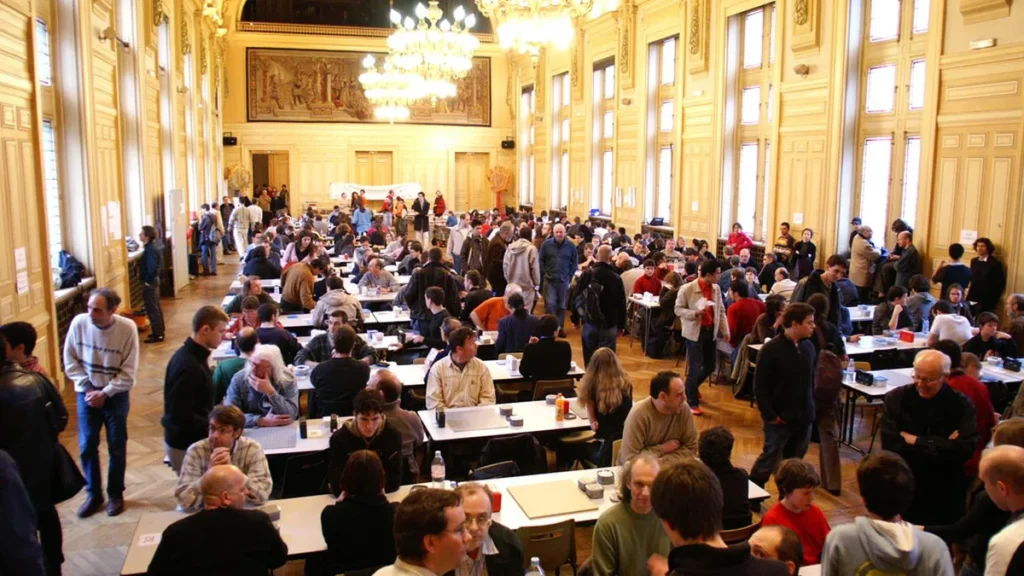
Four hundred and seventy-five players in one hall sounds impossible for a word game night, until you see it done well. The secret is not to shrink the games down to fit the crowd, but to choose games that grow with it. The nine games in this guide all work the same way: one host, one set of rules, and every team playing at the same time, so nobody waits around and nobody is left out of the fun.
A huge group changes the feel of a word game in the best ways. The room gets louder, the debates get friendlier, and the quiet player at the back of a team often turns out to be the one who knows the answer. If you have run word games for 473 players before, you will recognise the rhythm here, but these nine games are all new, with fresh mechanics that keep even regular players guessing.
This guide gives you everything you need to run the night: a quick comparison table, a full guide to each game, a plan for organising 475 players, a checklist to tick off before the doors open, and answers to the questions every host asks. Read it once, pick your nine games, and you will be ready to fill a hall with people who came to play with words.
Key Takeaways
- Split 475 players into teams of five, giving you 95 teams that can all play at once.
- Choose games where every team answers at the same time, so nobody waits for a turn.
- Keep each round short, between three and ten minutes, to hold the energy of a big hall.
- Use a big screen or a loud speaker so every team can see and hear the host clearly.
- Score simply, celebrate loudly, and let every team feel part of the night.
The 9 Games at a Glance
Use this table to pick the right mix for your group. A good night blends quiet thinking games with loud talking games, and quick rounds with slower ones, so every kind of player gets a moment to shine.
| Game | How It Plays | Best For |
|---|---|---|
| One-Word Clue Call | One clue links several words | Clever talkers |
| Colour Clue Word Guess | Coloured hints narrow the word | Visual thinkers |
| Tile Score Tally | Build the highest-scoring word | Patient planners |
| Part-of-Speech Sort | Sort words into grammar piles | Detail lovers |
| Forbidden Word Face-Off | Describe a word without banned words | Confident speakers |
| Regional Word Round | Match words from different places | Mixed-age teams |
| Jargon Buster | Decode job slang and jargon | Curious minds |
| Song Lyric Fill | Fill the missing word in a song | Music lovers |
| Two-Letter List-Off | List words starting with two letters | Fast teams |
The 9 Word Games
Each game below comes with its own rules, timing and tips for a hall of 475 players. Run them in the order given, or shuffle them to suit your crowd, and keep the scoring simple so the host can stay in control of the night.
1. One-Word Clue Call
Each team picks a clue giver, and the clue giver studies a board of twenty words. Their job is to say a single word that links as many of their team’s words as possible, without naming any of them directly. If the clue is OCEAN, the team might pick WAVE, SHIP and SALT, while hoping nobody reaches for DESERT by mistake.
The beauty of this game for 475 players is that every team plays the same board at the same time. One host reads the clue words aloud, all the teams discuss in their corners, and the answers come in together. A good clue feels clever in hindsight, a bad clue sends three teams in three different directions, and the room erupts either way. Keep the boards fresh, change the clue giver every round, and watch quiet players become the heroes of the night.
2. Colour Clue Word Guess
The host picks a secret five-letter word and every team writes down a guess. After each guess the host marks every letter with a colour: green means the letter is right and in the right place, amber means the letter is in the word but in the wrong place, and grey means it is not in the word at all. Teams use the colours to narrow the word down, guess by guess.
With 475 players, run this one on a big screen so the whole hall can see the coloured grid grow. Give each team six guesses and a strict thirty seconds per guess, and the tension builds beautifully as the grid fills up. Strong teams will talk through letter patterns, while beginners can still join in by shouting out a word they love. It is quick, visual and fair, and nobody needs any equipment beyond a pen and a score sheet.
3. Tile Score Tally
Hand every team a tray of letter tiles, each marked with a points value, just like the tiles in a classic board game. Teams have three minutes to build the highest-scoring word they can from their tray, and rare letters such as Z and Q are worth far more than common letters such as E and A. The longest word is not always the winner, which is exactly what makes it interesting.
This game rewards cunning over vocabulary size, and that keeps it open to everyone. A team with a small word built from high-value letters can beat a team with a long, ordinary word, so every table stays in the hunt until the scores are read out. Run three short rounds with fresh trays, add the scores together, and hand a small prize to the team with the best total. It is calm, clever and wonderfully competitive.
4. Part-of-Speech Sort
The host calls out a mixed list of words and every team must sort them into three piles: nouns, verbs and adjectives. Sounds simple, until the list includes words such as LIGHT, which can be all three, or FAST, which changes its job depending on the sentence. Teams score a point for every word in the right pile, and the tricky words are worth double.
This is the game that gets the whole room arguing in the best possible way. A table of teachers will sort quickly and confidently, while a table of friends will debate every single word and laugh at their own mistakes. Give teams one minute per list, read the answers out slowly, and let the room groan together when a word turns out to be something nobody expected. It is a grammar game that never feels like a lesson.
5. Forbidden Word Face-Off
One player from each team stands up with a secret word to describe, and a list of forbidden words they must not say. To describe PYRAMID they might say it is a stone shape in Egypt, but they may not say TRIANGLE, DESERT or TOMB. If a forbidden word slips out, the team loses the point and the other teams cheer.
This is the loudest game of the night, and it works because the pressure is on one person while the whole team shouts encouragement. With 475 players, run it as a relay: each team sends a new describer every minute, so nobody is stuck in the spotlight for long. Choose words everyone knows, keep the forbidden lists short, and let the host keep score on a big board where every team can follow the race.

6. Regional Word Round
English changes from place to place, and this game celebrates that. The host reads out a word used in one part of the world, such as a lift in Britain or a trunk in America, and teams must match it to its meaning or its twin in another region. A lorry is a truck, a jumper is a sweater, and a biscuit is a cookie, but only if your team knows which side of the ocean you are on.
This round is a gift for mixed groups, because everyone in the room knows some of the answers and nobody knows all of them. Older players remember words younger players have never heard, and players from different places become instant experts at their own tables. Keep the questions friendly, mix everyday words with funny ones, and read out the answers with a short story about where each word comes from.
7. Jargon Buster
Every job has its own secret language, and this game asks teams to crack it. The host reads out a piece of workplace jargon, such as a chef calling out an order, a pilot talking about a holding pattern, or a sailor shouting about the bow, and teams must write down what it really means. The jargon comes from kitchens, hospitals, building sites, offices and sports fields.
What makes this game sing for a huge group is that every table has a different expert. The nurse knows the hospital words, the builder knows the site words, and the office worker knows the meeting words, so the knowledge spreads around the room as teams compare answers. Use ten questions, give a bonus point for the funniest wrong answer, and keep the explanations short so the game moves at a lively pace.
8. Song Lyric Fill
The host plays the first line of a famous song, then stops the music just before a key word, and every team must write down the missing word. The songs should be ones the whole room knows, from old classics to recent chart hits, and the missing words should be the ones everyone sings along to without thinking. Play the line twice, then let the teams commit to an answer.
This game works because music unlocks memory in a way that plain questions never do. A team that struggles with spelling will suddenly remember every word of a song they last heard ten years ago, and the room fills with humming as people try to hear the next line in their heads. Keep the rounds short, mix the decades so every age group gets a turn to shine, and finish with a song the whole hall can sing together.
9. Two-Letter List-Off
The host calls out two letters, such as ST or BR, and every team has ninety seconds to list as many real words as they can that begin with those letters. One point for every correct word, and a bonus point for the longest word on the list. Short words count, long words count more, and made-up words count for nothing at all.
This is the perfect closing game because it is pure speed and teamwork. One player calls out words, another writes them down, and a third checks them against the dictionary while the clock ticks. With 475 players the hall goes quiet for ninety seconds, then explodes as the lists are compared. Run three rounds with different letter pairs, add up the totals, and crown the night’s word champions.
How to Run the Night for 475 Players
Start by splitting the hall into 95 teams of five. Five is the magic number: small enough that everyone gets a say, and large enough that every team has a mix of strengths. Put a number on each table, hand every team a score sheet and a pen, and give each team a name, because teams with names try harder than teams with numbers. A host with a microphone and a big screen can reach the whole hall at once, and a second helper walking the floor can answer questions and keep the slower tables moving.
Timing matters more than anything else when the group is this large. A round that drags will lose the back of the hall, while a round that is too short will frustrate the careful teams. Three minutes is right for a quick listing game, five minutes suits a guessing game, and ten minutes is the most any single round should take. Between rounds, read the scores out loud, praise the team at the top, and praise a different team for the funniest answer, because a hall that laughs together stays together. If you want more ideas for huge groups, the word games for 471 players guide uses the same team structure with a different set of games.
Scoring should be simple enough to do on one sheet of paper. One point per correct answer, a bonus point for the best answer of the round, and a running total that the host reads out every three games. Avoid complicated penalties, because disputes in a hall of 475 players can eat the whole evening. If two teams disagree over a word, the host decides quickly, the decision stands, and the game moves on. The best nights are the ones where the host is firm, friendly and fast.
Your Game-Night Checklist
- Book a hall with space for 95 tables of five, plus room for the host and a screen.
- Print 95 score sheets, one per team, with space for nine rounds of scores.
- Prepare pens, letter tiles, word cards and answer sheets before the doors open.
- Test the microphone, speakers and screen, and keep a spare microphone handy.
- Brief two helpers to walk the floor, answer questions and collect score sheets.
- Buy small prizes for the winning team and for the funniest answer of the night.
Frequently Asked Questions
How do you split 475 players into teams?
Divide the hall into 95 teams of five players each. Five is small enough for everyone to speak and large enough to hold a mix of skills. If a few players arrive late, add them to the smallest teams rather than starting a new one.
How long does the whole evening take?
Plan for about two hours. That gives you ten minutes to welcome everyone and explain the rules, around ninety minutes for the nine games, and twenty minutes for the final scores, prizes and a closing song. Keep the breaks short so the energy stays high.
What equipment do we need?
You need pens, printed score sheets, letter tiles for the scoring game, and word cards for the sorting and clue games. A microphone, speakers and a large screen are essential, because the host must reach every table in a hall of 475 players.
Can children play alongside adults?
Yes, and they often do very well. Children shine in the fast listing games and the song game, while adults lead on the jargon and regional words. Mix ages within teams where you can, so every table has a spread of knowledge.
How do you stop one strong team from winning every round?
Use a mix of game types so different skills matter in different rounds. A team that wins the clue game may lose the lyric game, and the bonus point for the funniest answer gives every team a way to score. Read the running totals often, so the middle teams stay motivated.
What happens if a team disputes a score?
The host decides, and the decision is final. Listen for a few seconds, check the answer sheet if you need to, then move on to the next round. A quick, friendly ruling keeps the night moving and stops one dispute from spoiling the evening for 475 people.
The Bottom Line
Word games for 475 players work when every team plays at once, every round is short, and every player has a job to do. The nine games in this guide give you that mix: clever clues, coloured hints, tile scores, grammar sorts, forbidden words, regional words, jargon, songs and speedy lists. Run them with a firm host, a loud speaker and a simple score sheet, and a hall of 475 strangers will leave as 95 teams who want to play again. For another night of big-group word play, take a look at the word games for 469 players guide, and keep the words coming.
The best word game night is not the one with the cleverest questions, but the one where the most people join in. Keep the rules simple, keep the rounds moving, and keep the prizes small and the laughter large, and your 475 players will remember the night long after the scores are forgotten.