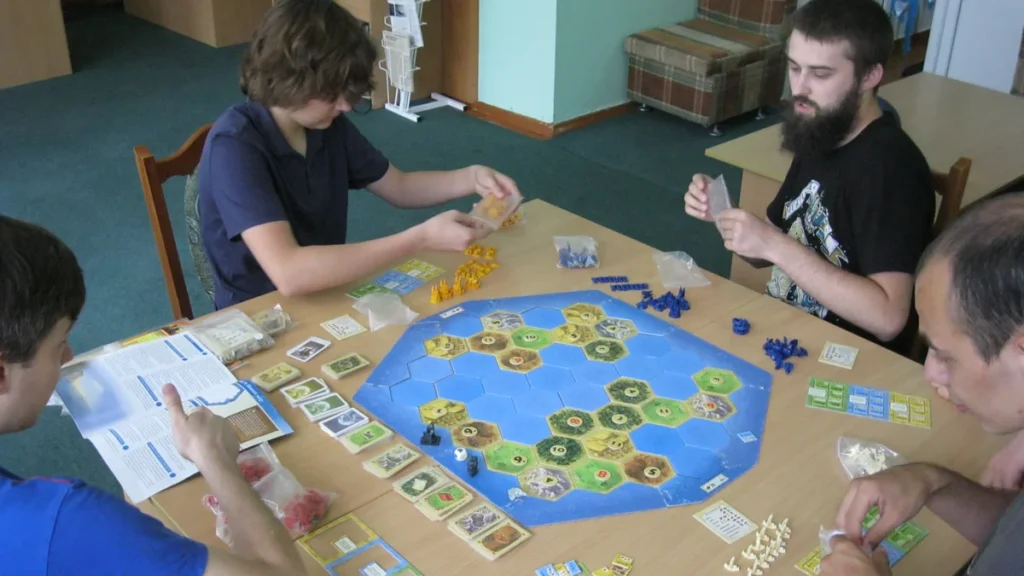
Four hundred and thirty-three players is a hall full of people, not a room full of friends. It is too many for one quizmaster, one microphone and one stack of paper answer sheets, and too many for a single long table where everyone shouts at once. It is, however, exactly the right size for a proper event: big enough to feel like an occasion, small enough that every team can still hear the questions and see the scoreboard. The trick is to stop thinking of it as one giant game and start thinking of it as sixty-odd small games happening at the same time, all pointed at the same stage.
This guide builds a complete trivia night for 433 players around nine rounds, each one themed on a famous kind of person. The rounds move from astronauts and Olympians to Nobel laureates and chess champions, then on through ballet dancers, photographers, explorers, inventors and poets. Every round mixes written questions, which reward a team that thinks together, with buzzer questions, which reward the team that thinks fastest. Nothing here needs specialist equipment beyond a sound system, a projector, answer sheets and a way of keeping score that everyone in the room can see.
Whether you are organising a school fundraiser, a company social, a community festival or a charity night, the plan below works as written. Follow the running order, use the checklist on the night, and keep the pace brisk. A crowd of 433 will forgive a hard question, but it will not forgive a slow evening. The nine rounds below are all new, with none repeating a theme from the recent nights for 431, 430, 429, 428, 427 or 426 players.
Key Takeaways
- Split 433 players into sixty-one teams of seven and one team of six, so every team is nearly the same size.
- Run nine rounds of ten questions each, mixing written rounds with buzzer rounds to keep the energy up.
- Use a hall with a stage, a projector and speakers in the middle of the room so the back tables hear every question.
- Score visibly after every round, and settle ties with a single sudden-death question.
- Keep the whole evening under three hours, with one break in the middle and prizes for the top three teams.

How a 433-Player Trivia Night Works
Four hundred and thirty-three divides neatly enough to run a fair night. Sixty-one teams of seven gives you 427 players, and one team of six takes you to exactly 433. That single smaller team is no real disadvantage, because six people around one table still get one answer sheet, and a smaller team often decides faster than a larger one. Every team sits together, every team has a captain, and every team answers on one sheet per round.
Each round has ten questions. Five are written questions, read aloud twice and answered on paper. Five are buzzer questions, asked one at a time, with the first team to buzz in getting the chance to answer. Written questions keep the room quiet and thinking, while buzzer questions keep it loud and laughing. A full round takes about twelve minutes, so nine rounds plus a break fit into a two-and-a-half-hour evening.
The host reads every question twice, slowly, and the projector shows the question text at the same time. This matters more than anything else at this scale. If the back rows cannot hear or see the question, they stop playing, and a hall that stops playing does not start again. Test the sound system with someone standing at the very back before the first team arrives. The team split here follows the same idea as the 431-player trivia format, with teams of seven and a scoreboard the whole hall can read.
Teams and Tables for 433 Players
Teams of seven are the sweet spot for a crowd this size. Seven people can sit around one table without shouting, and seven heads hold enough different knowledge to cover nine very different rounds, from astronauts to poets. A team of four would be too small for a night that ranges so widely, and a team of ten would be too large for anyone at the far end of the table to be heard. Seven gives every player a say and every round a fair chance.
Let teams choose their own names and write them large on their answer sheets. A good team name turns sixty-two groups of strangers into sixty-two small clubs that care about the result. Announce the best team name before the final round and give it a small prize, so even teams far from the top have something to play for. Seat teams in rows facing the stage rather than in a circle, so nobody has their back to the questions. Leave a clear aisle down the middle of the hall so score runners can collect sheets without climbing over chairs.
Put the team of six near the front, where the quizmaster can see them easily, and give them the same answer sheets as everyone else. If a team drops out on the night, do not rebuild the whole seating plan. Move one player from a team of seven to fill the gap, or let the table play short, exactly as the 429-player trivia format does when a team loses a player. The night survives a missing player far better than it survives a reshuffle.
The Room and the Sound
The hall matters more than the questions. You need a stage at one end, tables for sixty-two teams, and a second screen halfway down the room so the back tables can read the questions as well as hear them. Put speakers in the middle of the room, not just at the front, because the people at the back are the ones who stop playing first when they cannot hear. Test the sound from the farthest table before the audience arrives, and add side speakers if the back rows have to strain.
Lighting matters too, and it is the detail most organisers forget. Teams need enough light at their tables to read and write, while the stage stays bright enough for the quizmaster to be seen. Keep the house lights low but never off, and keep the scoreboard lit so the totals are readable from every seat. A dark hall looks dramatic for five minutes and then turns into a room full of people who cannot read their own answer sheets.
Keep the stage simple. One quizmaster, one microphone, one screen behind them, and a small table for the spare answer sheets and the tie-break questions. Anything else on the stage is something for the quizmaster to trip over. Hand the score runners a clear route from the tables to the marking table, and keep that route free all evening.
Scoring That Stays Fair
Score visibly after every round, and score the same way in every round. One point per correct answer, ten points per round, ninety points in total. No bonus points for funny answers, no double points in the final round, and no secret multipliers that only the quizmaster understands. When everyone can see the table and do the maths themselves, nobody argues with it. The visible scoreboard that works for the 430-player trivia night works here for the same reason.
Collect the written answer sheets at the end of each round and mark them while the next round is being played. Two scorers working together can mark sixty-two sheets in under ten minutes if the answers are short and the marking key is clear. Read out the top five scores after every round, and put the full table on the screen so every team can find its own place. A team in fortieth place that can see it is only six points behind tenth place will fight for every question in the second half.

For buzzer rounds, give the first team to buzz five seconds to answer, and if they get it wrong, open the question to the other teams. Award a bonus point for a perfect round, which gives a struggling team something to chase even when the leaders are far ahead. Settle a tie at the top with a single sudden-death question, and settle a tie further down the table by counting back to the most recent round, so the team that finished stronger takes the higher place.
The Nine Rounds at a Glance
| Round | Theme | Format | Sample Question |
|---|---|---|---|
| 1 | Famous Astronauts | Written | Who was the first person to walk on the Moon? |
| 2 | Famous Olympians | Buzzer | Which swimmer has won the most Olympic gold medals? |
| 3 | Famous Nobel Laureates | Written | Which physicist won the Nobel Prize twice? |
| 4 | Famous Chess Champions | Buzzer | Who was the youngest world chess champion? |
| 5 | Famous Ballet Dancers | Written | Which Russian dancer defected to the West in 1961? |
| 6 | Famous Photographers | Buzzer | Who photographed the Migrant Mother portrait? |
| 7 | Famous Explorers | Written | Who led the first expedition to reach the South Pole? |
| 8 | Famous Inventors | Buzzer | Who patented the first practical telephone? |
| 9 | Famous Poets | Written | Who wrote The Raven? |
The Nine Rounds
Round 1: Famous Astronauts
Astronauts make a strong opening round because everyone knows at least a few of them. Neil Armstrong, Buzz Aldrin and Yuri Gagarin turn up in school lessons, in films and in pub quizzes, so even a team with no space buff can score a point or two. Start here and the room warms up fast, which is exactly what an opening round should do.
- Who was the first person to walk on the Moon? Answer: Neil Armstrong.
- Who was the first human in space? Answer: Yuri Gagarin.
- Which Apollo mission first landed people on the Moon? Answer: Apollo 11.
Round 2: Famous Olympians
Olympians make a lively second round because the answers span every sport and every generation. Jesse Owens, Nadia Comaneci and Michael Phelps are known far beyond the sports pages, and that spread means different players on the same team will know different answers, which is the whole point of a team game.
- Which swimmer has won the most Olympic gold medals? Answer: Michael Phelps.
- Which sprinter won four gold medals at the 1936 Berlin Olympics? Answer: Jesse Owens.
- Which gymnast scored the first perfect ten at the Olympics? Answer: Nadia Comaneci.
Round 3: Famous Nobel Laureates
Nobel laureates give the night its cleverest round. Marie Curie, Albert Einstein and Malala Yousafzai are household names, and the prizes themselves give the host a ready-made way to sort the questions, from physics and chemistry to peace and literature. Teams that know nothing about science can still score on the peace and literature questions.
- Which physicist won the Nobel Prize twice, in physics and in chemistry? Answer: Marie Curie.
- Which scientist won the Nobel Prize for the theory of relativity? Answer: Albert Einstein.
- Who is the youngest person to win the Nobel Peace Prize? Answer: Malala Yousafzai.
Round 4: Famous Chess Champions
Chess champions are a sharper round, and that is why it sits in the middle of the night. Bobby Fischer, Garry Kasparov and Magnus Carlsen are famous well beyond chess, but the round also rewards the one player at each table who actually plays the game. That mix keeps the round fair without making it easy.
- Who was the youngest world chess champion? Answer: Garry Kasparov, at twenty-two.
- Which American beat Boris Spassky in the 1972 world championship? Answer: Bobby Fischer.
- Which Norwegian has held the world title since 2013? Answer: Magnus Carlsen.
Round 5: Famous Ballet Dancers
Ballet dancers bring grace to the second half of the night, and the round works because the names are dramatic. Rudolf Nureyev, Margot Fonteyn and Anna Pavlova turn up in films, in books and in the news, so teams can reach an answer through culture even if they have never seen a ballet. It is a gentle round, and the room needs one by now.
- Which Russian dancer defected to the West in 1961? Answer: Rudolf Nureyev.
- Which English ballerina was Nureyev’s most famous partner? Answer: Margot Fonteyn.
- Which dancer is famous for The Dying Swan? Answer: Anna Pavlova.
Round 6: Famous Photographers
Photographers make a visual round, which changes the pace nicely. Ansel Adams, Dorothea Lange and Henri Cartier-Bresson are names many players half know, and the famous photographs themselves give the host something to show on the screen. A picture on the projector wakes up a room that has been listening for an hour.
- Who photographed the Migrant Mother portrait? Answer: Dorothea Lange.
- Which photographer is famous for his black and white landscapes of Yosemite? Answer: Ansel Adams.
- Which French photographer co-founded the Magnum agency? Answer: Henri Cartier-Bresson.
Round 7: Famous Explorers
Explorers take the night back to school history, which every team can play. Christopher Columbus, Captain Cook and Ernest Shackleton are names from the classroom, and their voyages give the host a map full of questions. A team that knows nothing about ballet can still win this round on geography alone.
- Who led the first expedition to reach the South Pole? Answer: Roald Amundsen.
- Which explorer’s ship Endurance was crushed in the Antarctic ice? Answer: Ernest Shackleton.
- Which captain charted the east coast of Australia in 1770? Answer: Captain James Cook.
Round 8: Famous Inventors
Inventors are the crowd-pleaser of the second half. Thomas Edison, Alexander Graham Bell and the Wright brothers are names everyone learned young, and the inventions themselves are things every player uses or has seen. That familiarity makes the round fast and noisy, which is exactly what a buzzer round should be.
- Who patented the first practical telephone? Answer: Alexander Graham Bell.
- Which brothers made the first powered flight in 1903? Answer: The Wright brothers.
- Who is credited with inventing the practical light bulb? Answer: Thomas Edison.
Round 9: Famous Poets
Poets make a fitting final round because the answers are short, famous and satisfying to get right. William Shakespeare, Edgar Allan Poe and Maya Angelou are names that close a night on a high note, and a team that has struggled all evening can still finish with a perfect round. End on a round everyone can play, and the room leaves happy.
- Who wrote The Raven? Answer: Edgar Allan Poe.
- Who wrote the Sonnets and the plays Hamlet and Macbeth? Answer: William Shakespeare.
- Who wrote the poem Still I Rise? Answer: Maya Angelou.
Night-Ready Checklist
- Book a hall with a stage, sixty-two tables and a second screen halfway down the room.
- Test the sound and the projector from the farthest table before the first team arrives.
- Print sixty-two answer sheets per round, plus spares, and a clear marking key.
- Brief two scorers, two score runners and one timekeeper before doors open.
- Prepare ninety questions, a tie-break question and prizes for the top three teams.
- Announce the best team name before the final round, then read the final scores aloud.
Frequently Asked Questions
How many teams play in a 433-player trivia night?
Sixty-two teams play: sixty-one teams of seven and one team of six. That split keeps every team nearly the same size, so no table has a real advantage, and it uses exactly 433 players with nobody left over.
How long does the night last?
About two and a half hours. Nine rounds of ten questions take roughly twelve minutes each, which is just under two hours, and a single break in the middle plus scoring time brings the evening to about two and a half hours.
What equipment do we need?
A sound system with speakers in the middle of the room, a projector and a second screen, answer sheets, pens, a visible scoreboard and a buzzer system or a simple raised-hand rule for buzzer rounds. Nothing else is required.
How does scoring work?
One point per correct answer, ten points per round, ninety points in total. Written sheets are marked while the next round is played, and the full table goes on the screen after every round so every team can see where it stands.
What happens if two teams tie at the top?
A single sudden-death question settles the tie. The first team to answer correctly wins, and if both teams miss, the quizmaster asks another question until one team gets it right.
Can younger players join a 433-player night?
Yes, if the questions suit them. The rounds on astronauts, Olympians and inventors work well for mixed-age teams, and a team with a younger player often gains a fresh angle on the buzzer rounds.
The Bottom Line
A trivia night for 433 players works when the format does the heavy lifting. Sixty-two teams, nine fresh rounds, a sound system the back rows can hear, and a scoreboard everyone can see will carry the evening from the first question to the last. Pick a host who can project, keep the pace brisk, and let the room do the rest. The best trivia nights are not the ones with the hardest questions. They are the ones where every table feels it had a fair chance, and where the final round still matters to the team in fortieth place.