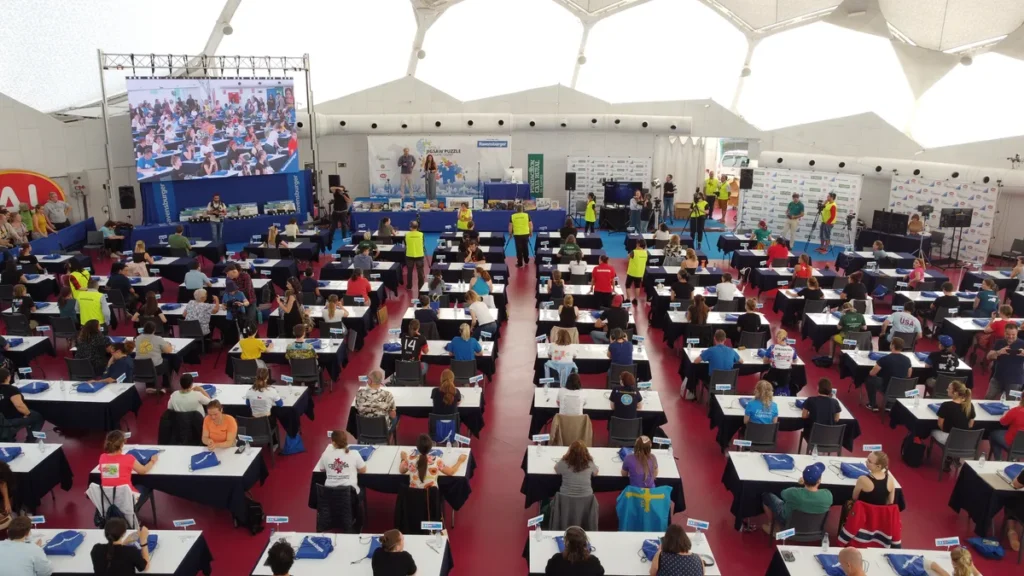
Top trivia games for 369 players sound impossible until you stop picturing one crowded room and start picturing a system. Three hundred and sixty nine people cannot all shout answers at one host, share one answer sheet, or hear one voice from the back of a hall. They can, however, play in forty one teams of nine, rotate through nine stations of forty one, or split into three divisions of one hundred and twenty three. The game stays the same. The structure around it changes, and that structure is the whole secret.
This guide treats 369 as a range, not a fixed headcount. The ideas here work for a pub quiz with twelve regulars, a school fundraiser with two hundred parents and pupils, and a company social with the full three hundred and sixty nine. Every format below has been chosen because it survives contact with a large crowd: questions stay fair, scores stay honest, and no team waits twenty minutes between turns. If you have ever watched a big quiz night collapse into noise, late scores, and bored tables at the back, the fixes are in the sections that follow.
You do not need expensive software, a stage crew, or a professional host to pull this off. You need clear rounds, a scoring plan that a volunteer can run, questions written for mixed ability, and a schedule that respects the clock. The six formats in the comparison table cover every kind of group, from a quiet library fundraiser to a loud office party, and the step by step hosting plan near the end turns the theory into a running order you can follow on the night.
Key takeaways
- Frame 369 as the 3-to-369 range: 41 teams of nine, 9 stations of 41, or 3 divisions of 123 all work.
- Split the crowd before the first question, because one room of 369 players cannot play as a single group.
- Use short rounds of six to eight questions so scoring stays fast and teams stay engaged.
- Mix question types across every round so no single kind of knowledge decides the winner.
- Appoint one scorekeeper per division and publish a live leaderboard after every round.

Why 369 Players Changes the Game
A quiz for ten people is a conversation. A quiz for three hundred and sixty nine people is an event, and events need logistics. Sound is the first problem. A single voice, even a loud one, cannot reach the back of a hall built for hundreds, and teams at the far tables will miss questions, ask for repeats, and slowly stop trying. A microphone and speakers solve the volume problem, but they do not solve the attention problem. When three hundred people wait for one host to mark one answer at a time, the room drifts.
Time is the second problem. Ten questions take ten minutes with a small group. With three hundred and sixty nine players, every pause multiplies: handing out sheets, collecting sheets, settling disputes, and announcing scores all take longer. A night that should finish in two hours can easily stretch past three, and tired players leave early. The answer is to run things in parallel. While one division plays a picture round, another division plays a music round, and a third division takes a break. Nobody waits, and the host team always has work in progress.
Fairness is the third problem, and it is the one that causes the most arguments. In a small quiz, the host can see every team and spot anyone looking at a phone. In a hall of three hundred and sixty nine, nobody can watch everyone. The formats that work at this scale remove the temptation instead of policing it: closed answer sheets, questions that reward speed of recall rather than search speed, and rounds where every team answers at the same moment. The 366-player trivia guide shows the same principle at a slightly smaller scale, with team sizes and station counts adjusted for three fewer players.
How the 3-to-369 Range Works
The number 369 is friendly once you factor it. Three hundred and sixty nine equals three times one hundred and twenty three, nine times forty one, and forty one times nine. Those factors are your building blocks. They let you split any crowd from three players to the full three hundred and sixty nine into equal groups without leftovers, awkward byes, or teams of one sitting next to teams of twelve. Equal groups matter because uneven teams create uneven scores and quiet complaints that last all night.
Start by counting confirmed players, not invitations. A company social might invite four hundred people and draw three hundred. A school fundraiser might sell two hundred tickets and seat one hundred and eighty on the night. Build your plan around the number that actually walks through the door, then round to the nearest clean split. If three hundred and fifty players arrive, run thirty five teams of ten and keep the same rounds, the same scoring, and the same schedule. The structure bends. The rules do not.
41 Teams of Nine
Nine is a strong team size for trivia. It is large enough to cover different kinds of knowledge — one person knows sport, another knows music, a third knows geography — and small enough that everyone at the table still talks. Forty one teams of nine fill a hall nicely, with each table acting as its own small quiz night. The host reads questions to the whole room, teams write answers on shared sheets, and runners collect the sheets at the end of each round.
9 Stations of 41
Stations suit venues with several rooms, a hall plus classrooms, or a large outdoor space with marquees. Each station runs a different round — general knowledge at station one, pictures at station two, music at station three — and groups of forty one rotate every fifteen minutes. Nobody sits still for two hours, and the change of scene keeps energy high through the later rounds.
3 Divisions of 123
Divisions are the tournament option. Split three hundred and sixty nine players into three divisions of one hundred and twenty three, run the same quiz in each division, and bring the top teams together for a final. Each division feels like a proper quiz night on its own, with its own host, its own leaderboard, and its own local rivalry. The final then feels like a real occasion rather than an afterthought.
The Six Formats That Scale Best
Not every trivia format survives a crowd of three hundred and sixty nine. Classic question and answer rounds work, but only with tight timing. Picture rounds work brilliantly because every team sees the same image at the same moment. Music rounds work because a song fills a hall in a way that a spoken question never does. The six formats below have each been tested at large scale, and the table gives a quick way to compare them before you choose.
| Format | Best group size | Round length | Scoring | Gear needed |
|---|---|---|---|---|
| Classic pub quiz | 3 to 369 | 8 questions, 10 minutes | 1 point per answer | Microphone, speakers, answer sheets |
| Picture round relay | 40 to 369 | 10 pictures, 12 minutes | 1 point per picture | Projector or screens, printed sheets |
| Music trivia | 20 to 369 | 8 clips, 12 minutes | 1 point per clip, bonus for artist | Speakers, playlist, answer sheets |
| Speed buzzer tournament | 9 to 123 | 15 questions, 15 minutes | 2 points per correct buzz, minus 1 for wrong buzz | Buzzers or phone app, scoreboard |
| Themed team challenge | 30 to 369 | 10 questions, 12 minutes | 1 point per answer, 3 bonus points for theme round | Printed theme sheets, timer |
| Progressive jackpot quiz | 100 to 369 | 6 rounds, 60 minutes | Points banked per round, jackpot for final | Leaderboard screen, prize fund |
Classic Pub Quiz
The classic pub quiz is the safest choice for a mixed crowd, and safety matters when three hundred and sixty nine people have paid to be there. Eight questions per round, ten minutes per round, one point per correct answer. The host reads each question twice, teams write answers on a sheet, and runners collect sheets at the end of the round. Nothing here depends on technology, so nothing can fail at the worst moment.
Write questions for a spread of ability. Two easy questions per round keep new players in the game, four medium questions reward regular quizzers, and two hard questions separate the leaders. Avoid questions with disputed answers, questions that depend on one very recent event, and questions that only one age group can answer. A good classic round feels fair to a teenager, a parent, and a grandparent at the same table. If you want a deeper look at running this format well, the guide on how to run a pub quiz covers room layout, timing, and host technique in detail.
Picture Round Relay
Picture rounds are the great leveller in large trivia nights. Every team sees the same image at the same moment, so nobody gains an advantage from sitting near the host. Famous faces, flags, landmarks, film stills, and food close ups all work. Ten pictures per round keeps the pace brisk, and twelve minutes gives teams time to argue without stalling the night.
Music Trivia
Music rounds fill a hall with energy in a way that spoken questions cannot. Play eight short clips, ten to fifteen seconds each, and ask teams to name the song, the artist, or both. A bonus point for naming both the song and the artist rewards real fans without punishing casual listeners. Twelve minutes per round allows time to play each clip twice and gives teams a moment to argue over half remembered choruses.
Speed Buzzer Tournament
Buzzer rounds bring drama, and drama keeps a large crowd watching. Two teams face each other, the host reads a question, and the first team to buzz answers. Two points for a correct answer, minus one for a wrong buzz, keeps teams honest instead of buzzing on every question. Fifteen questions take about fifteen minutes, which makes this format ideal for a final or a showcase round rather than the whole night.
Themed Team Challenge
Themed rounds give a quiz night its personality. One round on films, one on food, one on sport, one on science, one on the local area. Ten questions per round, twelve minutes, one point per answer, with three bonus points for the best team name in the theme. The theme gives teams something to prepare for and something to laugh about, and it lets the host write questions with a clear focus instead of reaching for random facts.
Progressive Jackpot Quiz
The jackpot format is built for very large crowds. Teams bank points across six rounds, and the running total is shown on a leaderboard after every round. The leading team at the end of round five wins a small prize, and the top three teams play a final jackpot round for the main prize. The leaderboard creates a story that runs all night: who is ahead, who is catching up, and who needs a perfect final round.
Scoring Systems That Stay Fair at Scale
Fair scoring is a system, not a hope. One point per correct answer is the simplest system and the easiest to defend. Every team understands it, every scorekeeper can apply it, and nobody can claim the maths favoured another table. Use it for most rounds, and save weighted scoring for clearly labelled bonus rounds where everyone knows the stakes in advance.
Publish scores after every round. A leaderboard on a screen, read out by the host, or pinned to a board near the bar all work. Published scores stop rumours before they start, and they give teams in the middle of the table a reason to keep trying. A team in twentieth place that sees it is only four points behind tenth place will fight for every question in the next round. A team that hears nothing until the end will assume it has lost and stop caring.
Hosting a 369-Player Night Step by Step
Good hosting at this scale is mostly preparation. Arrive early, test the sound from the back row, and walk the route a runner will take between tables. Place the score table where the host can see it and the audience cannot crowd it. Print twenty percent more answer sheets than you think you need, because teams lose sheets, spill drinks on sheets, and ask for fresh ones. Pack spare pens, a spare microphone battery, and a printed copy of every question in case the screen fails.
Run the rounds in a fixed rhythm: questions, thinking time, collection, marking, scores, next round. Teams learn the rhythm within two rounds, and the night starts to run itself. The host should talk less as the night goes on, because the game is the entertainment. Save the jokes and stories for the breaks, and keep the question segments clean and quick. If you are writing questions for the first time, the guide on how to write trivia questions explains how to pitch difficulty, avoid ambiguity, and test every question before the night.
Common Mistakes That Break Large Trivia Nights
The most common mistake is writing questions that are too hard. A host who loves obscure facts will write a quiz that only the host enjoys. Test every question on two or three people who are not trivia fans. If none of them can answer a question, replace it. A good large quiz has a spread of difficulty, and the easiest questions are the most important, because they keep new players in the game.
The second mistake is letting rounds run long. A round that should take ten minutes will take twenty if the host chats between questions, repeats questions four times, or waits for the slowest team. Use a visible timer, call time clearly, and collect sheets even if one team is still writing. Teams forgive a firm host. They do not forgive a night that finishes an hour late.
Checklist: Your 369-Player Trivia Night
- Count confirmed players and split them into equal teams, stations, or divisions before the night.
- Test the microphone, speakers, and screen from the back row during setup.
- Print twenty percent more answer sheets and pens than the headcount requires.
- Brief every volunteer host, scorekeeper, and runner on the schedule and the rules.
- Prepare a clear answer key that lists every accepted spelling and alternative answer.
- Publish a live leaderboard after every round so every team can see the standings.
Frequently Asked Questions
Can trivia games really work for 369 players?
Yes, with the right structure. Split the crowd into teams, stations, or divisions first, then run the same rounds in parallel. The formats in this guide scale from three players to three hundred and sixty nine because the game itself never changes size. Only the organisation around it grows, and the maths of 369 makes equal splits easy.
What is the best team size for a large trivia night?
Nine players per team works well for a crowd of this size. Nine covers a wide spread of knowledge without letting anyone hide, and forty one teams of nine use the number 369 exactly. Smaller teams of five or six work too, but they need more tables, more sheets, and more runners, so nine is the practical choice for most venues.
How long should a 369-player trivia night last?
Plan for two to two and a half hours of play, plus breaks. Six rounds of ten to twelve minutes, with short breaks for scoring and a longer break in the middle, fits comfortably into that window. Nights that run past three hours lose players to tiredness, so protect the schedule and cut a round rather than letting the night drift.
Do I need special software to run trivia for 369 players?
No. Paper answer sheets, a microphone, and a spreadsheet for scores are enough. Phone based buzzer apps and quiz platforms can add polish, but they also add points of failure. Start with the simple setup, test it at a smaller night first, and add technology only when the basics run smoothly.
How do I stop teams from looking up answers on their phones?
State a clear phone policy at the start, design rounds that reward recall rather than search, and keep thinking time short. Picture rounds and music rounds are hard to search quickly, and a ten second thinking window leaves little time to type. Most teams follow the rule when it is stated clearly and applied to everyone.
What prizes work best for a large trivia night?
Keep prizes simple and shared: a trophy or hamper for the winning team, small prizes for the best team name and the best dressed team, and a modest jackpot for the final round. Prizes that split easily across nine people, such as a shared hamper or a team meal, work better than a single item that nine winners must argue over.
Bottom Line
Trivia games for 369 players work when the crowd is split before the first question, the rounds stay short, the scoring stays visible, and the questions stay fair. Pick one format from the table, build your teams around the factors of 369, and run the night to a fixed rhythm. Do that, and three hundred and sixty nine players will feel like forty one lively tables, not one overwhelming crowd.