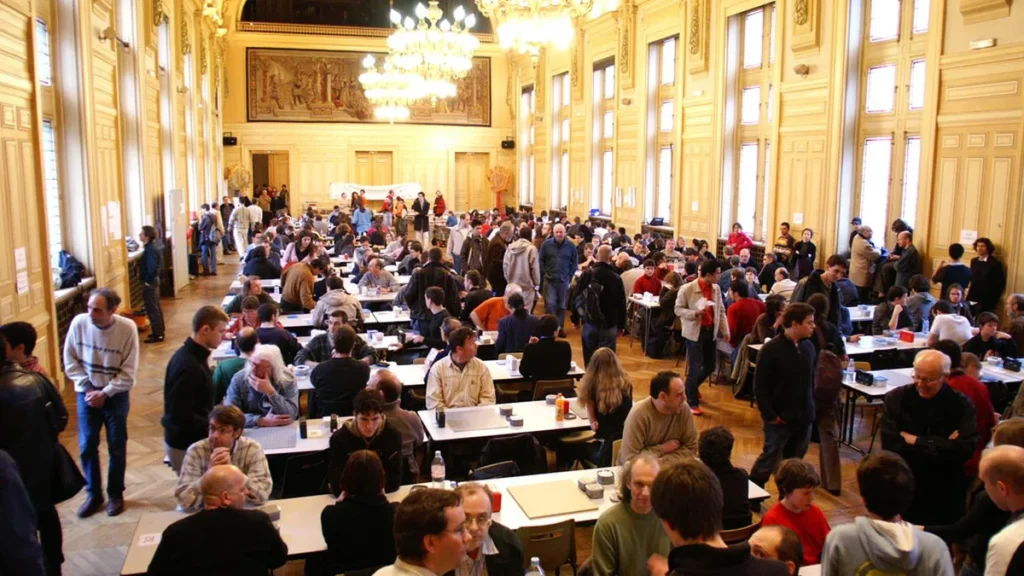
Four hundred and sixty people at one party sounds like a crowd that can only stand around and eat cake, but with the right games it becomes the best part of the day. The trick is to stop thinking of party games as something a dozen friends play in a living room and start thinking of them as a festival: many small teams, short rounds, clear rules, and a schedule that keeps everyone moving instead of waiting. When the games are built for scale, a huge guest list becomes the whole point.
The nine games in this guide share three qualities that matter at this size. First, they can be played by many teams at once, so nobody spends the afternoon standing in a queue. Second, they need little or no special equipment, so you can set them up in a park, a school field, or a large hall without hiring a production crew. Third, they are easy to explain in under a minute, which matters with 460 players of different ages.
Plan the day in waves rather than one giant free-for-all. Split the crowd into teams of ten, give each team a colour and a captain, and run the games in a rotation so every team plays every game. A simple scoreboard, a loud whistle, and a few volunteers at each station are all the organisation you need. Follow the plan below.
Key takeaways
- Split 460 players into 46 teams of ten, each with a colour and a captain, so every game runs in parallel waves.
- Choose games that need almost no equipment and take under a minute to explain, so nobody waits around.
- Rotate teams through stations on a fixed timetable instead of letting everyone crowd into one game at once.
- Keep rounds short, around ten to fifteen minutes, and use a single scoreboard so every team can see where it stands.
- Plan water, shade, seating, and a rain backup before the day starts, because comfort decides whether a huge party feels fun or chaotic.
How to Run Party Games for 460 Players
Running games for 460 players is a logistics job before it is a fun job, and the planning is what makes the fun possible. Divide the guest list into 46 teams of ten. Ten is small enough that everyone gets a turn. Give each team a coloured wristband and a captain who collects the scorecard, gathers the team at each station, and reports the result to the score table.
Set up nine stations in a wide loop around the field or hall, one per game, and give every station a volunteer host who knows the rules by heart. The host explains the game in under a minute, runs the round, records the score, and blows the whistle when time is up. Teams rotate every fifteen minutes, so every team plays every game in just over two hours, with a break in the middle for food and water. A printed rotation sheet keeps the movement simple.
Keep the scoring simple enough that a tired volunteer can do it without a calculator. Award ten points for a win, five for second place, and one point for taking part. If you want more ideas for structuring a huge gathering, the nine games in our guide to party games for 458 players use the same rotation system and show how a slightly smaller crowd can be organised in the same way.
The Nine Games at a Glance
Before the detailed rules, here is the whole day on one table. Use it to plan your space, your equipment, and your timetable, and share it with your station hosts so everyone works from the same plan.
| Game | Players per round | Space needed | Time per round | Energy level |
|---|---|---|---|---|
| Giant Parachute Wave Rally | 40 at once | Large open field | 15 minutes | Medium |
| Human Bingo Card Hunt | All 460 | Whole venue | 20 minutes | Low |
| Tug-of-War Tournament Bracket | 20 at once | Long flat lane | 15 minutes | High |
| Sack Race Sprint Circuit | 20 at once | Straight track | 10 minutes | High |
| Limbo Line Challenge | 30 at once | Small flat area | 10 minutes | Medium |
| Giant Jenga Tower Challenge | 10 at once | Table or flat ground | 15 minutes | Low |
| Three-Legged Race Tournament | 20 at once | Straight track | 10 minutes | High |
| Charades Marathon | 10 at once | Small stage or circle | 15 minutes | Low |
| Trivia Bowl Showdown | All 460 | Main hall or field | 20 minutes | Low |
The 9 Best Party Games for 460 Players
1. Giant Parachute Wave Rally
A giant play parachute is one of the few party games that genuinely gets better the more people hold it, which makes it perfect for a crowd of 460. Forty players at a time stand around the edge of a huge parachute, grip the handles, and work together to send waves rolling across the fabric, lift it high into a mushroom shape, and bring it down again without letting the beach balls on top escape.
Setup is simple: one large play parachute, at least six metres across, plus a dozen light beach balls and a flat stretch of grass. Spread the teams around it in groups of forty and appoint one caller per round to shout the moves: wave, lift, mushroom, and swap. The team that keeps the most balls on the parachute at the end of two minutes wins the round. It scales because the game is cooperative: adding more hands makes the waves bigger and the mushroom taller, so a huge group is an advantage instead of a problem.
2. Human Bingo Card Hunt
Human bingo turns a crowd of strangers into a room full of conversations. Every player gets a bingo card filled with prompts such as find someone who has been to another country, find someone who can whistle a tune, or find someone who owns a dog. Players walk around the venue, introduce themselves, and collect a tick in each square from a different person. First to complete a row shouts bingo; first to fill the card wins.
Setup needs nothing more than printed cards, pens, and a little imagination when writing the prompts. Print 460 cards with the squares shuffled so no two cards are identical, and hand them out at the entrance. Give players twenty minutes to mingle, and station a host at the score table to check winning cards and hand out small prizes. It scales because it uses the whole crowd as the game board: the more people there are, the easier it is to find someone who matches each square, and it works brilliantly as the opening game while late guests are still arriving.
3. Tug-of-War Tournament Bracket
Tug-of-war is the oldest large-group game in the world, and it still works because it is instantly understood by everyone. Two teams of ten stand on either side of a long rope, grip it tight, and pull until the marker in the middle crosses their line. At a 460-player party, run it as a knockout bracket: 46 teams play 23 first-round matches, winners advance, and the final is played in front of the whole crowd at the end of the day.
Setup needs a thick rope at least twenty metres long, a clear flat lane with a marked centre line, and a referee with a whistle. Mark the ground with chalk or tape so both teams can see the lines, and keep a volunteer at each end of the rope to make sure nobody wraps it around a hand or arm. Matches take about two minutes each, so run several lanes at once with a second rope and a second referee, and keep the bracket on a big board where everyone can follow it. The bracket builds all day towards one loud final.
4. Sack Race Sprint Circuit
The sack race is pure silliness, and that is exactly why it works for a huge party. Players step into a large sack, hold it up around their waist, and hop down a marked track to a turning point and back again. Teams race in heats of twenty, with each team sending its fastest hoppers first and its most enthusiastic hoppers last, .
Setup needs sturdy sacks, one per racer, and a straight flat track about twenty metres long with a clear start and finish line. Use sacks made for the job rather than old grain bags that split, and check the track for stones and holes before the first heat. A starter with a whistle and a judge at the finish line keep things fair, and a spare sack or two at the side saves the day when one tears mid-race. It scales because heats are fast: each race takes under a minute, so twenty players can race and be done before the next heat is lined up.
5. Limbo Line Challenge
Limbo is a small game with a big personality, and it fits a huge party because it needs almost no space and no waiting. A horizontal bar is held between two posts, music plays, and players take turns bending backwards to pass under the bar without touching it or falling over. After every round the bar drops a little lower, .
Setup needs a limbo set or two upright posts with a light bar, a speaker for music, and a flat patch of ground. Keep the bar light and soft so a knock is harmless, and have a host who lowers it slowly and fairly. Play in groups of thirty, with each group getting about ten minutes, and let the crowd clap the rhythm so even the players waiting their turn feel part of it. It scales because the game is endlessly repeatable: as soon as one group finishes, the bar goes back up and the next group starts, with no reset time.

6. Giant Jenga Tower Challenge
Giant Jenga takes a quiet tabletop game and turns it into a spectator sport. Teams of ten take turns pulling one wooden block at a time from a tower of oversized blocks and placing it on top, trying not to be the player who makes the whole tower crash down. The tower grows taller and more wobbly with every move, and a crowd always gathers to watch the final turns.
Setup needs a giant Jenga set, a flat table or a level patch of ground, and a little shade if the sun is strong. Place the tower where a small audience can stand around it without bumping the table, and give each team fifteen minutes to play as many turns as they can. Score the game by the number of blocks successfully placed before the tower falls, so a team that plays carefully can beat a team that plays quickly. It balances the loud games, and you can run several towers at once.
7. Three-Legged Race Tournament
The three-legged race is a test of teamwork disguised as a comedy act. Two players stand side by side, tie their inside legs together, and race down a track in step with each other. If they lose their rhythm they stumble, and if they fall they have to get up, dust themselves off, and keep going while their team cheers them on.
Setup needs soft ties or scarves for binding legs, a straight track about fifteen metres long, and a clear finish line. Tie the legs snugly but not tightly, and let pairs practise a few steps before the race starts so they find a shared rhythm. Run heats of twenty players, ten pairs at a time, and keep a first-aider nearby because falls are part of the fun and grazed knees are the most common injury at any party. Pairs are quick to organise, so heats move fast. For a similar crowd-sized challenge built on the same rotation idea, see the nine games in our guide to party games for 456 players.
8. Charades Marathon
Charades is the game that needs no equipment at all, just a list of words and a willingness to look silly in front of friends. One player acts out a word or a phrase without speaking while their team shouts guesses, and the team that guesses the most words in fifteen minutes wins the round. At a party of 460, run it as a marathon: teams rotate through the charades station all day, and the highest total score wins.
Setup needs a stack of word cards, a timer, and a small stage or a circle of chairs where the actor can be seen. Write the cards in advance and sort them into easy, medium, and hard piles so every team gets a fair mix. The host draws the cards, starts the timer, and keeps the score, while the actor mimes, points, and counts words on their fingers. Ban sounds, mouthing words, and pointing at objects in the room, and the game stays fair. A fresh deck of cards makes it endlessly repeatable for every age.
9. Trivia Bowl Showdown
The trivia bowl is the grand finale that brings all 460 players together in one place at one time. Teams sit together in a marked area, a host reads questions over a loudspeaker, and teams write their answers on a shared sheet. After ten questions the sheets are swapped and marked, and the scores are announced to a roar from the crowd. Run three rounds of ten questions each, with a different theme per round.
Setup needs a loudspeaker or a microphone, printed answer sheets, pens, and a set of ninety questions written in advance. Mix the themes so every team has a strength: general knowledge, music, food, sport, and a round about the guests themselves, such as who has travelled furthest to be here. Keep the questions short, read each one twice, and give teams thirty seconds to agree on an answer. It is the one game where all 460 players play at the same moment.
Party Day Checklist
Use this checklist in the week before the party.
- Divide the guest list into 46 teams of ten, assign a colour and a captain to each team, and print the team lists.
- Print 460 bingo cards, 460 scorecards, and the rotation sheet, and pack spare pens for every station.
- Buy or borrow the equipment early: parachute, ropes, sacks, limbo set, giant Jenga sets, ties, and beach balls.
- Set up water stations, shade, and seating around the field, and brief volunteers on where the first-aid kit lives.
- Walk the whole site the day before, checking every track, lane, and station for stones, holes, and trip hazards.
- Write a rain plan: which games move indoors, which tents cover the stations, and who makes the call on the morning.
Frequently Asked Questions
Can 460 players really play the same nine games?
Yes, because none of the nine games needs all 460 players at once. Most games run in heats of ten to forty players, while bingo and trivia include everyone at once.
How much space do we need for a 460-player party?
A full-size sports field or a large park is ideal, because you need room for nine stations plus space for teams to move between them. If you only have a hall, drop the running games and lean on the quieter ones such as charades, trivia, and giant Jenga.
How long does a full day of nine games take?
Plan for about three hours of games, including a break for food in the middle. Each rotation slot lasts fifteen minutes, and nine slots add up to just over two hours, with extra time for the opening welcome, the human bingo round, and the trivia bowl finale.
What if it rains halfway through the day?
Move the quiet games indoors first: charades, trivia, giant Jenga, and human bingo all work in a hall. The running games can pause under a tent or a marquee, and the parachute game can run in light rain if the ground is not slippery.
What equipment should we buy first?
Start with the items that are hardest to borrow: the giant parachute, the tug-of-war rope, and the giant Jenga sets. Sacks, ties, and beach balls are cheap and easy to find, and the bingo cards and scorecards can be printed at home. For more ideas on organising a large crowd, the nine games in our guide to party games for 454 players use the same equipment-first approach.
Can younger children and older guests play all nine games?
Almost all of them, with small adjustments. Children can join the parachute, bingo, Jenga, charades, and trivia games without any changes, and they love the sack race and the three-legged race with a grown-up as their partner. Older guests can captain teams, host stations, keep score, and play the quieter games, while the tug-of-war and the running races are best left to players who feel comfortable with them.
The Bottom Line
A party for 460 players works when the games are built for the crowd rather than in spite of it. Split the guests into teams of ten, rotate them through nine short stations, keep the scoring simple, and finish with a whole-crowd trivia bowl that brings everyone together. The nine games in this guide need little equipment, take minutes to explain, and leave room for every age and every level of energy.