Finding the best dice games for 190 players sounds like a puzzle in itself. Most dice games are built for a table of four to eight people, and the box rarely tells you what happens when the group grows to the size of a school hall, a company party, or a community festival. The good news is that dice are the most scalable game equipment ever made. They are cheap, they need no batteries, and a single set of rules can run across dozens of tables at the same time without anyone waiting for a turn.
The trick is choosing games that work in parallel. The best dice games for 190 players are not the ones with the longest turns or the most complicated scoring. They are the games where everyone rolls at once, where a table captain can explain the rules in under two minutes, and where the scores from twenty tables can be combined into one leaderboard. When every table plays the same game at the same time, 190 people stop feeling like a crowd and start feeling like one big game night.
This guide rounds up ten games that genuinely work at that scale, explains how to organise them, and shows you exactly what equipment and how many helpers you need. These games will keep 190 players rolling, laughing, and competing from the first throw to the final score.
Key takeaways
- Pick games where everyone rolls at the same time, so 190 players never sit waiting for a turn.
- Split the room into tables of six to ten players, each with its own dice set and a table captain.
- Use simple score sheets and one shared leaderboard to combine results across all tables.
- Bunco, Tenzi, Farkle, and Yahtzee-style tournaments scale best to very large groups.
- Budget about five dice per player, plus spare sets, score sheets, pencils, and a timer.
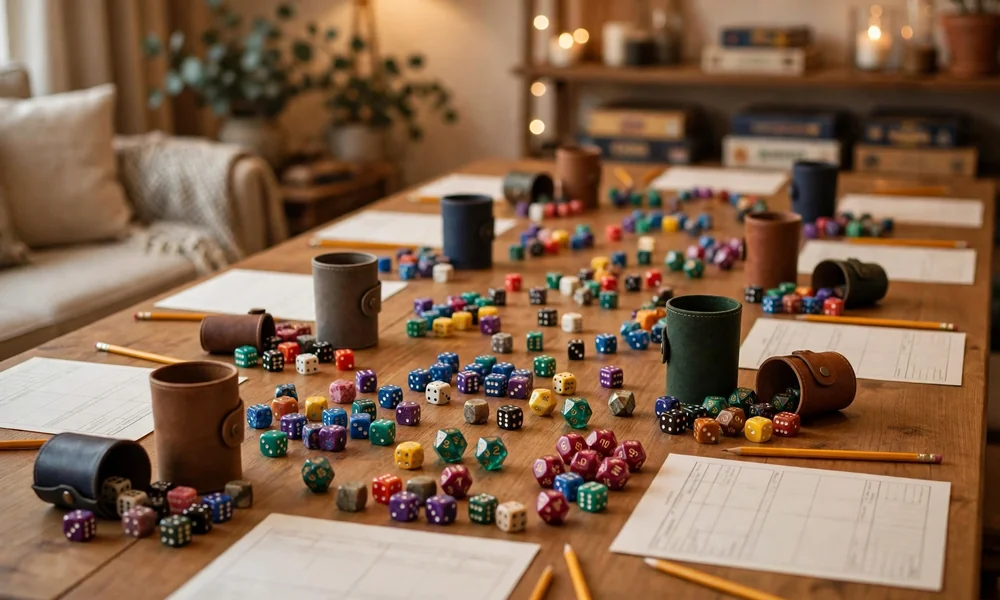
How to Run Dice Games for 190 Players
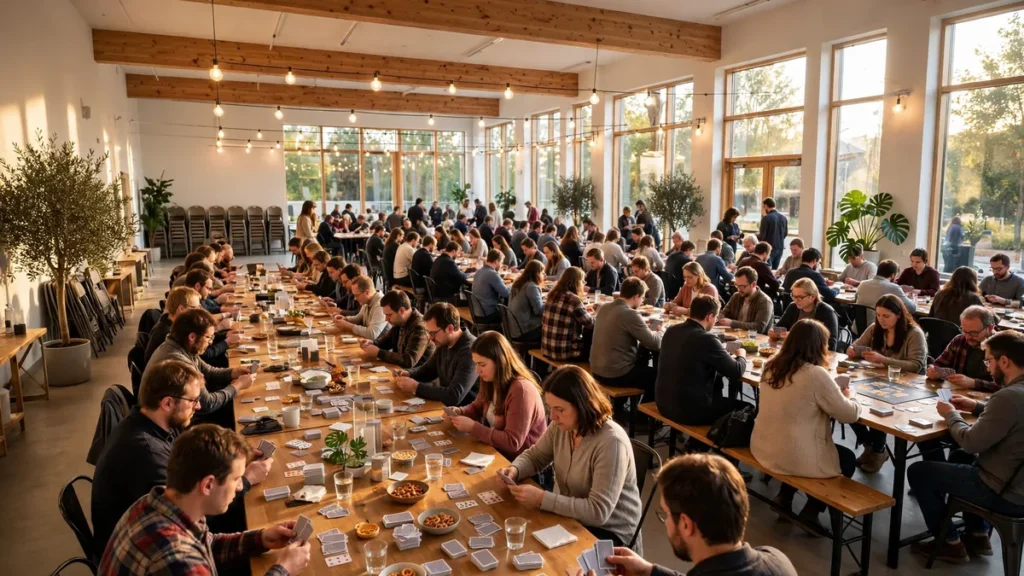
Running dice games for 190 players is mostly a logistics job. The games themselves are simple. What matters is the room layout, the number of helpers, and the way scores travel from the tables to the final leaderboard. Start by dividing 190 players into tables of six to ten, giving you roughly twenty to thirty tables, each with its own dice, score sheets, and one person who knows the rules well enough to settle a dispute.
Keep the schedule tight. Announce the game, give tables two minutes to read the rules card, run a single practice round, and then start the real game with a timer everyone can see. Short rounds of ten to fifteen minutes work far better than one long game, because they let you rotate games, mix up the tables, and keep the energy high.
The Scale Problem and How to Solve It
The biggest problem with 190 players is waiting. In a normal game, one person rolls while everyone else watches, and multiplied by 190, most of your guests would spend the evening watching strangers roll dice. The fix is simultaneous play. In every game on this list, all players roll at the same time, or all tables play the same round at the same time, so nobody waits and nobody gets bored. Use a microphone, a whistle, and a printed rules card at every table so nobody has to rely on hearing the announcement perfectly. If you are comparing formats before the night, the best dice games for 189 players show how a nearly identical group size is handled with the same table-based approach.
What You Need Before Game Night
For 190 players, plan on five dice per player as a minimum, which means close to a thousand dice. Bulk dice are cheap, and a mixed tub of standard six-sided dice costs far less than a single board game per table. Add at least ten spare sets, plus dice cups to keep dice on the table. Print one score sheet per player per game, with the player name, table number, and round scores already laid out, and bring a large visible leaderboard to update between rounds so the room can see who is winning.
Best Dice Games for 190 Players Compared
The table below compares the ten games in this guide by players per table, time per round, difficulty, and what makes each one work for a very large group. Use it to pick your line-up, and remember that you do not need all ten.
| Game | Players per Table | Minutes per Round | Difficulty | Why It Scales |
|---|---|---|---|---|
| Bunco | 4 | 15 | Easy | Tables rotate winners, so everyone meets new players. |
| Tenzi | 2 to 6 | 5 | Easy | Everyone rolls at once; the fastest table wins the round. |
| Farkle | 2 to 8 | 15 | Easy | Simple push-your-luck scoring that anyone can learn. |
| Yahtzee Tournament | 4 to 6 | 20 | Easy | Familiar rules and a score sheet that travels between tables. |
| Liar’s Dice | 4 to 8 | 10 | Medium | Bluffing works brilliantly in a noisy, social room. |
| Qwixx | 2 to 5 | 15 | Easy | Shared dice mean every roll matters to every player. |
| Dice Bingo | Any number | 10 | Easy | One caller serves the whole room at once. |
| Left Center Right | 4 to 10 | 10 | Easy | Chips move fast and eliminated players cheer on survivors. |
| Zombie Dice | 2 to 8 | 10 | Easy | Quick push-your-luck rounds with a fun theme. |
| Roll and Write Challenge | Any number | 15 | Medium | One shared roll drives every table at the same time. |
The 10 Best Dice Games for 190 Players
Each game below includes the table size, the equipment you need, and the reason it works when the player count climbs into the hundreds.
1. Bunco
Bunco is the classic large-group dice game, and it was practically designed for 190 players. Players sit in groups of four, roll three dice, and try to match the target number for the round. Winners move up a table, losers move down, and after a few rounds everyone has played with a dozen different people. That rotation is the secret: nobody is stuck at a quiet table all night. For 190 players you need about forty-eight tables of four, each with three dice, a score sheet, and a bell at the head table, which rings to start and stop each round so all tables stay in sync.
2. Tenzi
Tenzi is the fastest game on this list and the easiest to explain. Every player gets ten dice and races to roll the same number on all ten, and the first player at a table to finish shouts Tenzi and wins the round. A round takes about five minutes, so you can run six rounds in half an hour and crown a new winner every few minutes. Tenzi scales because there is no turn order at all: everyone rolls at the same time, as fast as they can. Use coloured dice sets so each player can spot their own dice quickly, and finish with a room final where the winner from each table rolls against the other table winners.
3. Farkle
Farkle is a push-your-luck game where players roll six dice, bank the scoring combinations, and decide whether to risk another roll or keep the points they have. Roll the wrong combination and you lose everything from that turn. That simple tension is what makes Farkle so addictive, and it works just as well at a table of eight as at a table of two. For a group of 190, run Farkle as a tournament: each table plays to a target score, and the winner of each table advances to a final table. Keep the target lower than usual, around 5,000 points, so rounds finish in about fifteen minutes.
4. Yahtzee Tournament
Almost everyone has played Yahtzee, which makes it the safest choice for a mixed group that includes people who have never played a dice game. Players roll five dice up to three times per turn, trying to fill the thirteen boxes on the score sheet, from ones through sixes to three of a kind, a full house, and the famous Yahtzee of five matching dice. The tournament format is what makes Yahtzee work for 190 players: each table plays one full game, the top scorer from each table advances, and the finalists play a championship game while the rest of the room watches and cheers.
5. Liar’s Dice
Liar’s Dice is the social game on this list. Each player shakes five dice in a cup, looks at them in secret, and bids on how many of a particular number are showing across the whole table. The next player can raise the bid or call the previous player a liar, and then all the cups are lifted to reveal the truth. It is bluffing, reading people, and laughing at bad calls, and it is at its best in a loud room full of people who enjoy each other. For 190 players, keep tables small, four to six players each, because bluffing needs eye contact and conversation, and run short elimination rounds where the last player standing at each table advances.
6. Qwixx
Qwixx is a clever dice game where two shared dice are rolled for everyone, and each player also uses one shared die combined with their own coloured die to mark numbers off their personal score sheet. Because every roll matters to every player, there is no downtime at all, which is rare in a dice game and valuable when you have 190 people to entertain. Qwixx works for large groups because the shared dice create a shared experience: when the caller announces the roll, every table reacts at the same time. You can even run it as a whole-room game, with one person calling the dice for all tables.
7. Dice Bingo
Dice Bingo is the simplest game on this list and the only one where a single caller can serve all 190 players at once. Each player gets a bingo-style card with numbers on it, the caller rolls two dice and announces the total, and players mark that number if it appears on their card. The first player to complete a line, and then a full card, wins. The beauty of Dice Bingo at this scale is that it needs almost no equipment per player, just a printed card and a pencil, and it works even if the tables are uneven. Use large dice or a projected dice roller so the whole room can see the result.
8. Left Center Right
Left Center Right, often called LCR, is a fast elimination game where players pass chips left, right, or into the centre based on the dice they roll. Start with three chips each, roll up to three dice, and keep playing until only one player at the table still has chips. A full game takes about ten minutes, the rules can be explained in thirty seconds, and the game produces a winner at every table with almost no scorekeeping. For 190 players, LCR is best used as a short, high-energy round between longer games. If you want more ideas for filling an evening with quick social games, the best board games for 188 players include several titles that pair well with a fast dice round like LCR.
9. Zombie Dice
Zombie Dice is a push-your-luck game with a theme that makes people smile. Players roll thirteen special dice showing brains, shotguns, and footsteps, collect brains to score, and stop before three shotgun blasts end their turn with nothing. The theme is light, the art is fun, and the game is over in about ten minutes, which makes it a great choice for a youth camp, a Halloween party, or any event where the group wants something playful. The catch for 190 players is the equipment: Zombie Dice uses special dice, so you need one set per table. Plan for about twenty-five to thirty sets, or run it as a rotation station.
10. Roll and Write Challenge
A roll and write challenge is a format rather than a single game, and it is the most flexible option for a group of 190. One person rolls a set of dice, announces the result to the whole room, and every player writes the result on their own sheet according to the rules of the challenge, whether that means filling a grid, building a pattern, or collecting sets. Because one roll drives every table, the whole room plays the same game at the same time, and the scores are directly comparable across all 190 players. You can design your own sheet for the event and use a projected dice roller so everyone can see the roll.
How to Organise 190 Players Without Chaos
Organisation is what separates a great game night from a confusing one, and the difference is almost entirely in the preparation. Arrive early, lay out the tables, and put a complete kit on each table before anyone walks in: dice, score sheets, pencils, a rules card, and a table number. Table captains are your most important helpers, so recruit one per table, or at least one per two tables, and brief them before the event. Their job is to explain the rules, settle disputes, collect the scores, and report the table winner.
Keep the scoring simple and visible. Collect one score per table per round, write it on the leaderboard, and announce the top five tables after each game. Players care far more about seeing their table on the board than about a complicated points system.
Timing the Evening
A good schedule for 190 players is four games of about twenty minutes each, with ten-minute breaks between them, inside a two-and-a-half-hour evening. Start with Dice Bingo as a warm-up while late arrivals settle in, then move to Tenzi for energy, Bunco for the social middle of the night, and a roll and write challenge or a Yahtzee final to close. Build slack into the schedule, because some tables will finish early and some will run late.
Prizes and Scoring That Keep Everyone Playing
Prizes do not need to be expensive to work. A small prize for each table winner, plus one larger prize for the overall champion, is enough to make every round matter. Consider team scoring alongside individual scoring: add up the scores of everyone at a table and rank the tables as teams, so a player who is losing personally can still help their table win. A party games guide for 188 players uses the same team-scoring idea to keep large groups competing right to the end, and it works just as well with dice.
Checklist for Your 190-Player Dice Game Night
Use this checklist in the week before the event. Everything on it is cheap or free, and missing any one item can slow the whole evening down.
- Book a hall with enough tables and chairs for 190 players, with space to walk between tables.
- Buy or borrow at least 1,000 standard dice, plus ten spare sets for tables that lose dice.
- Print one score sheet per player per game, plus a rules card for every table.
- Recruit twenty to thirty table captains and brief them on the rules before the night.
- Prepare a large leaderboard, a whiteboard or a projector, and update it between rounds.
- Bring a microphone, a timer, a whistle or bell, pencils, spare paper, and small prizes.
Frequently Asked Questions
Can 190 people really play dice games together?
Yes, as long as the games run in parallel across many tables. No single dice game seats 190 people at one table, but games like Bunco, Tenzi, and Dice Bingo let twenty or thirty tables play the same game at the same time, with one shared leaderboard to combine the results.
How many dice do I need for 190 players?
Plan on about five dice per player, which is roughly 950 dice, plus spare sets. Games like Tenzi need ten dice per player, so if Tenzi is on your list, budget for more. Bulk dice are inexpensive, and a mixed tub of standard six-sided dice will cover most of the games in this guide.
What is the best dice game for a large group of beginners?
Bunco is the best starting point, because the rules fit on a card, the rotation mixes the room, and a complete beginner can win. Tenzi is the best second choice, because it takes two minutes to learn and every round is over in five minutes.
How long should a dice game night for 190 players last?
Two to three hours is ideal. Plan four games of about twenty minutes each, with ten-minute breaks between them, plus time at the start for seating and at the end for prizes. Shorter than two hours feels rushed, and longer than three hours tires the room out, even with breaks.
Do I need a professional host for 190 players?
No, but you do need a confident announcer and enough table captains. One person with a microphone can run the whole evening if the table captains handle the rules and scoring at their tables.
Can children play these dice games too?
Most of the games on this list suit players aged eight and up, including Bunco, Tenzi, Dice Bingo, Left Center Right, and Zombie Dice. Liar’s Dice and Qwixx suit older children and adults better, because they need bluffing or quick mental maths.
Bottom Line
The best dice games for 190 players are the ones that let everyone roll at the same time, keep the rules on a single card, and turn twenty tables into one competition. Bunco mixes the room, Tenzi brings the energy, Farkle and Yahtzee reward steady play, and Dice Bingo gets all 190 people playing together from the first minute. Prepare the kits, recruit your table captains, keep the leaderboard visible, and the size of the group becomes the best part of the night rather than the hardest part.